FORCETALLY
Loading the evidence…
Preparing your view.


Preparing your view.
Ballistic missilesIn service
Short-range ballistic missile
Hwasong-11B is a short-range ballistic missile originating in North Korea. Reported operators include North Korea ( Korean People's Army Strategic Force ) Russia.
 North Korea
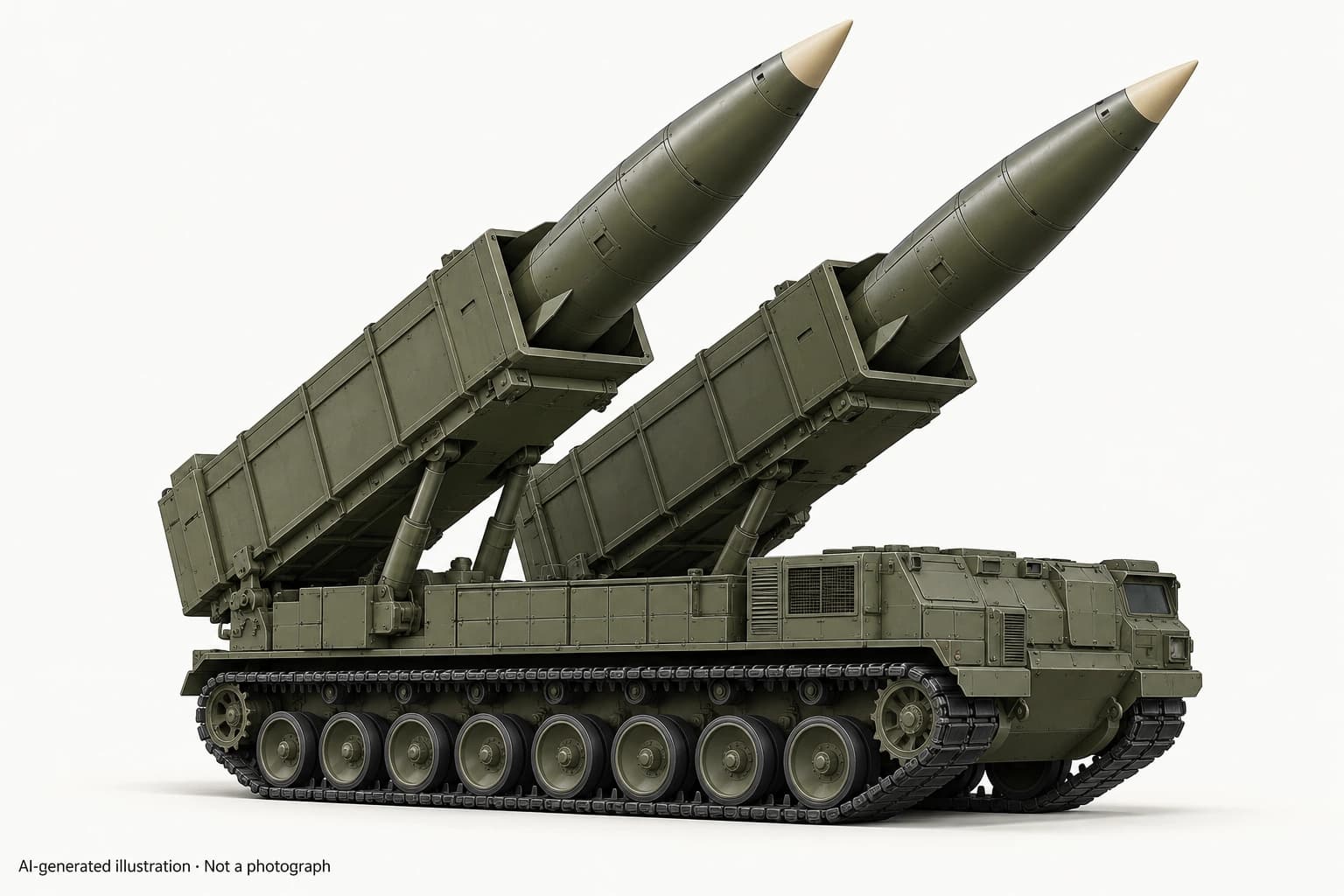
AI-generated illustration · Not a photograph. Representative rendering based on the page’s sourced specifications; exterior details are illustrative.
ForceTally · AI-generated illustration · Not a photograph · AI-generated · OpenAI output terms · Source ↗ · ModifiedTechnical data
Short-range ballistic missile
North Korea
North Korea ( Korean People's Army Strategic Force ) Russia
Russo-Ukrainian war
2019
7.2 m (24 ft)
1.0 m (3 ft 3 in)
400–500 kg (880–1,100 lb)
Solid fuel rocket
410 km (250 mi)
up to 2.1 km/s (Mach 6.2)
Inertial navigation system (INS), possible satellite navigation
35–200 m (115–656 ft)
tracked or 8×8 wheeled TEL
The Hwasong-11B ( Korean : 《화성포-11나》형 ; lit. ' Mars Artillery Type 11B ' ), also known as KN-24 under the United States naming convention and other names, is a North Korean single-stage, solid-fueled tactical ballistic missile .
The Hwasong-11B is a missile that bears similarities to the American ATACMS and South Korean KTSSM , especially in external resemblance, which is similar to ATACMS. It likely fills a similar role of supporting battlefield operations. The missile's aft-mounted aerodynamic fins are fixed rather than foldable like those on the ATACMS, requiring deployment from rectangular launch canisters. It flies in a "variable ballistic trajectory ," flattening out at a lower altitude, below around 50 km (31 mi), than traditional SRBMs like the Scud , where the atmosphere is dense enough, so the missile's fins can maintain aerodynamic control over its entire flight and dive toward the target.
The use of INS updated with satellite-guidance data could make it accurate to within 35–200 m (115–656 ft) CEP , depending whether the missile uses satellite guidance or INS alone. Although the missile is outwardly similar to the ATACMS, it has demonstrated greater range, suggesting its physical dimensions are larger. It appears to share a common booster with the Hwasong-11A (KN-23) and is estimated to carry a 400–500 kg (880–1,100 lb) payload with a unitary or submunition warhead. The Hwasong-11B is also capable of carrying the Hwasan-31 tactical nuclear warhead. It is likely to replace older liquid-fueled North Korean SRBMs, such as Hwasong-5 and Hwasong-6 , as its non-parabolic trajectory makes it more survivable against missile defense systems , and its increased accuracy reduces the number of missiles that would be needed to destroy a single target.
Despite their similarities to the ATACMS system, the Hwasong-11B is significantly larger, with estimated length and diameter being 7.2 m (24 ft) and 1.0 m (3 ft 3 in), respectively. The missile also likely uses the same motor as the Pukguksong-1 with similar jet vanes, and overall resembling a single stage version of it. The transporter erector launcher is a tracked chassis, which has a width of about 1.26 m (4 ft 2 in) and a wheel diameter of 0.78 m (2 ft 7 in), similar to the Pukguksong-2 's tracked mobile launcher. It is similar to the TEL of South Korean Hyunmoo-2A and 2B ; however, North Korean system utilizes two launch canisters instead of one used by South Korean counterpart. A number of images shown of the system appears to be manipulated, significantly increasing the size of the launcher. The Hwasong-11B can also be launched using a four-axle truck chassis.
全長 7.2m
直径 1.1m
誘導方式 慣性航法装置 (INS)、 衛星誘導 (可能性)
Constructeur Corée du Nord
Longueur 7,2 m
Diamètre 1,1 m
Vitesse Mach 6.2
Guidage Inertiel , possible GPS
KN-24; Hwasongpho-11Na
Short-Range Ballistic Missile
INA
Solid fuel rocket
400–500 kg
410 km
Mach 6.2
Inertial navigation system (INS), possible satellite navigation
35 m
Tracked or 8×8 wheeled TEL
Reference text from Wikipedia contributors, used under CC BY-SA 4.0.
True scale
Sourced dimensions beside a 1.75 m human reference.
Points represent sourced observations, including revisions. Revisions on the same effective date are not separate inventory events. Ranges appear in the table and are not plotted as exact points.
| Observation / report period | Value | Source | Claim state |
|---|---|---|---|
| 28 Sept 2026 | 1 m | Wikipedia contributors | superseded |
| 28 Sept 2026 | 1 m | Wikipedia contributors | superseded |
| 28 Sept 2026 | 1 m | Wikipedia contributors | superseded |
| 28 Sept 2026 | 1 m | Wikipedia contributors | superseded |
| 28 Sept 2026 | 1 m | Wikipedia contributors | superseded |
| 28 Sept 2026 | 1 m | Wikipedia contributors | superseded |
| 14 Oct 2026 | 1.1 m | Wikipedia contributors | superseded |
| 14 Oct 2026 | 1.1 m | Wikipedia contributors | approved |
7.2 m
1.1 m
INA
1,670 kg
Korea, Democratic People's Republic of (North
Hwasong-11B equipment records. Variants, orders and quantities are shown as reported in each inventory source; coverage is incomplete.
North KoreaStrategic Forces exact named equipment holdings: Hwasong-11B (KN-24) (in test). Active, operational-reserve and training units excluding equipment in store; November 2025 IISS assessment. Named service only; no parent-force or national total inferred. Source role: GROUND-LAUNCHED MISSILES / SBRM. Original estimates, ranges, reporting names, reserve, lease and employment scopes retained; nested included counts are not added. Missile-system quantities mean launchers, not rounds. No readiness, crew, carried weapon, payload, factory-production or future order count inherited.
North Korea ( Korean People's Army Strategic Force ) Russia
Equipment reference ↗Keep exploring
 India
 Russia
 Pakistan