FORCETALLY
Loading the evidence…
Preparing your view.


Preparing your view.
Support aircraftIn production
Light aircraft
Piper PA-46 is a light aircraft originating in United States. It was built by Piper Aircraft.
 United States
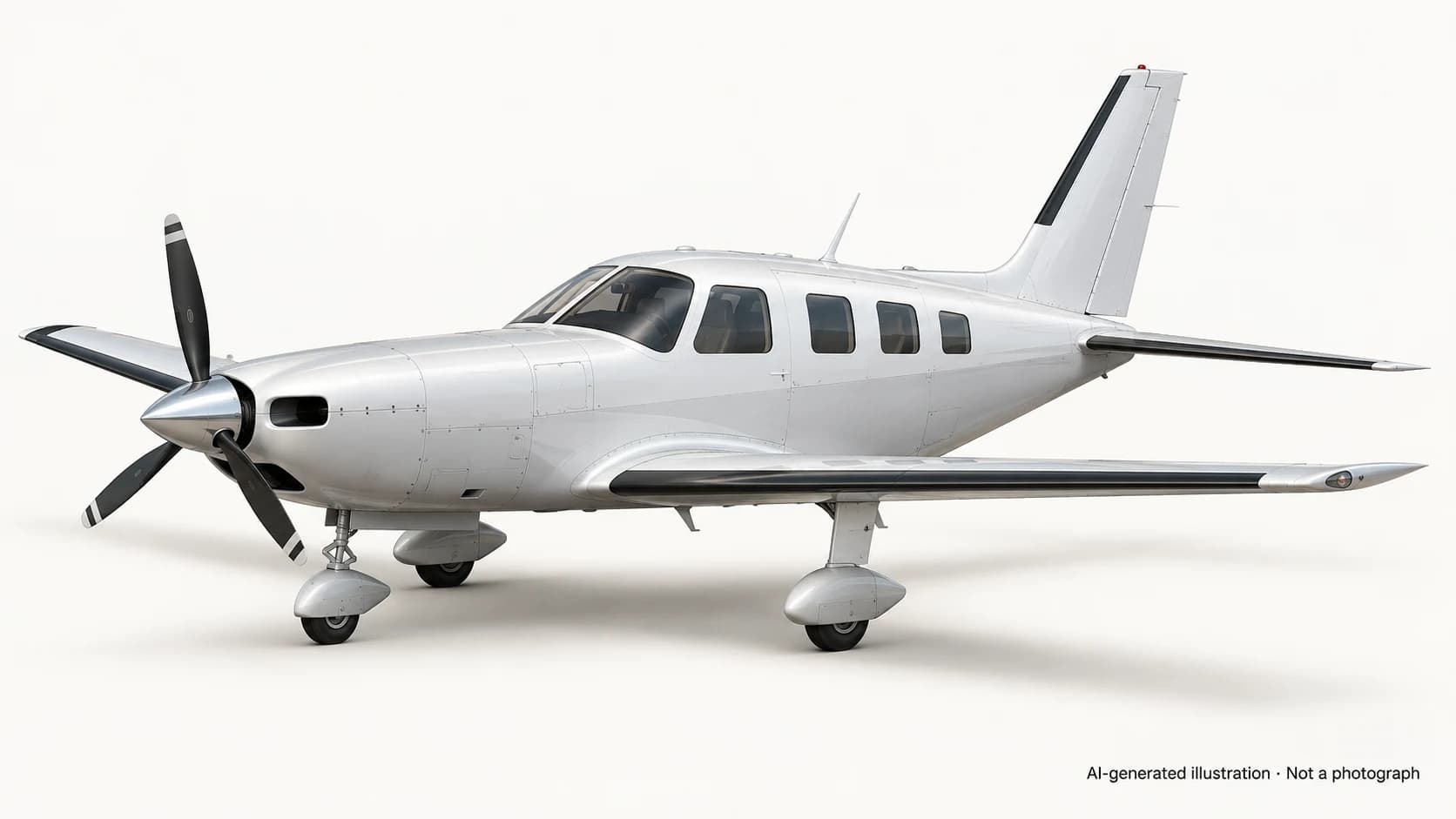
AI-generated illustration · Not a photograph — Representative exterior of Piper PA-46; geometry is illustrative. Not evidence for specifications. — Representative PA-46 family illustration using the retained M350 piston configuration; not a verified military fit or every PA-46 variant.
ForceTally · AI-generated illustration · Not a photograph · AI-generated · OpenAI output terms · Source ↗ · ModifiedLight aircraft
United States
Piper Aircraft
In production
1,000 (as of early 2024)
1979—present
30 November 1979
43.0 ft / 13.11 m
28.11 ft / 8.6 m
11.3 ft / 3.44 m
4,340 lb / 1,969 kg
3,003 lb / 1,362 kg
120 USgal / 454 L
Lycoming TIO-540 -AE2A
350 hp (260 kW)
213 kt / 395 km/h
25,000 ft / 7,620 m
6
The Piper M-Class ( PA-46 ; formerly called the Malibu , Malibu Mirage , Malibu Meridian , and Matrix ) is a family of American light aircraft manufactured by Piper Aircraft of Vero Beach, Florida .
The PA-46-310P is powered by a Continental TSIO-520BE engine rated at 310 hp (230 kW). The PA-46-310P has lower fuel consumption, greater range, and the ability to cruise at " lean-of-peak ." The PA-46-310P has a maximum cruising range of 1,550 nmi (2,870 km) (with reserves), while the PA-46-350P initially had a maximum cruising range of only 1,055 nautical miles (1,954 km), although this is now increased to 1,345 nautical miles (2,491 km).
The PA-46-310P Malibu has set several world speed records: Seattle to New York set November 23, 1987 at 259.27 mph (417 km/h); Detroit to Washington, DC set January 4, 1989 at 395.96 mph (637 km/h); and Chicago to Toronto set on January 8, 1989, at 439.13 mph (707 km/h). All three records were set by Steve Stout in his 1986 Malibu N9114B.
Production of the Malibu Mirage commenced in October 1988 for the 1989 model year. New features included a more powerful Lycoming TIO-540-AE2A 350 hp (260 kW) engine and a new wing. Various changes have occurred over the model years. Earlier models had an all-King panel and later this became largely Garmin , the Garmin G1000 glass cockpit is now standard.
In 1997, Piper announced its intention to market a turboprop-powered version of the Malibu, and flew a prototype the following year powered by a Pratt & Whitney Canada PT6 A-42A of 500 shp (370 kW). Certification was achieved in September 2000 and deliveries began in November that year. Changes made to allow for turboprop power include larger wings and tail surfaces. In 2009, Piper began offering the Meridian with a three-screen version of the Garmin G1000 including the Garmin GFC 700 autopilot as a replacement for the Avidyne Entegra system.
Piper added wing root filets to increase wing area and 342 lb (155 kg) of fuel capacity, a larger tailplane and reinforced wing spar and landing gear to raise MTOW to 4,850 lb (2,200 kg) then 5,092 lb (2,310 kg) from 2003. For a 1,000 nmi (1,900 km) trip, block fuel is 985 lb (447 kg) at 233 kn (432 km/h) block speed, while its maximum cruise speed is 260 kn (480 km/h).
The M350 is fitted with the same 350 hp (261 kW) turbocharged Lycoming TIO-540-AE2A engine and Hartzell three-bladed propeller as the Mirage. Improvements over the Mirage are an Ametek digital fuel quantity system and an improved Garmin G1000 NXi flight system. The new Garmin system has envelope-protection and anti- hypoxia tools. It will initiate an emergency descent in the case that the pilot becomes incapacitated as a result of hypoxia. The M350 is capable of cruising at 213 kn (394 km/h) with a range of 1,343 nmi (2,487 km). The plane has a service ceiling of 25,000 ft (7,620 m). No wind, standard day gross weight takeoff is achieved in 1,087 ft (331 m) and landing in 1,020 ft (311 m).
The M500 is an updated version of the Meridian. It also has the updated Garmin G1000 NXi flight system, like the M350. The G1000 NXi system includes an automatic wings-level function and control override to prevent exceeding the plane's flight envelope. Its purpose is to maintain a safe, stable flight condition in the case of pilot disorientation or incapacitation. The safety feature is called Electronic Stability and Protection (ESP). The M500 also has ADS-B , but no FADEC . The M500's fuel tanks can carry 170 US gal (644 L) and its Pratt & Whitney PT6A-42A engine burns 37 US gal/h (140 L/h). It is a light plane with a maximum ramp weight of 5,135 lb (2,329 kg) and 5,092 lb (2,310 kg) MTOW . It cruises at 260 kn (482 km/h) at an altitude of 30,000 ft (9,144 m).
In 2015, Piper introduced the M600 (company designation PA-46-600TP), as an upgrade to the M500. The M600 is powered by a 600 hp (447 kW) PT6A-42A engine. The new M600 is equipped with the Garmin G3000 , a new wing and more fuel capacity. The aircraft is more capable than the M500, as the M600 has greater range and a slightly higher top speed. It has anti-hypoxia tools like in the M350.
It received its FAA certification on June 18, 2016. Its NBAA Instrument Flight Rules (IFR) range is 1,484 nmi (2,748 km), up from 1,000 nmi (1,852 km) for the M500, and maximum cruise speed is 274 kn (507 km/h; 315 mph), up from the M500's 260 kn (480 km/h; 300 mph). The M600's MTOW is 6,000 lb (2,700 kg), up from the M500's 5,092 lb (2,310 kg), with a 260 US gal (980 L) fuel capacity, greater than the M500's 170 US gal (640 L). The M600's standard equipped weight is 200 lb (91 kg) higher than the M500's. Full-fuel payload for the M600 is 645 lb (293 kg) compared to 550 lb (250 kg) for the M500.
Between June 2016 and March 2018, 50 have been delivered, mostly in the U.S. and mostly are owner-flown. It offers nearly the range of the TBM 900 for much less cost, and can operate from shorter runways than very light jets like the Eclipse 500 or the Citation Mustang . It burns 350 lb (160 kg) (56.3 usgal/hr) in the first hour, 300 lb (140 kg) (50 usgal/hr) the second hour and 200 lb (91 kg) thereafter, averaging 270 lb/hr (45 US gal (170 L)) per hour.
Starting in 2020, Piper offered an emergency autoland system by Garmin , which initiates at the push of a button. Built into the G3000 integrated avionics for the new SLS model, the system will be a first in general aviation , along with the Cirrus Vision Jet . Piper calls the technology "HALO". Offered for $170,000 including extra equipment, it provides access to more than 9,000 runways over 4,500 ft (1,400 m). Transport Canada granted approval for the HALO system on August 3, 2023.
In 2024, Piper unveiled the M700 Fury (company designation PA-46-701TP) to replace the M600. The M700 is powered by a 700 hp (522 kW) PT6A-52 engine and retains the Garmin G3000 avionics and HALO system of its predecessor. The first production M700 was the 1,000th PA-46 produced. The M700 received FAA certification on February 29, 2024, with Piper announcing that deliveries would begin immediately thereafter. In August 2024, Piper Aircraft announced that its M700 FURY received FAA certification for unpaved field operations. This approval marks a significant expansion in the aircraft's operational capabilities, allowing it to operate in more diverse and challenging environments, including remote and undeveloped airstrips.
In October 2007 Piper announced the Matrix, an unpressurized version of the Mirage. The new model was designated as the PA-46R-350T, indicating retractable landing gear, 350 horsepower (260 kW), and turbocharging.
As with the Malibu Mirage, Matrix's powerplant is a turbocharged Lycoming TI0-540-AE2A producing 350 hp (260 kW). The aircraft's performance includes a cruise speed of 215 knots (398 km/h) at 25,000 feet (7,600 m), 215 knots (398 km/h) at 17,500 feet (5,300 m) and 188 knots (348 km/h) at 12,000 feet (3,700 m). Maximum takeoff weight is 4,340 lb (1,969 kg) and an empty weight of 2,937 lb (1,332 kg) giving a standard useful load of 1,421 lb (645 kg)).
ZeroAvia , a Cranfield University partner, is a U.S./UK startup developing a Hydrogen fuel cell power train targeting to halve a turbine operating costs. It flight-tests a pair of 130 kW (170 hp) electric motors replacing the piston engine of a Piper Malibu Mirage in California. In September 2019, the UK government granted £2.7 million ($3.3 million) for its HyFlyer demonstrator, culminating in a 250–300 nmi (460–560 km) flight using hydrogen fuel cells. Other partners, including the Orkney Isles -based EMEC , Cranfield Aerospace Solutions, and fuel-cell developer Intelligent Energy should match this funding. The prototype made its maiden hydrogen-powered flight at Cranfield Airport on September 24, 2020.
On 30 June 2024, a Piper Malibu, registration N85PG, en route from Oneonta, New York to Charleston, West Virginia crashed in the hamlet of Trout Creek, New York , killing the pilot and his four passengers. The cause of the accident is under investigation.
Seating 6
Cabin Volume 201 ft 3 (5.7 m 3 )
Pressurization None 5.5 psi (0.38 bar) 5.6 psi (0.39 bar) 5.5 psi (0.38 bar)
Wingspan 43.0 ft / 13.11 m 43.2 ft / 13.2 m
Length 28.11 ft / 8.6 m 29.6 ft / 9.02 m 29.7 ft / 9.1 m
Height 11.3 ft / 3.44 m 11.5 ft / 3.5 m
MTOW 4,340 lb / 1,969 kg 5,092 lb / 2,310 kg 6,000 lb / 2,721 kg
OEW 3,003 lb / 1,362 kg 3,050 lb / 1,383 kg 3,436 lb / 1,559 kg 3,650 lb / 1,656 kg 3,730 lb / 1,692 kg
Fuel Capacity 120 USgal / 454 L 170 USgal / 644 L 260 USgal / 984 L
Constant-speed propeller 3 blade 4 blade feathering, reversible 5 blade, reversible
Engine Lycoming TIO-540 -AE2A Pratt & Whitney PT6A -42A PT6A-52
Power 350 hp (260 kW) 500 hp (370 kW) 600 hp (450 kW) 700 hp (520 kW)
Maximum cruise 213 kt / 395 km/h 260 ktas / 482 km/h 274 ktas / 507 km/h 301 ktas / 557 km/h
Ceiling 25,000 ft / 7,620 m 30,000 ft / 9,144 m
Range (45 minute reserve) 1,343 nm / 2,487 km 1,000 nm / 1,852 km 1,484 nm / 2,748 km 1,424 nmi (2,637 km)
Takeoff (50 ft obstacle) 2,090 ft / 637 m 2,438 ft / 743 m 2,635 ft / 803 m 1,994 ft / 607 m
Landing (50 ft obstacle) 1968 ft / 600 m 2,110 ft / 643 m 2,659 ft / 810 m 1,950 ft / 594 m
Model Matrix M350 M500 M600 M700 Seating 6 Cabin Volume 201 ft 3 (5.7 m 3 ) Pressurization None 5.5 psi (0.38 bar) 5.6 psi (0.39 bar) 5.5 psi (0.38 bar) Wingspan 43.0 ft / 13.11 m 43.2 ft / 13.2 m Length 28.11 ft / 8.6 m 29.6 ft / 9.02 m 29.7 ft / 9.1 m Height 11.3 ft / 3.44 m 11.5 ft / 3.5 m MTOW 4,340 lb / 1,969 kg 5,092 lb / 2,310 kg 6,000 lb / 2,721 kg OEW 3,003 lb / 1,362 kg 3,050 lb / 1,383 kg 3,436 lb / 1,559 kg 3,650 lb / 1,656 kg 3,730 lb / 1,692 kg Fuel Capacity 120 USgal / 454 L 170 USgal / 644 L 260 USgal / 984 L Constant-speed propeller 3 blade 4 blade feathering, reversible 5 blade, reversible Engine Lycoming TIO-540 -AE2A Pratt & Whitney PT6A -42A PT6A-52 Power 350 hp (260 kW) 500 hp (370 kW) 600 hp (450 kW) 700 hp (520 kW) Maximum cruise 213 kt / 395 km/h 260 ktas / 482 km/h 274 ktas / 507 km/h 301 ktas / 557 km/h Ceiling 25,000 ft / 7,620 m 30,000 ft / 9,144 m Range (45 minute reserve) 1,343 nm / 2,487 km 1,000 nm / 1,852 km 1,484 nm / 2,748 km 1,424 nmi (2,637 km) Takeoff (50 ft obstacle) 2,090 ft / 637 m 2,438 ft / 743 m 2,635 ft / 803 m 1,994 ft / 607 m Landing (50 ft obstacle) 1968 ft / 600 m 2,110 ft / 643 m 2,659 ft / 810 m 1,950 ft / 594 m
Model Matrix M350 M500 M600 M700 Seating 6 Cabin Volume 201 ft 3 (5.7 m 3 ) Pressurization None 5.5 psi (0.38 bar) 5.6 psi (0.39 bar) 5.5 psi (0.38 bar) Wingspan 43.0 ft / 13.11 m 43.2 ft / 13.2 m Length 28.11 ft / 8.6 m 29.6 ft / 9.02 m 29.7 ft / 9.1 m Height 11.3 ft / 3.44 m 11.5 ft / 3.5 m MTOW 4,340 lb / 1,969 kg 5,092 lb / 2,310 kg 6,000 lb / 2,721 kg OEW 3,003 lb / 1,362 kg 3,050 lb / 1,383 kg 3,436 lb / 1,559 kg 3,650 lb / 1,656 kg 3,730 lb / 1,692 kg Fuel Capacity 120 USgal / 454 L 170 USgal / 644 L 260 USgal / 984 L Constant-speed propeller 3 blade 4 blade feathering, reversible 5 blade, reversible Engine Lycoming TIO-540 -AE2A Pratt & Whitney PT6A -42A PT6A-52 Power 350 hp (260 kW) 500 hp (370 kW) 600 hp (450 kW) 700 hp (520 kW) Maximum cruise 213 kt / 395 km/h 260 ktas / 482 km/h 274 ktas / 507 km/h 301 ktas / 557 km/h Ceiling 25,000 ft / 7,620 m 30,000 ft / 9,144 m Range (45 minute reserve) 1,343 nm / 2,487 km 1,000 nm / 1,852 km 1,484 nm / 2,748 km 1,424 nmi (2,637 km) Takeoff (50 ft obstacle) 2,090 ft / 637 m 2,438 ft / 743 m 2,635 ft / 803 m 1,994 ft / 607 m Landing (50 ft obstacle) 1968 ft / 600 m 2,110 ft / 643 m 2,659 ft / 810 m 1,950 ft / 594 m
Model Matrix M350 M500 M600 M700 Seating 6 Cabin Volume 201 ft 3 (5.7 m 3 ) Pressurization None 5.5 psi (0.38 bar) 5.6 psi (0.39 bar) 5.5 psi (0.38 bar) Wingspan 43.0 ft / 13.11 m 43.2 ft / 13.2 m Length 28.11 ft / 8.6 m 29.6 ft / 9.02 m 29.7 ft / 9.1 m Height 11.3 ft / 3.44 m 11.5 ft / 3.5 m MTOW 4,340 lb / 1,969 kg 5,092 lb / 2,310 kg 6,000 lb / 2,721 kg OEW 3,003 lb / 1,362 kg 3,050 lb / 1,383 kg 3,436 lb / 1,559 kg 3,650 lb / 1,656 kg 3,730 lb / 1,692 kg Fuel Capacity 120 USgal / 454 L 170 USgal / 644 L 260 USgal / 984 L Constant-speed propeller 3 blade 4 blade feathering, reversible 5 blade, reversible Engine Lycoming TIO-540 -AE2A Pratt & Whitney PT6A -42A PT6A-52 Power 350 hp (260 kW) 500 hp (370 kW) 600 hp (450 kW) 700 hp (520 kW) Maximum cruise 213 kt / 395 km/h 260 ktas / 482 km/h 274 ktas / 507 km/h 301 ktas / 557 km/h Ceiling 25,000 ft / 7,620 m 30,000 ft / 9,144 m Range (45 minute reserve) 1,343 nm / 2,487 km 1,000 nm / 1,852 km 1,484 nm / 2,748 km 1,424 nmi (2,637 km) Takeoff (50 ft obstacle) 2,090 ft / 637 m 2,438 ft / 743 m 2,635 ft / 803 m 1,994 ft / 607 m Landing (50 ft obstacle) 1968 ft / 600 m 2,110 ft / 643 m 2,659 ft / 810 m 1,950 ft / 594 m
Model Matrix M350 M500 M600 M700 Seating 6 Cabin Volume 201 ft 3 (5.7 m 3 ) Pressurization None 5.5 psi (0.38 bar) 5.6 psi (0.39 bar) 5.5 psi (0.38 bar) Wingspan 43.0 ft / 13.11 m 43.2 ft / 13.2 m Length 28.11 ft / 8.6 m 29.6 ft / 9.02 m 29.7 ft / 9.1 m Height 11.3 ft / 3.44 m 11.5 ft / 3.5 m MTOW 4,340 lb / 1,969 kg 5,092 lb / 2,310 kg 6,000 lb / 2,721 kg OEW 3,003 lb / 1,362 kg 3,050 lb / 1,383 kg 3,436 lb / 1,559 kg 3,650 lb / 1,656 kg 3,730 lb / 1,692 kg Fuel Capacity 120 USgal / 454 L 170 USgal / 644 L 260 USgal / 984 L Constant-speed propeller 3 blade 4 blade feathering, reversible 5 blade, reversible Engine Lycoming TIO-540 -AE2A Pratt & Whitney PT6A -42A PT6A-52 Power 350 hp (260 kW) 500 hp (370 kW) 600 hp (450 kW) 700 hp (520 kW) Maximum cruise 213 kt / 395 km/h 260 ktas / 482 km/h 274 ktas / 507 km/h 301 ktas / 557 km/h Ceiling 25,000 ft / 7,620 m 30,000 ft / 9,144 m Range (45 minute reserve) 1,343 nm / 2,487 km 1,000 nm / 1,852 km 1,484 nm / 2,748 km 1,424 nmi (2,637 km) Takeoff (50 ft obstacle) 2,090 ft / 637 m 2,438 ft / 743 m 2,635 ft / 803 m 1,994 ft / 607 m Landing (50 ft obstacle) 1968 ft / 600 m 2,110 ft / 643 m 2,659 ft / 810 m 1,950 ft / 594 m
Model Matrix M350 M500 M600 M700 Seating 6 Cabin Volume 201 ft 3 (5.7 m 3 ) Pressurization None 5.5 psi (0.38 bar) 5.6 psi (0.39 bar) 5.5 psi (0.38 bar) Wingspan 43.0 ft / 13.11 m 43.2 ft / 13.2 m Length 28.11 ft / 8.6 m 29.6 ft / 9.02 m 29.7 ft / 9.1 m Height 11.3 ft / 3.44 m 11.5 ft / 3.5 m MTOW 4,340 lb / 1,969 kg 5,092 lb / 2,310 kg 6,000 lb / 2,721 kg OEW 3,003 lb / 1,362 kg 3,050 lb / 1,383 kg 3,436 lb / 1,559 kg 3,650 lb / 1,656 kg 3,730 lb / 1,692 kg Fuel Capacity 120 USgal / 454 L 170 USgal / 644 L 260 USgal / 984 L Constant-speed propeller 3 blade 4 blade feathering, reversible 5 blade, reversible Engine Lycoming TIO-540 -AE2A Pratt & Whitney PT6A -42A PT6A-52 Power 350 hp (260 kW) 500 hp (370 kW) 600 hp (450 kW) 700 hp (520 kW) Maximum cruise 213 kt / 395 km/h 260 ktas / 482 km/h 274 ktas / 507 km/h 301 ktas / 557 km/h Ceiling 25,000 ft / 7,620 m 30,000 ft / 9,144 m Range (45 minute reserve) 1,343 nm / 2,487 km 1,000 nm / 1,852 km 1,484 nm / 2,748 km 1,424 nmi (2,637 km) Takeoff (50 ft obstacle) 2,090 ft / 637 m 2,438 ft / 743 m 2,635 ft / 803 m 1,994 ft / 607 m Landing (50 ft obstacle) 1968 ft / 600 m 2,110 ft / 643 m 2,659 ft / 810 m 1,950 ft / 594 m
Length 8.81 m (28.9 ft)
Height 3.44 m (11.3 ft)
Length 8.81 m (28.9 ft)
Height 3.44 m (11.3 ft)
Length 9.02 m (29.6 ft)
Height 3.44 m (11.3 ft)
Length 8.81 m (28.9 ft)
Height 3.44 m (11.3 ft)
Length 9.05 m (29.7 ft)
Height 3.44 m (11.3 ft)
Length 9.05 m (29.7 ft)
Height 3.44 m (11.3 ft)
17. Minimum Flight Crew: 1 (Pilot)
18. Max. Passenger Seating Capacity: 5, for passenger seating locations see applicable AFM/POH.
Reference text from Wikipedia contributors, used under CC BY-SA 4.0.
True scale
Sourced dimensions beside a 1.75 m human reference.
See it in your room. Scan with your phone to open this model in 3D, then place it in your space.
Points represent sourced observations, including revisions. Revisions on the same effective date are not separate inventory events. Ranges appear in the table and are not plotted as exact points.
| Observation / report period | Value | Source | Claim state |
|---|---|---|---|
| 28 Sept 2026 | 3.44 m | Wikipedia contributors | superseded |
17. Minimum Flight Crew: 1 (Pilot)
18. Max. Passenger Seating Capacity: 5, for passenger seating locations see applicable AFM/POH.
17. Minimum Flight Crew: 1 (Pilot)
18. Max. Passenger Seating Capacity: 5, for passenger seating locations see applicable AFM/POH
17. Minimum Flight Crew: 1 (Pilot)
18. Max.Passenger Seating Capacity: 5, for passenger seating locations see applicable AFM/POH
17. Minimum Flight Crew: 1 (Pilot)
18. Max. Passenger Seating Capacity: 5, for passenger seating locations see applicable AFM/POH
17. Minimum Flight Crew: 1 (Pilot)
18. Max. Passenger Seating Capacity: 5, for passenger seating locations see applicable AFM/POH
Piper PA-46 equipment records. Variants, orders and quantities are shown as reported in each inventory source; coverage is incomplete.
 Pakistan
Reported count for Piper M-Class. Service scope: Pakistan Air Force aircraft; does not replace a national total. 1 distinct quantity component(s) from the same source list; shared rowspan cells counted once. Explicit source inventory scope: active; no other stock status or total inferred. Count column(s): in service: 2. Origin: United States. The listed variants/roles are the scope, not an immediately deployable count. The components do not establish one inventory census date; the stored date is the retrieved source snapshot.
Keep exploring
Light aircraft
 ItalyCompare with Piper PA-46
Light aircraft
United StatesLight aircraft
 AustriaCompare with Piper PA-46
Light aircraft
 South Korea
Light aircraft
 France
Light utility aircraft
United StatesCompare with Piper PA-46