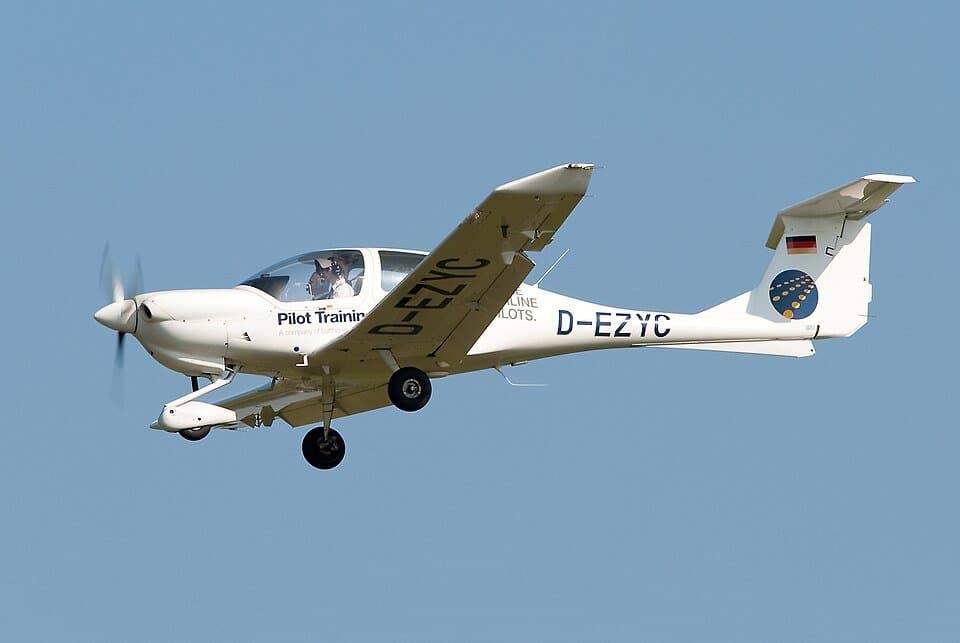

Credit
bomberpilot · CC BY-SA 2.0 · Resized · CC BY-SA 2.0 · Source ↗ · Modified


Preparing your view.

At a glance
True scale
Side by side. From every angle. A human reference for perspective.
3.43 MB · Loads when you open it| Model | Length | Width / span | Height |
|---|---|---|---|
| Diamond DA40 Diamond Star | ≈ 8.1 m | ≈ 11.9 m (Width) | ≈ 2.38 m |
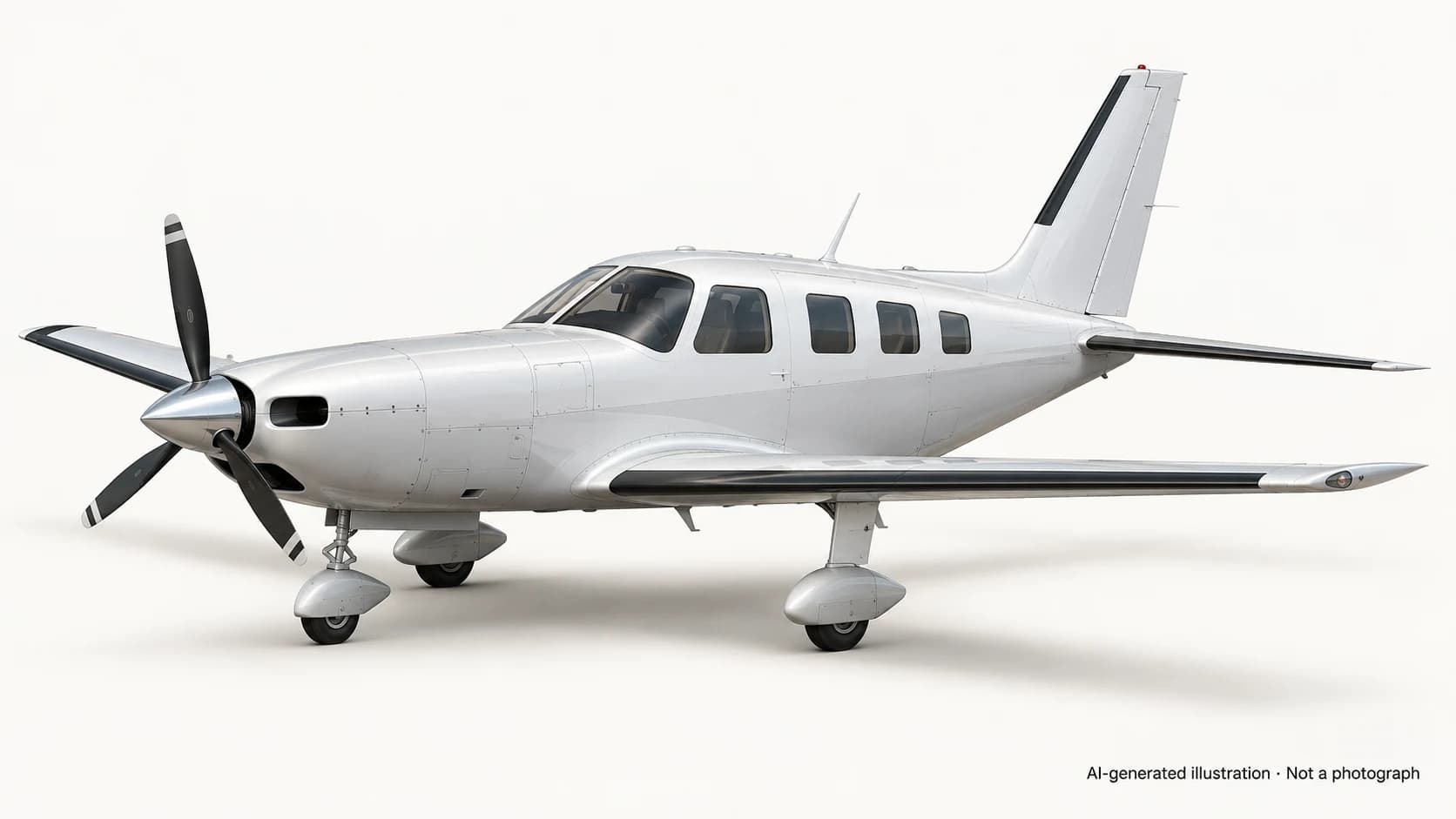
| Piper PA-46 | ≈ 8.6 m | ≈ 13.11 m (Width) | ≈ 3.44 m |
Scaled uniformly to the sourced length of 8.1 m. The shape was turned square to the axes; the width was fitted to the sourced 11.9 m. Not an official model or a measured survey.
ForceTally · All rights reserved
Scaled uniformly to the sourced length of 8.6 m. The shape was turned square to the axes; the height was fitted to the sourced 3.44 m; the width was fitted to the sourced 13.11 m. Not an official model or a measured survey.
ForceTally · All rights reserved
The human reference is a generic 1.75 m figure. Models describe external size, not combat performance.
Measured figures
2007 model Diamond DA40 XL Diamond Star · Length
Single source8.1 m (26 ft 7 in)[source]
Configuration
| Specification | Diamond DA40 Diamond Star | Piper PA-46 |
|---|---|---|
| Crew | one[source] | 1 (Pilot)[source]PA46 · Section A: PA-46-310P (Malibu) · certified minimum flight crew 1 (Pilot)[source]PA46 · Section B: PA-46-350P (Malibu Mirage) · certified minimum flight crew 1 (Pilot)[source]PA46 · Section C: PA-46-500TP (Malibu Meridian) · certified minimum flight crew 1 (Pilot)[source]PA46 · Section D: PA-46R-350T (Malibu Matrix) · certified minimum flight crew 1 (Pilot)[source]PA46 · Section E: PA-46-600TP (M600) · certified minimum flight crew 1 (Pilot) |
Length
28.11 ft / 8.6 m[source]
8.81 m (28.9 ft)[source]PA46 · Section A: PA-46-310P (Malibu) · native Length
8.81 m (28.9 ft)[source]PA46 · Section B: PA-46-350P (Malibu Mirage) · native Length
9.02 m (29.6 ft)[source]PA46 · Section C: PA-46-500TP (Malibu Meridian) · native Length
8.81 m (28.9 ft)[source]PA46 · Section D: PA-46R-350T (Malibu Matrix) · native Length
9.05 m (29.7 ft)[source]PA46 · Section E: PA-46-600TP (M600) · native Length
9.05 m (29.7 ft)[source]PA46 · Section F: PA-46-701TP (M700 Fury) · native Length
2007 model Diamond DA40 XL Diamond Star · Height
Single source1.98 m (6 ft 6 in)[source]
Height
Single source11.3 ft / 3.44 m[source]
3.44 m (11.3 ft)[source]PA46 · Section A: PA-46-310P (Malibu) · native Height
3.44 m (11.3 ft)[source]PA46 · Section B: PA-46-350P (Malibu Mirage) · native Height
3.44 m (11.3 ft)[source]PA46 · Section C: PA-46-500TP (Malibu Meridian) · native Height
3.44 m (11.3 ft)[source]PA46 · Section D: PA-46R-350T (Malibu Matrix) · native Height
3.44 m (11.3 ft)[source]PA46 · Section E: PA-46-600TP (M600) · native Height
3.44 m (11.3 ft)[source]PA46 · Section F: PA-46-701TP (M700 Fury) · native Height
Empty; 2007 model Diamond DA40 XL Diamond Star · Empty weight
Single sourceGross; 2007 model Diamond DA40 XL Diamond Star · Gross weight
Single sourceMaximum take-off; DA40 NG · FACTS AND SPECIFICATIONS · standard equipped aircraft; source states approximately specifications and may change without notice · DA40 NG · FACTS AND SPECIFICATIONS · standard equipped aircraft; source states approximately specifications and may change without notice
Single sourceMaximum take-off; DA40 XLT · FACTS AND SPECIFICATIONS · standard equipped aircraft; source states approximately specifications and may change without notice · DA40 XLT · FACTS AND SPECIFICATIONS · standard equipped aircraft; source states approximately specifications and may change without notice
Single source795 kg (1,753 lb)[source]
1,198 kg (2,641 lb)[source]
1,310 kg[source]DA40 NG · FACTS AND SPECIFICATIONS · standard equipped aircraft; source states approximately specifications and may change without notice
1,200 kg[source]DA40 XLT · FACTS AND SPECIFICATIONS · standard equipped aircraft; source states approximately specifications and may change without notice
Maximum take-off; Maximum takeoff weight
Single source4,340 lb / 1,969 kg[source]
2007 model Diamond DA40 XL Diamond Star · Range
Single source1,341 km (833 mi, 724 nmi)[source]
M350 · range with 45 minute reserve · 1,343 nm /
Single sourceM500 · range with 45 minute reserve · 1,000 nm /
Single sourceM600 · range with 45 minute reserve · 1,484 nm /
Single sourceM700 · range with 45 minute reserve
Single sourceMatrix · range with 45 minute reserve · 1,343 nm /
Single source1,343 nm / 2,487 km[source]Matrix · range with 45 minute reserve
1,343 nm / 2,487 km[source]M350 · range with 45 minute reserve
1,000 nm / 1,852 km[source]M500 · range with 45 minute reserve
1,484 nm / 2,748 km[source]M600 · range with 45 minute reserve
1,424 nmi (2,637 km)[source]M700 · range with 45 minute reserve
2007 model Diamond DA40 XL Diamond Star · Wing area
Single source13.5 m 2 (145 sq ft)[source]
2007 model Diamond DA40 XL Diamond Star · 1,120 ft/min
Single source5.69 m/s (1,120 ft/min)[source]
Bars compare reported quantities only. A larger figure does not make a system better; configurations and test conditions differ.
| Type | Light aircraft[source] | Light aircraft[source] |
|---|
| Manufacturer | Diamond Aircraft Industries[source] | Piper Aircraft[source] |
|---|
| Status | In production[source] | In production[source] |
|---|
| Number built | 2,200 (December 2020)[source] | 1,000 (as of early 2024)[source] |
|---|
| Manufactured | 1997–present[source] | 1979—present[source] |
|---|
| First flight | 5 November 1997[source] | 30 November 1979[source] |
|---|
| Developed from | Diamond DA20[source] | — |
|---|
| Capacity | three passengers[source] | — |
|---|
| Airfoil | Wortmann FX 63-137[source] | — |
|---|
| Stall speed | 91 km/h (57 mph, 49 kn) flaps down[source] | — |
|---|
| Power/mass | 0.110 kW/kg (0.067 hp/lb)[source] | — |
|---|
| National origin | Austria[source] | United States[source] |
|---|
| Role | Austrian four-seat, single-engine, light aircraft constructed[source] | family of American light aircraft[source] |
|---|
| Source measurement | In late 2006, the XL and FP models replaced the DA40-180. The FP replaced the fixed pitch propeller version of the 180 and the XL replaced the constant speed propeller version. The major difference between the new models and the 180 is the higher maximum cruise speeds. The DA40-XL is approximately four knots faster than the preceding DA40-180/G1000 with the two-blade Hartzell propeller and the "Speed Gear" option. The XL's speed increase is mostly due to the Powerflow exhaust system.[source]Diamond DA40 Diamond Star · Development; only the objects and conditions stated in this passage In October 2021, Diamond Aircraft announced an all- electric training variant, the eDA40, with initial flights scheduled for the second quarter of 2022 and EASA/FAA Part 23 certification expected in 2023. It should fly for 90 minutes, with a fast charge for 20 minutes turnarounds and operating costs 40% lower than piston aircraft.[source]Diamond DA40 Diamond Star · Development; only the objects and conditions stated in this passage The DA40-XL has a constant speed propeller and is powered by a 180 hp (130 kW) Lycoming IO-360-M1A fuel injected engine. It has a maximum cruise speed of 147 kn (272 km/h; 169 mph), burning 9.2 gallons of Avgas per hour. Its maximum takeoff weight is 2,535 lb (1,150 kg).[source]Diamond DA40 Diamond Star · Design; only the objects and conditions stated in this passage The DA40-F (marketed as the "FP") has a fixed pitch propeller, a 180 hp (130 kW) Lycoming O-360-A4M engine, which has a carburetor rather than fuel injection and a more basic interior, but is otherwise similar to the XL.[source]Diamond DA40 Diamond Star · Design; only the objects and conditions stated in this passage The DA40-TDI uses a Thielert "Centurion" 135 hp (101 kW) diesel engine and burns diesel or jet fuel . It has a constant speed propeller and FADEC (single lever) engine control. The Diesel DA40D is not certified in the US .[source]Diamond DA40 Diamond Star · Design; only the objects and conditions stated in this passage The DA40 has accumulated a very low accident record, particularly with regard to stall and spin accidents. Its overall and fatal accident rates are one-eighth that of the general aviation fleet and include no stall-related accidents. The level of safe operation is attributed to its high aspect ratio wing, low wing loading and benign flight characteristics. The aircraft can be trimmed full nose up, engine set to idle and it will descend at 600–1,200 feet per minute (180–370 m/min) at 48 kn (55 mph; 89 km/h) hands-off, a lower rate of descent than the competitor Cirrus SR22 can achieve with its airframe ballistic parachute deployed.[source]Diamond DA40 Diamond Star · Operational history; only the objects and conditions stated in this passage In a 2011 analysis by Aviation Consumer magazine, the DA40 was shown to have had a fatal accident rate of 0.35/100,000 hours, the lowest in US general aviation and considerably better than the market leading Cirrus SR20 and SR22 , which that year had a combined fatal accident rate of 1.6/100,000, despite its full aircraft parachute system. By comparison, the Cessna 172 had a fatal accident rate of 0.45/100,000 hours.[source]Diamond DA40 Diamond Star · Operational history; only the objects and conditions stated in this passage Initial model, powered by a Textron Lycoming IO-360 M1A 180 hp (135 kW) engine and a MT Propellers MTV-12-B/180-17. Maximum gross weight is 1150 kg (2535 lb) or 1200 kg (2646 lb) with modifications installed. In increasingly refined versions marketed as the DA40-180, XL, CS and XLS.[source]Diamond DA40 Diamond Star · Variants; only the objects and conditions stated in this passage Diesel model, powered by a Thielert TAE 125-01 (Centurion 1.7) or TAE 125-02-99 (Centurion 2.0) engine of 135 hp (101 kW) and MT Propellers MTV-6-A/187-129. Maximum gross weight is 1150 kg (2535 lb). Marketed primarily in Europe, although certified in Canada and Australia as well, as the DA40 TDI.[source]Diamond DA40 Diamond Star · Variants; only the objects and conditions stated in this passage Fixed pitch propeller model, powered by Textron Lycoming O-360-A4M and a Sensenich 6EM8S10-0-63 or a MT-Propeller MT 188R135-4G propeller. Maximum gross weight is 1150 kg (2535 lb). Marketed as the DA40 FP. This model is no longer offered.[source]Diamond DA40 Diamond Star · Variants; only the objects and conditions stated in this passage Latest model, offered in select markets only (DA40 model is still offered in other markets), powered by an Austro Engine AE 300 165.6 hp (123.5 kW) running on JET A-1 fuel. EASA certified April 2010. By December 2020, 500 NG models had been produced.[source]Diamond DA40 Diamond Star · Variants; only the objects and conditions stated in this passage Version with strengthened landing gear, larger tires for operation from unimproved surfaces and a 168 hp (125 kW) Austro AE300 diesel engine that burns jet fuel.[source]Diamond DA40 Diamond Star · Variants; only the objects and conditions stated in this passage All- electric training variant, announced in October 2021, initially targeting a 2022 first flight and a 2023 certification, with 90 minute endurance. Charging can be accomplished in 20 minutes but certification could slip to early 2024, and the 90-minute endurance goal could be reached only as battery technology allows. The first flight actually occurred on 20 July 2023. The company expects it to be the first EASA/FAA Part 23 certified electric aircraft.[source]Diamond DA40 Diamond Star · Variants; only the objects and conditions stated in this passage Austrian Air Force – 4 in service.[source]Diamond DA40 Diamond Star · Operators / Military; only the objects and conditions stated in this passage Bangladesh Army – 4 in service with 2 more on order. Bangladesh Army Aviation Group[source]Diamond DA40 Diamond Star · Operators / Military; only the objects and conditions stated in this passage Capacity: three passengers[source]Diamond DA40 Diamond Star · Specifications (2007 model Diamond DA40 XL Diamond Star); only the objects and conditions stated in this passage Length: 8.1 m (26 ft 7 in)[source]Diamond DA40 Diamond Star · Specifications (2007 model Diamond DA40 XL Diamond Star); only the objects and conditions stated in this passage Wingspan: 11.9 m (39 ft 1 in)[source]Diamond DA40 Diamond Star · Specifications (2007 model Diamond DA40 XL Diamond Star); only the objects and conditions stated in this passage Height: 1.98 m (6 ft 6 in)[source]Diamond DA40 Diamond Star · Specifications (2007 model Diamond DA40 XL Diamond Star); only the objects and conditions stated in this passage Wing area: 13.5 m 2 (145 sq ft)[source]Diamond DA40 Diamond Star · Specifications (2007 model Diamond DA40 XL Diamond Star); only the objects and conditions stated in this passage Empty weight: 795 kg (1,753 lb)[source]Diamond DA40 Diamond Star · Specifications (2007 model Diamond DA40 XL Diamond Star); only the objects and conditions stated in this passage Gross weight: 1,198 kg (2,641 lb)[source]Diamond DA40 Diamond Star · Specifications (2007 model Diamond DA40 XL Diamond Star); only the objects and conditions stated in this passage Powerplant: 1 × Lycoming IO-360-M1A 4-cylinder air-cooled horizontally-opposed piston engine, 134 kW (180 hp)[source]Diamond DA40 Diamond Star · Specifications (2007 model Diamond DA40 XL Diamond Star); only the objects and conditions stated in this passage Cruise speed: 279 km/h (173 mph, 151 kn) TAS[source]Diamond DA40 Diamond Star · Specifications (2007 model Diamond DA40 XL Diamond Star); only the objects and conditions stated in this passage Stall speed: 91 km/h (57 mph, 49 kn) flaps down[source]Diamond DA40 Diamond Star · Specifications (2007 model Diamond DA40 XL Diamond Star); only the objects and conditions stated in this passage Range: 1,341 km (833 mi, 724 nmi)[source]Diamond DA40 Diamond Star · Specifications (2007 model Diamond DA40 XL Diamond Star); only the objects and conditions stated in this passage Service ceiling: 5,000 m (16,000 ft)[source]Diamond DA40 Diamond Star · Specifications (2007 model Diamond DA40 XL Diamond Star); only the objects and conditions stated in this passage Rate of climb: 5.69 m/s (1,120 ft/min)[source]Diamond DA40 Diamond Star · Specifications (2007 model Diamond DA40 XL Diamond Star); only the objects and conditions stated in this passage | The PA-46-310P is powered by a Continental TSIO-520BE engine rated at 310 hp (230 kW). The PA-46-310P has lower fuel consumption, greater range, and the ability to cruise at " lean-of-peak ." The PA-46-310P has a maximum cruising range of 1,550 nmi (2,870 km) (with reserves), while the PA-46-350P initially had a maximum cruising range of only 1,055 nautical miles (1,954 km), although this is now increased to 1,345 nautical miles (2,491 km).[source]Piper PA-46 · Variants / PA-46-310P Malibu; only the objects and conditions stated in this passage The PA-46-310P Malibu has set several world speed records: Seattle to New York set November 23, 1987 at 259.27 mph (417 km/h); Detroit to Washington, DC set January 4, 1989 at 395.96 mph (637 km/h); and Chicago to Toronto set on January 8, 1989, at 439.13 mph (707 km/h). All three records were set by Steve Stout in his 1986 Malibu N9114B.[source]Piper PA-46 · Variants / PA-46-310P Malibu; only the objects and conditions stated in this passage Production of the Malibu Mirage commenced in October 1988 for the 1989 model year. New features included a more powerful Lycoming TIO-540-AE2A 350 hp (260 kW) engine and a new wing. Various changes have occurred over the model years. Earlier models had an all-King panel and later this became largely Garmin , the Garmin G1000 glass cockpit is now standard.[source]Piper PA-46 · Variants / PA-46-350P Malibu Mirage; only the objects and conditions stated in this passage In 1997, Piper announced its intention to market a turboprop-powered version of the Malibu, and flew a prototype the following year powered by a Pratt & Whitney Canada PT6 A-42A of 500 shp (370 kW). Certification was achieved in September 2000 and deliveries began in November that year. Changes made to allow for turboprop power include larger wings and tail surfaces. In 2009, Piper began offering the Meridian with a three-screen version of the Garmin G1000 including the Garmin GFC 700 autopilot as a replacement for the Avidyne Entegra system. |
|---|
| OEW | — | 3,003 lb / 1,362 kg[source] |
|---|
| Fuel Capacity | — | 120 USgal / 454 L[source] |
|---|
| Engine | — | Lycoming TIO-540 -AE2A[source] |
|---|
| Passengers | — |
|---|
| Source specifications · Seating | — | Seating 6[source]Matrix / M350 / M500 / M600 / M700 · Seating |
|---|
| Source specifications · Cabin Volume | — | Cabin Volume 201 ft 3 (5.7 m 3 )[source]Matrix / M350 / M500 / M600 / M700 · Cabin Volume |
|---|
| Source specifications · Pressurization | — | Pressurization None 5.5 psi (0.38 bar) 5.6 psi (0.39 bar) 5.5 psi (0.38 bar)[source]Matrix / M350 / M500 / M600 / M700 · Pressurization |
|---|
| Source specifications · Wingspan | — | Wingspan 43.0 ft / 13.11 m 43.2 ft / 13.2 m[source]Matrix / M350 / M500 / M600 / M700 · Wingspan |
|---|
| Source specifications · Length | — | Length 28.11 ft / 8.6 m 29.6 ft / 9.02 m 29.7 ft / 9.1 m[source]Matrix / M350 / M500 / M600 / M700 · Length |
|---|
| Source specifications · Height | — | Height 11.3 ft / 3.44 m 11.5 ft / 3.5 m[source]Matrix / M350 / M500 / M600 / M700 · Height |
|---|
| Source specifications · MTOW | — | MTOW 4,340 lb / 1,969 kg 5,092 lb / 2,310 kg 6,000 lb / 2,721 kg[source]Matrix / M350 / M500 / M600 / M700 · MTOW |
|---|
| Source specifications · OEW | — | OEW 3,003 lb / 1,362 kg 3,050 lb / 1,383 kg 3,436 lb / 1,559 kg 3,650 lb / 1,656 kg 3,730 lb / 1,692 kg[source]Matrix / M350 / M500 / M600 / M700 · OEW |
|---|
| Source specifications · Fuel Capacity | — | Fuel Capacity 120 USgal / 454 L 170 USgal / 644 L 260 USgal / 984 L[source]Matrix / M350 / M500 / M600 / M700 · Fuel Capacity |
|---|
| Source specifications · Constant-speed propeller | — | Constant-speed propeller 3 blade 4 blade feathering, reversible 5 blade, reversible[source]Matrix / M350 / M500 / M600 / M700 · Constant-speed propeller |
|---|
| Source specifications · Engine | — | Engine Lycoming TIO-540 -AE2A Pratt & Whitney PT6A -42A PT6A-52[source]Matrix / M350 / M500 / M600 / M700 · Engine |
|---|
| Source specifications · Power | — | Power 350 hp (260 kW) 500 hp (370 kW) 600 hp (450 kW) 700 hp (520 kW)[source]Matrix / M350 / M500 / M600 / M700 · Power |
|---|
| Source specifications · Maximum cruise | — | Maximum cruise 213 kt / 395 km/h 260 ktas / 482 km/h 274 ktas / 507 km/h 301 ktas / 557 km/h[source]Matrix / M350 / M500 / M600 / M700 · Maximum cruise |
|---|
| Source specifications · Ceiling | — | Ceiling 25,000 ft / 7,620 m 30,000 ft / 9,144 m[source]Matrix / M350 / M500 / M600 / M700 · Ceiling |
|---|
| Source specifications · Range (45 minute reserve) | — | Range (45 minute reserve) 1,343 nm / 2,487 km 1,000 nm / 1,852 km 1,484 nm / 2,748 km 1,424 nmi (2,637 km)[source]Matrix / M350 / M500 / M600 / M700 · Range (45 minute reserve) |
|---|
| Source specifications · Takeoff (50 ft obstacle) | — | Takeoff (50 ft obstacle) 2,090 ft / 637 m 2,438 ft / 743 m 2,635 ft / 803 m 1,994 ft / 607 m[source]Matrix / M350 / M500 / M600 / M700 · Takeoff (50 ft obstacle) |
|---|
| Source specifications · Landing (50 ft obstacle) | — | Landing (50 ft obstacle) 1968 ft / 600 m 2,110 ft / 643 m 2,659 ft / 810 m 1,950 ft / 594 m[source]Matrix / M350 / M500 / M600 / M700 · Landing (50 ft obstacle) |
|---|
| Troop or passenger capacity | — | 5, for passenger seating locations see applicable AFM/POH.[source]PA46 · Section A: PA-46-310P (Malibu) · maximum passenger seating, excludes pilot 5, for passenger seating locations see applicable AFM/POH.[source]PA46 · Section B: PA-46-350P (Malibu Mirage) · maximum passenger seating, excludes pilot 5, for passenger seating locations see applicable AFM/POH[source]PA46 · Section C: PA-46-500TP (Malibu Meridian) · maximum passenger seating, excludes pilot 5, for passenger seating locations see applicable AFM/POH[source]PA46 · Section D: PA-46R-350T (Malibu Matrix) · maximum passenger seating, excludes pilot 5, for passenger seating locations see applicable AFM/POH[source]PA46 · Section E: PA-46-600TP (M600) · maximum passenger seating, excludes pilot 5, for passenger seating locations see applicable AFM/POH[source]PA46 · Section F: PA-46-701TP (M700 Fury) · maximum passenger seating, excludes pilot |
|---|
Piper added wing root filets to increase wing area and 342 lb (155 kg) of fuel capacity, a larger tailplane and reinforced wing spar and landing gear to raise MTOW to 4,850 lb (2,200 kg) then 5,092 lb (2,310 kg) from 2003. For a 1,000 nmi (1,900 km) trip, block fuel is 985 lb (447 kg) at 233 kn (432 km/h) block speed, while its maximum cruise speed is 260 kn (480 km/h).[source]Piper PA-46 · Variants / PA-46-500TP Malibu Meridian; only the objects and conditions stated in this passage
The M350 is fitted with the same 350 hp (261 kW) turbocharged Lycoming TIO-540-AE2A engine and Hartzell three-bladed propeller as the Mirage. Improvements over the Mirage are an Ametek digital fuel quantity system and an improved Garmin G1000 NXi flight system. The new Garmin system has envelope-protection and anti- hypoxia tools. It will initiate an emergency descent in the case that the pilot becomes incapacitated as a result of hypoxia. The M350 is capable of cruising at 213 kn (394 km/h) with a range of 1,343 nmi (2,487 km). The plane has a service ceiling of 25,000 ft (7,620 m). No wind, standard day gross weight takeoff is achieved in 1,087 ft (331 m) and landing in 1,020 ft (311 m).[source]Piper PA-46 · Variants / Piper M-Class / M350; only the objects and conditions stated in this passage
The M500 is an updated version of the Meridian. It also has the updated Garmin G1000 NXi flight system, like the M350. The G1000 NXi system includes an automatic wings-level function and control override to prevent exceeding the plane's flight envelope. Its purpose is to maintain a safe, stable flight condition in the case of pilot disorientation or incapacitation. The safety feature is called Electronic Stability and Protection (ESP). The M500 also has ADS-B , but no FADEC . The M500's fuel tanks can carry 170 US gal (644 L) and its Pratt & Whitney PT6A-42A engine burns 37 US gal/h (140 L/h). It is a light plane with a maximum ramp weight of 5,135 lb (2,329 kg) and 5,092 lb (2,310 kg) MTOW . It cruises at 260 kn (482 km/h) at an altitude of 30,000 ft (9,144 m).[source]Piper PA-46 · Variants / Piper M-Class / M500; only the objects and conditions stated in this passage
In 2015, Piper introduced the M600 (company designation PA-46-600TP), as an upgrade to the M500. The M600 is powered by a 600 hp (447 kW) PT6A-42A engine. The new M600 is equipped with the Garmin G3000 , a new wing and more fuel capacity. The aircraft is more capable than the M500, as the M600 has greater range and a slightly higher top speed. It has anti-hypoxia tools like in the M350.[source]Piper PA-46 · Variants / Piper M-Class / M600; only the objects and conditions stated in this passage
It received its FAA certification on June 18, 2016. Its NBAA Instrument Flight Rules (IFR) range is 1,484 nmi (2,748 km), up from 1,000 nmi (1,852 km) for the M500, and maximum cruise speed is 274 kn (507 km/h; 315 mph), up from the M500's 260 kn (480 km/h; 300 mph). The M600's MTOW is 6,000 lb (2,700 kg), up from the M500's 5,092 lb (2,310 kg), with a 260 US gal (980 L) fuel capacity, greater than the M500's 170 US gal (640 L). The M600's standard equipped weight is 200 lb (91 kg) higher than the M500's. Full-fuel payload for the M600 is 645 lb (293 kg) compared to 550 lb (250 kg) for the M500.[source]Piper PA-46 · Variants / Piper M-Class / M600; only the objects and conditions stated in this passage
Between June 2016 and March 2018, 50 have been delivered, mostly in the U.S. and mostly are owner-flown. It offers nearly the range of the TBM 900 for much less cost, and can operate from shorter runways than very light jets like the Eclipse 500 or the Citation Mustang . It burns 350 lb (160 kg) (56.3 usgal/hr) in the first hour, 300 lb (140 kg) (50 usgal/hr) the second hour and 200 lb (91 kg) thereafter, averaging 270 lb/hr (45 US gal (170 L)) per hour.[source]Piper PA-46 · Variants / Piper M-Class / M600; only the objects and conditions stated in this passage
Starting in 2020, Piper offered an emergency autoland system by Garmin , which initiates at the push of a button. Built into the G3000 integrated avionics for the new SLS model, the system will be a first in general aviation , along with the Cirrus Vision Jet . Piper calls the technology "HALO". Offered for $170,000 including extra equipment, it provides access to more than 9,000 runways over 4,500 ft (1,400 m). Transport Canada granted approval for the HALO system on August 3, 2023.[source]Piper PA-46 · Variants / Piper M-Class / M600; only the objects and conditions stated in this passage
In 2024, Piper unveiled the M700 Fury (company designation PA-46-701TP) to replace the M600. The M700 is powered by a 700 hp (522 kW) PT6A-52 engine and retains the Garmin G3000 avionics and HALO system of its predecessor. The first production M700 was the 1,000th PA-46 produced. The M700 received FAA certification on February 29, 2024, with Piper announcing that deliveries would begin immediately thereafter. In August 2024, Piper Aircraft announced that its M700 FURY received FAA certification for unpaved field operations. This approval marks a significant expansion in the aircraft's operational capabilities, allowing it to operate in more diverse and challenging environments, including remote and undeveloped airstrips.[source]Piper PA-46 · Variants / Piper M-Class / M700 Fury; only the objects and conditions stated in this passage
In October 2007 Piper announced the Matrix, an unpressurized version of the Mirage. The new model was designated as the PA-46R-350T, indicating retractable landing gear, 350 horsepower (260 kW), and turbocharging.[source]Piper PA-46 · Variants / PA-46R-350T Matrix; only the objects and conditions stated in this passage
As with the Malibu Mirage, Matrix's powerplant is a turbocharged Lycoming TI0-540-AE2A producing 350 hp (260 kW). The aircraft's performance includes a cruise speed of 215 knots (398 km/h) at 25,000 feet (7,600 m), 215 knots (398 km/h) at 17,500 feet (5,300 m) and 188 knots (348 km/h) at 12,000 feet (3,700 m). Maximum takeoff weight is 4,340 lb (1,969 kg) and an empty weight of 2,937 lb (1,332 kg) giving a standard useful load of 1,421 lb (645 kg)).[source]Piper PA-46 · Variants / PA-46R-350T Matrix; only the objects and conditions stated in this passage
ZeroAvia , a Cranfield University partner, is a U.S./UK startup developing a Hydrogen fuel cell power train targeting to halve a turbine operating costs. It flight-tests a pair of 130 kW (170 hp) electric motors replacing the piston engine of a Piper Malibu Mirage in California. In September 2019, the UK government granted £2.7 million ($3.3 million) for its HyFlyer demonstrator, culminating in a 250–300 nmi (460–560 km) flight using hydrogen fuel cells. Other partners, including the Orkney Isles -based EMEC , Cranfield Aerospace Solutions, and fuel-cell developer Intelligent Energy should match this funding. The prototype made its maiden hydrogen-powered flight at Cranfield Airport on September 24, 2020.[source]Piper PA-46 · Variants / ZeroAvia HyFlyer; only the objects and conditions stated in this passage
On 30 June 2024, a Piper Malibu, registration N85PG, en route from Oneonta, New York to Charleston, West Virginia crashed in the hamlet of Trout Creek, New York , killing the pilot and his four passengers. The cause of the accident is under investigation.[source]Piper PA-46 · Accidents and incidents; only the objects and conditions stated in this passage