FORCETALLY
Loading the evidence…
Preparing your view.


Preparing your view.
TanksIn development
Main battle tank
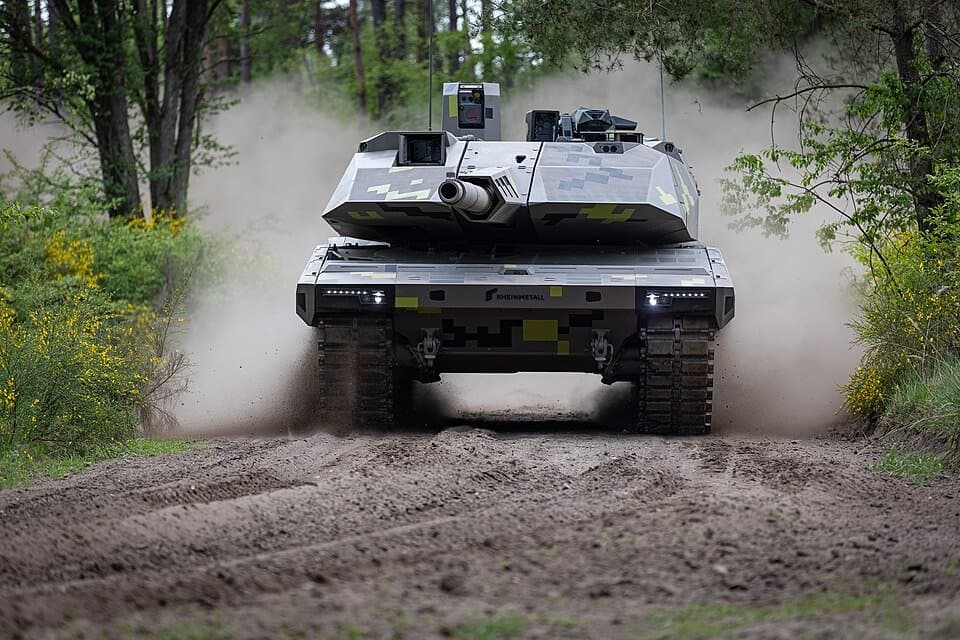
Panther KF51 is a main battle tank originating in Germany.
 Germany
Technical data
True scale
Sourced dimensions beside a 1.75 m human reference.
Points represent sourced observations, including revisions. Revisions on the same effective date are not separate inventory events. Ranges appear in the table and are not plotted as exact points.
| Observation / report period | Value | Source | Claim state |
|---|---|---|---|
| 28 Sept 2026 | 3–4 people | Wikipedia contributors | superseded |
| 28 Sept 2026 | 3–4 people | Wikipedia contributors | superseded |
| 28 Sept 2026 | 3–4 people | Wikipedia contributors | approved |
Main battle tank
Germany
Not yet in service
Rheinmetall
Commenced 2016
59 tonnes (58 long tons; 65 short tons)
7.8 m (10 m with tank gun )
3.7 m
2.5 m
3–4 Commander (turret) Gunner (turret) Driver (hull) Additional crew member (hull)
Composite armour , reactive armour and active protection systems ( StrikeShield )
Rh-130 L/52 130 mm smoothbore cannon (up to 20 rounds)
12.7 mm coaxial machine gun (250 rounds), 7.62 mm 'Natter' RCWS (2,500 rounds)
MTU MB 873 Ka-501 V-12 water-cooled diesel 1,500 PS
25.4 PS/t
Renk HSWL 354
Torsion bar
1,100 L (242 imp gal; 291 US gal)
70 kilometres per hour (43 mph)
The Panther KF51 (KF is short for German " Kettenfahrzeug " lit. ' tracked vehicle ' ) is a German fourth-generation main battle tank (MBT) that is under development by Rheinmetall .
The KF51 is based on the hull of the Leopard 2A4 , but with a new turret mounting an autoloaded 130 mm main gun . On 5 December 2022, Rheinmetall announced its plans to target mostly existing Leopard 2 operators with the KF51.
The Panther provides all crew members except the gunner with standardized crew stations, each featuring a large central 23-inch display screen and two smaller 10-inch displays below that. Two further screens are mounted to the left and right of the operator respectively, displaying the view from the left and right situational awareness cameras. Due to the demonstrator turret utilizing a version of the Leopard 2's EMES 15 gunner's sight, the gunner's place is slightly different. The use of standardized crew stations and drive-by-wire technology means that every crew member can take over every role, e.g. in theory the tank can also be driven by the commander and the gun can be fired by the driver.
Where the design of the KF51 departs from that of the preceding generation of most Western MBTs is by the introduction of a new two-person turret fitted with an autoloaded main gun. The rear of the turret houses the magazines for the main gun's automatic loader and pods for loitering munitions if these have been equipped. There are housings for cameras on all four corners of the turret and in the middle of each side of the turret.
The engine, tracks and most of the running gear of the vehicle are also believed to have been derived from those of the Leopard 2. The Leopard 2's engine is an MTU MB 873 Ka-501 water-cooled V12 diesel engine producing 1,100 kilowatts (1,500 hp) at 2,600 rpm, coupled to a Renk HSWL 354 four-speed automatic transmission. The running gear of Leopard 2A4 consists of seven dual-tired rubber road wheels and four rubber-tired offset track return rollers on each side, with the idler at the front and the drive sprocket at the rear. The road wheels are supported by torsion bar suspension with advanced friction dampers. The first, second, third, sixth, and seventh road wheels feature advanced friction dampers and hydraulic bump stops to dampen oscillations, with the fourth and fifth fitted with solid bump stops. The KF51 is fitted with an 82-link Defence Service Tracks 570F track of 635 mm width with rubber-bushed end connectors on each side.
The KF51 Panther uses a Leopard 2 hull structure, running gear and power pack, to make the switch from Leopard 2 easier. At a weight of 59 tons, the Panther has a top speed of 70 kilometres per hour (43 mph) forward and 30 kilometres per hour (19 mph) backward. It can accelerate from 0 to 40 kilometres per hour (25 mph) in 8 seconds. It has a maximum range of 500 km. The Panther has a combat weight of 59 tonnes, making it lighter than most Western MBTs. Due to its lower weight and physical size, the KF51 Panther fits within the railroad tunnel profile AmovP-4l.
Six SCM60 day and night digital see-through-armour system modules are mounted around the turret, providing a 360° situational awareness for the crew members. The system is already fielded on the Boxer CRV, Lynx and Puma IFV . For further situational awareness, an acoustic shooter locating system and laser warning receivers are installed on the KF51 Panther as well. All information is fused in a central computer system and provided to the crew. To detect drones, flat AESA radar panels could be installed on the turret.
For additional short range reconnaissance purposes, the KF51 Panther demonstrator turret includes launching bays for two small Stinger quadcopter, i.e. short-range UAVs, developed in cooperation with BärDrones. They have a 20–30 minute flight time and could be fitted with a small 200 grams (7.1 oz) warhead for combat purposes.
The primary armament of the KF51 is a stabilised Rheinmetall Rh-130 L/52 130 mm smoothbore gun that can be elevated from −9˚ to +20˚. Rheinmetall claims that this is capable of delivering between 18 and 20 megajoules (13,000,000 and 15,000,000 foot-pounds force) of energy onto a target and has a 50% longer effective range than Rheinmetall's 120 mm tank guns. The Rh-130 can fire armour-piercing fin-stabilized discarding sabot (APFSDS) ammunition, programmable air burst high-explosive (HE) rounds and practice projectiles .
The main gun is fed by an autoloader that consists of two conveyor-based magazines with a capacity of ten rounds each. Up to 10 further rounds can be carried on the tank. During a test firing in April 2022, the Rh-130 mounted on a test rig was able to fire three rounds in 16 seconds, though this included the time to perform safety checks. Two hatches are located in the turret sides to allow the autoloader's magazines to be replenished within five minutes. An option is available to carry an additional 10 rounds on the back of the vehicle outside of the hull and turret.
The secondary armament consists of a coaxially mounted 12.7 mm machine gun. Rheinmetall's 'Natter' remote controlled weapon station (RCWS) with a 7.62 mm machine gun (can be elevated from −15˚ to +85˚ and can carry 2,500 rounds of ammunition) can be mounted on the rear of the turret roof to provide close-in defence and a counter-unmanned aircraft system (C-UAS) capability. The combination of commander's sight and RWS enables so-called hunter-killer and killer-killer operations.
The UAV pod mission pod was developed in cooperation with BärDrones. It carries a larger reconnaissance quadcopter that has a flight time of 50 minutes and automatically connects its battery for recharging after landing on the Panther. The bottom of the pod contains hydropneumatic launch tubes for twelve smaller Stinger drones. Those are micro-UAVs and have 20–30 minute flight time, 90 kilometres per hour (56 mph) top speed and the capacity to carry a 200 grams (7.1 oz) warhead.
In June 2024, Rheinmetall presented the KF51-U at the Eurosatory defence fair. It uses a modified version of the original Panther demonstrator hull fitted with the Concept Unmanned Turret (CUT). Its three-men crew sits in the hull just in front of the turret. The KF51-U retains the 130 mm smoothbore gun and 20 round autoloader from two magazines, but can carry a further 5 spare rounds in the turret. As secondary armament, the KF51-U has a coaxial 12.7 mm heavy machine gun and a 7.62 mm RMG as Main Sensor Slaved Armament (MSSA). The main gun has a maximum depression of −9° and a maximum elevation of +20°.
Unlike other unmanned turrets, the KF51-U's CUT is understood to feature 'good' protection while being 10 to 20% lighter than the manned Panther turret, which accounts for more than 1,000 kilograms (2,200 lb) lower weight. The combat weight of the tank is somewhere between 50 and 60 tonnes. In addition to the StrikeShield system mounted on the hull, the KF51-U is also fitted with the Iron Fist and MUSS 2.0 active protection systems. Additionally, the ROSY_VL system is installed on top of the turret for protection against top-attack missiles and drones.
Both the gunner and commander are provided with newer SEOSS 400 sights, which offer improved performance and greater detection ranges than the previous SEOSS 300 and EMES 15 sights used in the Panther demonstrator turret. The SEOSS 400 sight was presented in detail at the DSEI 2025 exhibition. It features larger, 5 megapixel CCD and MWIR sensors, increasing identification range of tank-sized targets to above 6 kilometres (3.7 mi). The commander's SEOSS 400 sight acts as optic for the MSSA system, which also includes a counter-UAS radar to detect and track drones.
View of the 12.7 mm coaxial machine gun, gunner's sight and commander's sight
The NMBT has a four-person crew, consisting of a commander, a driver, a gunner and a specialist unmanned systems operator. Its primary armament consists of a 120 mm L/55A1 smoothbore gun, but the turret is designed in such a way that it can be upgraded with Rheinmetall's 130 mm FGS in under twelve hours. A twenty-round autoloader located in the turret bustle reloads the main gun.The secondary armament consists of a 12.7 mm coaxial machine gun mounted on the gun mantlet and a Leonardo Hitrole C-UAS remotely controlled weapon station armed with a 30 x 103 mm Blaze 30 autocannon with 150 rounds. The NMBT will be able to fire Leonardo's new Vulcano 120 beyond line-of-sight round with a range of up to 30 kilometres (19 mi).
Depending on the configuration, the NMBT weighs between 61 and 67 tonnes with a maximum gross vehicle weight of 69.5 tonnes (68.4 long tons; 76.6 short tons). It utilises a combination of active, hybrid and passive protection systems. In particular the prominent front of the turret is fitted with a hybrid protection system that can defeat kinetic energy projectiles. Unlike the previous KF51 and KF51-U Panther demonstrators that were showcased at earlier Eurosatory expositions, the Strike Shield APS is mounted on the turret rather than the hull. ROSY smoke grenade dischargers, including the ROSY_VL system, are mounted on the turret roof.
The NMBT implements the NATO Generic Vehicle Architecture standards and is outfitted with wide range of sensors, including laser warning receivers (the MSH from the MUSS 2.0 system), acoustic sensors and a 360° electro-optical day-and-night situational awareness system. The main sights for commander and gunner are upgraded versions of Leonardo's ATTILA sight.
As of Eurosatory 2026, the power pack for the NMBT has yet to be decided; engine options from both MTU and Iveco Defence Vehicles being under consideration. LRMV expects the series production variant to reach a top speed of 70 kilometres per hour (43 mph) and accelerate from 0 to 40 kilometres per hour (25 mph) within eight seconds. The road range is expected to be 450 kilometres (280 mi). Unlike the earlier KF51 Panther concepts, the NMBT will not feature an APU. Instead it will utilise a lithium-ion battery power pack that will enable it to drive up to eight hours without using its combustion engines.
The Panther EVO Upgrade was first presented to the public at the Eurosatory in June 2024. While the hull of the Panther demonstrator was re-used for the KF51-U variant, the Panther KF51 turret was fitted to a Leopard 2A4 chassis. This showcases the potential to upgrade existing Leopard 2 tanks with the Panther turret. It is armed with Rheinmetall's 120 mm L55A1 smoothbore gun but can be up-gunned with the 130 mm Future Gun System (FGS) instead. Coaxial armament consits of a 12.7 mm heavy machine gun. The 'Natter' RCWS was removed from the turret.
At the MSPO 2024 international defence exhibition in Kielce, Poland, the same tank was showcased under the name Leopard 2A4 Panther Upgrade , again armed with a 120 mm L/55A1 gun.
The variant to be built in Hungary, with the 120 mm L/55A1 cannon (found also on the Leopard 2A7HU tank) and a hull derived from the Bergepanzer 3 'Büffel' chassis.
Hungary : On 15 December 2023, Rheinmetall announced that the company had signed a contract worth €288 million with the Hungarian government to develop the Panther KF51 EVO variant with the 120 mm L/55A1 cannon and a hull based on the Bergepanzer 3 chassis.
{"datatype": "wikibase-item", "datavalue": {"type": "wikibase-entityid", "value": {"entity-type": "item", "id": "Q161544", "numeric-id": 161544}}, "hash": "30b6d9dc88b9ce12f21deaf3a072c6308c769d18", "property": "P176", "snaktype": "value"}
Reichweite ca. 500 km
Reference text from Wikipedia contributors, used under CC BY-SA 4.0.
 North Korea
 Poland