FORCETALLY
Loading the evidence…
Preparing your view.


Preparing your view.
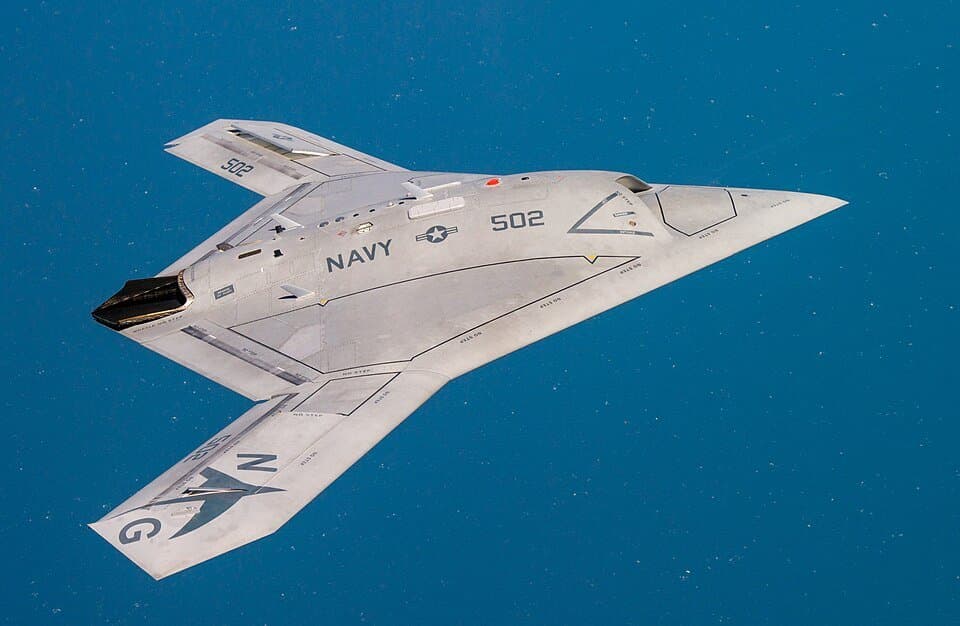
Drones & UAVsIn service
Unmanned combat aerial vehicle Technology demonstrator
Northrop Grumman X-47B is a unmanned combat aerial vehicle Technology demonstrator originating in United States. It was built by Northrop Grumman.
 United States
Technical data
Unmanned combat aerial vehicle Technology demonstrator
United States
Northrop Grumman
Active
United States Navy
2
4 February 2011
Northrop Grumman X-47A Pegasus
None aboard (semi-autonomous operation)
38 ft 2 in (11.63 m)
62.1 ft (18.9 m) extended; 30.9 ft (9.4 m) folded
10 ft 5 in (3.10 m)
953.6 sq ft (88.59 m 2 )
28,837 lb (13,080 kg) zero fuel weight
44,501 lb (20,185 kg)
1 × Pratt & Whitney F100-220U turbofan
2,400 mi (3,900 km, 2,100 nmi)
42,000 ft (12,800 m)
Mach 0.9+ / 690 mph (high subsonic)
The Northrop Grumman X-47B is a demonstration unmanned combat aerial vehicle (UCAV) designed for aircraft carrier -based operations.
The X-47B prototype rolled out from United States Air Force Plant 42 in Palmdale, California , on 16 December 2008.
On 26 November 2012, the X-47B began its carrier-based evaluation aboard the USS Harry S. Truman (CVN-75) at Naval Station Norfolk , Virginia. On 18 December 2012, the X-47B completed its first at-sea test phase; it was remarked to have performed "outstandingly", having proved compatible with the flight deck , hangar bays, and communication systems of an aircraft carrier. With deck testing completed, the X-47B returned to NAS Patuxent River for further tests. On 4 May 2013, it successfully performed an arrested landing on a simulated carrier deck at Patuxent River. The X-47B launched from the USS George H.W. Bush (CVN-77) on 14 May 2013 in the Atlantic Ocean , marking the first time that a UAV was catapulted off an aircraft carrier. On 17 May 2013, another first was achieved when it performed touch-and-go landings and take-offs from George H.W. Bush while underway.
After 24 minutes, the X-47B landed on the flight deck and taxied away to give the Hornet room to land.
It met its objective of performing launches and recoveries at 90-second intervals with manned Hornets.
After the USAF made plans for a next generation bomber following the 2006 Quadrennial Defense Review, Northrop Grumman proposed a variety of derivatives based on the X-47B, informally called "X-47C" by the company. One iteration was a bomber to have a payload of 10,000 pounds (4,500 kg) of bombs, significantly exceeding that of the X-47A. Although Northrop Grumman estimated that the X-47C could enter service in 2018, the NGB program was shelved in 2010.
Original proof-of-concept prototype with a 27.8-foot (8.5 m) wingspan, first flown in 2003.
Demonstrator aircraft with a 62-foot (19 m) wingspan, first flown in 2011.
Length: 38 ft 2 in (11.63 m)
Wingspan: 62.1 ft (18.9 m) extended; 30.9 ft (9.4 m) folded
Height: 10 ft 5 in (3.10 m)
Wing area: 953.6 sq ft (88.59 m 2 )
Empty weight: 28,837 lb (13,080 kg) zero fuel weight
Max takeoff weight: 44,501 lb (20,185 kg)
Range: 2,400 mi (3,900 km, 2,100 nmi)
Service ceiling: 42,000 ft (12,800 m)
Cruise speed: Mach 0.9+ / 690 mph (high subsonic)
2 weapon bays, providing for up to 4,500 lb (2,000 kg) of ordnance
Długotrwałość lotu >6 h
Reference text from Wikipedia contributors, used under CC BY-SA 4.0.
True scale
Sourced dimensions beside a 1.75 m human reference.
Points represent sourced observations, including revisions. Revisions on the same effective date are not separate inventory events. Ranges appear in the table and are not plotted as exact points.
| Observation / report period | Value | Source | Claim state |
|---|---|---|---|
| 14 Oct 2026 | 6 h | Wikipedia contributors | approved |
Country inventory links have not yet been documented for this equipment.
Keep exploring
Unmanned combat aerial vehicle
 SerbiaCompare with Northrop Grumman X-47B
Unmanned combat aerial vehicle
 IranCompare with Northrop Grumman X-47B
Unmanned combat aerial vehicle
IranUnmanned combat aerial vehicle
Compare with Northrop Grumman X-47BUnmanned combat aerial vehicle
Unmanned combat aerial vehicle
 United Arab Emirates