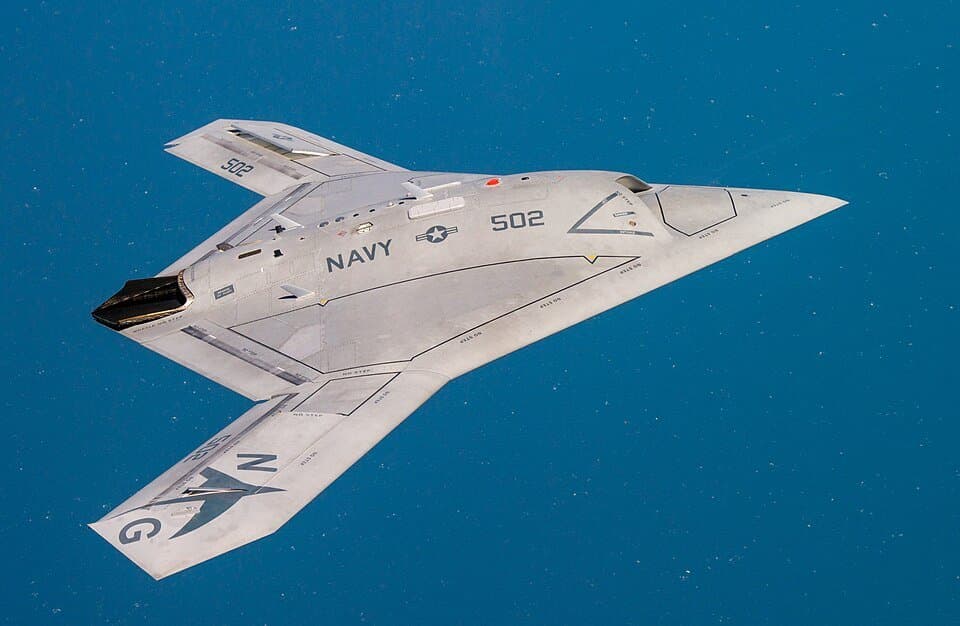

Credit
US Navy · Public domain · Resized · Public domain · Source ↗ · Modified


Preparing your view.

At a glance
Measured figures
X-47B · Length
Single source38 ft 2 in (11.63 m)[source]
Length
Single sourceConfiguration
| Specification | Northrop Grumman X-47B | Pegaz |
|---|---|---|
| Crew | None aboard (semi-autonomous operation)[source] | — |
| Type | Unmanned combat aerial vehicle Technology demonstrator[source] | Unmanned combat aerial vehicle[source] |
| National origin | United States[source] | Serbia[source] |
| Manufacturer | Northrop Grumman[source] | Utva Aviation Industry[source] |
5.395 m (17 ft 8 in)[source]
Bars compare reported quantities only. A larger figure does not make a system better; configurations and test conditions differ.
| Status | Active[source] | In service[source] |
|---|
| Primary user | United States Navy[source] | Serbian Air Force and Air Defence[source] |
|---|
| Number built | 12+[source] |
|---|
| First flight | 4 February 2011[source] | 2011[source] |
|---|
| Developed from | Northrop Grumman X-47A Pegasus[source] | — |
|---|
| Powerplant | 1 × Pratt & Whitney F100-220U turbofan[source] | — |
|---|
| Role | demonstration unmanned combat aerial vehicle (UCAV)[source] | Serbian -produced unmanned combat aerial vehicle ,[source] |
|---|
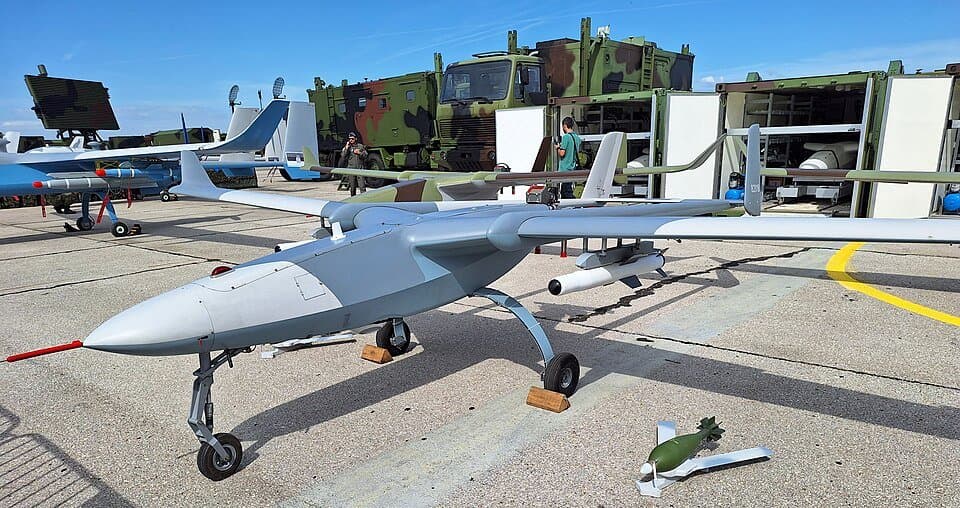
| Source measurement | The X-47B prototype rolled out from United States Air Force Plant 42 in Palmdale, California , on 16 December 2008.[source]Northrop Grumman X-47B · Design and development / Origins; only the objects and conditions stated in this passage On 26 November 2012, the X-47B began its carrier-based evaluation aboard the USS Harry S. Truman (CVN-75) at Naval Station Norfolk , Virginia. On 18 December 2012, the X-47B completed its first at-sea test phase; it was remarked to have performed "outstandingly", having proved compatible with the flight deck , hangar bays, and communication systems of an aircraft carrier. With deck testing completed, the X-47B returned to NAS Patuxent River for further tests. On 4 May 2013, it successfully performed an arrested landing on a simulated carrier deck at Patuxent River. The X-47B launched from the USS George H.W. Bush (CVN-77) on 14 May 2013 in the Atlantic Ocean , marking the first time that a UAV was catapulted off an aircraft carrier. On 17 May 2013, another first was achieved when it performed touch-and-go landings and take-offs from George H.W. Bush while underway.[source]Northrop Grumman X-47B · Design and development / Flight testing; only the objects and conditions stated in this passage After 24 minutes, the X-47B landed on the flight deck and taxied away to give the Hornet room to land.[source]Northrop Grumman X-47B · Design and development / Flight testing; only the objects and conditions stated in this passage It met its objective of performing launches and recoveries at 90-second intervals with manned Hornets.[source]Northrop Grumman X-47B · Design and development / Flight testing; only the objects and conditions stated in this passage After the USAF made plans for a next generation bomber following the 2006 Quadrennial Defense Review, Northrop Grumman proposed a variety of derivatives based on the X-47B, informally called "X-47C" by the company. One iteration was a bomber to have a payload of 10,000 pounds (4,500 kg) of bombs, significantly exceeding that of the X-47A. Although Northrop Grumman estimated that the X-47C could enter service in 2018, the NGB program was shelved in 2010.[source]Northrop Grumman X-47B · Derivative development; only the objects and conditions stated in this passage Original proof-of-concept prototype with a 27.8-foot (8.5 m) wingspan, first flown in 2003.[source]Northrop Grumman X-47B · Variants; only the objects and conditions stated in this passage Demonstrator aircraft with a 62-foot (19 m) wingspan, first flown in 2011.[source]Northrop Grumman X-47B · Variants; only the objects and conditions stated in this passage Length: 38 ft 2 in (11.63 m)[source]Northrop Grumman X-47B · Specifications (X-47B); only the objects and conditions stated in this passage Wingspan: 62.1 ft (18.9 m) extended; 30.9 ft (9.4 m) folded[source]Northrop Grumman X-47B · Specifications (X-47B); only the objects and conditions stated in this passage Height: 10 ft 5 in (3.10 m)[source]Northrop Grumman X-47B · Specifications (X-47B); only the objects and conditions stated in this passage Wing area: 953.6 sq ft (88.59 m 2 )[source]Northrop Grumman X-47B · Specifications (X-47B); only the objects and conditions stated in this passage Empty weight: 28,837 lb (13,080 kg) zero fuel weight[source]Northrop Grumman X-47B · Specifications (X-47B); only the objects and conditions stated in this passage Max takeoff weight: 44,501 lb (20,185 kg)[source]Northrop Grumman X-47B · Specifications (X-47B); only the objects and conditions stated in this passage Range: 2,400 mi (3,900 km, 2,100 nmi)[source]Northrop Grumman X-47B · Specifications (X-47B); only the objects and conditions stated in this passage Service ceiling: 42,000 ft (12,800 m)[source]Northrop Grumman X-47B · Specifications (X-47B); only the objects and conditions stated in this passage Cruise speed: Mach 0.9+ / 690 mph (high subsonic)[source]Northrop Grumman X-47B · Specifications (X-47B); only the objects and conditions stated in this passage 2 weapon bays, providing for up to 4,500 lb (2,000 kg) of ordnance[source]Northrop Grumman X-47B · Specifications (X-47B); only the objects and conditions stated in this passage | Capacity: 50 kg (110 lb) payload[source]Pegaz · Specifications; only the objects and conditions stated in this passage Length: 5.395 m (17 ft 8 in)[source]Pegaz · Specifications; only the objects and conditions stated in this passage Wingspan: 7.025 m (23 ft 1 in)[source]Pegaz · Specifications; only the objects and conditions stated in this passage Height: 1.6 m (5 ft 3 in)[source]Pegaz · Specifications; only the objects and conditions stated in this passage Wing area: 4.24 m 2 (45.6 sq ft)[source]Pegaz · Specifications; only the objects and conditions stated in this passage Empty weight: 120 kg (265 lb)[source]Pegaz · Specifications; only the objects and conditions stated in this passage Max takeoff weight: 245 kg (540 lb)[source]Pegaz · Specifications; only the objects and conditions stated in this passage Maximum speed: 160–180 km/h (99–112 mph, 86–97 kn) |
|---|
| Designer | — | Military Technical Institute[source] |
|---|
| Manufactured | — | 2011–present[source] |
|---|
| Introduction date | — | 2025[source] |
|---|
| Capacity | — | 50 kg (110 lb) payload[source] |
|---|
| Propellers | — | 2-bladed pusher propeller[source] |
|---|
| Rockets | — | 2 × FT-8D laser guided rocket[source] |
|---|
| Engine | — | internal combustion engine[source]Pegaz own named aircraft paragraph; SM-2, CH-95, CH-92, Vrabac and Shadow systems elsewhere on page explicitly excluded |
|---|
| Reported operators | — |
|---|
Cruise speed: 130–150 km/h (81–93 mph, 70–81 kn)[source]Pegaz · Specifications; only the objects and conditions stated in this passage
Range: 250 km (160 mi, 130 nmi) exact maximum range is yet unknown[source]Pegaz · Specifications; only the objects and conditions stated in this passage
Endurance: 6 to 10 hours[source]Pegaz · Specifications; only the objects and conditions stated in this passage
Service ceiling: 6,000 m (20,000 ft)[source]Pegaz · Specifications; only the objects and conditions stated in this passage