FORCETALLY
Loading the evidence…
Preparing your view.


Preparing your view.
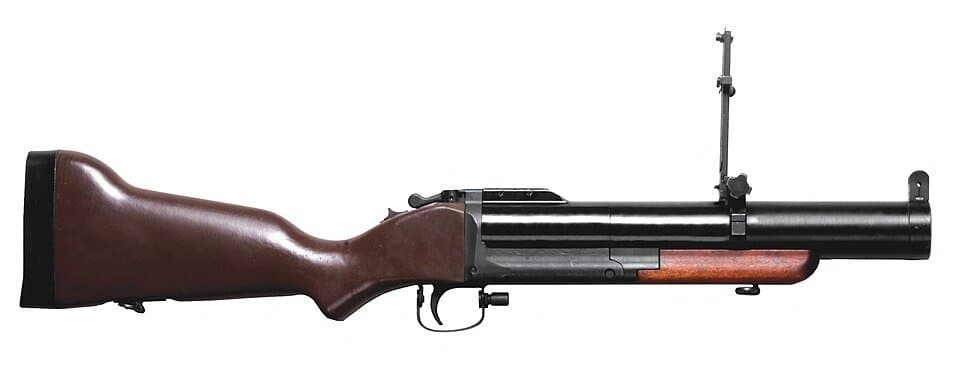
Small armsIn service
Grenade launcher
M79 grenade launcher is a grenade launcher originating in United States. It was built by Springfield Armory , Action Manufacturing Company , Kanarr Corporation , and Thompson-Ramo-Wooldridge. Reported operators include Australia, Brazil, Cambodia, Chad, China, Colombia, Costa Rica, Dominican Republic, El Salvador, Eritrea, Ethiopia, Fiji, Greece, Guatemala, Haiti, Honduras, Indonesia, Iran, Ireland, Israel, Jamaica, Jordan, Kenya, Iraq, Iraqi Kurdistan, Laos, Lebanon, Malaysia, Myanmar, New Zealand, Nicaragua, Niger, Oman, Paraguay, Panama, Philippines, Portugal, Saint Vincent and the Grenadines, Saudi Arabia, Somalia, South Africa, South Korea, Spain, Taiwan, Thailand, Türkiye, United Kingdom, United States, Vietnam, Yemen.
 United States
M79 grenade launcher
US Air Force from USA · Public domain · Resized · Public domain · Source ↗ · ModifiedTechnical data
Grenade launcher
United States
1961–present
See Users
Vietnam War Cambodian Civil War Laotian Civil War Communist insurgency in Thailand Dominican Civil War Communist Insurgency War The Troubles Operation Marajoara Lebanese Civil War South African Border War Sino-Vietnamese War Salvadoran Civil War Falklands War Bougainville conflict War in Afghanistan (2001–2021) Iraq War Gulf War Desert Storm Sistan and Baluchestan insurgency 2008–2011 Cambodia–Thailand border crisis 2010 Burma border clashes Syrian Civil War Battle of Marawi Myanmar Civil War
Springfield Armory
1953–1960
Springfield Armory , Action Manufacturing Company , Kanarr Corporation , and Thompson-Ramo-Wooldridge
1961–1971 (U.S.)
True scale
Sourced dimensions beside a 1.75 m human reference.
See it in your room. Scan with your phone to open this model in 3D, then place it in your space.
Points represent sourced observations, including revisions. Revisions on the same effective date are not separate inventory events. Ranges appear in the table and are not plotted as exact points.
| Observation / report period | Value | Source | Claim state |
|---|---|---|---|
| 28 Sept 2026 | 0.3556 m | Wikipedia contributors | superseded |
| 28 Sept 2026 | 0.3556 m | Wikipedia contributors | superseded |
| 28 Sept 2026 | 0.3556 m | Wikipedia contributors | superseded |
| 28 Sept 2026 | 0.3556 m | Wikipedia contributors | superseded |
| 28 Sept 2026 | 0.3556 m | Wikipedia contributors | superseded |
| 28 Sept 2026 | 0.3556 m | Wikipedia contributors | superseded |
| 28 Sept 2026 | 0.3556 m | Wikipedia contributors | approved |
350,000 (U.S. only)
2.93 kg (6.45 lb) loaded 2.7 kg (5.95 lb) empty
73.1 cm (28.78 in)
35.56 cm (14 in)
40×46mm grenade
Break-action
Depends on the speed of the operator
76 m/s (247 ft/s)
350 m (383 yd)
400 m (437 yd)
Breech-loaded
Blade and leaf type
Australia
Brazil : Used by the Brazilian Army .
Cambodia
Chad
China : Grenade launcher captured and used in Sino-Vietnamese War and Sino-Vietnamese conflicts
Colombia
Costa Rica
Dominican Republic : Used by the Dominican Army .
El Salvador
Eritrea
Ethiopia
Fiji
Greece
Guatemala
Haiti
Honduras
Indonesia
Iran
Ireland
Israel
Jamaica : Jamaica Defence Force .
Jordan
Kenya
Iraq Iraqi Kurdistan – Peshmerga
Iraqi Kurdistan – Peshmerga
Laos
Lebanon
Malaysia
Myanmar
New Zealand
Nicaragua
Niger
Oman
Paraguay
Panama : Panama Defense Force
Philippines
Portugal
Saint Vincent and the Grenadines
Saudi Arabia
Somalia
South Africa : Used by 32 Battalion operators.
South Korea : Manufactured by S&T Daewoo under license as KM79.
Spain
Taiwan
Thailand
Turkey
United Kingdom : Introduced during the 1960s, but was not widely distributed. Was available as late as the autumn of 1995.
United States
Vietnam : Locally produced (at Factory Z125) as M79-VN , with plum-red synthetic stock and optical sight . Industrial name is SPL40 .
Yemen
The M79 grenade launcher is a single-shot , shoulder-fired, break-action grenade launcher that fires a 40×46mm grenade , which uses what the US Army calls the High-Low Propulsion System to keep recoil forces low, and first appeared during the Vietnam War .
The M79 grenade launcher is a single-shot , shoulder-fired, break-action grenade launcher that fires a 40×46mm grenade , which uses what the US Army calls the High-Low Propulsion System to keep recoil forces low, and first appeared during the Vietnam War . Its distinctive report has earned it colorful nicknames such as "Thumper," "Thump-Gun," "Bloop Tube," "Big Ed," "Elephant Gun," and "Blooper" among American soldiers as well as "Can Cannon" in reference to the grenade size; Australian units referred to it as the "Wombat Gun", while British soldiers adopted the "Elephant Gun" moniker. The M79 can fire a wide variety of 40 mm rounds including explosive, anti-personnel , smoke , buckshot , flechette (pointed steel projectiles with a vaned tail for stable flight), and illumination. While largely replaced by the M203 , the M79 has remained in service in many units worldwide in niche roles.
The M79 was a result of the US Army 's Project Niblick , an attempt to increase firepower for the infantryman by having an explosive projectile more accurate with further range than rifle grenades , but more portable than a mortar . Project Niblick created the 40 x 46 mm grenade, but was unable to create a satisfactory launcher for it that could fire more than a single shot. One of the launchers at Springfield Armory was the three-shot "harmonica" T148 (not to be confused with the later, underbarrel XM148 ), which did see some limited production and fielding in Vietnam, but problems with the three-round magazine prevented widespread acceptance. The other design was a single-shot break-open, shoulder-fired weapon, the S-3. This was refined into the S-5, which resembled an oversized single-barrel shotgun. Unable to solve the problems with the multi-shot T148 launcher, the Army adopted the S-5 as the XM79. With a new sight, the XM79 was officially adopted as the M79 on December 15, 1960.
However, its single-shot nature was a serious drawback. Reloading after every shot meant a slow rate of fire and an inability to keep up a constant volume of fire during a firefight. This led the Navy to develop the China Lake Grenade Launcher , which was produced for deployed SEAL Teams. For close-in situations, the minimum arming range (the round travels 30 meters to arm itself) and the blast radius meant a grenadier had to use his .45 ACP (11.43 mm) M1911 pistol, or fire and hope that the grenade acted as a giant slow bullet. Special grenades for close-in fighting were created to compensate, though a soldier was not always able to load one in the heat of battle. Moreover, the size and weight of both the M79 and its ammunition meant that a grenadier armed with this weapon could not also carry a rifle, having only a sidearm to use in a firefight after expending his rounds. Some grenadiers did choose to carry a slung M16 rifle in lieu of a sidearm.
Some US Navy SEALs and Army Special Forces in Iraq were seen using the M79 due to its greater accuracy and range compared to the M203 (350 meters effective versus 150 meters effective). The M79 saw notable limited use during Operation Iraqi Freedom , such as for clearing IEDs . The grenade launcher also sees continued use as a mission-specific tool with Special warfare combatant-craft crewmen .
Visually, the M79 grenade launcher resembles a large bore, break-action, sawed-off shotgun , and is simple in design, having only five major parts: a receiver group, a fore-end assembly, a barrel group, a sight assembly, and a stock. The fore-end assembly beds the barrel to the receiver. The stock is made out of wood or fiberglass. A rubber pad affixed to the buttstock absorbs some recoil. The front sight is a fixed blade. The rear sight on the M79 is a folding ladder–style leaf sight. When folded, the leaf sight acts as a fixed sight at close range. A grenadier may simply point and shoot with high accuracy. When unfolded, the leaf sight can be adjusted for ranges from 75 to 375 meters, in 25-meter increments. Additionally, Appendix A of the U.S. Army field manual for the M203 includes instructions on attaching the M16 rifle grenade sight to the M79's stock and marking the sling for indirect fire at elevations greater than 40°.
The M406 40 mm HE (high explosive) grenades fired from the M79 travel at a muzzle velocity of 75 meters per second. The M406 contained enough explosive to produce over 300 fragments that travel at 1,524 meters per second within a lethal radius of 5 meters. This round incorporated a spin-activation safety feature which prevents the grenade from arming while still within range of the shooter; it armed itself after traveling a distance of about 14–27 meters. The round would not arm at point blank ranges and it usually did not have enough kinetic energy to kill, although it sometimes penetrated the abdomen or caused large hematomas.
M79 grenade launcher United States Grenade launcher 40 mm M79 unknown
Reference text from Wikipedia contributors, used under CC BY-SA 4.0.
M79 grenade launcher equipment records. Variants, orders and quantities are shown as reported in each inventory source; coverage is incomplete.
 Australia
 Bolivia
 Brazil
 Cambodia
 Chad
 China
 Colombia
 Costa Rica
 Dominican Republic
 Egypt
 El Salvador
 Eritrea
 Ethiopia
 Fiji
 Greece
 Guatemala
 Haiti
 Honduras
 Indonesia
 Iran
 Iraq
 Ireland
 Israel
 Jamaica
 Jordan
 Kenya
 Laos
 Lebanon
 Malaysia
 Myanmar
 New Zealand
 Nicaragua
 Niger
 Oman
 Panama
 Paraguay
 Philippines
 Portugal
 Saint Vincent and the Grenadines
 Saudi Arabia
 Somalia
 South Africa
 South Korea
 Spain
 Taiwan
 Thailand
 Türkiye
 United Kingdom United States
 Vietnam
 Yemen
Australia, Brazil, Cambodia, Chad, China, Colombia, Costa Rica, Dominican Republic, El Salvador, Eritrea, Ethiopia, Fiji, Greece, Guatemala, Haiti, Honduras, Indonesia, Iran, Ireland, Israel, Jamaica, Jordan, Kenya, Iraq, Iraqi Kurdistan, Laos, Lebanon, Malaysia, Myanmar, New Zealand, Nicaragua, Niger, Oman, Paraguay, Panama, Philippines, Portugal, Saint Vincent and the Grenadines, Saudi Arabia, Somalia, South Africa, South Korea, Spain, Taiwan, Thailand, Türkiye, United Kingdom, United States, Vietnam, Yemen
Equipment reference ↗ Switzerland
 Singapore
 India