FORCETALLY
Loading the evidence…
Preparing your view.


Preparing your view.
Small armsIn service
Assault rifle Carbine
M4 carbine is a assault rifle Carbine originating in United States. It was built by Colt's Manufacturing Company FN Herstal Remington Arms. Reported operators include Afghanistan, Albania, Antigua and Barbuda, Argentina, Australia, Azerbaijan, Bahamas, Bahrain, Belize, Bosnia & Herzegovina, Bolivia, Brazil, Croatia, Czech Republic, China, Colombia, Costa Rica, Dominican Republic, East Timor, Ecuador, Egypt, El Salvador, France, Georgia, Ghana, Greece, Guatemala, Hungary, India, Indonesia, Iraq, Kurdistan Region, Israel, Italy, Jamaica, Japan, Jordan, Kenya, Kosovo, Kuwait, Lebanon, Malaysia, Morocco, Nepal, New Zealand, North Macedonia, Oman, Pakistan, Palestine, Palestinian Authority, Hamas, Panama, Peru, Philippines, Poland, Romania, Russia, Senegal, Serbia, Singapore, Slovakia, Sweden, Taiwan, Thailand, Tonga, Tunisia, Türkiye, Uganda, Ukraine, United Arab Emirates, United States, Uruguay, Yemen.
 United States
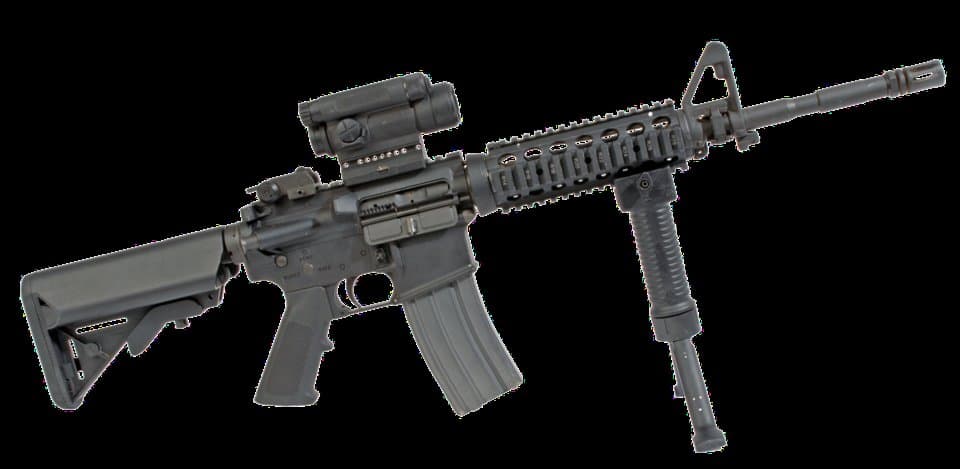
M4 carbine
Photo Courtesy of PEO Soldier · Public domain · Resized · Public domain · Source ↗ · ModifiedTechnical data
Assault rifle Carbine
United States
1994–present
See Users
See Conflicts
1982–1993
Colt's Manufacturing Company FN Herstal Remington Arms
$700 (avg. cost) in 2012 $647 per unit in 2015
1987–present
500,000 (as of 2021)
See Variants
6.43 lb (2.92 kg) empty 7.75 lb (3.52 kg) with 30 rounds loaded magazine and sling
True scale
Sourced dimensions beside a 1.75 m human reference.
See it in your room. Scan with your phone to open this model in 3D, then place it in your space.
Points represent sourced observations, including revisions. Revisions on the same effective date are not separate inventory events. Ranges appear in the table and are not plotted as exact points.
| Observation / report period | Value | Source | Claim state |
|---|---|---|---|
| 28 Sept 2026 | 0.368 m | Wikipedia contributors | superseded |
33 in (838 mm) ( stock extended) 29.75 in (756 mm) (stock retracted)
14.5 in (368 mm)
5.56×45mm NATO
Gas-operated , closed rotating bolt , Stoner bolt and carrier piston
700–970 rounds/min cyclic
2,970 ft/s (910 m/s) ( M855A1 round) 2,887 ft/s (880 m/s) (M855 round) 2,986 ft/s (910 m/s) (M193 round)
500 m (550 yd) (individual/point targets) 600 m (660 yd) (area targets)
3,600 m (3,900 yd)
30-round detachable STANAG magazine
Iron sights or various optics
Afghanistan : Former Afghan National Army commando stocks in use by the Taliban .
Albania : Used by Albanian Land Force 2015.
Antigua and Barbuda : M4/M4A1s announced to be sold via FMS program in 2017.
Argentina : Used by Argentine Army , Argentine Navy and Argentine National Gendarmerie
Australia : M4A1 (designated M4A5 ), used by Special Operations Command , Clearance Divers , and Police Tactical Groups .
Azerbaijan : M4 carbine used by the special military units and State Border Service (DSX).
Bahamas : M4 carbine used by Royal Bahamas Defence Force and seen in hands of RBDF soldiers during joint-exercise with Americans.
Bahrain : M4A1s sold as a 2008 Foreign Military Sales package. More M4/M4A1s announced to be sold via FMS program in 2017.
Belize : M4s/M4A1s sold as part of a 2006 Foreign Military Sales package. More M4/M4A1s announced to be sold via FMS program in 2017.
Bosnia & Herzegovina : M4A1s used by the military and air guard units.
Bolivia : M4s used by UMOPAR and GTIDE units of the Policia Nacional . M4A1 in use with rangers.
Brazil : Used by Civil Police , Military Police of Espirito Santo State , Military Police of Rio de Janeiro State , the Brazilian Federal Police and Special Forces of the Brazilian Army , Brazilian Navy .
Croatia : User since 2003, several hundred purchased for Croatian ISF contingent as well as Special Forces .
Czech Republic : Bushmaster M4A3 B.M.A.S., Daniel Defense M4A1 and MK18 is used by (601st Special forces group, Military police, 43rd Airborne mechanized battalion) of Czech Army .
China : A variant is made by Norinco as the Norinco CQ . CQ-A carbine variant used by the Sichuan Police Department, Chongqing SWAT teams, and the Snow Leopard Commando Unit .
Colombia : M4A1s as part of a 2008 Foreign Military Sales. More M4/M4A1s announced to be sold via FMS program in 2017.
Costa Rica
Dominican Republic
East Timor
Ecuador : M4s sold as a 2008 Foreign Military Sales package.
Egypt
El Salvador : M4s sold as part of a 2007 Foreign Military Sales package. Additional M4s sold as a 2008 Foreign Military Sales package.
France : Used by the 1er RPIMa
Georgia : Bushmaster M4s being replaced by Colt M4s for the military. More M4/M4A1s announced to be sold via FMS program in 2017. Joint Georgian-Israeli production M4 based "GI-4" launched in 2021.
Ghana
Greece : M16A2s and M4s are used by the "Special Forces" branch as well as by the airborne battalions of the Hellenic Army.
Guatemala : Took deliveries of 2000 M4A1 carbines as 48 years old arms freeze finally lifted.
Hungary : M4A1 SOPMOD by Hungarian MH 34th Bercsényi László special operation battalion More M4/M4A1s announced to be sold via FMS program in 2017.
India : M4A1s as part of a 2008 Foreign Military Sales. M4A1 is used by the Mizoram Armed Police , PARA SF and Force One of the Mumbai Police .
Indonesia : Used by Detachment 88 Counter-terrorism Police Squad operators. Also used by Komando Pasukan Katak (Kopaska) tactical diver group and Komando Pasukan Khusus (Kopassus) special forces group.
Iraq : Used by the Iraqi Army . Main weapon of the Iraqi National Counter-Terrorism Force . More M4/M4A1s announced to be sold via FMS program in 2017. Kurdistan Region : Used by Peshmerga .
Kurdistan Region : Used by Peshmerga .
Israel : Sold as part of a January 2001 Foreign Military Sales package to Israel. Standard issue in the Israel Defense Forces , but it has been gradually replaced with the IWI Tavor since 2001.
Italy : Used by the Special Forces
Jamaica : M4s sold as part of a 2007 Foreign Military Sales package.
Japan : M4A1s as part of a 2008 Foreign Military Sales package. M4A1 SOPMOD rifles are in use by the Japanese Special Forces Group , but is supposedly denied by the JGSDF after Ishiba was arrested for violating American export laws.
Jordan : M4s sold as part of a 2007 Foreign Military Sales package. Additional M4s sold as a 2008 Foreign Military Sales package. More M4/M4A1s announced to be sold via FMS program in 2017.
Kenya : Used by Kenyan troops Kenya Defence Forces in AMISOM ops.
Kosovo
Kuwait
Lebanon : M4 components being sold to Lebanese special forces . M4/M4A1s sold as a 2008 Foreign Military Sales package. More M4/M4A1s announced to be sold via FMS program in 2017.
Malaysia : Made under license by SME Ordnance Sdn Bhd. Used by military and police special forces.
Morocco
Nepal : 1,070 M4s, sold as part of a 2005 Foreign Military Sales package.
New Zealand : Used by NZSAS operators and standard issue to New Zealand Police including Special Tactics Group and Armed Offenders Squad units.
North Macedonia : Used by the Army of North Macedonia
Oman : M4/M4A1s announced to be sold via FMS program in 2017.
Pakistan : M4A1 variant used by the Special Forces of the Pakistani military besides the POF G3P4 standard rifle for the Pakistani military— also used by the Special Security Unit (SSU) of the Sindh Police . More M4/M4A1s announced to be sold via FMS program in 2017.
Palestine Palestinian Authority : Used by Palestinian security forces. Hamas : Used by Hamas militants both in the Gaza Strip and in areas that are under control of the Palestinian Authority .
Palestinian Authority : Used by Palestinian security forces.
Hamas : Used by Hamas militants both in the Gaza Strip and in areas that are under control of the Palestinian Authority .
Panama : M4A1s sold as a 2008 Foreign Military Sales package. More M4/M4A1s announced to be sold via FMS program in 2017.
Peru : Airforce Special Group and anti-narcotics units
Philippines : Colt M4/M4A1s sold as a 2008 Foreign Military Sales package. 63,000 R4A3 rifles from Remington Arms for the Philippine Army and the Philippine Marine Corps . Several units also used by the Defense Intelligence and Security Group.
Poland : Used by Wojska Specjalne military unit JW Grom .
Romania : M4/M4A1s announced to be sold via FMS program in 2017.
Russia : Used in limited quantities by FSB Alpha and spotted in hands of RuAF in a training exercise.
Senegal : M4/M4A1s announced to be sold via FMS program in 2017. 2,200 M4s sold through FMS program in 2019.
Serbia : Used by Gendarmery and Special Anti-Terrorist Unit .
Singapore : Used by the Commandos and the Police Coast Guard (only the Port Squadron and the Coastal Patrol Squadron) of the Singapore Police Force .
Slovakia : M4/M4A1s announced to be procured via FMS program in 2017.
Sweden : 15,000 M4A1s purchased directly from US Army stocks in 2024 to act as interim service weapons while awaiting full delivery of the new Automatkarbin 24
Taiwan : Used by Republic of China Army , Republic of China Marine Corps and National Police Agency The First Security Battalion, Air Defense and Base Guard Group are equipped with M4A1 carbines.
Thailand : M4A1s sold as part of a 2006 Foreign Military Sales package.
Tonga : M4/M4A1s sold as a 2008 Foreign Military Sales package.
Tunisia : Used by the Tunisian Army's Special Forces Group (GFS), 51st Infantry Navy Commandos Regiment, Presidential Guard and various National Guard and Police special forces units. Used by the Unité Spéciale – Garde Nationale .
Turkey : Produced under license by Sarsılmaz Firearms . M4A1 carbines used by Underwater Offence .
Uganda : Used by Ugandan troops in AMISOM ops.
Ukraine : Used by special forces and many other ground units.
United Arab Emirates : Purchased 2,500 M4 carbines in 1993.
United States
Uruguay : Colt M4 and Bushmaster M4 carbines for Special Operation Group (Metropolitan Police)
Yemen : M4s sold as part of a 2006 Foreign Military Sales package.
The M4 carbine (officially Carbine, Caliber 5.56 mm, M4 ) is an assault rifle developed in the United States during the 1980s.
The M4 carbine (officially Carbine, Caliber 5.56 mm, M4 ) is an assault rifle developed in the United States during the 1980s. It is a shortened version of the M16A2 assault rifle. The M4 is extensively used by the U.S. military , which decided to largely replace the M16 rifle in U.S. Army (starting 2010) and U.S. Marine Corps (starting 2016) combat units as the primary infantry service rifle . The M4 has been adopted by over 60 countries, and has been described as "one of the defining firearms of the 21st century".
The M4 carbine (officially Carbine, Caliber 5.56 mm, M4 ) is an assault rifle developed in the United States during the 1980s.
Following the military adoption of the Armalite AR-15 as the M16 rifle , carbine variants were also adopted for CQC operations, the first of which was the CAR-15 family of weapons, which was used in the Vietnam War . However, these rifles had design issues, as the barrel length was halved to 10 inches (25 cm), which upset the ballistics , reducing its range and accuracy and leading to considerable muzzle flash and blast, meaning that a large flash suppressor had to be fitted.
In 1983, the 9th Infantry Division requested a Quick Reaction Program (QRP) for a 5.56mm carbine to replace the M1 carbine and M3 submachine gun in service.
Later, the gun was updated with improved furniture and a barrel with rifling of 1 turn in 7 inches (180 mm).
The ARDC recommended additional commonality with the M16A2 rifle, as well as lengthening the barrel to 14.5 inches (370 mm).
In June 1985, the Picatinny Arsenal was given a contract to produce 40 prototypes of the XM4. Initially a joint program between the Army and Marines, the Army withdrew its funding in 1986. The XM4 was finished in 1987, and the Marines adopted 892 for that fiscal year , with the designation "carbine, 5.56mm, M4". Owing to experience from the 1991 Gulf War , the Army gave Colt its first production contracts for M4 carbines in May and July 1993, and M4A1 carbines for United States Special Operations Command (SOCOM) operators in February 1994.
Interest in the M4 carbine was accelerated after the Battle of Mogadishu (1993) , in which Rangers complained that their M16 rifles were "unwieldy", whereas members of Delta Force in the same battle, equipped with the CAR-15, had no such complaints. The M4 carbine first saw action in the hands of U.S. troops deployed to Kosovo in 1999 in support of the NATO -led Kosovo Force . It was subsequently used heavily by U.S. forces during the war on terror , including in Operation Enduring Freedom and the Iraq War . In the Army, the M4 had largely replaced M16A2s as the primary weapon of forward-deployed personnel by 2005. The M4 carbine also replaced most submachine guns and selected handguns in U.S. military service, as it fires more effective rifle ammunition that offers superior stopping power and is better able to penetrate modern body armor .
The M4–M4A1 conversion increases weapon weight from 7.46 lb (3.38 kg) to 7.74 lb (3.51 kg), counting a backup iron sight, forward pistol grip, empty magazine, and sling.
The program aimed to replace the M4 Carbine and the M249 SAW with weapons that would compensate for their perceived deficiencies when fighting at longer ranges, as well as addressing concerns about the effectiveness of traditional 5.56×45mm ammunition against troops wearing body armor in a future peer or near-peer conflict.
Textron submitted a cased-telescoped (CT) ammunition-firing rifle for the program; FN Herstal submitted their HAMR IAR re-chambered in 6.8mm caliber; PCP Tactical submitted a modified Desert Tech MDRx ; SIG Sauer submitted a redesigned MCX variant known as the MCX-SPEAR.
The M4, and its variants, is a lightweight 5.56×45mm NATO (and .223 Remington ) caliber, gas-operated, magazine-fed, air-cooled selective fire AR-15-pattern firearm .
The receiver is made of forged 7075-T6 aluminum, while the 14.5 in (368 mm) barrel, bolt, bolt carrier, and fire control group are made of steel; these components can be easily serviced and replaced by unit armories, enabling the addition of enhanced components and thus making the platform readily upgradable.
The M4 is a shorter and lighter variant of the M16A2 rifle, sharing much of the same operation mechanisms and has 80% parts commonality; the chief differences are a shorter barrel of 14.5 inches rather than 20 inches as well as a shortened receiver extension and buffer.
The M4's maneuverability makes it beneficial for non-infantry troops (vehicle crews, clerks and staff officers), as well as for close-quarters battle . The M4, along with the M16A4, has mostly replaced the M16A2 in the Army and Marines. The U.S. Air Force , for example, has transitioned completely to the M4 for Security Forces squadrons, while other armed personnel retain the M16A2. The U.S. Navy uses M4A1s for Special Operations and vehicle crews. However, the M4's shorter barrel reduces its range, with its rear iron sights integrated in the (removable) carry handle only adjustable from 300 m (328 yd) up to 600 m (656 yd), compared to the M16A2 rear iron sights integrated in the fixed carry handle, which can reach up to 800 m (875 yd).
In 2002, the Block II modification kit was adopted featuring two new upper receivers: the Special Purpose Receiver (SPR) with a 16 or 18 in (406 or 457 mm) barrel and Close Quarter Battle Receiver (CQBR) with a 10.3 in (262 mm) barrel. M4A1s fitted with the SPR were designated by the Navy as the Mk 12 Special Purpose Rifle , a type of designated marksman rifle . M4A1s with the CQBR were designated the Mk 18 Mod 0. The Block II program then focused on component improvements to the M4A1, with the adoption of the heavier "SOCOM profile" barrel in 2004 and free-float Rail Interface System II (RIS-II) handguard from Daniel Defense in 2008. Owing to the modularity of the AR-15/M4 platform, some operators have replaced issued optics, handguards, and buttstocks with aftermarket ones.
The M4A1 carbine is a fully automatic variant of the basic M4 carbine. The M4A1 was developed in May 1991 and entered service in 1994; starting in 2014 the U.S. Army began upgrading all of its existing M4s to the M4A1 standard. The M4A1 was the first M4 model with the removable carry handle. The M4A1 has a "S-1-F" (safe/semi-automatic/fully automatic) trigger group, while the M4 has a "S-1-3" (safe/semi-automatic/3-round burst) trigger group. The M4A1 is used by almost all U.S. special operation units and is the standard service rifle across the U.S. Army (including conventional forces). It has a maximum effective range of 500 to 600 meters (550–660 yd). The fully automatic trigger gives a more consistent trigger pull, which leads to better accuracy. According to Mark Westrom, owner of ArmaLite, Inc. , automatic fire is better for clearing rooms than burst fire.
The Close Quarters Battle Receiver (CQBR) was originally a Special Operations Peculiar Modification (SOPMOD) program item that would increase the close quarters maneuverability of the M4A1 by mating the lower receiver with a 10.3-inch (262 mm) barreled upper receiver; with the CQBR installed, the weapon would then be classified as the Mk. 18 CQBR . The Mk. 18 CQBR may be issued as a standalone complete weapon system to SOCOM personnel, or as a separate upper receiver for their M4A1 to enable greater mission flexibility.
The SOPMOD program also introduced the Special Purpose Receiver (SPR), a 16-or-18 in (406-or-457 mm) barreled upper receiver that would be mated to an M4A1 lower receiver to allow the weapon to serve as a designated marksman rifle (DMR). Although originally intended as an upper receiver kit for the M4A1 like the CQBR, the SPR would eventually be issued as a standalone complete rifle designated the Mk. 12 Special Purpose Rifle , with some assembled from M4A1 lower receivers.
The SOPMOD Block II is a more radical modification kit for the baseline M4A1 that can be fitted at first-echelon unit maintenance level. Components of the Block II were phased in gradually, but the most distinctive feature is the free-floated Daniel Defense Rail Interface System II (RIS II), first issued in 2008. The RIS II is available in 9.5 inches for the Mk 18 Mod 1 or 12.5 inches for the M4A1. Other components of the Block II include the L3 Advanced Target Pointer Illuminator Aiming Laser (ATPIAL), or the AN/PEQ-15 as well as the LA5 high-power variants, and the ELCAN SpecterDR 1-4 optic.
The CNA conducted surveys on 2,608 troops returning from combat in Iraq and Afghanistan over the previous 12 months.
Only troops who fired their weapons at enemy targets were allowed to participate. 917 troops were armed with M4 Carbines, making up 35% of the survey. 89% of M4 users reported they were satisfied with the weapon. 90% were satisfied with handling qualities such as handguards, size, and weight.
Despite 863 minor stoppages—termed "class one" stoppages, which require 10 seconds or less to clear, or "class two" stoppages, which require more than ten seconds to clear—the M4 functioned well, with over 98% of the 60,000 total rounds firing without a problem. The Army said it planned to improve the M4 with a new cold-hammer-forged barrel to give longer life and more reliable magazines to reduce the stoppages. Magazine failures caused 239 of the M4's failures. Army officials said the new magazines could be combat-ready by spring if testing went well. The Army began issuing an improved STANAG magazine in March 2009.
In early 2010, two journalists from the New York Times spent three months with soldiers and Marines in Afghanistan. While there, they questioned around 100 infantrymen about the reliability of their M4 carbines, as well as the M16 rifle. Troops did not report reliability problems with their rifles. While only 100 troops were asked, they fought at least a dozen intense engagements in Helmand Province , where the ground is covered in fine powdered sand (called "moon dust" by troops) that can stick to firearms. Weapons were often dusty, wet, and covered in mud. Intense firefights lasted hours with several magazines being expended. Only one soldier reported a jam when his M16 was covered in mud after climbing out of a canal . The weapon was cleared and resumed firing with the next chambered round. Furthermore, a Marine chief warrant officer reported that there were no issues with his battalion 's 700 M4s and 350 M16s.
In a study conducted by the Army Marksmanship Unit , they found that at a distance of 300 yd (270 m), the M16 achieved a 24 in (610 mm) grouping , and the M4 achieved a 32 in (810 mm) grouping, which dropped to 12 in (300 mm) and 18 in (460 mm) respectively when using match grade ammunition. As the average male torso is 18–19 in (460–480 mm) wide, author Chris McNab concluded that this meant the M4 can be consistently accurate up to 300 yards, and noted that the frequent usage of optical attachments meant it could be accurate to higher ranges.
The weight of the cyclic components of the gun has been doubled (while retaining the weapon's weight at less than 8 pounds).
The M4 was developed and produced for the United States government by Colt Firearms, which had an exclusive contract to produce the M4 family of weapons through 2011. However, a number of other manufacturers offer M4-like firearms. Colt previously held a U.S. trademark on the term "M4". Many manufacturers offer production firearms that are essentially identical to a military M4, but with a 16-inch (41 cm) barrel. The Bushmaster M4 Type Carbine is a popular example. Civilian models are sometimes colloquially referred to as "M4gery" ( / ɛ m ˈ f ɔːr dʒ ər i / em- FOR -jə-ree , a portmanteau of "M4" and "forgery.") Colt had maintained that it retained sole rights to the M4 name and design, while other manufacturers had long maintained that Colt had been overstating its rights, and that "M4" had now become a generic term for a shortened AR-15.
M4 carbine United States Assault rifle M4A1
M4A1 United States Carbine 5.56mm M4s/M4A1s sold as part of a 2006 Foreign Military Sales package. More M4/M4A1s announced to be sold via FMS program in 2017
M4 carbine United States 5.56mm NATO assault rifle M4A1 Standard issue carbine.
M4 carbine United States assault rifle M4A1
M4 Carbine United States M4A1 5.56x45mm NATO Used by Underwater Offence (Turkish Armed Forces) and Underwater Defence (Turkish Armed Forces)
M4 carbine United States M4A1 5.56×45mm NATO Used by special forces.
Reference text from Wikipedia contributors, used under CC BY-SA 4.0.
M4 carbine equipment records. Variants, orders and quantities are shown as reported in each inventory source; coverage is incomplete.
 Afghanistan
 Albania
 Algeria
 Antigua and Barbuda
 Argentina
 Australia
 Azerbaijan
 Bahrain
 Bangladesh
 Belize
 Bhutan
 Bolivia
 Bosnia and Herzegovina
 Brazil
 Cambodia
 Chile
 China
 Colombia
 Costa Rica
 Croatia
 Czechia
 Dominican Republic
 East Timor
 Ecuador
 Egypt
 El Salvador
 France
 Georgia
 Ghana
 Greece
 Guatemala
 Hungary
 India
 Indonesia
 Iran
 Iraq
 Israel
 Italy
Approximate count for M4 "SOPMOD Variant". Service scope: Italian Army; does not replace a national total. 1 distinct count cell(s) from the same source list; shared rowspan cells counted once. Excludes retired/reserve/on-order rows. Count column(s): quantity: ~ 2,000. Origin: United States. The listed variants/roles are the scope, not an immediately deployable count. The components do not establish one inventory census date; the stored date is the retrieved source snapshot.
 Jamaica
 Japan
 Jordan
 Kenya
 Kosovo
 Kuwait
 Kyrgyzstan
 Lebanon
 Libya
 Malaysia
 Mexico
 Moldova
 Monaco
 Mongolia
 Morocco
 Nepal
 New Zealand
 North Macedonia
 Oman
 Pakistan
 Palestine
 Panama
 Peru
 Philippines
 Poland
 Qatar
 Romania
 Russia
 Saudi Arabia
 Senegal
 Serbia
 Singapore
 Slovakia
 Somalia
 Sweden
Reported count for Automatkarbin M4A. Service scope: Swedish Army; does not replace a national total. 1 distinct count cell(s) from the same source list; shared rowspan cells counted once. Excludes retired/reserve/on-order rows. Count column(s): quantity: 15,000. Origin: United States. The listed variants/roles are the scope, not an immediately deployable count. The components do not establish one inventory census date; the stored date is the retrieved source snapshot.
 Syria
 Taiwan
 Thailand
 The Bahamas
 Tonga
 Tunisia
 Türkiye
 Uganda
 Ukraine
 United Arab Emirates United States
 Uruguay
 Yemen
Afghanistan, Albania, Antigua and Barbuda, Argentina, Australia, Azerbaijan, Bahamas, Bahrain, Belize, Bosnia & Herzegovina, Bolivia, Brazil, Croatia, Czech Republic, China, Colombia, Costa Rica, Dominican Republic, East Timor, Ecuador, Egypt, El Salvador, France, Georgia, Ghana, Greece, Guatemala, Hungary, India, Indonesia, Iraq, Kurdistan Region, Israel, Italy, Jamaica, Japan, Jordan, Kenya, Kosovo, Kuwait, Lebanon, Malaysia, Morocco, Nepal, New Zealand, North Macedonia, Oman, Pakistan, Palestine, Palestinian Authority, Hamas, Panama, Peru, Philippines, Poland, Romania, Russia, Senegal, Serbia, Singapore, Slovakia, Sweden, Taiwan, Thailand, Tonga, Tunisia, Türkiye, Uganda, Ukraine, United Arab Emirates, United States, Uruguay, Yemen
Equipment reference ↗Keep exploring
 South Korea