FORCETALLY
Loading the evidence…
Preparing your view.


Preparing your view.
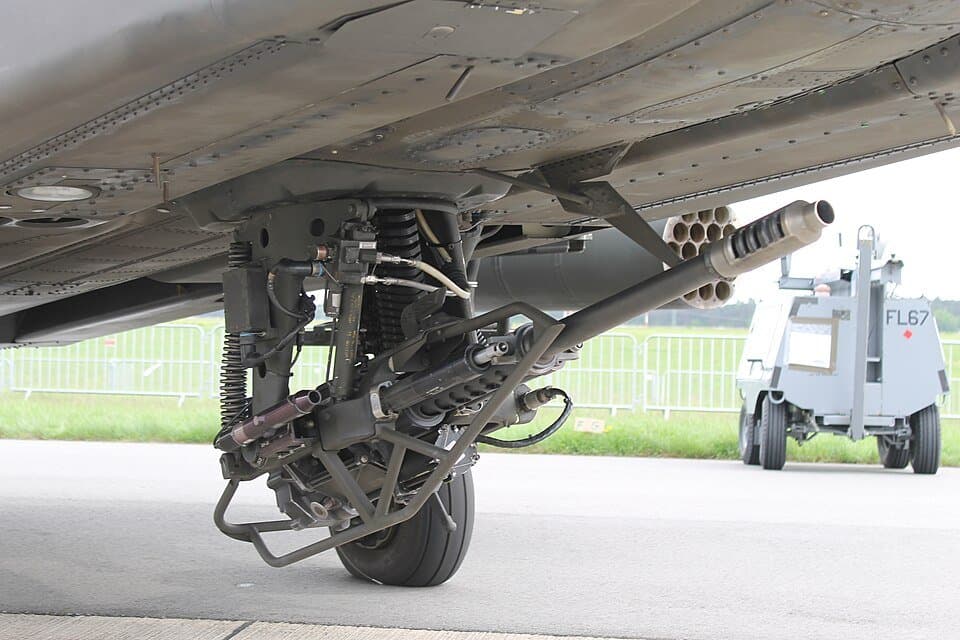
Aircraft gunsIn service
Chain gun
M230 chain gun is a chain gun originating in United States. It was built by Hughes Helicopters (1975–1985) McDonnell Douglas Helicopters (1985–2002) Alliant Techsystems (2002–2015) Orbital ATK (2015–2018) Northrop Grumman Innovation Systems (from 2018). Reported operators include United States, and other countries.
 United States
Chain gun
United States
1983–present
United States, and other countries
Persian Gulf War War in Afghanistan Iraq War
Hughes Helicopters
1973
Hughes Helicopters (1975–1985) McDonnell Douglas Helicopters (1985–2002) Alliant Techsystems (2002–2015) Orbital ATK (2015–2018) Northrop Grumman Innovation Systems (from 2018)
Since 1975
M230LF
59.5 kg (130 lb)
2,181 mm (85.9 in)
277.2 mm (10.9 in)
288.8 mm (11.4 in)
30×113 mmB M788 Target Practice (TP) M789 High Explosive Dual Purpose (HEDP) M799 High Explosive Incendiary (HEI)
30 millimetres (1.18 in) caliber
Open bolt
625±25 rpm
805 m/s (2,641 ft/s)
300 m (328 yd)
4,000 m (4,370 yd)
The M230 Cannon is a 30 mm (30×113 mm) , single-barrel electrically-driven autocannon , using external electrical power (as opposed to recoil or expanding gas generated by the firing cartridge) to cycle the weapon between shots.
The M230 Cannon is a 30 mm (30×113 mm) , single-barrel electrically-driven autocannon , using external electrical power (as opposed to recoil or expanding gas generated by the firing cartridge) to cycle the weapon between shots. It was designed and manufactured originally by Hughes Helicopters in Culver City, California. As of 2019 , it is produced by Northrop Grumman Innovation Systems .
In 1972, Hughes Helicopters began a company-funded research effort to design a machine gun to fire the U.S. Army's M50 20 mm round. By April 1973, the program had fired test rounds of more powerful 30 mm WECOM linked ammunition, from a prototype (A model). In January 1975, a model C was added, a linkless version for the proposed Advanced Attack Helicopter YAH-64; the helicopter was eventually adopted as the AH-64 Apache, with the model C as standard armament. The linked ammunition version was intended for use on the AH-1S Cobra as the M230E1, but was later dropped.
The M230 Chain Gun is used on the MH-60L Direct Action Penetrator . It is also the Area Weapon System on the Boeing AH-64 Apache attack helicopter , mounted on the chin turret. It uses a 2 hp (1.5 kW) electric motor to fire 30 mm (1.2 in) linkless ammunition at a rate of 625±25 rounds per minute. The air-cooled gun's practical rate of fire is about 300 rounds per minute with a 10-minute cooling period. The gun has a positive cook-off safety for open bolt clearing, and double ram prevention. Spent casings are ejected overboard through the bottom of the gun.
The mount on the AH-64 uses secondary hydraulics to move the gun. The elevation is provided via a single hydraulic actuator on the gun's centerline just forward of the pivot point. The gun is spring-loaded to return to its centerline stowed position with the barrel angled up about 11 degrees if hydraulic power is lost. This allows the gun, which is mounted below the copilot station, to collapse into a space between the pilots' stations in a hard landing.
The M230 can fire the 30×113 mm rounds used in the ADEN cannon and DEFA cannon , although U.S. Apaches use Lightweight 30 mm rounds made with a lighter alloy than brass (ADEN) or steel (DEFA) cases. The M230 rounds cannot be fired by weapons designed for the ADEN or DEFA rounds. The Lightweight 30 mm rounds come in three varieties: the M788 rounds, which have a blue band near the nose, the M789 with a yellow stripe atop a black band, and the M799 with a red stripe atop a yellow band. The M799 HEI round is not used by the U.S. Army because of the danger of a round exploding in the gun barrel.
The M789 is the U.S. Apache's main tactical round, a High Explosive Dual Purpose (HEDP) ammunition cartridge. Each round contains 21.5 g (0.76 oz) of explosive charge sealed in a shaped-charge liner. The liner collapses into an armor-piercing jet of metal that can penetrate more than 50 mm (2.0 in) of rolled homogeneous armour at 2500 m (2,734 yds). The shell is also designed to fragment upon impact, and produces antipersonnel effects out to 13 ft (4 m) from the point of impact.
The M230LF, offered by Orbital ATK , is a more capable version of the Apache autocannon. Features include an anti-hangfire system, a delinking feeder that exploits linked ammunition, and an extended-length barrel, which results in greater muzzle velocity and hitting power from the same M789 HEDP and NATO standard 30 mm ADEN/DEFA projectiles. The rate of fire is reduced to 200 rounds/minute and overall length decreased to 84.0 inches (213 cm). The chain gun can be installed in an enclosed turret on patrol boats and ground vehicles.
In February 2015, Oshkosh Defense and ATK conducted a firing demonstration of the M230LF on an Oshkosh M-ATV MRAP to demonstrate the viability and effectiveness of a medium caliber weapon system for light tactical vehicles. The live fire demonstration showcased improved accuracy in mobile engagements and improved lethality on the M-ATV using the gun, mounted on the Electro Optic Systems (EOS) R400S-Mk2, a 3-axis stabilized remote weapon station (RWS) weighing less than 400 kg (880 lb). The addition of the 72.6 kg (160 lb) M230LF stabilized on the RWS provides mobile precise lethality, usually reserved for heavier combat vehicles, with increased off-road mobility and MRAP levels of protection, along with optional Stinger missiles . Oshkosh has also fitted the M230LF to the L-ATV to fulfil the U.S. Army's light reconnaissance vehicle (LRV) role.
Australian company Electro Optic Systems also utilises the M230LF for its " Slinger " defensive system. The system is planned for usage against drones by using a radar and a variety of sensors to track and destroy targets with a single shot. All together it weighs less than 400 kg (880 lb) and can be mounted on a flatbed truck, allowing for a more cost effective way of destroying drones compared to missile based systems. On October 2, 2023 it was confirmed that EOS would send an undisclosed number of Slingers to Ukraine to combat the growing drone threat.
The system can be fitted with a Stinger pod and Longbow Hellfire missile rails and comes equipped with a 30 mm M230LF chain gun and the 7.62 mm coaxial machine gun, as well as non-kinetic defeat capabilities and a Rada onboard multimission hemispheric radar.
All 144 M-SHORAD systems are planned to be delivered by 2022.
The system can act in a secondary anti-vehicle role, as the 30 mm cannon is larger than the 25 mm gun mounted on the M2 Bradley and the Hellfire has greater range than TOW missiles typically used by ground vehicles.
In September 2020, the US Marines contracted Kongsberg to qualify the XM914 RWS on the Joint Light Tactical Vehicle (JLTV), equipped with an XM914E1 30 mm cannon , 7.62 mm coaxial machinegun, and Stinger missiles to fulfill an air defense role. The Marine Air Defense Integrated System (MADIS) fills the gap left by the retirement of the AN/TWQ-1 Avenger by the USMC in the mid-2000s. It consists of two JLTVs, one with the turret fitted with a 30 mm cannon, 4-round Stinger pod, and an optical sensor and the other with an RPS-42 360-degree radar, 7.62 mm M134 minigun , and EO/IR sensors; both have the Modi II dismounted electronic countermeasures system and shoulder-fired Stingers. The indefinite delivery / indefinite quantity (IDIQ) contract was signed in October 2021.
On 4 April 2023, the United States included "counter-Unmanned Aerial System 30 mm gun trucks" as part of Ukraine Security Assistance Initiative funds during the Russian invasion of Ukraine . The Northrop Grumman Agnostic Gun Truck consists of an M230LF mounted on a civilian pickup truck. Three battery sets each including three gun trucks and one Mobile, Acquisition, Cueing and Effector System (M-ACE) will be delivered; M-ACE incorporates a mast-mounted 3D radar that can detect a drone out to 10 km (6.2 mi) as well as tracking and identification cameras. The radar cues the guns onto a target, which fires M1211 High Explosive Proximity Self Destruct rounds capable of engaging UAS up to Class 2 . The AGT was meant to be delivered within 30 to 90 days of the contract award, however by early August delays in the procurement process had prevented the full complement of trucks from being built. They were to be sent "very shortly" by October 2023.
The M230 Chain Gun is used on the MH-60L Direct Action Penetrator . It is also the Area Weapon System on the Boeing AH-64 Apache attack helicopter , mounted on the chin turret.
Rate of Fire 625 + 25 spm
Barrel 32 lb 14.5 kg
Reference text from Wikipedia contributors, used under CC BY-SA 4.0.
True scale
Sourced dimensions beside a 1.75 m human reference.
Points represent sourced observations, including revisions. Revisions on the same effective date are not separate inventory events. Ranges appear in the table and are not plotted as exact points.
| Observation / report period | Value | Source | Claim state |
|---|---|---|---|
| 1 Oct 2026 | 30 mm | Wikipedia contributors | superseded |
| 1 Oct 2026 | 30 mm | Wikipedia contributors | approved |
M230 chain gun equipment records. Variants, orders and quantities are shown as reported in each inventory source; coverage is incomplete.
 Netherlands
Reported count for M230 Chain Gun · —. Service scope: Equipment of the Royal Netherlands Air Force; does not replace a national total. 1 distinct count cell(s) from the same source list; shared rowspan cells counted once. Retired, wholly reserve and on-order rows are excluded; the reported count retains any explicitly mixed stock scope in the quoted row. Count column(s): quantity: 28. Origin: United States. The listed variants/roles are the scope, not an immediately deployable count. The components do not establish one inventory census date; the stored date is the retrieved source snapshot.
 Sweden
Keep exploring
Aircraft rotary heavy machine gun
Rotary cannon
United StatesRotary cannon
United StatesRevolver cannon
 Germany
Aircraft cannon
principal cannon armament of United States military fixed-wing aircraft
United States