FORCETALLY
Loading the evidence…
Preparing your view.


Preparing your view.
Aircraft gunsIn service
principal cannon armament of United States military fixed-wing aircraft
M61 Vulcan is a rotary cannon originating in United States. It was built by General Dynamics Sumitomo Heavy Industries SNT Dynamics. Reported operators include United States, some NATO members, Japan , South Korea , Saudi Arabia , and others.
 United States
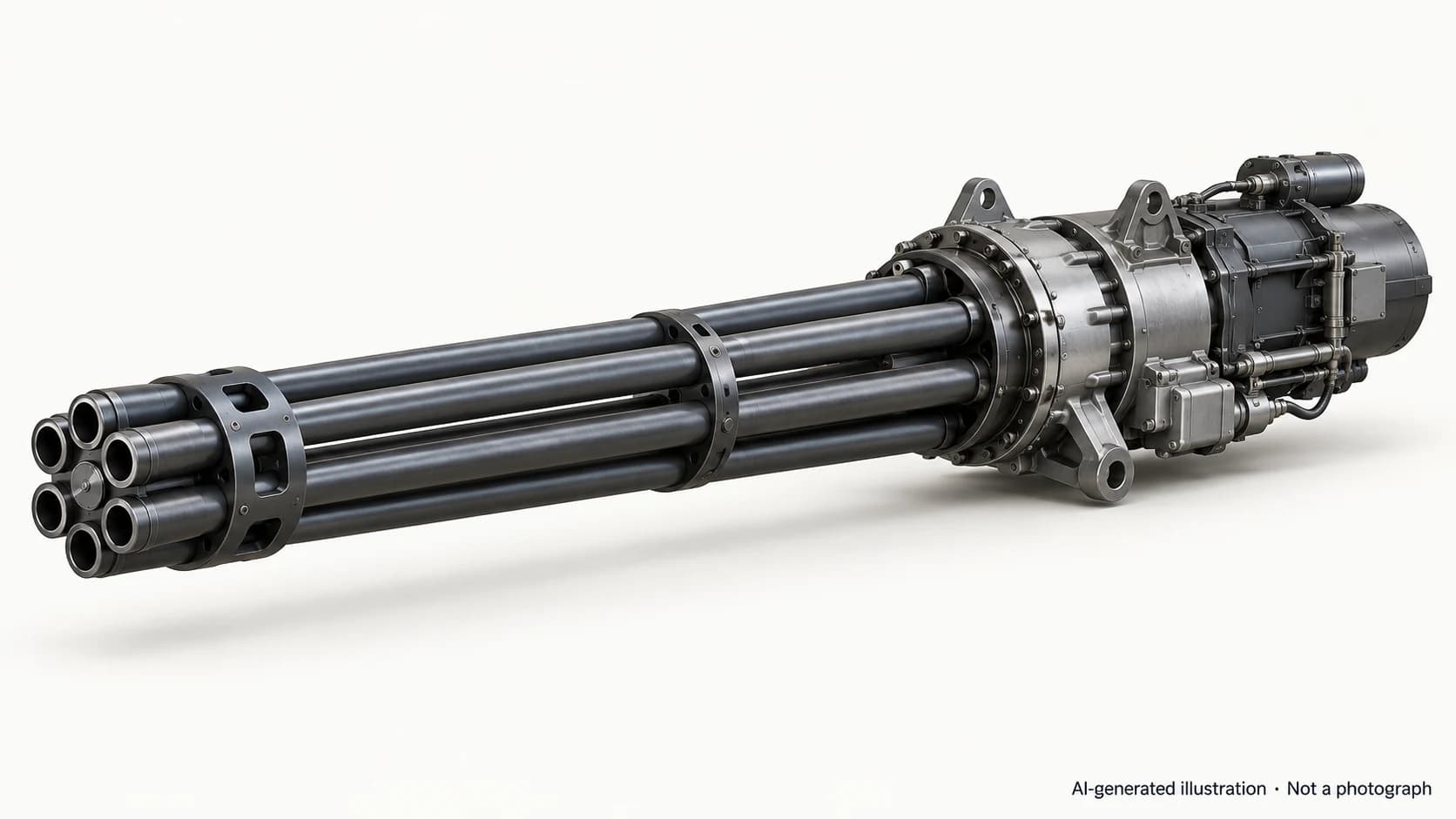
AI-generated illustration · Not a photograph — Representative exterior of M61 Vulcan; geometry is illustrative. Not evidence for specifications.
ForceTally · AI-generated illustration · Not a photograph · AI-generated · OpenAI output terms · Source ↗ · ModifiedRotary cannon
United States
1959–present
United States, some NATO members, Japan , South Korea , Saudi Arabia , and others
Vietnam War Iran–Iraq War Gulf War War in Afghanistan Iraq War War in Iraq (2013–2017) Yemeni Civil War (2014–present) Saudi Arabian-led intervention in Yemen Turkish military operation in Idlib Governorate Russo-Ukrainian War
General Electric
1946
General Dynamics Sumitomo Heavy Industries SNT Dynamics
See below
M61A1: 248 lb (112 kg) M61A2: 202 lb (92 kg) (light barrel), 228 lb (103 kg) (heavy barrel)
71.93 in (1.827 m)
59.8 in (1.52 m)
20×102mm Vulcan
20 mm (0.8 in)
6-barrel (progressive RH parabolic twist, 9 grooves)
Hydraulically operated , electrically fired, rotary cannon
6,000 rounds per minute
3,450 ft/s (1,050 m/s) with PGU-28/B round
About 9,842 ft (3,000 m)
Belt or linkless feed system
The M61 Vulcan is a hydraulically , electrically, or pneumatically driven, six- barrel , air-cooled, electrically fired Gatling-style rotary cannon which fires 20 mm caliber rounds at an extremely high rate (typically 6,000 rounds per minute).
The M61 Vulcan is a hydraulically , electrically, or pneumatically driven, six- barrel , air-cooled, electrically fired Gatling-style rotary cannon which fires 20 mm caliber rounds at an extremely high rate (typically 6,000 rounds per minute). The M61 and its derivatives have been the principal cannon armament of United States military fixed-wing aircraft since 1959.
In 1947, the Air Force became a separate branch of the military. The new Air Force made a request for a new aircraft gun. A lesson of World War II air combat was that German, Italian, and Japanese fighters with center line-mounted weapons could attack American aircraft from long range with their cannon main armament. American fighters with .50 caliber (12.7 mm) main armament, such as the P-51 and P-47 , had to be close to enemy aircraft in order to cause significant damage to strong parts deep inside the jet. The 20 mm (0.79 in) Hispano cannon carried by the P-38 and P-61 , while formidable against propeller-driven planes, had a relatively low rate of fire in the age of jets, while other Allied cannons were notoriously unreliable.
In 1946, the Army issued General Electric a contract for "Project Vulcan", a six-barrel weapon capable of firing 7,200 rounds per minute (rpm).
Although European designers were moving towards heavier 30 mm (1.181 in) weapons for better hitting power, the U.S. initially concentrated on a powerful 0.60-inch (15 mm) caliber cartridge designed for a pre-war anti-tank rifle, expecting that the cartridge's high muzzle velocity would be beneficial for improving hit ratios on high-speed targets.
The first GE prototypes of the 0.60-inch (15 mm) caliber T45 were ground-fired in 1949; it achieved 2,500 rpm, which was increased to 4,000 rpm by 1950.
Due to air combat experience in the Korean War , the USAF decided that high velocity alone might not be sufficient to ensure target destruction and tested 20 and 27 mm (0.787 and 1.06 in) alternatives based on the 0.60-inch (15 mm) caliber cartridge.
Eventually, the standard 20×102 mm cartridge was determined to have the desired balance of projectile/explosive mass and muzzle velocity, resulting in an optimum balance of range, accuracy and kinetic energy on target.
The self-powered version, the GAU-4 (called M130 in Army service), is gas-operated , tapping gun gas from three of the six barrels to operate the gun gas-driven mechanism. The self-powered Vulcan weighs about 4.5 kilograms (10 lb) more than its electric counterpart, but requires no external power source to operate, except for an electric inertia starter to initiate gun rotation, allowing the first rounds to be chambered and fired.
The feed system must be custom-designed for each application, adding 140 to 180 kg (300 to 400 lb) to the complete weapon. Most aircraft installations are double-ended, because the ejection of empty cartridges can cause a foreign-object damage hazard for jet engines and because the retention of spent cases assists in maintaining the center of gravity of the aircraft. The first aircraft to carry the M61A1 was the C model of the F-104 , starting in 1959.
A lighter version of the Vulcan developed for use on the F-22 Raptor , designated M61A2, is mechanically the same as the M61A1, but with thinner barrels to reduce overall weight to 92 kilograms (202 lb). The rotor and housing have also been modified to remove any piece of metal not absolutely needed for operation and replaces some metal components with lighter-weight materials. The F/A-18E/F Super Hornet also uses this version.
The Vulcan's rate of fire is typically 6,000 rounds per minute, although some versions (such as that of the AMX and the F-106 Delta Dart ) are limited to a lower rate, and others ( A-7 Corsair , F-15 Eagle ) have a selectable rate of fire of either 4,000 or 6,000 rounds per minute. The M61A2's lighter barrels allow a somewhat higher rate of fire, up to 6,600 rounds per minute.
Until the late 1980s, the M61 primarily used the M50 series of ammunition, which includes armor-piercing incendiary, high-explosive incendiary, and training rounds. The gun typically fires a 99-gram (3.5 oz) projectile at a muzzle velocity of about 1,030 metres per second (3,380 ft/s).
A new PGU-28/B round was developed in the mid-1980s: a semi-armor-piercing high-explosive incendiary (SAPHEI) round, providing improvements in range, accuracy, and power over the preceding M56A3 HEI round. The PGU-28/B is a "low-drag" round designed to reduce in-flight drag and deceleration, and has a slightly increased muzzle velocity of 1,050 metres per second (3,450 ft/s). However, the PGU-28/B has not been without problems. A 2000 USAF safety report noted 24 premature detonation mishaps (causing serious damage in many cases) in 12 years with the SAPHEI round, compared to only two such mishaps in the entire recorded history of the M56 round. The report estimated that the PGU-28/B had a potential failure rate 80 times higher than USAF standards permit. Due to safety issues, it was limited to emergency wartime use in 2000.
Practically no powered rotary cannon is supplied with sufficient ammunition for a full minute of firing, due to weight (at 6,000 rpm, the projectiles alone would represent a mass of about 600 kg (1,300 lb) for one minute of firing; and by including the brass shell, filling and primer the weight is approximately double that at 1,225 kg (2,701 lb)). In order to avoid using 600 to 1,000 rounds carried by aircraft all at once, a burst controller is generally used to limit the number of rounds fired at each trigger pull. Bursts from two or three up to 40 or 50 can be selected. The size of the airframe and available internal space limits the size of the ammunition drum and thus the ammunition capacity. When vehicle-mounted, the only limiting factor is the vehicle's safe carry weight, so commensurately larger ammo storage is available.
The Vulcan was first used in aerial combat on 4 April 1965, when four North Vietnamese Vietnam People's Air Force (VPAF) MiG-17s ) attacked a force of 10 North American F-100 Super Sabres (two of which were assigned weather reconnaissance duties) escorting 48 Vulcan-armed and "bomb-laden" F-105 Thunderchiefs , shooting down two of the latter. The MiG leader and only survivor from the four MiGs, Captain Tran Hanh, reported that U.S. jets had pursued them and that F-105s had shot down three of his aircraft, killing lieutenants Pham Giay, Le Minh Huan and Tran Nguyen Nam. Captain Donald Kilgus, piloting an F-100, received an official probable kill with his four M39 20 mm cannons during the engagement; however no other US pilot reported destroying any MiGs during the battle, leaving open the possibility that at least two of the MiG-17s may have been downed by their own anti-aircraft fire.
The first confirmed Vulcan gun kill occurred on 29 June 1966 when Major Fred Tracy, flying his F-105 with the 421st TFS, fired 200 rounds of 20 mm into a MiG-17 that had just fired a 23 mm shell which entered one side of his cockpit and exited the other. When the VPAF MiG flew in front of him after making its pass, Tracy opened fire on it.
The Vulcan was later fitted into the weapons bay of some Convair F-106 Delta Dart and General Dynamics F-111 Aardvark models. It was also adopted as standard in the "teen"-series air superiority fighters: the Grumman F-14 Tomcat , the McDonnell Douglas F-15 Eagle , General Dynamics F-16 Fighting Falcon , and McDonnell Douglas F/A-18 Hornet . Other aircraft include the Italian/Brazilian AMX International AMX (on Italian aircraft only), and the F-22 Raptor . It was fitted in a side-firing installation on the Fairchild AC-119 and some marks of the Lockheed AC-130 gunships , and was used in the tail turrets of both the Convair B-58 Hustler and Boeing B-52H Stratofortress bombers. Japan's Mitsubishi F-1 carried one internally mounted JM61A1 Vulcan with 750 rounds.
Two gun pod versions, the SUU-16/A (also designated M12 by the US Army) and improved SUU-23/A (US Army M25), were developed in the 1960s, often used on gunless versions of the F-4. The SUU-16/A uses the electric M61A1 with a ram-air turbine to power the motor. This proved to cause serious aerodynamic drag at higher speeds, while speeds under 640 kilometres per hour (400 mph) did not provide enough airflow for the maximum rate of fire.
The subsequent SUU-23/A uses the GAU-4/A self-powered Vulcan, with an electric inertia starter to bring it up to speed. Both pods ejected empty cases and unfired rounds rather than retaining them. Both pods contained 1,200 rounds of ammunition, with a loaded weight of 733 and 780 kilograms (1,615 and 1,720 lb) respectively. During service in the Vietnam War , the pods proved to be relatively inaccurate: the pylon mounting was not rigid enough to prevent deflection when firing, and repeated use would misalign the pod on its pylon, making matters worse.
A variant with much shorter barrels, designated the M195, was also developed for use on the M35 Armament Subsystem as used on the AH-1G Cobra helicopter . This variant fed from ammunition boxes fitted to the landing skid and was developed to provide the AH-1 helicopter with a longer-range suppressive fire system before the adoption of the M97 universal turret mounting the M197 cannon.
On 13 December 2024, the Ukrainian Air Force claimed an F-16 shot down six Russian cruise missiles in one sortie. Two were shot down with “medium-range missiles”, another two with “short-range missiles” and finally two with the M61 Vulcan 20 mm cannon. The pilot wasn't identified for security reasons but said: "A few bursts from the cannon – and an explosion... then another one! 'A secondary detonation,' I thought, but, as it turned out, there were two missiles".
The M61 and its derivatives have been the principal cannon armament of United States military fixed-wing aircraft since 1959.
Origin United States
Type Autocannon
Caliber 20x102mm
Feed system Belt-fed
Barrel length 1.52 m
Rifling 9 grooves, progressive right hand twist
Muzzle velocity 1.030 m/s
Reference text from Wikipedia contributors, used under CC BY-SA 4.0.
True scale
Sourced dimensions beside a 1.75 m human reference.
Points represent sourced observations, including revisions. Revisions on the same effective date are not separate inventory events. Ranges appear in the table and are not plotted as exact points.
| Observation / report period | Value | Source | Claim state |
|---|---|---|---|
| 29 Sept 2026 | 1.52 m | Wikipedia contributors | superseded |
| 29 Sept 2026 | 1.52 m | Wikipedia contributors | superseded |
| 29 Sept 2026 | 1.52 m | Wikipedia contributors | superseded |
| 29 Sept 2026 | 1.52 m | Wikipedia contributors | superseded |
| 29 Sept 2026 | 1.52 m | Wikipedia contributors | superseded |
| 29 Sept 2026 | 1.52 m | Wikipedia contributors | superseded |
| 29 Sept 2026 | 1.52 m | Wikipedia contributors | approved |
Action Six barrel Gatling type
Rate of fire 6.000 rpm cyclic
Power source External, 25 kW
Weight About 110 kg
Length 1.8 m
M61 Vulcan equipment records. Variants, orders and quantities are shown as reported in each inventory source; coverage is incomplete.
 Finland
Number column of the Wikipedia list table under "Aircraft cannon". The list's own wording applies; it is a compiled secondary source, not an official census.
 Indonesia
 Pakistan United States
United States, some NATO members, Japan , South Korea , Saudi Arabia , and others
Equipment reference ↗Keep exploring