FORCETALLY
Loading the evidence…
Preparing your view.


Preparing your view.
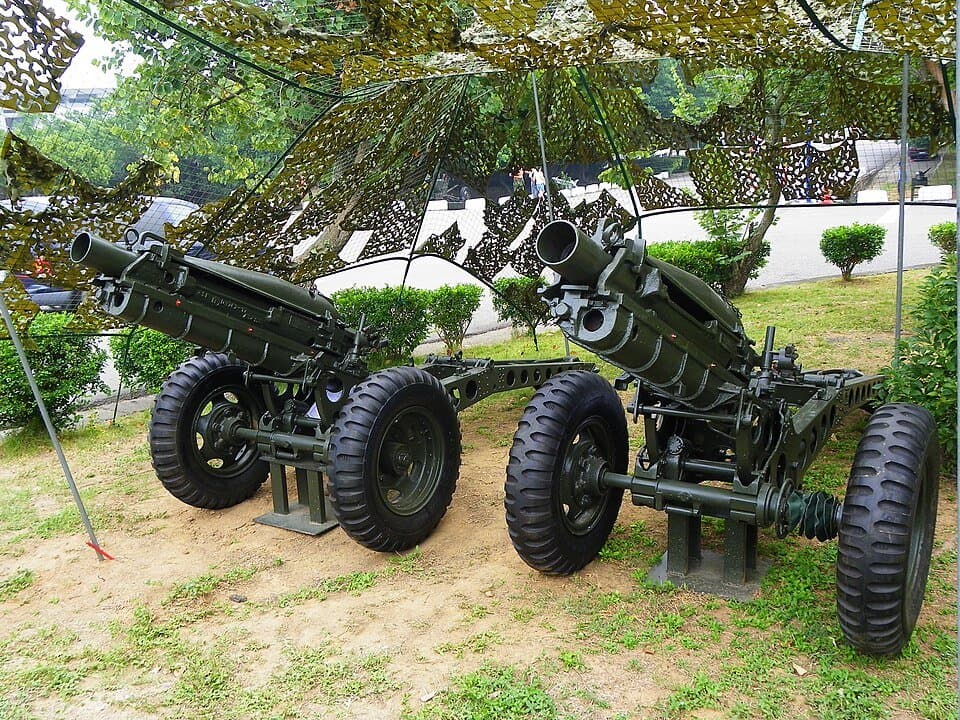
ArtilleryIn service
Pack howitzer
M116 howitzer is a pack howitzer originating in United States. It was built by General Electric. Reported operators include Bolivia, Brazil, Cameroon, China, Colombia, Congo, Cuba, Cyprus, Ethiopia, France, Greece, Guatemala, Haiti, Honduras, India, Iran, Iraq, Japan, South Korea, Laos, Liberia, Mexico, Morocco, Nepal, Oman, Pakistan, Paraguay, Philippines, Senegal, Taiwan, Thailand, Türkiye, United States, United Kingdom, Venezuela, South Vietnam, Vietnam, Yugoslavia, Zaire.
 United States
Technical data
Pack howitzer
United States
1927–present
See Users
World War II Second Sino-Japanese War Korean War Chinese Civil War First Indochina War Vietnam War Laotian Civil War Cambodian Civil War Kurdish–Turkish conflict
General Electric
1927–1944
8,400
653 kg (1,439 lbs)
3.68 m (12 ft 1 in)
Overall 1.38 m (4 ft 6 in) L/18.4 Bore: 1.19 m (3 ft 11 in) L/15.9
1.22 m (4 ft)
94 cm (3 ft 1 in)
8 (in U.S. service)
Fixed and Semi-fixed 75 x 272 mm R
8.27 kg (18 lb 4 oz)
True scale
Sourced dimensions beside a 1.75 m human reference.
See it in your room. Scan with your phone to open this model in 3D, then place it in your space.
Points represent sourced observations, including revisions. Revisions on the same effective date are not separate inventory events. Ranges appear in the table and are not plotted as exact points.
| Observation / report period | Value | Source | Claim state |
|---|---|---|---|
| 28 Sept 2026 | 1.38 m | Wikipedia contributors | superseded |
| 28 Sept 2026 | 1.38 m | Wikipedia contributors | superseded |
| 28 Sept 2026 | 1.38 m | Wikipedia contributors | superseded |
| 28 Sept 2026 | 1.38 m | Wikipedia contributors | superseded |
| 28 Sept 2026 | 1.38 m | Wikipedia contributors | superseded |
| 28 Sept 2026 | 1.38 m | Wikipedia contributors | superseded |
| 28 Sept 2026 | 1.38 m | Wikipedia contributors | superseded |
| 28 Sept 2026 | 1.38 m | Wikipedia contributors | approved |
75 mm (2.95 in)
Horizontal-block
Hydro-pneumatic , constant
Box trail or Split-trail depending on model
-5° to +45°
6°
6 rpm
381 m/s (1,250 ft/s)
8.8 km (5.5 mi)
Bolivia
Brazil
Cameroon
China
Colombia
Congo
Cuba
Cyprus
Ethiopia
France
Greece
Guatemala
Haiti
Honduras
India
Iran
Iraq
Japan
South Korea
Laos
Liberia
Mexico
Morocco
Nepal
Oman
Pakistan
Paraguay
Philippines
Senegal
Taiwan
Thailand
Turkey
United States
United Kingdom
Venezuela
South Vietnam
Vietnam
Yugoslavia
Zaire
Croatia − 12 are kept in active service primarily as ceremonial cannons.
The 75mm pack howitzer M1 (redesignated the M116 in 1962) was a pack howitzer designed in the United States.
The 75mm pack howitzer M1 (redesignated the M116 in 1962) was a pack howitzer designed in the United States. The gun saw combat in World War II with the United States Army (primarily in airborne units) and the United States Marine Corps , and was also supplied to foreign militaries. Initially designed to be moved across difficult terrain, the gun and carriage could be broken down into several pieces to be carried by pack animals , and this ability as well as its compact size allowed it to be used by paratroop and glider forces.
In addition to the pack or air-portable configuration, the gun was also mounted on a split-trail carriage to serve as a field artillery piece. The M1 in its original version was mated to a number of self-propelled carriages, though only one of those – 75 mm HMC T30 – reached mass production, while the M2 and M3 variants were vehicle-mounted in the 75 mm HMC M8 and some LVT models.
The 75 mm pack howitzer was designed in the United States in the 1920s to meet a need for an artillery piece that could be moved across difficult terrain. Development began in 1920, and in August 1927, the weapon was standardized as howitzer, pack, 75mm M1 on carriage M1 . Due to meager funding, production rates were very low; by 1933, only 32 guns had been manufactured, and by 1940, only 91 pieces. It was not until September 1940 that the howitzer was put into mass production. By then, the M1 had been succeeded by the slightly modified M1A1. Production continued until December 1944.
The howitzer M1 or M1A1 consisted of the gun tube and breech , joined together by interrupted threads , allowing for quick assembly and disassembly. One-eighth of a turn was required to connect or disconnect the two elements. The tube had uniform, right-hand rifling with one turn in 20 calibers. The breech was of horizontal sliding-block type, with a continuous-pull firing mechanism. The recoil system was hydro-pneumatic , with the buffer and recuperator under the barrel.
The pack howitzer carriage M1 was of box trail type, and originally had steel-rimmed wooden wheels. For transportation, the howitzer M1 or M1A1 on carriage M1 could be broken down into six loads for pack animals, with weights between 73 kg (161 lb) and 107 kg (236 lb) each:
The carriage M8 was identical except for the axle arms and wheels, which were metal with pneumatic tires. The howitzer on carriage M8 could be broken down into seven mule loads or into nine parachute loads (the latter arrangement included 18 rounds of ammunition). It could also be towed by a vehicle such as a 1/4 ton jeep , or transported by plane or glider such as the CG-4 Waco .
75 mm howitzer on carriage M1
75 mm howitzer on carriage M8
75 mm howitzer on carriage M3A3
In the Second World War era US Army, 75 mm howitzers were issued to airborne and mountain units.
An airborne division , according to the table of organization and equipment (T/O&E) of February 1944, had three 75 mm howitzer battalions – two glider field artillery battalions (two six-gun batteries each) and one parachute field artillery battalion (three four-gun batteries), in total 36 pieces per division. In December 1944, new Tables of Organization and Equipment increased the divisional firepower to 60 75 mm howitzers, while as an option, the 75 mm pieces in the glider battalions could be replaced with the more powerful 105 mm M3 howitzer ).
The only mountain division formed, the 10th , had three 75 mm howitzer battalions, with 12 pieces each. The gun was also used by some separate field artillery battalions. These included mule-packed field artillery battalions seeing service in Burma.
In the US Marine Corps , under the "E-Series" T/O&E from 15 April 1943, the divisional artillery included three 75 mm howitzer battalions with 12 pieces each. The F-series T/O&E from 5 May 1944 reduced the number of 75 mm battalions to two, while the G-series T/O&E removed them altogether and marked a completion of the shift to 105 mm and 155 mm howitzers. Although the G-series T/O&E was only adopted officially on 4 September 1945, in practice many changes contained in the table were introduced early in 1945.
The 75 mm howitzer was also used by Australian forces – two mountain batteries and some other units.
In 2010, the M116 75 mm pack howitzer was used by the Turkish Army in operations against Kurdish separatists in southeastern Turkey.
Two nearly identical vehicle mounted variants – M2 and M3 – were developed based on tube and breech of the M1A1, for use in the 75 mm howitzer motor carriage T47 / M8 . Both variants had a cylindrical "recoil surface" around the tube. In the M2, the surface was provided by use of a separately manufactured sleeve, while in the M3 it became an integral part of the barrel. M2 and M3 were fully interchangeable. These guns were mounted on the below armored vehicles:
75 mm howitzer motor carriage T47 / M8 – M2 / M3 in mount M7.
75 mm howitzer motor carriage T1 (tank development chassis T2).
75 mm howitzer motor carriage T3 (combat car M1 chassis).
75 mm howitzer motor carriage T17 (combat car M1E3 chassis).
75 mm howitzer motor carriage T18 ( light tank M3 chassis) – M1A1.
75 mm howitzer motor carriage T30 – M1A1 in mount T10.
75 mm howitzer motor carriage T41 ( light tank M5 chassis).
The gun fired fixed (HEAT M66) and semi-fixed ammunition, fitted with 75 mm cartridge case M5A1 (type II) and (type I) accordingly. The propelling charge of the semi-fixed ammunition consisted of base charge and three incremental charges, forming four different charges from 1 (the smallest) to 4 (the largest).
HEAT M66 shell penetrated about 91 mm (3.6 in) of homogeneous armor at 0 degrees at any range. While the powder charge was different, this gun fired the same types of shell projectiles as used in the 75 mm tank guns of WWII, which were themselves derived from the 75×350 mm R ammunition of the French 75mm field gun of WWI .
Range: 9,700 yards (8,800 metres)
Reference text from Wikipedia contributors, used under CC BY-SA 4.0.
M116 howitzer equipment records. Variants, orders and quantities are shown as reported in each inventory source; coverage is incomplete.
 Bolivia
 Brazil
 Cameroon
 China
 Colombia
 Croatia
Reported count for M116 howitzer. Service scope: Croatian Army; does not replace a national total. 1 distinct count cell(s) from the same source list; shared rowspan cells counted once. Excludes retired/reserve/on-order rows. Count column(s): quantity: 12. Origin: United States. The listed variants/roles are the scope, not an immediately deployable count. The components do not establish one inventory census date; the stored date is the retrieved source snapshot.
 Cuba
 Cyprus
 France
 Greece
 Guatemala
 Haiti
 Honduras
Reported count for M116 howitzer. Service scope: Honduran Army; does not replace a national total. 1 distinct count cell(s) from the same source list; shared rowspan cells counted once. Retired, wholly reserve and on-order rows are excluded; the reported count retains any explicitly mixed stock scope in the quoted row. Count column(s): quantity: 12. Origin: United States. The listed variants/roles are the scope, not an immediately deployable count. The components do not establish one inventory census date; the stored date is the retrieved source snapshot.
 India
 Iran
 Japan
 Laos
Reported count for M116 howitzer. Country-wide list; no individual service specified. 1 distinct count cell(s) from the same source list; shared rowspan cells counted once. Retired, wholly reserve and on-order rows are excluded; the reported count retains any explicitly mixed stock scope in the quoted row. Count column(s): quantity: 10. Origin: United States. The listed variants/roles are the scope, not an immediately deployable count. The components do not establish one inventory census date; the stored date is the retrieved source snapshot.
 Liberia
 Mexico
 Morocco
 Nepal
 Oman
 Pakistan
 Paraguay
 Philippines
 Republic of the Congo
 Senegal
 South Korea
 Taiwan
 Thailand
 Türkiye
 United Kingdom United States
 Venezuela
 Vietnam
Bolivia, Brazil, Cameroon, China, Colombia, Congo, Cuba, Cyprus, Ethiopia, France, Greece, Guatemala, Haiti, Honduras, India, Iran, Iraq, Japan, South Korea, Laos, Liberia, Mexico, Morocco, Nepal, Oman, Pakistan, Paraguay, Philippines, Senegal, Taiwan, Thailand, Türkiye, United States, United Kingdom, Venezuela, South Vietnam, Vietnam, Yugoslavia, Zaire
Equipment reference ↗Keep exploring
 Italy
 Spain
 Israel