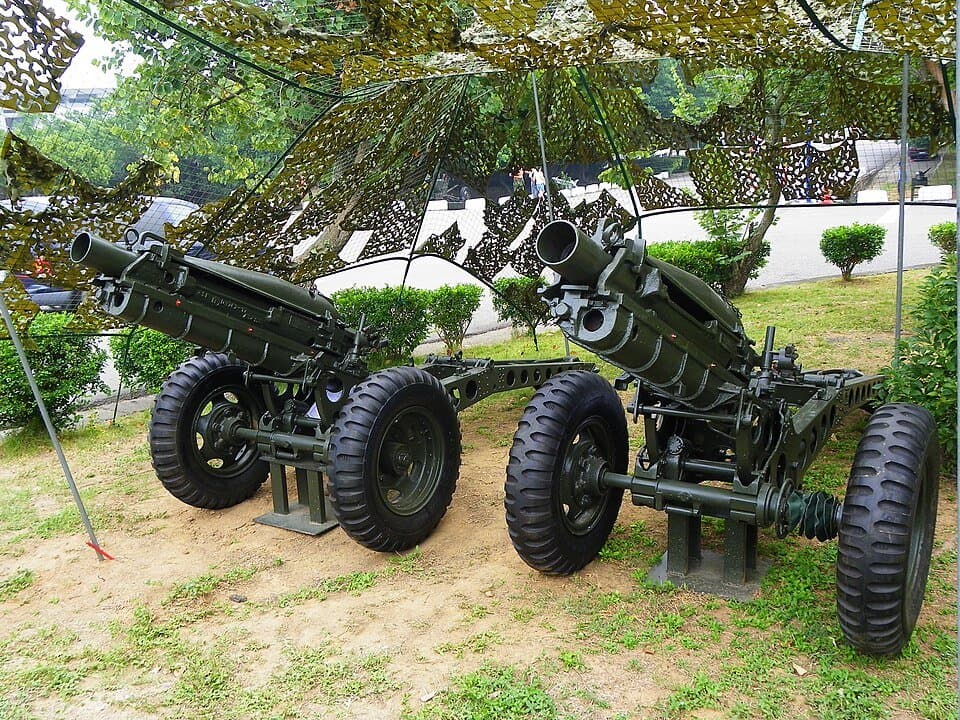

Credit
玄史生 · CC BY-SA 3.0 · Resized · CC BY-SA 3.0 · Source ↗ · Modified


Preparing your view.


At a glance
M116 howitzerlarger figure on 0 of 5
True scale
Side by side. From every angle. A human reference for perspective.
3.09 MB · Loads when you open it| Model | Length | Width / span | Height |
|---|---|---|---|
| M116 howitzer | ≈ 3.68 m | ≈ 1.22 m (Width) | ≈ 0.993 m |
| Santa Bárbara Sistemas 155/52 | ≈ 10.3 m | ≈ 2.8 m (Width) | ≈ 2.75 m |
Scaled uniformly to the sourced length of 3.68 m. The width was fitted to the sourced 1.22 m. Not an official model or a measured survey.
ForceTally · All rights reserved
Scaled uniformly to the sourced length of 10.3 m. Thin antennas or poles standing above the body were pressed down to it, so they do not set the height; the width was fitted to the sourced 2.8 m. Not an official model or a measured survey.
ForceTally · All rights reserved
The human reference is a generic 1.75 m figure. Models describe external size, not combat performance.
Measured figures
Length
Single source3.68 m (12 ft 1 in)[source]
Length
Single sourceConfiguration
| Specification | M116 howitzer | Santa Bárbara Sistemas 155/52 |
|---|---|---|
| Type | Pack howitzer[source] | Howitzer[source] |
| Place of origin | United States[source] | Spain[source] |
| In service | 1927–present[source] | 2002–present[source] |
| Used by | See Users[source] | Colombia Spain El Salvador |
Counts only measures both sources give with the same scope. A larger figure is not a better system.
10.3 m (33 ft 10 in)[source]
Maximum; Maximum speed
Single source18 km/h (11 mph)[source]
Diesel APU
Single sourceDiesel APU 106 hp (79 kW )[source]
Muzzle velocity
Single source381 m/s (1,250 ft/s)[source]
Bars compare reported quantities only. A larger figure does not make a system better; configurations and test conditions differ.
| Wars | World War II Second Sino-Japanese War Korean War Chinese Civil War First Indochina War Vietnam War Laotian Civil War Cambodian Civil War Kurdish–Turkish conflict[source] | — |
|---|
| Manufacturer | General Electric[source] | Santa Bárbara Sistemas[source]Santa Bárbara Sistemas 155/52 — explicit named producer; no component/sibling identity |
|---|
| Produced | 1927–1944[source] | — |
|---|
| No. built | 8,400[source] | 111[source] |
|---|
| Shell | Fixed and Semi-fixed 75 x 272 mm R[source] | Separate loading charge and projectiles[source] |
|---|
| Shell weight | 8.27 kg (18 lb 4 oz)[source] | — |
|---|
| Breech | Horizontal-block[source] | Interrupted screw[source] |
|---|
| Recoil | Hydro-pneumatic , constant[source] | Hydro-pneumatic[source] |
|---|
| Carriage | Box trail or Split-trail depending on model[source] | Split trail[source] |
|---|
| Elevation | -5° to +45°[source] | −3° to +72°[source] |
|---|
| Traverse | 6°[source] | 40°[source] |
|---|
| Role | pack howitzer[source] | modern field howitzer[source] |
|---|
| Source measurement | The 75mm pack howitzer M1 (redesignated the M116 in 1962) was a pack howitzer designed in the United States. The gun saw combat in World War II with the United States Army (primarily in airborne units) and the United States Marine Corps , and was also supplied to foreign militaries. Initially designed to be moved across difficult terrain, the gun and carriage could be broken down into several pieces to be carried by pack animals , and this ability as well as its compact size allowed it to be used by paratroop and glider forces.[source]M116 howitzer · Lead; only the objects and conditions stated in this passage In addition to the pack or air-portable configuration, the gun was also mounted on a split-trail carriage to serve as a field artillery piece. The M1 in its original version was mated to a number of self-propelled carriages, though only one of those – 75 mm HMC T30 – reached mass production, while the M2 and M3 variants were vehicle-mounted in the 75 mm HMC M8 and some LVT models.[source]M116 howitzer · Lead; only the objects and conditions stated in this passage The 75 mm pack howitzer was designed in the United States in the 1920s to meet a need for an artillery piece that could be moved across difficult terrain. Development began in 1920, and in August 1927, the weapon was standardized as howitzer, pack, 75mm M1 on carriage M1 . Due to meager funding, production rates were very low; by 1933, only 32 guns had been manufactured, and by 1940, only 91 pieces. It was not until September 1940 that the howitzer was put into mass production. By then, the M1 had been succeeded by the slightly modified M1A1. Production continued until December 1944.[source]M116 howitzer · Development and production; only the objects and conditions stated in this passage The howitzer M1 or M1A1 consisted of the gun tube and breech , joined together by interrupted threads , allowing for quick assembly and disassembly. One-eighth of a turn was required to connect or disconnect the two elements. The tube had uniform, right-hand rifling with one turn in 20 calibers. The breech was of horizontal sliding-block type, with a continuous-pull firing mechanism. The recoil system was hydro-pneumatic , with the buffer and recuperator under the barrel.[source]M116 howitzer · Description; only the objects and conditions stated in this passage The pack howitzer carriage M1 was of box trail type, and originally had steel-rimmed wooden wheels. For transportation, the howitzer M1 or M1A1 on carriage M1 could be broken down into six loads for pack animals, with weights between 73 kg (161 lb) and 107 kg (236 lb) each:[source]M116 howitzer · Description; only the objects and conditions stated in this passage The carriage M8 was identical except for the axle arms and wheels, which were metal with pneumatic tires. The howitzer on carriage M8 could be broken down into seven mule loads or into nine parachute loads (the latter arrangement included 18 rounds of ammunition). It could also be towed by a vehicle such as a 1/4 ton jeep , or transported by plane or glider such as the CG-4 Waco .[source]M116 howitzer · Description; only the objects and conditions stated in this passage 75 mm howitzer on carriage M1[source]M116 howitzer · Description; only the objects and conditions stated in this passage 75 mm howitzer on carriage M8[source]M116 howitzer · Description; only the objects and conditions stated in this passage 75 mm howitzer on carriage M3A3[source]M116 howitzer · Description; only the objects and conditions stated in this passage In the Second World War era US Army, 75 mm howitzers were issued to airborne and mountain units.[source]M116 howitzer · Organization and service / US military; only the objects and conditions stated in this passage An airborne division , according to the table of organization and equipment (T/O&E) of February 1944, had three 75 mm howitzer battalions – two glider field artillery battalions (two six-gun batteries each) and one parachute field artillery battalion (three four-gun batteries), in total 36 pieces per division. In December 1944, new Tables of Organization and Equipment increased the divisional firepower to 60 75 mm howitzers, while as an option, the 75 mm pieces in the glider battalions could be replaced with the more powerful 105 mm M3 howitzer ).[source]M116 howitzer · Organization and service / US military; only the objects and conditions stated in this passage The only mountain division formed, the 10th , had three 75 mm howitzer battalions, with 12 pieces each. The gun was also used by some separate field artillery battalions. These included mule-packed field artillery battalions seeing service in Burma.[source]M116 howitzer · Organization and service / US military; only the objects and conditions stated in this passage In the US Marine Corps , under the "E-Series" T/O&E from 15 April 1943, the divisional artillery included three 75 mm howitzer battalions with 12 pieces each. The F-series T/O&E from 5 May 1944 reduced the number of 75 mm battalions to two, while the G-series T/O&E removed them altogether and marked a completion of the shift to 105 mm and 155 mm howitzers. Although the G-series T/O&E was only adopted officially on 4 September 1945, in practice many changes contained in the table were introduced early in 1945.[source]M116 howitzer · Organization and service / US military; only the objects and conditions stated in this passage The 75 mm howitzer was also used by Australian forces – two mountain batteries and some other units.[source]M116 howitzer · Organization and service / Other operators; only the objects and conditions stated in this passage In 2010, the M116 75 mm pack howitzer was used by the Turkish Army in operations against Kurdish separatists in southeastern Türkiye.[source]M116 howitzer · Organization and service / Other operators; only the objects and conditions stated in this passage Two nearly identical vehicle mounted variants – M2 and M3 – were developed based on tube and breech of the M1A1, for use in the 75 mm howitzer motor carriage T47 / M8 . Both variants had a cylindrical "recoil surface" around the tube. In the M2, the surface was provided by use of a separately manufactured sleeve, while in the M3 it became an integral part of the barrel. M2 and M3 were fully interchangeable. These guns were mounted on the below armored vehicles:[source]M116 howitzer · Self-propelled mounts; only the objects and conditions stated in this passage 75 mm howitzer motor carriage T47 / M8 – M2 / M3 in mount M7.[source]M116 howitzer · Self-propelled mounts; only the objects and conditions stated in this passage 75 mm howitzer motor carriage T1 (tank development chassis T2).[source]M116 howitzer · Self-propelled mounts; only the objects and conditions stated in this passage 75 mm howitzer motor carriage T3 (combat car M1 chassis).[source]M116 howitzer · Self-propelled mounts; only the objects and conditions stated in this passage 75 mm howitzer motor carriage T17 (combat car M1E3 chassis).[source]M116 howitzer · Self-propelled mounts; only the objects and conditions stated in this passage 75 mm howitzer motor carriage T18 ( light tank M3 chassis) – M1A1.[source]M116 howitzer · Self-propelled mounts; only the objects and conditions stated in this passage 75 mm howitzer motor carriage T30 – M1A1 in mount T10.[source]M116 howitzer · Self-propelled mounts; only the objects and conditions stated in this passage 75 mm howitzer motor carriage T41 ( light tank M5 chassis).[source]M116 howitzer · Self-propelled mounts; only the objects and conditions stated in this passage The gun fired fixed (HEAT M66) and semi-fixed ammunition, fitted with 75 mm cartridge case M5A1 (type II) and (type I) accordingly. The propelling charge of the semi-fixed ammunition consisted of base charge and three incremental charges, forming four different charges from 1 (the smallest) to 4 (the largest).[source]M116 howitzer · Ammunition; only the objects and conditions stated in this passage HEAT M66 shell penetrated about 91 mm (3.6 in) of homogeneous armor at 0 degrees at any range. While the powder charge was different, this gun fired the same types of shell projectiles as used in the 75 mm tank guns of WWII, which were themselves derived from the 75×350 mm R ammunition of the French 75mm field gun of WWI .[source]M116 howitzer · Ammunition; only the objects and conditions stated in this passage | For transport, the split trail carriage can be closed and the barrel and rotated 180° while being towed by an IVECO Pegaso 6x6 artillery tractor . There is also a 106 hp (79 kW ) diesel auxiliary power unit (APU) at the front of the carriage with a driver's station that can move the gun at 18 km/h (11 mph) over short distances. The APU also powers the hydraulic automatic gun-laying system (AGLS) that controls elevation, traverse, spreading, and retraction. Two retractable wheels on the tail of the gun carriage can be lowered when the gun is being moved by the APU.[source]Santa Bárbara Sistemas 155/52 · Design; only the objects and conditions stated in this passage The howitzer fires a variety of separate loading NATO standard projectiles, including extended-range base bleed and rocket-assisted projectiles up to 40 km (25 mi). The howitzer has a hydraulic ammunition loader that can be loaded at any angle and provides a high rate of fire.[source]Santa Bárbara Sistemas 155/52 · Design; only the objects and conditions stated in this passage Santa Bárbara Sistemas 155/52 APU (V07) – is an upgraded coastal artillery model. There are 16 in service with the Coastal Artillery Regiment No. 4 ( Regimiento de Artillería de Costa nº 4 ) of the Spanish Army. The system software is specialized for tracking and firing at mobile naval targets instead of static land targets.[source]Santa Bárbara Sistemas 155/52 · Models; only the objects and conditions stated in this passage |
|---|
| Action | — | Hydraulic loader[source] |
|---|
| Source manufacturer statement | — | The Santa Bárbara Sistemas 155/52 is a modern field howitzer designed and manufactured by the Spanish armament manufacturer Santa Bárbara Sistemas (SBS) a division of General Dynamics and was produced from 2002 to 2009 at the La Vega and Trubia factories in Asturias .[source]Only the subject, component or variant named in this passage; unresolved names do not create a manufacturer identity The barrel is produced by the German company Rheinmetall , while the gun carriage is produced by SBS.[source]Only the subject, component or variant named in this passage; unresolved names do not create a manufacturer identity |
|---|