FORCETALLY
Loading the evidence…
Preparing your view.


Preparing your view.
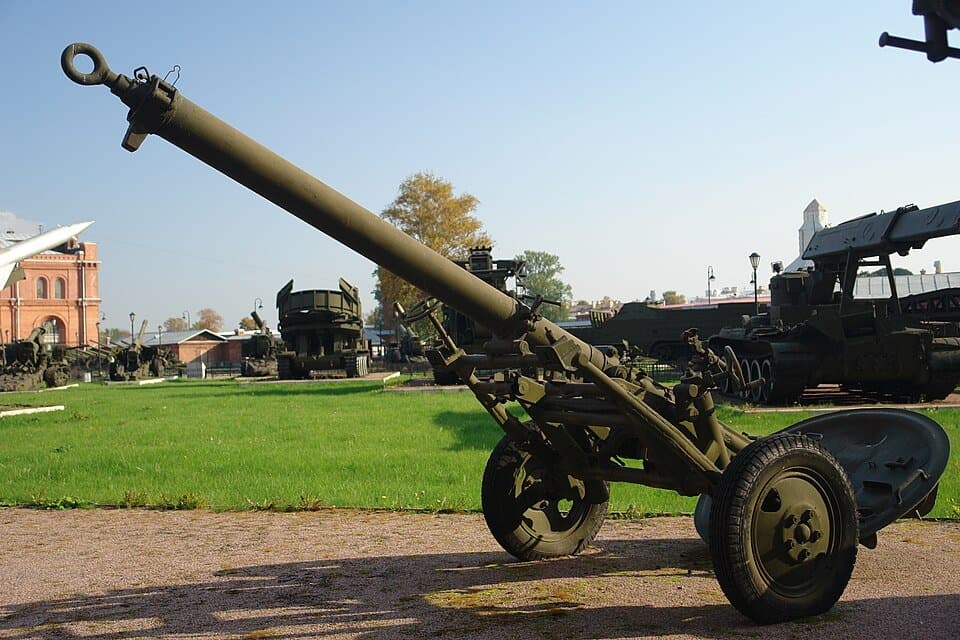
MortarsIn service
Mortar
M-160 mortar is a mortar originating in Soviet Union. It was built by Tula Plant No. 535 (now Tulamashzavod ) V111, V113 and V125 Plant (Vietnam). Reported operators include Russia, Cambodia, Egypt, Syria.
Technical data
Points represent sourced observations, including revisions. Revisions on the same effective date are not separate inventory events. Ranges appear in the table and are not plotted as exact points.
| Observation / report period | Value | Source | Claim state |
|---|---|---|---|
| 28 Sept 2026 | 4.55 m | Wikipedia contributors | superseded |
| 28 Sept 2026 | 4.55 m | Wikipedia contributors | superseded |
| 28 Sept 2026 | 4.55 m | Wikipedia contributors | superseded |
| 28 Sept 2026 | 4.55 m | Wikipedia contributors | superseded |
| 28 Sept 2026 | 4.55 m | Wikipedia contributors | superseded |
| 28 Sept 2026 | 4.55 m | Wikipedia contributors | approved |
Mortar
Soviet Union
1953–present
Arab–Israeli conflict Vietnam War Indo-Pakistani War of 1971 Iran–Iraq War Syrian civil war
Tula Plant No. 535 (now Tulamashzavod ) V111, V113 and V125 Plant (Vietnam)
1949–1957 (USSR) 1974 (Vietnam, with support from USSR)
2,353 (USSR) 100 (Vietnam)
See variants
1,470 kilograms (3,240 lb)
4.55 metres (14.9 ft)
7
41.5 kilograms (91 lb) bomb
160 millimetres (6.3 in)
+50° to +80°
24°
2–3 rounds/minute
343 metres per second (1,130 ft/s)
8,040 metres (8,790 yd)
Russia
Cambodia
Egypt
Syria
China − Produced locally as the Type 56
India
Iraq
Nicaragua − 4 in storage as of 2024
Poland
Romania
The Soviet 160 mm Mortar M-160 is a smoothbore breech loading heavy mortar which fired a 160 mm shell.
The Soviet 160 mm Mortar M-160 is a smoothbore breech loading heavy mortar which fired a 160 mm shell. It replaced the 160mm Mortar M1943 in Soviet service after World War II.
The M-160 has a minimum range of 750 m (820 yd) and a maximum range of 8,040 m (8,790 yd).
According to the combat doctrine of the Vietnamese People's Army , the 160mm mortar was developed to destroy the enemy's fortified bunkers and trenches , and can also be used to ambush military bases. The mortar can be deployed in all terrains such as hills, mountains, plains, and urban areas. It is most effective when deployed in elevated terrain and urban areas where the target is often hidden behind defensive cover.
T-54 with 160 mm mortar − An Iraqi modification of the T-54/T-55 tank, with the turret removed and replaced with a fixed superstructure with an enclosed M-160 mortar with limited traverse. Access doors were provided on the sides and rear of the superstructure and when travelling the mortar was left in horizontal position. It never entered Iraqi Army service in significant numbers.
The M-160 has a minimum range of 750 m (820 yd) and a maximum range of 8,040 m (8,790 yd).
The M-160 has a minimum range of 750 m (820 yd) and a maximum range of 8,040 m (8,790 yd).
Reference text from Wikipedia contributors, used under CC BY-SA 4.0.
M-160 mortar equipment records. Variants, orders and quantities are shown as reported in each inventory source; coverage is incomplete.
 Egypt
Army exact named equipment holdings: M-160. Active, operational-reserve and training units excluding equipment in store; November 2025 IISS assessment. Named service only; no parent-force or national total inferred. Source role: ARTILLERY / 160mm. Original estimates, ranges, reporting names, reserve, lease and employment scopes retained; nested included counts are not added. Missile-system quantities mean launchers, not rounds. No readiness, crew, carried weapon, payload, factory-production or future order count inherited.
 Russia
Stored Army exact named equipment holdings: M-160. Explicit source inventory scope: stored; independently counted whole stock in store. November 2025 IISS assessment. Named service only; no operational holding, readiness or parent-force total inferred. Source role: ARTILLERY / 160mm. Original estimates, ranges, reporting names and exact storage declarations retained. Stored quantities earn no operational index points.
 Cambodia
 Mongolia
 Myanmar
 Syria
 United States