FORCETALLY
Loading the evidence…
Preparing your view.


Preparing your view.
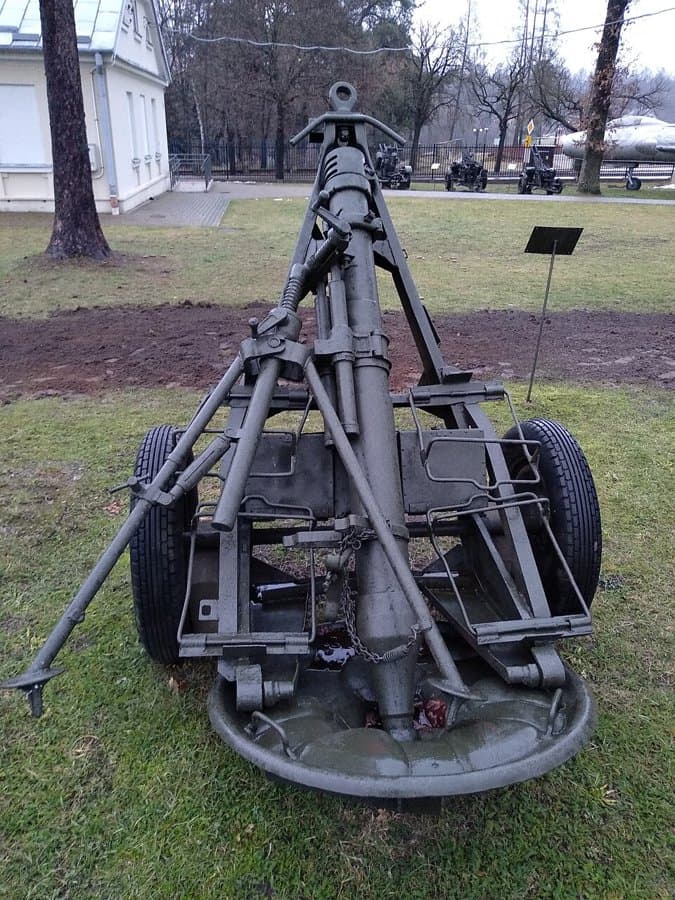
MortarsIn service
Mortar
M1938 mortar is a mortar originating in Soviet Union.
Technical data
Points represent sourced observations, including revisions. Revisions on the same effective date are not separate inventory events. Ranges appear in the table and are not plotted as exact points.
| Observation / report period | Value | Source | Claim state |
|---|---|---|---|
| 28 Sept 2026 | 1.86 m | Wikipedia contributors | superseded |
| 28 Sept 2026 | 1.86 m | Wikipedia contributors | superseded |
| 28 Sept 2026 | 1.86 m | Wikipedia contributors | superseded |
| 28 Sept 2026 | 1.86 m | Wikipedia contributors | superseded |
| 28 Sept 2026 | 1.86 m | Wikipedia contributors | superseded |
| 28 Sept 2026 | 1.86 m | Wikipedia contributors | superseded |
| 28 Sept 2026 | 1.86 m | Wikipedia contributors | superseded |
| 28 Sept 2026 | 1.86 m | Wikipedia contributors | superseded |
| 28 Sept 2026 | 1.86 m | Wikipedia contributors | superseded |
| 28 Sept 2026 | 1.86 m | Wikipedia contributors | superseded |
| 28 Sept 2026 | 1.86 m | Wikipedia contributors | approved |
Mortar
Soviet Union
World War II Chinese Civil War Korean War First Indochina War Vietnam War Suez Crisis Six-Day War Lebanese Civil War Iran–Iraq War
1938
1939
Reșița Model 1942 (Romania)
travel: 477 kg (1,052 lb) combat: 280 kg (620 lb)
1.86 m (6 ft 1 in) L/15.5
6
16 kg (35 lb)
120 mm (4.7 in)
muzzle loaded
+45° to +80°
6°
10 rpm
272 m/s (890 ft/s)
6 km (3.7 mi)
The 120-PM-38 or M1938 was a 120 mm Soviet mortar that was used in large numbers by the Red Army during World War II .
The 120-PM-38 or M1938 was a 120 mm Soviet mortar that was used in large numbers by the Red Army during World War II . Although a conventional design its combination of light weight, mobility, heavy firepower and range saw its features widely copied by successive generations of mortars.
The origins of the M1938 lay in the French Mortier Brandt de 120mm Modele 1935 and the Brandt mle 27/31 which the Soviet Union produced under license as the 82-PM-36 . In 1937 the Soviets produced a modified version of the 82-PM-36 known as the 82-PM-37 and this mortar served as the pattern for the 120-PM-38. The main difference between the 82-PM-37 and the earlier 82-PM-36 was the adoption of a round base-plate, revised traverse/elevation controls, simplified sights and spring-loaded shock absorbers on the bi-pod to reduce the amount of relaying needed between shots. The 120-PM-38 is essentially a scaled up 82-PM-37 which uses the same two-wheeled limber as the 107 mm PBHM-38 . The limber works in much the same way as a hand truck . The limber is wheeled vertically into place, hooks on the base-plate hook onto the limber, the barrel is clamped down and then everything is lowered into towing position. The limber can either be towed directly or attached to a 20-round caisson for towing by a vehicle or horse team.
During the early phases of Operation Barbarossa the Germans captured large quantities of Soviet hardware including the 120-PM-38 which they designated the 12 cm Granatwerfer 378(r) . After being on the receiving end of the 120-PM-38's firepower they adopted it to supplement their own mortars and eventually produced a modified version called the 12 cm Granatwerfer 42 . The Granatwerfer 42 was widely issued to German units and often took the place of infantry guns later in the war. The Finnish and Romanians also made use of captured stocks of Soviet weapons and eventually the Romanians also created their own design, the Reșița Model 1942 , produced at the Reșița Works with a rate of 80 pieces per month as of October 1942.
Выпуск 120-мм миномётов был освоен в осаждённом Ленинграде . Выпущенные миномёты использовались не только в войсках Ленинградского фронта , но и на других фронтах (в ноябре 1941 года 220 шт. 120-мм миномётов были переданы из Ленинграда в Москву и использовались в ходе битвы под Москвой , ещё 25 шт. были переданы в войска Волховского фронта ) . Кроме того, выпуск 120-мм полковых миномётов и 120-мм миномётных мин к ним был освоен на хабаровском заводе "Дальсельмаш" .
Максимальная дальность, м до 5900
Reference text from Wikipedia contributors, used under CC BY-SA 4.0.
M1938 mortar equipment records. Variants, orders and quantities are shown as reported in each inventory source; coverage is incomplete.
 Azerbaijan
Army exact named equipment holdings: M-1938 (PM-38). Active, operational-reserve and training units excluding equipment in store; November 2025 IISS assessment. Named service only; no parent-force or national total inferred. Source role: ARTILLERY / 120mm. Original estimates, ranges, reporting names, reserve, lease and employment scopes retained; nested included counts are not added. Missile-system quantities mean launchers, not rounds. No readiness, crew, carried weapon, payload, factory-production or future order count inherited.
 Moldova
Army exact named equipment holdings: PM-38. Active, operational-reserve and training units excluding equipment in store; November 2025 IISS assessment. Named service only; no parent-force or national total inferred. Source role: ARTILLERY / 120mm. Original estimates, ranges, reporting names, reserve, lease and employment scopes retained; nested included counts are not added. Missile-system quantities mean launchers, not rounds. No readiness, crew, carried weapon, payload, factory-production or future order count inherited.
 Turkmenistan
Army exact named equipment holdings: M-1938 (PM-38). Active, operational-reserve and training units excluding equipment in store; November 2025 IISS assessment. Named service only; no parent-force or national total inferred. Source role: ARTILLERY / 120mm. Original estimates, ranges, reporting names, reserve, lease and employment scopes retained; nested included counts are not added. Missile-system quantities mean launchers, not rounds. No readiness, crew, carried weapon, payload, factory-production or future order count inherited.
 Afghanistan
 Cuba
 Egypt
 Guinea
 Laos
 Libya
 Tajikistan
 United States