FORCETALLY
Loading the evidence…
Preparing your view.


Preparing your view.
Combat aircraftIn service
Ground-attack aircraft and close air support gunship for SOF teams
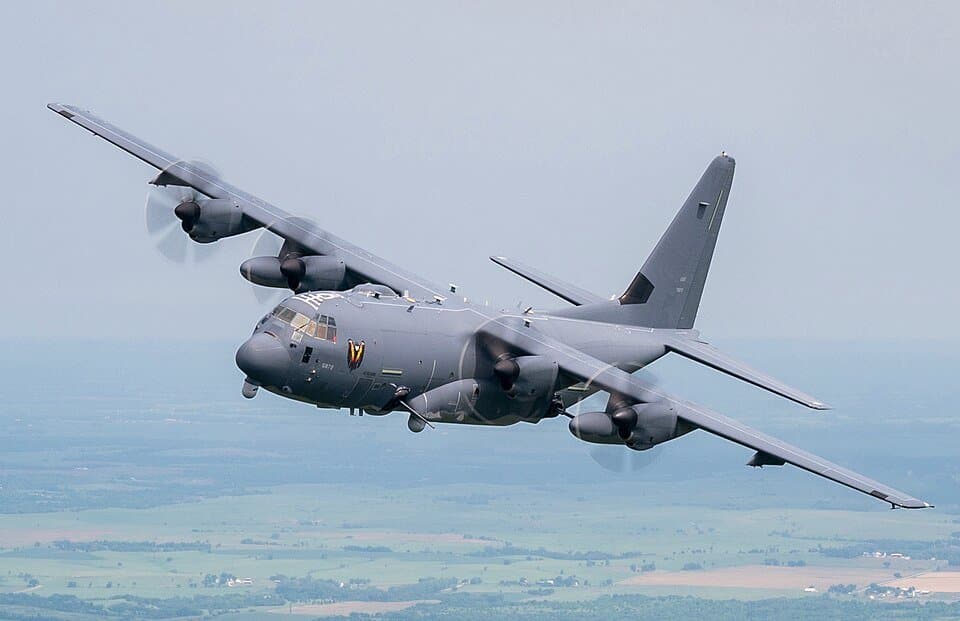
Lockheed AC-130 is a ground-attack aircraft and close air support gunship for SOF teams originating in United States. It was built by Lockheed Martin Boeing. Reported operators include United States Air Force.
 United States
Lockheed AC-130
MSgt Christopher Boitz · Public domain · Resized · Public domain · Source ↗ · ModifiedGround-attack aircraft and close air support gunship for SOF teams
United States
Lockheed Martin Boeing
In service (AC-130J)
United States Air Force
AC-130A: 1968 AC-130H: 1969 AC-130U: 1995 AC-130W: 2012 AC-130J: 2017
AC-130A: 1967
AC-130A: 1995 AC-130H: 2015 AC-130U: 2020 AC-130W: 2022
Lockheed C-130 Hercules Lockheed Martin C-130J Super Hercules
7 Officers: 4 (Two Pilots, Two Combat Systems Officers) Enlisted: 3 (Special Mission Aviators)
97 ft 9 in (29.79 m)
132 ft 7 in (40.41 m)
38 ft 6 in (11.73 m)
1,745.5 sq ft (162.16 m 2 )
155,000 lb (70,307 kg)
4 × Allison T56 -A-15 turboprop engine, 4,300 shp (3,200 kW) each (AC-130U)
362 kn (416 mph, 669 km/h)
39,000 ft (12,000 m)
4 (Two Pilots, Two Combat Systems Officers)
3 (Special Mission Aviators)
6-bladed Dowty R391 featuring ARA-D/A airfoils
Teledyne Ryan (now part of Northrop Grumman ) AN/APN-218 radar – doppler navigation radar
AN/APN-59 radar – search and weather radar
Raytheon AN/APQ-180 multimode attack radar – enhanced version of AN/APG-70 radar (used on F-15E Strike Eagle ) incorporating several enhanced air-to-ground modes such as fixed target track, ground moving target indication and track, projectile impact point position, beacon track, and a weather detection Raytheon AN/AAQ-26 IDS – LWIR FLIR (mounted on port side of the nose landing gear door) Lockheed Martin AN/AAQ-39 Gunship Multispectral Sensor System (GMS2) – EO/IR fire control system consists of mid-wave infrared (MWIR) FLIR, two Image-Intensified Television (I2TV) cameras ( CCD-TV ), laser target designator/rangefinder with eyesafe mode (1064 and 1570 nm dual mode laser emitter), and near-infrared (NIR) laser pointer/marker (860 nm laser emitter) (mounted under the nose of port landing gear sponson)
Raytheon AN/ALR-69 – digital Radar warning receiver (RWR) L-3 Communications AN/AAR-44 – UV-based Missile Approach Warning System (MAWS) ITT Exelis AN/ALQ-172 – Digital radio frequency memory (DRFM) jammer-based Electronic countermeasure (ECM) incorporating integrated Electronic Warfare (EW) self-protection function of detection, processing, warning, prioritization, jamming, and threat display BAE Systems AN/ALQ-196 Low-Band Jammer (LBJ) – low frequency DRFM jammer-based ECM Northrop Grumman AN/AAQ-24 Nemesis – laser-based Directional Infrared Counter Measures (DIRCM) (mounted on the port and starboard rear fuselage) BAE Systems AN/ALE-47 Countermeasure Dispensing System (CMDS) – chaff/flare dispenser
The Lockheed AC-130 gunship is a heavily armed, long-endurance, ground-attack variant of the C-130 Hercules transport, fixed-wing aircraft . It carries a wide array of ground-attack weapons that are integrated with sensors , navigation , and fire-control systems . Since its large profile and low operating altitudes around 7,000 feet (2,100 m) make it an easy target, its close air support missions are usually flown at night.
The AC-130 has an unpressurized cabin, with the weaponry mounted to fire from the port side of the fuselage. During an attack, the gunship performs a pylon turn , flying in a large circle around the target, so is able to fire at it for far longer than in a conventional strafing attack. The AC-130H Spectre was armed with two 20 mm M61 Vulcan cannons, one L/60 Bofors 40 mm cannon, and an M137 105 mm cannon and M37 recoil mechanism from the M102 howitzer . After 1994, the 20 mm cannons were removed. The upgraded AC-130U Spooky has a 25 mm GAU-12 Equalizer cannon in place of the Spectre's two 20 mm cannons, an improved fire-control system, and increased ammunition capacity. The new AC-130J was based on the MC-130J Commando II special-operations tanker. The AC-130W Stinger II is a modified C-130H with upgrades including a precision strike package.
Seven more airframes were converted to the "Plain Jane" configuration like the AC-130 prototype in 1968, and one aircraft received the "Surprise Package" refit in 1969. The Surprise Package upgrade included the latest 20 mm rotary autocannons and 40 mm Bofors cannon , but no 7.62 mm close-support armament. The Surprise Package configuration served as a test bed for the avionic systems and armament for the AC-130E. In 1970, 10 more AC-130As were acquired under the "Pave Pronto" project. In the summer of 1971, Surprise Package AC-130s were converted to the Pave Pronto configuration and assumed the new nickname of "Thor". Conversion of C-130Es into AC-130Es for the "PAVE Spectre" project followed. Regardless of their project names, the aircraft were more commonly referred to by the squadron's call sign, Spectre.
In 2007, AFSOC initiated a program to upgrade the armament of AC-130s. The test program planned for the 25 mm GAU-12/U and 40 mm Bofors cannon on the AC-130U gunships to be replaced with two 30 mm Mk 44 Bushmaster II cannons. In 2007, the Air Force modified four AC-130U gunships as test platforms for the Bushmasters. These were referred to as AC-130U Plus 4 or AC-130U+4. AFSOC, however, canceled its plans to install the new cannons on its fleet of AC-130Us. It has since removed the guns and reinstalled the original 40 mm and 25 mm cannons and returned the planes to combat duty. Brigadier General Bradley A. Heithold, AFSOC's director of plans, programs, requirements, and assessments, said on 11 August 2008 that the effort was canceled because of problems with the Bushmaster's accuracy in tests "at the altitude we were employing it". Schedule considerations also drove the decision, he said.
Plans were made for the possible replacement of the 105 mm M102 howitzer with a breech-loading variant of the 120 mm M120 mortar . The 120mm breech-loading mortar concept offers more flexibility with the use of munitions that are currently available with greater lethality, precision strike capabilities, reduction in collateral damage, and decreased casualties in danger close scenarios. Using the newer AGM-114 Hellfire missiles, the Advanced Precision Kill Weapon System (based on the Hydra 70 rockets), or the Viper Strike glide bombs can dramatically increase the standoff capability of the AC-130.
The conceptual breechloading variant of the 120 mm M120 mortar has several key advantages over the conventional M102 105 mm howitzer. 100 rounds of ammunition weighs 4,200 lb (1,900 kg) for the M102 105 mm howitzer compared to 3,200 lb (1,500 kg) for the M120 120 mm mortar. The recoil load is 10,900 lbf (48,000 N) with the 105 mm howitzer compared to 5,600 lbf (25,000 N) with the M120 120 mm mortar. The gun recoiling weight for the M102 105 mm howitzer is 1,465 lb (665 kg) compared to 1,315 lb (596 kg) for the M120 120 mm mortar. The muzzle pressure for the M102 105 mm howitzer is 3,560 psi (24.5 MPa) compared to 1,620 psi (11.2 MPa) for the M120 120 mm mortar.
In 2010, the Air Force awarded L-3 Communications a $61 million (~$85.4 million in 2024) contract to add precision strike packages to eight MC-130W Combat Spear special-mission aircraft to give them a gunship-like attack capability; such-equipped MC-130Ws are known as Dragon Spears. AFSOC is arming these aircraft to relieve the high operational demands on AC-130 gunships until new AC-130Js enter service. The MC-130W Dragon Spear was renamed AC-130W Stinger II in 2011. The precision strike packages consist of a 30 mm gun and several precision guided munitions . Rails are mounted on the outboard pylon of the wing for four Hellfire missiles, SDBs, or SDB IIs under each. Ten common launch tubes (CLTs) are mounted on the rear ramp to fire Griffin A missiles; additional missiles are stored in the aircraft that can be reloaded in flight. CLTs are able to fire other small munitions able to fit inside the 6-inch (15 cm)-diameter, 48-inch (1.2 m)-long tubes.
The AC-130J Ghostrider came from a 2011 initiative that sought to acquire 16 new gunships based on newly built MC-130J Commando II special-operations tankers outfitted with a "precision strike package" to give them an attack capability, requesting $1.6 billion from fiscal years 2011 through 2015. This was to increase the size of the gunship fleet to 33 aircraft, a net increase of eight after the planned retirement of eight aging AC-130Hs. The first aircraft would be bought in fiscal 2012, followed by two in fiscal 2013, five in fiscal 2014, and the final eight in fiscal 2015. The decision to retain the C-130 came after funding for 16 C-27Js was removed from the fiscal 2010 budget.
The AC-130J was to follow the path of the Dragon Spear program. On 9 January 2013, the Air Force began converting the first MC-130J into an AC-130J. The first AC-130J was delivered to AFSOC on 29 July 2015. The first AC-130J gunships achieved initial operational capability (IOC) on 30 September 2017. The AC-130J has two planned increments: the Block 10 configuration includes an internal 30 mm gun, small diameter bombs, and laser-guided missiles launched from the rear cargo door; and Block 20 configuration adds a 105 mm cannon, large aircraft infrared countermeasures , wing-mounted Hellfire missiles, and radio-frequency countermeasures.
The Air Force decided to add a 105 mm cannon to the AC-130J in addition to the 30 mm cannon and smart bombs, the shells being more accurate and cheaper than dropping SDBs.
It was to produce a beam of up to 120 kW, or potentially even 180–200 kW, weigh about 5,000 lb (2,300 kg), defensively destroy antiaircraft missiles, and offensively engage communications towers, boats, cars, and aircraft.
A laser armament would have only been installed on a few aircraft rather than the entire AC-130J fleet; the laser would be mounted on the side in place of the 30 mm cannon.
AFSOC was to initially use the Raytheon Coyote small UAV for the TOBS mission, as it is an off-the-shelf design with a one-hour endurance, but planned to fulfill the role with a new drone capable of a four-hour endurance by 2019.
The Air Force was also interested in acquiring a glide bomb that can be launched from the CLTs, capable of hitting ground vehicles traveling as fast as 120 km/h (70 mph) while above 10,000 ft (3,000 m). In June 2016, Dynetics was awarded a contract by SOCOM to integrate its tactical munition onto the AC-130. Designated the GBU-69/B Small Glide Munition, the weapon weighs 27 kg (60 lb) and is armed with a 16-kilogram (35 lb) blast-fragmentation warhead that can detonate by direct impact or at a selected height; despite being smaller, being unpowered allows for its warhead to be heavier than those on the Hellfire and Griffin A missiles, 9 kg (20 lb) and 5.9 kg (13 lb), respectively. Guidance is provided by a GPS receiver with anti-spoofing software and four distributed-aperture semiactive laser seeker apertures adapted from the WGU-59/B APKWS for terminal guidance. Approval for fielding occurred in early 2017. Dynetics was awarded a contract to deliver an initial batch of 70 SGMs in June 2017, with plans to buy up to 1,000. The SGM can travel 20 mi (32 km).
AFSOC is considering a number of changes to the AC-130J in order to make it effective against advanced adversaries including removing the 105mm cannon and upgrading the aircraft with small cruise missiles , an AESA radar , and adaptive mission networking enhancements. In 2025, it was announced that the aircraft has carried out launch tests of Black Arrow , also known as the Small Cruise Missile (SCL), using its Ramp Launch Tubes.
The AC-130U is equipped with the AN/APQ-180 , a synthetic aperture radar , for long-range target detection and identification. The gunship's navigational devices include inertial navigation systems and a global positioning system . The AC-130U employs technologies developed in the 1990s, which allow it to attack two targets simultaneously. It has twice the munitions capacity of the AC-130H. Although the AC-130U conducts some operations in daylight, most of its combat missions are conducted at night. The AC-130H's unit cost is US$132.4 million, and the AC-130U's cost is $190 million (fiscal 2001 dollars).
The PGM-38/U enhanced 25 mm high-explosive incendiary round was created to expand the AC-130U gunships' mission in standoff range and survivability for its 25 mm GAU-12/U gun. This round is a combination of the existing PGU-25 HEI and a M758 fuze designated as FMU-151/B to meet the MIL-STD-1316. The FMU-151 has an improved arming delay with multisensitive range.
In late 1969, under code name "Surprise Package", 56-0490 arrived with solid-state, laser-illuminated, low light-level TV with a companion YAG laser designator , an improved forward-looking infrared (FLIR) sensor, video recording for TV and FLIR, an inertial navigation system , and a prototype digital fire-control computer. The remaining AC-130s were refitted with upgraded similar equipment in the summer of 1970, and then redeployed to Ubon RTAFB. On 25 October 1971, the first "Cadillac" gunship, the AC-130E, arrived in Vietnam. On 17 February 1972, the first 105mm cannon arrived for service with Spectre and was installed on Gunship 570. It was used from mid-February until the aircraft received battle damage to its right flap. The cannon was switched to Gunship 571 and was used until 30 March when the aircraft was shot down.
With the conclusion of hostilities in Southeast Asia in the mid-1970s, the AC-130H became the sole gunship in the regular Air Force, home based at Hurlburt Field, Florida, while the AC-130A fleet was transferred to the Air Force Reserve's 919th Tactical Airlift Group (919 TAG) at Eglin AFB Auxiliary Field #3/ Duke Field , Florida. With the transition to the AC-130A, the 919 TAG was then redesignated as the 919th Special Operations Group .
In the late 1970s, when the AC-130H fleet was first being modified for in-flight refueling capability, a demonstration mission was planned and flown from Hurlburt Field, Florida, nonstop, to conduct a 2-hour live-fire mission over Empire Firing Range in the Republic of Panama, then return home. This 13-hour mission with two in-flight refuelings from KC-135 tankers proved the validity of flying long-range missions outside the contiguous United States to attack targets then return to home base without intermediate stops.
In July 1979, AC-130H crews deployed to Howard Air Force Base , Panama, as a precaution against possible hostile actions against American personnel during the Nicaraguan Revolution . New time aloft and nonstop distance records were subsequently set by a 16th SOS two-ship AC-130H formation flight that departed Hurlburt Field on 13 November 1979 and landed on 15 November at Andersen Air Force Base , Guam , a distance of 7,200 nautical miles (13,300 km) and 29 hours 43 minutes nonstop, refueling four times in-flight. Refueling support for the Guam deployment was provided by KC-135 crews from the 305th Air Refueling Wing from Grissom AFB , Indiana.
In November 1979, four AC-130H gunships flew nonstop from Hurlburt Field to Anderson AFB, Guam, because of the hostage situation at the US Embassy in Iran . On Guam, AC-130H crews developed communications-out/lights-out refueling procedures for later employment by trial-and-error. This deployment with the 1 SOW/CC as task force commander was directed from the office of the CJCS for fear that Iranian militants could begin executing American Embassy personnel who had been taken hostage on 4 November . One early option considered AC-130H retaliatory punitive strikes deep within Iran. Later gunship flights exceeded the 1979 Hurlburt-to-Guam flight. Upon return in March 1980, the four planes soon found themselves in Egypt to support the ill-fated hostage rescue attempt .
During the Gulf War of 1990–1991 (Operations Desert Shield and Desert Storm), Regular Air Force and Air Force Reserve AC-130s provided close air support and force protection (air base defense) for ground forces, and battlefield interdiction. The primary interdiction targets were early-warning/ ground-control intercept sites along the southern border of Iraq . At its standard altitude of 12,000 ft (3,700 m), the aircraft had a proven ability to engage moving ground targets. The first gunship to enter the Battle of Khafji helped stop a southbound Iraqi armored column on 29 January 1991. One day later, three more gunships provided further aid to Marines participating in the operation. The gunships attacked Iraqi positions and columns moving south to reinforce their positions north of the city.
Despite the threat of SAMs and increasing visibility during the early morning hours of 31 January 1991, one AC-130H, AF Serial No. 69-6567, call-sign Spirit 03, opted to stay to continue to protect the Marines. A lone Iraqi with a Strela-2 MANPADS shot Spirit 03 down, and all 14 crew members were killed. The loss of Spirit 03 did however result in the US DoD joining the development of the AN/AAQ-24 Directed Infrared Countermeasures System which, in its updated laser-based form, is now a common fit across large US military aircraft.
The AC-130U gunship set a new record for the longest sustained flight by any C-130 on 22 and 23 October 1997, when two AC-130U gunships flew 36 hours nonstop from Hurlburt Field to Taegu Air Base (Daegu), South Korea, being refueled seven times in the air by KC-135 tankers. The two gunships took on 410,000 lb (186,000 kg) of fuel. Gunships also were part of the buildup of US forces in 1998 to compel Iraq to allow UNSCOM weapons inspections.
During the intense fighting, the planes fired more than 1,300x 40mm and 1,200x 105mm rounds.
Close air support was the main mission of the AC-130 in Iraq. Night after night, at least one AC-130 was in the air to fulfill one or more air-support requests (ASRs). A typical mission had the AC–130 supporting a single brigade's ASRs followed by aerial refueling and another two hours with another brigade or SOF team. The use of AC-130s in places like Fallujah, urban settings where insurgents were among crowded populations of non-combatants, was criticized by human rights groups. AC-130s were also used for intelligence gathering with their sophisticated long-range video, infrared and radar sensors. In 2007, US Special Operations forces also used the AC-130 in attacks on suspected Al-Qaeda militants in Somalia.
Eight AC-130H and 17 AC-130U aircraft were in active-duty service as of July 2010. In March 2011, the Air Force deployed two AC-130U gunships to take part in Operation Odyssey Dawn , the US military intervention in Libya , which eventually came under NATO as Operation Unified Protector .
By September 2013, 14 MC-130W Dragon Spear aircraft have been converted to AC-130W Stinger II gunships. The Stinger gunships have been deployed to Afghanistan to replace the aging AC-130H aircraft and provide an example for the new AC-130J Ghostrider. Modifications began by cutting holes in the plane to make room for weapons and adding kits and bomb bases for laser-guided munitions. Crews added a 105 mm cannon, 20-inch infrared and electro-optical sensors, and the ability to carry 250-lb bombs on the wings.
The final AC-130H Spectre gunship, tail number 69-6569 "Excalibur" was retired on 26 May 2015 at Cannon Air Force Base , New Mexico.
On 3 October 2015, an AC-130 mistakenly attacked the Doctors Without Borders hospital in Kunduz, Afghanistan , killing 42 people and injuring over 30. In five separate runs, the gunship struck the hospital, which had been erroneously identified as the source of attacks on coalition members. Subsequent inquiries led to punishment of 16 military personnel and cited "human error" as the root cause.
On 30 September 2017, the Air Force declared the AC-130J Ghostrider had achieved initial operational capability, with six gunships having been delivered; the aircraft is planned to reach full operational capability by 2023 with 37 gunships delivered. The J-variant is lighter and more fuel efficient than previous versions, able to fly at 416 mph (669 km/h) with a range of 3,000 mi (4,800 km) and service ceiling of 28,000 ft (8,500 m). The AC-130U returned from its final combat deployment on 8 July 2019; the final AC-130U was retired in June 2020. AFSOC started taking delivery of the AC-130J in spring 2019, and the aircraft began deploying to Afghanistan by the summer.
Based on MC-130J ; 32 aircraft were procured as of 2014 to replace the AC-130H. As of 2018, the first AC-130J Ghostrider squadron, the 73rd Special Operations Squadron, is operating from Hurlburt Field, Florida.
Conversions of C-130Es ; 11 completed; 10 upgraded to AC-130H configuration.
AC-130H Spectre
The 37 mm shell destroyed everything below the crew deck and barely missed striking two crew members.
Ultimate End demonstrated the durability of the C-130 after surviving hits in five places by 37 mm anti-aircraft artillery on 12 December 1970, extensive left wing leading edge damage on 12 April 1971 and a 57 mm round damaging the belly and injuring one crewman on 4 March 1972.
A third AC-130A, AF serial no. 54–1630, is on display in the Cold War Gallery at the National Museum of the United States Air Force at Wright-Patterson AFB , Ohio. Named Azrael for the angel of death in Islam who severs the soul from the body, this aircraft figured prominently in the closing hours of Operation Desert Storm. On 26 February 1991, Coalition ground forces were driving the Iraqi Army out of Kuwait. With an Air Force Reserve crew called to active duty, Azrael was sent to the Al Jahra highway (Highway 80) between Kuwait City and Basra , Iraq, to intercept the convoys of tanks, trucks, buses, and cars fleeing the battle. Facing SA-6 and SA-8 surface-to-air missiles and 37 mm and 57 mm radar-guided anti-aircraft artillery the crew attacked and destroyed or disabled most of the convoys. Azrael was also assigned to the 919th Special Operations Wing and retired to the museum in October 1995.
AC-130H serial no. 69-6575, named "Wicked Wanda" is on display at the Hurlburt Field, FL airpark.
Length: 97 ft 9 in (29.79 m)
Wingspan: 132 ft 7 in (40.41 m)
Height: 38 ft 6 in (11.73 m)
Wing area: 1,745.5 sq ft (162.16 m 2 )
Max takeoff weight: 155,000 lb (70,307 kg)
Powerplant: 4 × Allison T56 -A-15 turboprop engine, 4,300 shp (3,200 kW) each (AC-130U)
Powerplant: 4 × Rolls-Royce AE 2100D3 , 4,700 shp (3,500 kW) each (AC-130J)
Maximum speed: 362 kn (416 mph, 669 km/h)
Service ceiling: 39,000 ft (12,000 m)
4 × 7.62 mm GAU-2/A miniguns
4 × 20 mm (0.787 in) M61 Vulcan 6-barrel rotary cannon
2× 7.62 mm GAU-2/A miniguns
2× 20 mm M61 Vulcan cannon
2× 40 mm (1.58 in) L/60 Bofors cannon
1× 40 mm (1.58 in) L/60 Bofors cannon
1× 105 mm (4.13 in) M102 howitzer
AC-130H Spectre (retired)
1× General Dynamics 25 mm (0.984 in) GAU-12/U Equalizer 5-barreled rotary cannon
1× 30 mm ATK GAU-23/A autocannon
1× 105 mm M102 howitzer
The J-variant is lighter and more fuel efficient than previous versions, able to fly at 416 mph (669 km/h) with a range of 3,000 mi (4,800 km) and service ceiling of 28,000 ft (8,500 m).
Leermasse 28.575 kg
Reference text from Wikipedia contributors, used under CC BY-SA 4.0.
True scale
Sourced dimensions beside a 1.75 m human reference.
Points represent sourced observations, including revisions. Revisions on the same effective date are not separate inventory events. Ranges appear in the table and are not plotted as exact points.
| Observation / report period | Value | Source | Claim state |
|---|---|---|---|
| 28 Sept 2026 | 7 people | Wikipedia contributors | superseded |
| 28 Sept 2026 | 7 people | Wikipedia contributors | superseded |
| 28 Sept 2026 | 7 people | Wikipedia contributors | superseded |
| 28 Sept 2026 | 7 people | Wikipedia contributors | superseded |
| 28 Sept 2026 | 7 people | Wikipedia contributors | superseded |
| 28 Sept 2026 | 7 people | Wikipedia contributors | approved |
Lockheed AC-130 equipment records. Variants, orders and quantities are shown as reported in each inventory source; coverage is incomplete.
United StatesAir Force Special Operations Command (AFSOC) exact named equipment holdings: AC-130J Ghostrider. Active, operational-reserve and training units excluding equipment in store; November 2025 IISS assessment. Named service only; no parent-force or national total inferred. Source role: AIRCRAFT / ATK. Original estimates, ranges, reporting names, reserve, lease and employment scopes retained; nested included counts are not added. Missile-system quantities mean launchers, not rounds. No readiness, crew, carried weapon, payload, factory-production or future order count inherited.
Keep exploring
Ground-attack aircraft and close air support gunship
United StatesCompare with Lockheed AC-130 Attack aircraft / close air support
Compare with Lockheed AC-130Attack aircraft / close air support
Compare with Lockheed AC-130Close air support attack aircraft
United StatesCompare with Lockheed AC-130 Ground-attack aircraft
 ChinaCompare with Lockheed AC-130