FORCETALLY
Loading the evidence…
Preparing your view.


Preparing your view.
Naval support & landing craftIn service
Topsail schooner or Barquentine
Jadran (training ship) is a topsail schooner or Barquentine. It was built by H. C. Stülcken Sohn , Hamburg.
 Germany
Jadran (training ship)
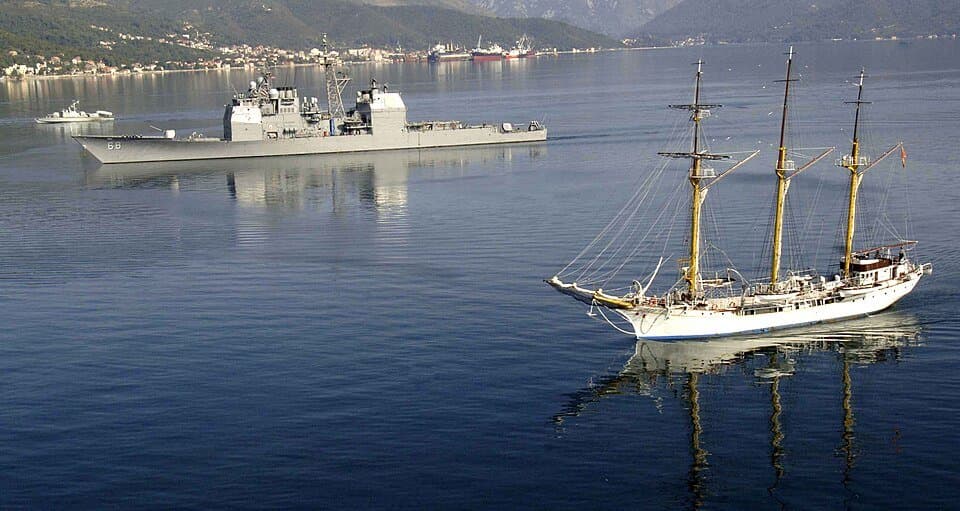
U.S. Navy photo by Mass Communication Specialist 3rd Class Matthew D. Leistikow · Public domain · Resized · Public domain · Source ↗ · ModifiedJadran
Adriatic Sea
4 September 1930
H. C. Stülcken Sohn , Hamburg
8,407,030 dinars
1930
25 June 1931
19 August 1933
Captured by Italians in April 1941
1941
1945
Montenegrin Navy
MMSI number : 262999000 Callsign : 4OMA
In active service
Topsail schooner or Barquentine
720 long tons (730 t)
60 m (196 ft 10 in) ( oa )
8.90 m (29 ft 2 in)
39.1 m (128 ft 3 in)
4.05 m (13 ft 3 in)
14.5 knots (26.9 km/h; 16.7 mph) (sail alone) 8.5–9 kn (15.7–16.7 km/h; 9.8–10.4 mph) (engine alone)
3,000 nautical miles (5,600 km; 3,500 mi) at 9 kn (17 km/h; 10 mph) 4,600 nmi (8,500 km; 5,300 mi) at 6 kn (11 km/h; 6.9 mph)
156
Name Jadran
Jadran was constructed of steel as a three-mast topsail schooner , although some sources describe her as a barquentine . She had a displacement of 720 long tons (730 t), a length overall of 60 m (196 ft 10 in), and waterline length of 41 m (134 ft 6 in). Her beam was 8.90 m (29 ft 2 in), her draught was 4 m (13 ft 1 in) forward and 4.2 m (13 ft 9 in) aft, with an average draught of 4.05 m (13 ft 3 in), and her hull depth ranged between 4.55 m (14 ft 11 in) and 6.43 m (21 ft 1 in). The hull and lower masts were built of Siemens-Martin steel , and there were three steel decks : upper, main, and between-deck. The weather decks were covered with Oregon pine planks. Steel transverse bulkheads divided the hull into compartments , intended to keep the ship afloat even if a compartment was entirely flooded. Both forward and aft collision bulkheads were part of the design. Due to the rough sea conditions in the Adriatic, her anchors and chains were made stronger than was usually required by Norddeutscher Lloyd . She carried 125 long tons (127 t) of ballast .
The total sail area was 800 m 2 (8,600 sq ft), the main mast was 39.1 m (128 ft 3 in) high and the rigging was a total of 11 km (6.8 mi) long. With sails alone, Jadran could reach 14.5 knots (26.9 km/h; 16.7 mph). The ship had a Linke-Hoffmann-Busch 6-cylinder diesel engine for auxiliary propulsion which generated 380 bhp (280 kW) and under its power alone Jadran could achieve a top speed of 8.5–9 kn (15.7–16.7 km/h; 9.8–10.4 mph). With a full 24.5 t (24.1 long tons; 27.0 short tons) of fuel, the ship's range on the engine alone was 3,000 nautical miles (5,600 km; 3,500 mi) at 9 knots and 4,600 nmi (8,500 km; 5,300 mi) at 6 kn (11 km/h; 6.9 mph). Jadran had auxiliary generators for electricity and a steam boiler for heating the engine room and cabins . The exhaust for the auxiliary engine was hidden in the trunk of the mizzen mast, with the opening well above the bridge.
Jadran was initially equipped with seven or eight ship's boats : three cutters , one of which was equipped as a lifeboat , and a second as a motorboat ; two yawls ; two dinghies ; and a ceremonial gig . Most of the boats were hung on davits outboard, and were only brought on deck to secure them in poor weather. The ship held four outboard engines for use with the ship's boats. Her armament consisted to two 47 mm (1.9 in) L/33 saluting guns and two obsolescent 7.9 mm (0.31 in) Schwarzlose machine guns of World War I vintage, with 56 rifles for the crew. She was fitted with an electrical fire alarm and semi-automatic foam fire suppression systems.
Her 3,114 nmi (5,767 km; 3,584 mi) voyage to Yugoslavia had been completed in 17 sailing days, at an average speed of 7.5 kn (13.9 km/h; 8.6 mph).
The voyage was the longest made by Jadran in the pre-war period, a total of 11,262 nmi (20,857 km; 12,960 mi).
New topmasts and gaffs were installed and rigged, a 380 bhp (280 kW) Fiat diesel engine, new shaft tunnel and propeller, new auxiliary engines, water and drainage plumbing, electrical cabling and instruments were installed, the pine deck planking was replaced, and the complement of boats reduced to two yawls, two dinghies and one gig.
Her ballast was increased to 179.5 long tons (182.4 t).
Her foremast was 37.3 m (122 ft 5 in) high, her main mast remained at 39.1 m high, and her mizzen mast was 35.8 m (117 ft 5 in) high.
New sail sets were ordered in linen and synthetic fibre, and her total sail area increased to 933 m 2 (10,040 sq ft).
Her Fiat engine was replaced by a Burmeister & Wain Alpha engine, produced under license by Litostroj of Ljubljana , generating 500 bhp (373 kW), and under its power alone the ship could sail at a maximum speed of 10.4 kn (19.3 km/h; 12.0 mph), although this later reduced to 9.5 kn (17.6 km/h; 10.9 mph).
A total of 26.95 tonnes (29.71 tons) of fuel meant that the ship's range on the engine alone increased to 4,730 nmi (8,760 km; 5,440 mi) at 7 kn (13 km/h; 8.1 mph).
Her displacement also increased to 776.5 t (855.9 tons).
With 48 long tons (49 t) of water and a hold full of supplies, the ship could sail for two weeks without reprovisioning.
For example, Jadran undertook two training cruises in late 1972 and a further two in 1974, and nine cruises in the first half of 1975.
The same year, she sailed over 5,000 nmi (9,300 km; 5,800 mi).
In the summer of 2006, Montenegro became an independent state, and ships that had served in the state union became the property of the new country. Jadran sailed to Barcelona in 2008 as part of an event organized by the International Union for Conservation of Nature for the 2008 World Conservation Congress. It sailed with 20 other sailing vessels, ranging from schooners to catamarans , and two research vessels, leaving Kotor on 24 September and arriving in Barcelona on 10 October. She then led a contingent of sailing vessels to the congress site on 12 October. The ship sailed with her usual sailing crew of 34 plus trainees and conservationists. This was the first time that the ship had carried civilian passengers. She was valued at approximately US$8,000,000 in 2008. In 2009, she was in good shape, and there were plans to offer sailing training to trainees from neighboring countries. In 2013, the Montenegrin government funded another overhaul of Jadran .
On 19 April 2019, Montenegrin military police seized around 50 kg (110 lb) of cocaine on the ship, just before its scheduled Tivat-Istanbul-Piraeus voyage. Three days later, Duško Radenović, a midshipman of the Montenegrin Navy , was arrested for drug smuggling. In December 2021, the Montenegrin government announced that it had agreed with Croatia to form an inter-governmental commission to resolve the ship's future status. In the statement, Montenegrin prime minister Zdravko Krivokapić stated that relations between the two countries were "friendly" on the whole, and that since Montenegrin independence, Croatia had continually supported Montenegro's process of European integration.
Jadran is a sailing ship for basic naval training built for the Yugoslav Royal Navy and currently in Montenegrin Navy service. A three-mast topsail schooner or barquentine with an auxiliary engine, Jadran was built in Hamburg , Germany between 1930 and 1933, and commissioned on 19 August 1933. Prior to World War II she completed seven long training cruises with trainees from the Yugoslav Naval Academy, including one to North America. As Yugoslavia was neutral at the outbreak of World War II, Jadran was able to conduct short cruises in the Adriatic Sea . In April 1941, Yugoslavia was invaded by the Axis powers , and Jadran was captured and renamed Marco Polo by the Italian Navy . She continued to be used as a training ship in the Adriatic, operating out of the Istrian port of Pola , and was featured in an Italian propaganda film.
Reference text from Wikipedia contributors, used under CC BY-SA 4.0.
True scale
Sourced dimensions beside a 1.75 m human reference.
Points represent sourced observations, including revisions. Revisions on the same effective date are not separate inventory events. Ranges appear in the table and are not plotted as exact points.
| Observation / report period | Value | Source | Claim state |
|---|---|---|---|
| 1 Oct 2026 | 8.9 m | Wikipedia contributors | superseded |
| 1 Oct 2026 | 8.9 m | Wikipedia contributors | approved |
Jadran (training ship) equipment records. Variants, orders and quantities are shown as reported in each inventory source; coverage is incomplete.
 Montenegro
Navy exact named Jadran component holdings; active, operational-reserve and training equipment excluding equipment in store, except explicit status exclusions stated below. November 2025 IISS assessment. Named service only, not a national total or combat-readiness measure. Source armament/capacity counts are excluded.
Reported count for Jadran. Service scope: Montenegrin Navy; does not replace a national total. 1 distinct quantity component(s) from the same source list; shared rowspan cells counted once. Explicit source inventory scope: active; no other stock status or total inferred. Count column(s): number: 1. Origin: unstated. The listed variants/roles are the scope, not an immediately deployable count. The components do not establish one inventory census date; the stored date is the retrieved source snapshot.
Keep exploring
Iron-hulled barquentine
 France
Sail training ship
 United Kingdom
Sail training ship
 Australia
Sail training ship
 United StatesCompare with Jadran (training ship)
Command ship (originally submarine tender )
 Japan
sail training vessel
Germany