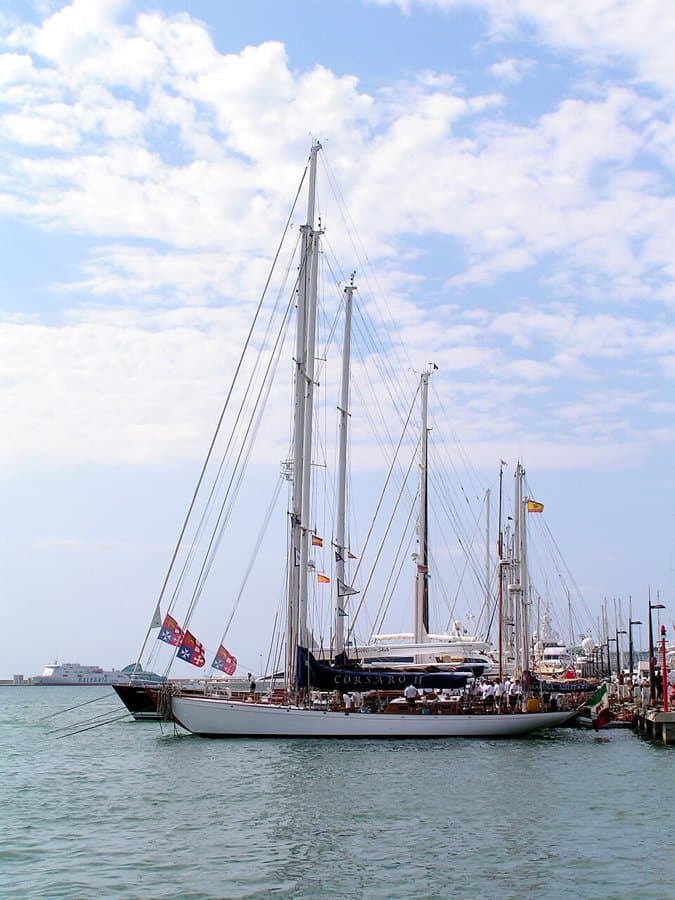

Credit
Lucas Rodriguez Crespo · CC BY-SA 3.0 es · Resized · CC BY-SA 3.0 es · Source ↗ · Modified


Preparing your view.

At a glance
Italian training ship Corsaro IIlarger figure on 0 of 3
Measured figures
Length
Single sourceLOA
Single sourceConfiguration
| Specification | Italian training ship Corsaro II | Jadran (training ship) |
|---|---|---|
| Power | 1 x diesel engine FIAT AIFO 71.59 kW (96.00 bhp) 1 shaft 1 x diesel engine generator Fischer Panda[source] | — |
| Name | Corsaro II[source] | Jadran[source] |
| Operator | Italian Navy[source] | — |
| Builder | Cantiere Navale Costaguta Voltri , Genova , Italy[source] | H. C. Stülcken Sohn , Hamburg[source] |
| Launched | 1960 |
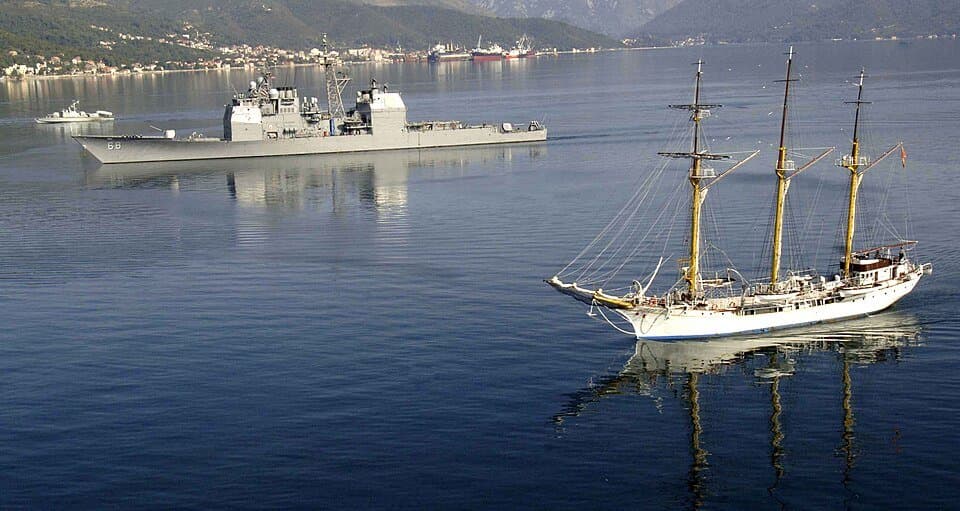
Jadran (training ship)larger figure on 3 of 3
Counts only measures both sources give with the same scope. A larger figure is not a better system.
LPP
Single sourceoa
Single source60 m (196 ft 10 in) ( oa )[source]
at 7.0 knots (13.0 km/h; 8.1 mph) (on engine prop)
Single source500 nmi (930 km; 580 mi) at 7.0 knots (13.0 km/h; 8.1 mph) (on engine prop)[source]
500 miglia (motore)[source]
at 6 kn (11 km/h; 6.9 mph)
Single sourceat 9 kn (17 km/h; 10 mph)
Single source3,000 nautical miles (5,600 km; 3,500 mi) at 9 kn (17 km/h; 10 mph) 4,600 nmi (8,500 km; 5,300 mi) at 6 kn (11 km/h; 6.9 mph)[source]
Bars compare reported quantities only. A larger figure does not make a system better; configurations and test conditions differ.
25 June 1931[source] |
| Commissioned | 5 January 1961[source] | 19 August 1933[source] |
|---|
| In service | — |
|---|
| Home port | La Spezia[source] | — |
|---|
| Identification | ITA 1643 (Sail number)[source] | MMSI number : 262999000 Callsign : 4OMA[source] |
|---|
| Status | in service[source] | In active service[source] |
|---|
| Notes | Pennant number A 5316[source] | — |
|---|
| Type | Sail training ship[source] | Topsail schooner or Barquentine[source] |
|---|
| Tonnage | 47 t (46 long tons) full load[source] | — |
|---|
| Sail plan | - Sail surface 700 square metres (7,500 square feet ) - Sail surface upwind 205 square metres (2,210 square feet )[source] | — |
|---|
| Source measurement | Designed by Sparkman & Stephens Designs New York City (United States), project 1505, Corsano II for the RORC 1st class, is a Bermudan-rig yawl , sister of Stella Polare , commissioned by Italian Navy to be used as a training ship for the cadets at the Italian Naval Academy in Livorno , Italy. She is constructed of wood; iroko keelson, acacia frames and double planked of Philippine mahogany. The ship's fasteners are silicon bronze, spars are of sitka spruce. Original engine Mercedes-Benz OM/321 (96 HP) was then replaced by a FIAT AIFO engine.[source]Italian training ship Corsaro II · Characteristics; only the objects and conditions stated in this passage Corsaro II can accommodate 16 persons. First Commander of the ship was Agostino Straulino , who won the 1952 Olympic Games in the class Star. In 1961 Corsaro II was the only naval ship to join in the Los Angeles – Honolulu classifying sixth in real time. In 1962 participated in the Newport – Bermuda with 138 boats arriving at the sixth place, and in the Torbay – Rotterdam arriving first in the class. In 1963 participated in: Annapolis – Newport, Newport – Plymouth (second place), the Channel Race and the Fastnet Race. In 1964 took part in the Lisbon – Canaries – Bermuda reaching the first place. In 1965 participated in the Buenos Aires – Rio de Janeiro then sailed to Sydney racing in local regatta. The following year sailed from Sydney to San Diego coming to Italy. From then on the Corsaro II participated mainly in the Mediterranean sea with home port in La Spezia .[source]Italian training ship Corsaro II · History; only the objects and conditions stated in this passage | Jadran was constructed of steel as a three-mast topsail schooner , although some sources describe her as a barquentine . She had a displacement of 720 long tons (730 t), a length overall of 60 m (196 ft 10 in), and waterline length of 41 m (134 ft 6 in). Her beam was 8.90 m (29 ft 2 in), her draught was 4 m (13 ft 1 in) forward and 4.2 m (13 ft 9 in) aft, with an average draught of 4.05 m (13 ft 3 in), and her hull depth ranged between 4.55 m (14 ft 11 in) and 6.43 m (21 ft 1 in). The hull and lower masts were built of Siemens-Martin steel , and there were three steel decks : upper, main, and between-deck. The weather decks were covered with Oregon pine planks. Steel transverse bulkheads divided the hull into compartments , intended to keep the ship afloat even if a compartment was entirely flooded. Both forward and aft collision bulkheads were part of the design. Due to the rough sea conditions in the Adriatic, her anchors and chains were made stronger than was usually required by Norddeutscher Lloyd . She carried 125 long tons (127 t) of ballast .[source]Jadran (training ship) · Design and construction / Design; only the objects and conditions stated in this passage The total sail area was 800 m 2 (8,600 sq ft), the main mast was 39.1 m (128 ft 3 in) high and the rigging was a total of 11 km (6.8 mi) long. With sails alone, Jadran could reach 14.5 knots (26.9 km/h; 16.7 mph). The ship had a Linke-Hoffmann-Busch 6-cylinder diesel engine for auxiliary propulsion which generated 380 bhp (280 kW) and under its power alone Jadran could achieve a top speed of 8.5–9 kn (15.7–16.7 km/h; 9.8–10.4 mph). With a full 24.5 t (24.1 long tons; 27.0 short tons) of fuel, the ship's range on the engine alone was 3,000 nautical miles (5,600 km; 3,500 mi) at 9 knots and 4,600 nmi (8,500 km; 5,300 mi) at 6 kn (11 km/h; 6.9 mph). Jadran had auxiliary generators for electricity and a steam boiler for heating the engine room and cabins . The exhaust for the auxiliary engine was hidden in the trunk of the mizzen mast, with the opening well above the bridge.[source]Jadran (training ship) · Design and construction / Sail plan and engines; only the objects and conditions stated in this passage Jadran was initially equipped with seven or eight ship's boats : three cutters , one of which was equipped as a lifeboat , and a second as a motorboat ; two yawls ; two dinghies ; and a ceremonial gig . Most of the boats were hung on davits outboard, and were only brought on deck to secure them in poor weather. The ship held four outboard engines for use with the ship's boats. Her armament consisted to two 47 mm (1.9 in) L/33 saluting guns and two obsolescent 7.9 mm (0.31 in) Schwarzlose machine guns of World War I vintage, with 56 rifles for the crew. She was fitted with an electrical fire alarm and semi-automatic foam fire suppression systems.[source]Jadran (training ship) · Design and construction / Accommodation, boats and armament; only the objects and conditions stated in this passage Her 3,114 nmi (5,767 km; 3,584 mi) voyage to Yugoslavia had been completed in 17 sailing days, at an average speed of 7.5 kn (13.9 km/h; 8.6 mph).[source]Jadran (training ship) · Design and construction / Voyage to Yugoslavia; only the objects and conditions stated in this passage The voyage was the longest made by Jadran in the pre-war period, a total of 11,262 nmi (20,857 km; 12,960 mi).[source]Jadran (training ship) · Service history / Interwar period; only the objects and conditions stated in this passage New topmasts and gaffs were installed and rigged, a 380 bhp (280 kW) Fiat diesel engine, new shaft tunnel and propeller, new auxiliary engines, water and drainage plumbing, electrical cabling and instruments were installed, the pine deck planking was replaced, and the complement of boats reduced to two yawls, two dinghies and one gig.[source]Jadran (training ship) · Service history / Return to Yugoslav service; only the objects and conditions stated in this passage Her ballast was increased to 179.5 long tons (182.4 t).[source]Jadran (training ship) · Service history / Return to Yugoslav service; only the objects and conditions stated in this passage Her foremast was 37.3 m (122 ft 5 in) high, her main mast remained at 39.1 m high, and her mizzen mast was 35.8 m (117 ft 5 in) high.[source]Jadran (training ship) · Service history / Return to Yugoslav service; only the objects and conditions stated in this passage New sail sets were ordered in linen and synthetic fibre, and her total sail area increased to 933 m 2 (10,040 sq ft).[source]Jadran (training ship) · Service history / Return to Yugoslav service; only the objects and conditions stated in this passage Her Fiat engine was replaced by a Burmeister & Wain Alpha engine, produced under license by Litostroj of Ljubljana , generating 500 bhp (373 kW), and under its power alone the ship could sail at a maximum speed of 10.4 kn (19.3 km/h; 12.0 mph), although this later reduced to 9.5 kn (17.6 km/h; 10.9 mph).[source]Jadran (training ship) · Service history / Return to Yugoslav service; only the objects and conditions stated in this passage A total of 26.95 tonnes (29.71 tons) of fuel meant that the ship's range on the engine alone increased to 4,730 nmi (8,760 km; 5,440 mi) at 7 kn (13 km/h; 8.1 mph).[source]Jadran (training ship) · Service history / Return to Yugoslav service; only the objects and conditions stated in this passage Her displacement also increased to 776.5 t (855.9 tons).[source]Jadran (training ship) · Service history / Return to Yugoslav service; only the objects and conditions stated in this passage With 48 long tons (49 t) of water and a hold full of supplies, the ship could sail for two weeks without reprovisioning.[source]Jadran (training ship) · Service history / Return to Yugoslav service; only the objects and conditions stated in this passage For example, Jadran undertook two training cruises in late 1972 and a further two in 1974, and nine cruises in the first half of 1975.[source]Jadran (training ship) · Service history / Return to Yugoslav service; only the objects and conditions stated in this passage The same year, she sailed over 5,000 nmi (9,300 km; 5,800 mi).[source]Jadran (training ship) · Service history / Return to Yugoslav service; only the objects and conditions stated in this passage In the summer of 2006, Montenegro became an independent state, and ships that had served in the state union became the property of the new country. Jadran sailed to Barcelona in 2008 as part of an event organized by the International Union for Conservation of Nature for the 2008 World Conservation Congress. It sailed with 20 other sailing vessels, ranging from schooners to catamarans , and two research vessels, leaving Kotor on 24 September and arriving in Barcelona on 10 October. She then led a contingent of sailing vessels to the congress site on 12 October. The ship sailed with her usual sailing crew of 34 plus trainees and conservationists. This was the first time that the ship had carried civilian passengers. She was valued at approximately US$8,000,000 in 2008. In 2009, she was in good shape, and there were plans to offer sailing training to trainees from neighboring countries. In 2013, the Montenegrin government funded another overhaul of Jadran .[source]Jadran (training ship) · Service history / Rump Yugoslavia and Montenegro; only the objects and conditions stated in this passage On 19 April 2019, Montenegrin military police seized around 50 kg (110 lb) of cocaine on the ship, just before its scheduled Tivat-Istanbul-Piraeus voyage. Three days later, Duško Radenović, a midshipman of the Montenegrin Navy , was arrested for drug smuggling. In December 2021, the Montenegrin government announced that it had agreed with Croatia to form an inter-governmental commission to resolve the ship's future status. In the statement, Montenegrin prime minister Zdravko Krivokapić stated that relations between the two countries were "friendly" on the whole, and that since Montenegrin independence, Croatia had continually supported Montenegro's process of European integration.[source]Jadran (training ship) · Service history / Rump Yugoslavia and Montenegro; only the objects and conditions stated in this passage |
|---|
| Country of origin | United States[source]Corsaro II · own design project1505 by Sparkman & Stephens Designs, New York City, United States; Italian Navy sail-training commission. The source’s Corsano II spelling is retained in its excerpt. | Germany[source]Shipbuilding origin of the exact Jadran training ship, built1930–1933; later operator flags do not change this source origin. |
|---|
| Propulsion | vela e motore Superficie velica: circa 205 m² Apparato motore: Iveco AIFO[source] | — |
|---|
| Namesake | — | Adriatic Sea[source] |
|---|
| Ordered | — | 4 September 1930[source] |
|---|
| Cost | — | 8,407,030 dinars[source] |
|---|
| Laid down | — | 1930[source] |
|---|
| Fate | — | Captured by Italians in April 1941[source] |
|---|
| Acquired | — | 1941[source] |
|---|
| Out of service | — | 1945[source] |
|---|
| Owner | — | Montenegrin Navy[source] |
|---|
| Alternative designation | — | Jadran[source] |
|---|
14.5 knots (26.9 km/h; 16.7 mph) (sail alone) 8.5–9 kn (15.7–16.7 km/h; 9.8–10.4 mph) (engine alone)[source]