FORCETALLY
Loading the evidence…
Preparing your view.


Preparing your view.
Ballistic missilesIn service
Surface-to-surface ballistic missile Surface-to-surface cruise missile Submarine-launched ballistic missile
Hyunmoo is a surface-to-surface ballistic missile Surface-to-surface cruise missile Submarine-launched ballistic missile originating in South Korea. It was built by Hanwha (Hyunmoo-2/4/5) LIG Defense & Aerospace (Hyunmoo-3). Reported operators include Republic of Korea Armed Forces.
 South Korea
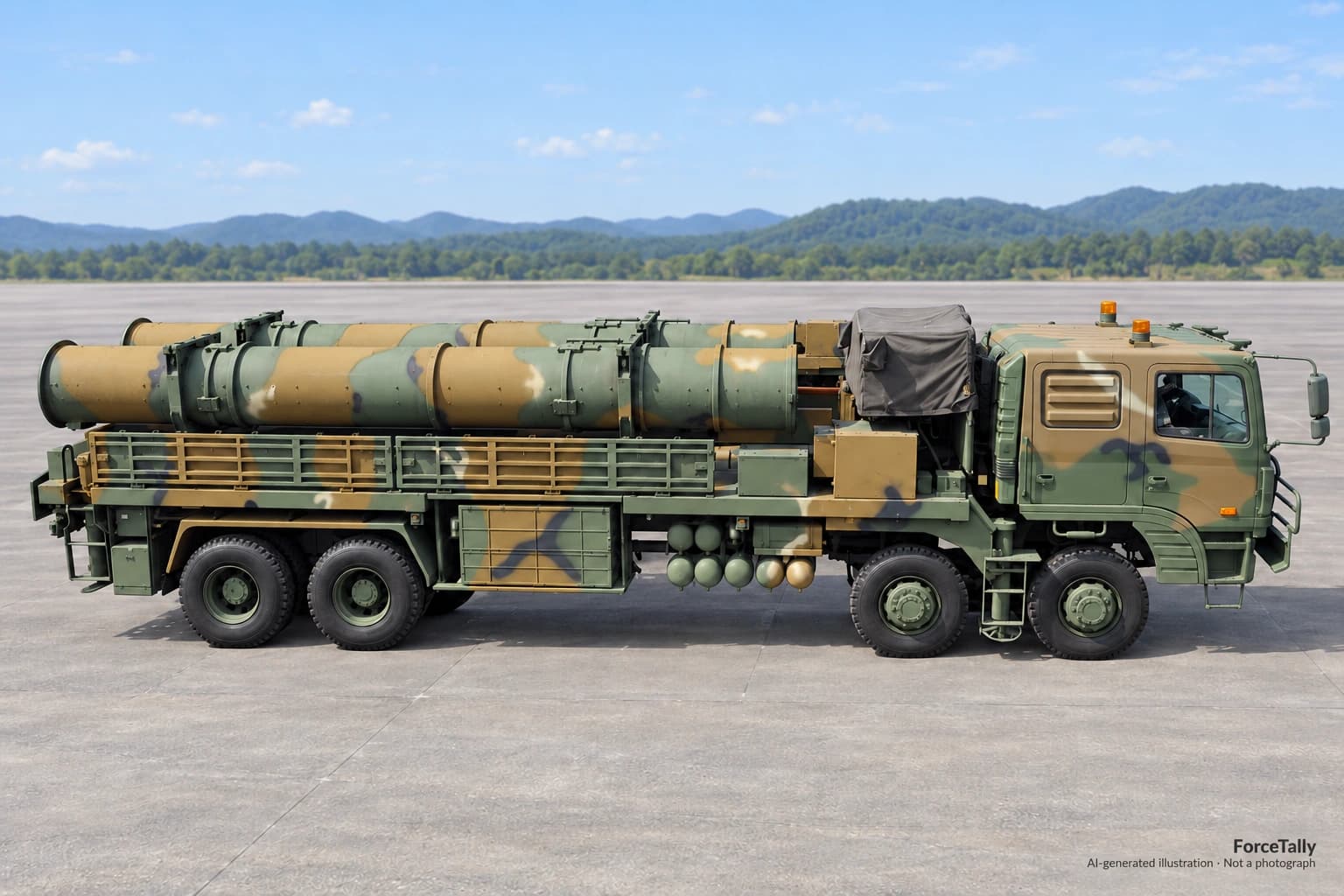
AI-generated illustration · Not a photograph — Hyunmoo-3 missile carrier with two closed horizontal canisters, representative of the Hyunmoo family. Based on the source-pictured four-axle vehicle; exterior detail and perspective are illustrative, not engineering verified.
ForceTally · AI-generated illustration · Not a photograph · Adapted from Hyunmoo-3 missile carrier.jpg by Teukwonjae707, CC BY-SA 4.0 (https://creativecommons.org/licenses/by-sa/4.0/), https://commons.wikimedia.org/wiki/File:Hyunmoo-3_missile_carrier.jpg. Changes: Parade crowds, other vehicles, flags and insignia removed; clean scene and disclosure added. Perspective and fine exterior detail are illustrative; no enclosed missile geometry is shown. This adaptation is licensed CC BY-SA 4.0. · CC BY-SA 4.0 · Source ↗ · ModifiedTechnical data
Surface-to-surface ballistic missile Surface-to-surface cruise missile Submarine-launched ballistic missile
South Korea
1987–present
Republic of Korea Armed Forces
Agency for Defense Development
Hanwha (Hyunmoo-2/4/5) LIG Defense & Aerospace (Hyunmoo-3)
1980s–present
Hyunmoo-1 Hyunmoo-2A Hyunmoo-2B Hyunmoo-2c Hyunmoo-3A Hyunmoo-3B Hyunmoo-3C Hyunmoo-3D Hyunmoo-4 Hyunmoo-4.4 ( submarine version ) Hyunmoo-5 ( bunker buster )
36,000 kilograms (79,000 lb) (Hyunmoo-5)
Conventional
500 to 8,000 kg (1,100 to 17,600 lb)
solid fuel
up to 3,000 km (1,900 mi)
> Mach 4 (3,045 mph ; 4,900 km/h )
command guidance
mobile launchers
KM1500
Hyunmoo ( Korean : 현무 ; Hanja : 玄武 ) is a series of South Korean ballistic and cruise missiles developed by the Agency for Defense Development (ADD) and manufactured by Hanwha and LIG Defense & Aerospace (former LIG Nex1).
Hyunmoo-1 is the first domestically-produced ballistic missile used by the South Korean Army . It was developed by the South Korean national Agency for Defense Development , and is based on the American 1960s Nike Hercules missile system; the US designates it as the Nike Hercules Korea (NHK-1). In 1986, South Korea succeeded in test-launching a missile with a current payload of 480 kg (1,060 lb) and a range of 180 km (110 mi).
The Hyunmoo system, which means "guardian angel of the northern skies" in Korean, launches a missile from a mobile launcher which is fire-controlled from the missile battery's command and control vehicle. The Hyunmoo-1 missile, which is 12 m (39 ft) long and weighing 5 t (11,000 lb), is propelled by a two-stage solid rocket motor. It features an independent inertial guidance and control system which means it can reach any target in any weather conditions without further commands after launch.
In 1990 the US withheld approval on a request by South Korea to start selling the Hyunmoo-1 abroad. The US only granted export approval after South Korea provided technical information on its Hyunmoo system, and agreed to not develop rockets with ranges of more than 180 km (110 mi). South Korea was permitted to produce a limited number of Hyunmoo missiles under US inspection until production ended.
The Hyunmoo-2A was the first of South Korea's attempts to develop an newer indigenous ballistic missile with an increased range, over Hyunmoo-1. Due to an agreement in 2001 with the MTCR ( Missile Technology Control Regime ), the missile's range was limited to 300 km (190 mi). It is carried by a 4 axle transporter erector launcher (TEL).
Eventually the missile range was increased to 800 km (500 mi) which spurred on the development of Hyunmoo-2B and Hyunmoo-2C.
South Korea released the upgraded version of Hyunmoo-2A, named Hyunmoo-2B, which was put into service in late 2009. This ballistic missile had an increased range of 500 km (310 mi). If launched from the central region of South Korea, all of North Korean territory is under a 550-kilometer striking range. Its accuracy is 30 m circular error probable .
The upgraded version of Hyunmoo-2B, named Hyunmoo-2C, was unveiled in 2017. The ballistic missile has an increased range of 800 km (500 mi), but with a warhead weight reduced by half, and uses a different type of TEL with 5 axles (K501), and launch canister that is wider and longer, suggesting increased weight. The warhead section features maneuvering fins (similar to those on Pershing II ), which suggests a maneuverable reentry vehicle or some type of terminal guidance for increased accuracy. It has extreme accuracy ( circular error probable of 1–5 m), ideal as a bunker buster . If fired from southernmost Jeju Island , it can still reach all of North Korea but will be outside the range of North Korean Scud missiles.
On 7 September 2021, South Korea tested a submarine-launched ballistic missile (SLBM) from a Dosan Ahn Changho-class submarine , making it the third country to develop a conventionally-armed SLBM capability on a conventionally powered (diesel-electric) submarine after the Soviet Union ( Golf -class submarine) and North Korea ( Sinpo -class submarine). The missile was the Hyunmoo 4-4, a variant of the Hyunmoo-2B with a 500 km (310 mi) range.
In 2006, the South Korean defense ministry released a statement that it had been testing several cruise missiles under the series of Hyunmoo-3 which were similar to the American Tomahawk or the Russian Kalibr . The first official model, Hyunmoo-3B, was unveiled in 2009 with a maximum range of 1,000 km (620 mi) meaning it could hit any part of North Korea as well as some parts of China and Tokyo. Unlike Hyunmoo-2 missiles, the Hyunmoo-3 missiles would use cruise missile technology. It uses the same four axle TEL like the Hyunmoo 2.
The Hyunmoo-3C missile's deployment is still unknown. The missile would have an increased maximum range of 1,500 km (930 mi).
While the South Korean military's missiles are currently capable of destroying structures at surface level, it says it needs heavier warheads to be able to destroy North Korea's underground facilities and bunkers. The new Hyunmoo IV ballistic missile is fitted with a new warhead capable of destroying North Korea's underground military facilities, command centers and its leadership and is probably a variant of the extended-range Hyunmoo-2C missile currently under development. Seoul reached a de facto deal with the U.S. in September 2017 to revise their missile development guidelines so that it can double the maximum payload of its ballistic missiles. Two Hyunmoo-4 missiles were test-fired in April 2020, with one of them misfiring. The Hyunmoo-4 has a range of 800 km (500 mi) and an increased payload of 2,000 kg (4,400 lb).
On 1 October 2024, the ROK Armed Forces unveiled the Transporter Erector Launcher for the Hyunmoo-5 surface-to-surface ballistic missile with a range of 3,000 kilometers at the 76th anniversary Armed Forces Day ceremony. The missile itself was not unveiled, only its launch canister and vehicle were displayed. According to data released through the South Korean National Defense Committee , the missile weighs 36 tons and has a warhead payload of 8 tons, which is the same weight as the LGM-30 Minuteman III , a 36-ton Intercontinental ballistic missile (ICBM) developed in the United States, and was developed as a bunker-buster missile for striking underground shafts in the North Korean military .
A non-nuclear ballistic missile equipped with an 8 ton warhead is unprecedented; other modern conventional warheads generally are less than one ton. It probably includes a heavy dense metal penetrator or tandem charges for deeply buried bunker penetration. Until the 2021 abolition of the South Korea Ballistic Missile Range Guidelines , such a missile would not have been permitted.
It is thought to be powered by a two-stage solid-fuel engine, with an estimated length of about 16 m and a diameter of 1.6 m. It uses a nine-axle K901 Transporter Erector Launcher vehicle produced by Kia Motors . The warhead can destroy structures deeper than 100 meters below the surface, missile speed is close to Mach 10 in the descending phase.
South Korea revealed that the missiles will be deployed by the end of 2025. The range of this missile with an 8 ton warhead payload is reported to be up to 3,500 km (2,200 mi), which could be extended to over 5,500 km (3,400 mi) using a different warhead under 1 ton.
On 23 June 2017, South Korea unveiled footage of a successful missile test launch of a Hyunmoo-2C missile. Unlike its predecessor, which had a maximum range of 500 km, the Hyunmoo-2C has a maximum range of 800 km and thus is capable of hitting any part of North Korea. South Korean President Moon Jae-in was shown to be observing the missile launch at the time.
On 4 September 2017, South Korea President Moon Jae-In & U.S. President Trump agreed to lift the 500 kg limit on South Korea's missile warheads. This would allow South Korea to develop and deploy missiles with a warhead weighing up to 2,000 kg. This would enable South Korea to target and destroy virtually all of North Korea's underground facilities and hardened bunkers.
On 6 September 2017, South Korea's MoD announced the upcoming development of a new missile dubbed the "Frankenmissile." The Hyunmoo missile variant would carry a warhead weighing up to 1,000 kg and would be used to target key North Korean sites both above and underground.
Length >12 m
Diameter 0.9 m
Range 300 km
Reference text from Wikipedia contributors, used under CC BY-SA 4.0.
Points represent sourced observations, including revisions. Revisions on the same effective date are not separate inventory events. Ranges appear in the table and are not plotted as exact points.
| Observation / report period | Value | Source | Claim state |
|---|---|---|---|
| 11 Oct 2026 | 0.9 m | CSIS Missile Threat | approved |
Hyunmoo equipment records. Variants, orders and quantities are shown as reported in each inventory source; coverage is incomplete.
South KoreaReported count for Hyunmoo-2. Service scope: Republic of Korea Army; does not replace a national total. 1 distinct quantity component(s) from the same source list; shared rowspan cells counted once. Explicit source inventory scope: active; no other stock status or total inferred. Count column(s): in service: 30. Origin: unstated. The listed variants/roles are the scope, not an immediately deployable count. Dates are the count-cell citations' stated source period (2025), not the article revision. 2025 cited publication year. Edition or publication years do not claim an exact inventory census day.
Keep exploring
Short-range submarine launched ballistic missile
 India
Air-launched ballistic missile
 Russia
Theater quasiballistic missile ; air-launched ballistic missile
 Israel
Ballistic missile
IsraelTactical ballistic missile
Tactical ballistic missile
India