FORCETALLY
Loading the evidence…
Preparing your view.


Preparing your view.
Ballistic missilesIn service
Short-range submarine launched ballistic missile
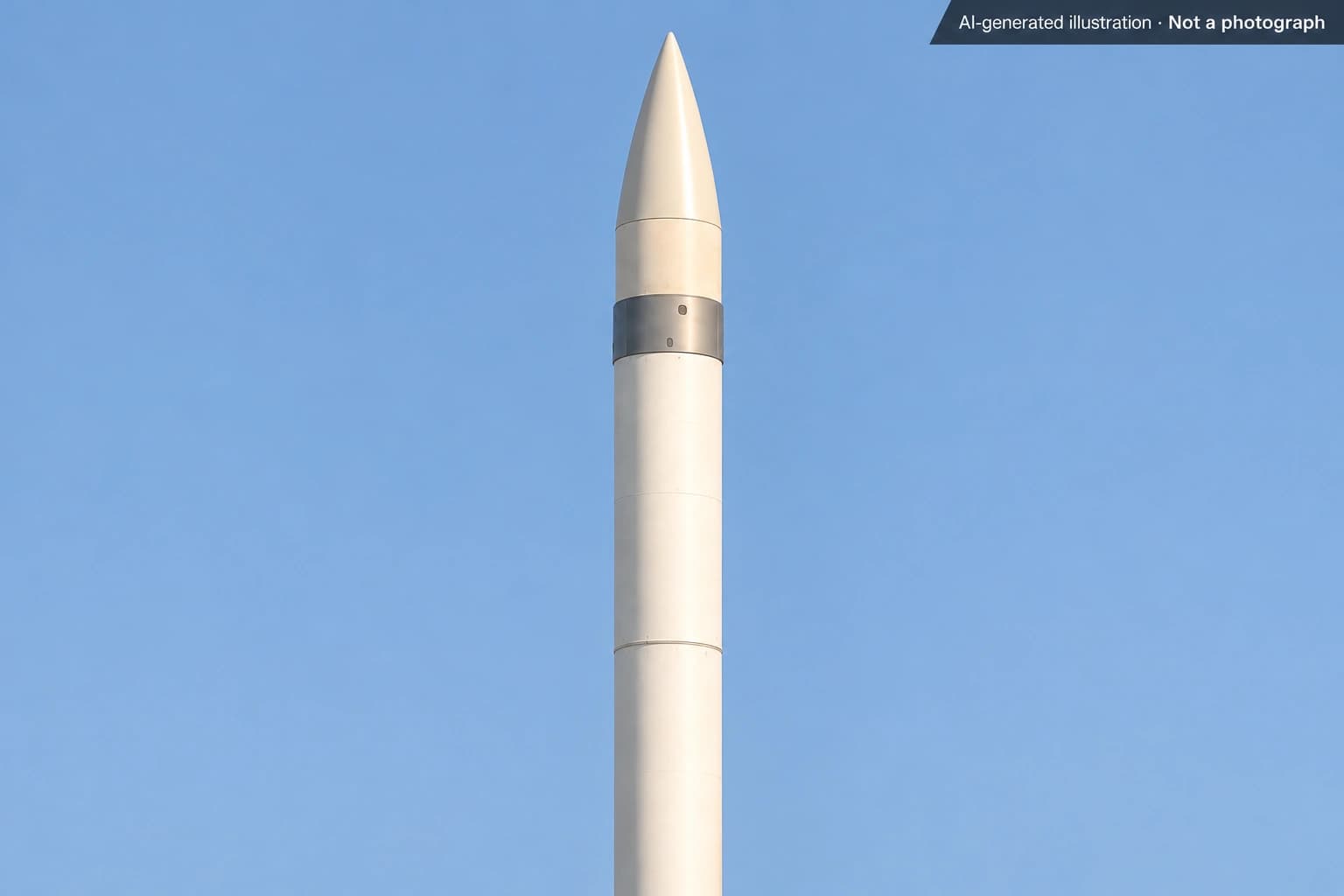
Sagarika (missile) is a short-range submarine launched ballistic missile originating in India. It was built by Bharat Dynamics Limited. Reported operators include Indian Navy.
 India
AI-generated illustration · Not a photograph. Sagarika (B05) upper-body detail based on its own flight-test photograph; aft body, nozzle, launcher and submarine are outside this view.
ForceTally · AI-generated adaptation of the reference photograph by Ministry of Defence, Government of India / Press Information Bureau · GODL-India. Upper-body detail only; background and unproved hardware omitted. Reference source remains GODL-India; this generated output carries OpenAI generation terms. · AI-generated illustration · GODL-India reference · Source ↗ · ModifiedTechnical data
Short-range submarine launched ballistic missile
India
August 2018
Indian Navy
Defence Research and Development Organisation
Bharat Dynamics Limited
6–7 t (6.6–7.7 short tons )
10 m (33 ft )
0.74 m (2.4 ft)
High explosive or nuclear warhead
1,000 kg (2,200 lb )
Two stage solid-fuel rocket motor
Solid propellant
750–1,500 km (470–930 mi)
Mach 7.5 ( Shaurya missile , which is land-based version of Sagarika K-15 missile)
Mid-course: INS + multi- GNSS Terminal: TERCOM
<10 m
Arihant -class submarines , S5-class submarines
Indian Navy
Sagarika ( pronounced: sɑːgərikɑː ) ( lit. ' Oceanic ' ), also known by the code names K-15 or B-05 or PJ-08 , is an Indian submarine-launched ballistic missile (SLBM) with a range of 750 kilometres (466 mi) that was designed for retaliatory nuclear strikes. It belongs to the K Missile family and forms a part of India's nuclear triad .
The K-15 is a two-stage submarine-launched ballistic missile which uses a gas booster to eject out of its launch platform and rise up to the surface of water. A solid rocket motor is fired after the missile reaches a fixed altitude. The missile has a range of around 750 kilometres (466 mi).
By 2008, the missile was successfully test fired seven times, and tested to its full range up to four times. The tests of 26 February 2008, were conducted from a submerged pontoon 50 metres (160 ft) beneath the surface off the coast of Visakhapatnam .
The missile was test fired on 26 December 2012 in full operational configuration after being delayed from November. Though two tests were scheduled, one from a pontoon and other from a live submarine, the latter task was cancelled and scheduled for a later day the following year. The missile was fired from a depth of 20-40 m with the help of a gas generator and reached an altitude of 20 km (12 mi). It was tested at a range of 650 km (400 mi) during its 11th developmental trial. A.K. Chakrabarti was the then Programme Director of the K-15 programme and was also the Director of the Defence Research and Development Laboratory (DRDL).
The twelfth and final development trial of the missiles was conducted on 27 January 2013. According to DRDO Director General V. K. Saraswat , the missile was again tested for its full range of 700 km and met all its objectives with a single digit impact-accuracy. The test will be followed by integration of the missile with INS Arihant .
Reference text from Wikipedia contributors, used under CC BY-SA 4.0.
True scale
Sourced dimensions beside a 1.75 m human reference.
Points represent sourced observations, including revisions. Revisions on the same effective date are not separate inventory events. Ranges appear in the table and are not plotted as exact points.
| Observation / report period | Value | Source | Claim state |
|---|---|---|---|
| 1 Oct 2026 | 0.74 m | Wikipedia contributors | superseded |
| 2 Oct 2026 | 0.74 m | Wikipedia contributors | approved |
Sagarika (missile) equipment records. Variants, orders and quantities are shown as reported in each inventory source; coverage is incomplete.
Keep exploring
 Iran
 Russia
 Pakistan
 North Korea