FORCETALLY
Loading the evidence…
Preparing your view.


Preparing your view.
Patrol & mine warfare vesselsIn service
Gunboat
Humaitá-class gunboat is a gunboat. It was built by Cantieri Odero , Genoa. Reported operators include Paraguayan Navy.
 Paraguay
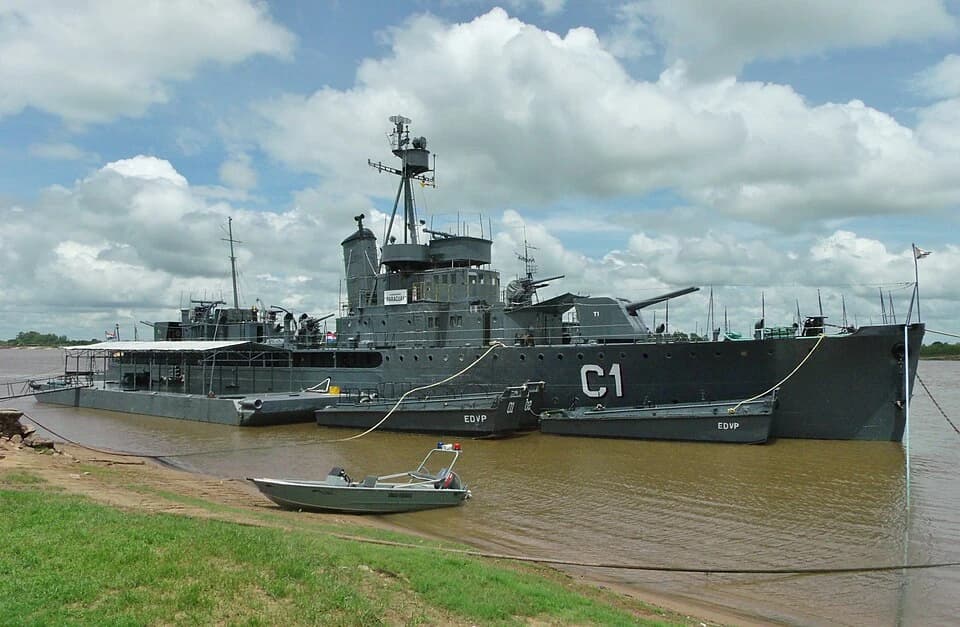
Humaitá-class gunboat ARP C-1 Paraguay, the complete source-pictured exterior configuration; not proof of every vessel fit.
Leopard123 · CC BY-SA 4.0 · Resized / optimized · CC BY-SA 4.0 · Source ↗ · ModifiedHumaitá class
Cantieri Odero , Genoa
Paraguayan Navy
£300,000 total
1931–1992
2
2
2
Gunboat
856 tn
70 m (229.7 ft)
10.7 m (35.1 ft)
1.7 m (5.6 ft)
2 Parsons geared steam turbines 2 shafts 3,800 shp (2,800 kW)
18 knots (21 mph; 33 km/h)
1,700 nmi (3,100 km) at 16 kn (30 km/h)
86
4 × 4.7-inch (119 mm) 3 × 3-inch (76 mm) 2 × 40-millimetre (2 in) autocannon 6 mines
Belt : 0.5 in (13 mm) Deck : 0.3 in (8 mm) Turrets : 0.3 in (8 mm) Conning tower : 0.76 in (19 mm)
The Humaitá class was designed to meet the Paraguayan goal of achieving naval supremacy in the Paraguay River , given the conflict with Bolivia over the Chaco region . The original plan had not was part of Bozzano's thesis at the Massachusetts Institute of Technology . The gunboats had a larger freeboard than other fresh-water designs of the time. The forecastle was also longer than usual riverine units. The twin 4.7-inch (119 mm) guns and the 76 mm (3 in) cannons made their gunnery heavier than some seagoing destroyer classes, like the Italian Freccia and Turbine , or the British flotilla leaders . A British officer stated that the Paraguayan ships were the most powerful riverine vessels in the world. The range and the strength of the design foresaw the need of troop transports in the incoming war. Bozzano was asked to build vessels capable of carrying a 1,400 men-strong regiment each.
The main battery consisted of two twin Ansaldo 4.7 in (120 mm) guns . The secondary armament was made of three Ansaldo anti-aircraft 76 mm (3 in) cannons, one for each band and a third on the foredeck. Originally the vessels mounted two Vickers 40 mm autocannons and cranes and racks for lying mines , of which each gunboat carried six.
The engines, main guns and bridge were protected by a light armour shield. The armoured belt was 0.5 in (13 mm) thick, the turrets and deck armour had a thickness of 0.3 in (8 mm) and the bridge 's armoured plate 0.75 in (19 mm).
The propulsion system consisted of two boilers connected to two Parsons geared turbines. The turbines produced 3.800 hp for a speed of 18 knots (21 mph; 33 km/h).
The first operational mission of Humaitá was the deployment of a detachment of reservists to Puerto Casado , some 200 km (120 mi) from the frontline, in July 1932, barely a month after the beginning of the Chaco War with Bolivia. Along with their role of fast transport of soldiers and resupplies, the gunboats provided air defense to the shipping on the Paraguay River. The first engagement against Bolivian aircraft took place near Puerto Leda on 22 December 1932, when two Vickers Vespas dropped a bomb and strafed Humaitá , only to be driven off. Paraguayan sources claimed one aircraft damaged. The Vespas had attacked and damaged the Paraguayan gunboat ARP Tacuary at Bahía Negra just minutes before. Humaitá was hit by several machine-gun rounds from one of the planes, but her armour shield prevented any damage.
According to the Paraguayan Navy files, Humaitá ferried 62,546 troops upriver for a total of 84 trips. Paraguay carried 51,867 soldiers to the frontlines in 81 trips. The Bolivian army gave up any hope of a naval presence in the Paraguay River when they learned of the firepower of the gunboats, although they deployed the 50-ton armed launch Tahuamanu on the river for a brief time.
In the last months of the war, as the Paraguayan offensives around Villa Montes dragged on, the Paraguayan High Command consulted the navy about the feasibility of dismounting Humaitá ' s main guns and moving them in an 800 km (500 mi) inland trip to the trenches. A special tracked vehicle was adapted from a tractor to tow the ship's turrets through the forest. The Commander-in-Chief of the army, General Estigarribia , hoped that the rate of fire and range of the 4.7 in twin guns would pound the defenses of Villa Montes to pieces from 22 km (14 mi) away, but the war was over before the plan could come together.
The rebel ships then steamed up the Paraná River , and near Paso de la Patria, Argentina, the government T-6 Texans aircraft unleashed a series of airstrikes on the rebel flotilla, disabling Humaitá , which was hit by a 210-pound (95 kg) bomb that destroyed the central gunfire director and became stranded off Ituzaingó .
Paraguay 0 references
Reference text from Wikipedia contributors, used under CC BY-SA 4.0.
True scale
Sourced dimensions beside a 1.75 m human reference.
See it in your room. Scan with your phone to open this model in 3D, then place it in your space.
Humaitá-class gunboat equipment records. Variants, orders and quantities are shown as reported in each inventory source; coverage is incomplete.
ParaguayNavy exact named equipment holdings: Capitan Cabral. Active, operational-reserve and training units excluding equipment in store; November 2025 IISS assessment. Named service only; no parent-force or national total inferred. Source role: PATROL AND COASTAL COMBATANTS / PBR. Original estimates, ranges, reporting names, reserve, lease and employment scopes retained; nested included counts are not added. Missile-system quantities mean launchers, not rounds. No readiness, crew, carried weapon, payload, factory-production or future order count inherited.
Keep exploring
 Denmark
 Vietnam
 China
 United States
 United Kingdom