FORCETALLY
Loading the evidence…
Preparing your view.


Preparing your view.
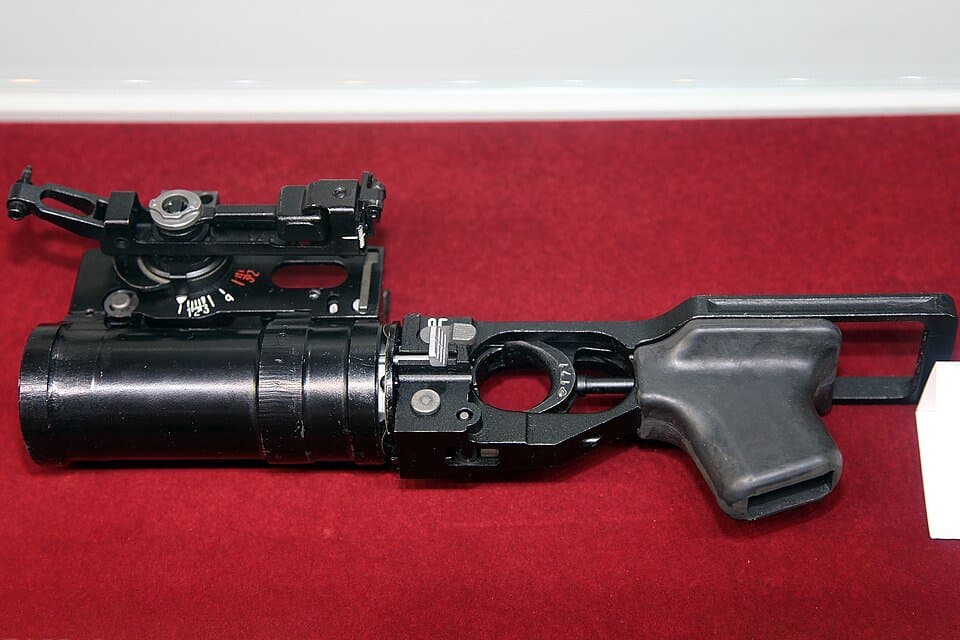
Small armsIn service
Grenade launcher
GP-25 is a grenade launcher originating in Soviet Union. It was built by Kalashnikov Concern STC Delta Arsenal AD Zastava Arms. Reported operators include Algeria, Angola, Armenia, Botswana, Bulgaria, Burundi, Congo-Kinshasa, Cyprus, Georgia, Greece, India, Indonesia, Iran, Lithuania, North Korea, Pakistan, Russia, Serbia, North Macedonia, Syria, Ukraine, Vietnam.
Grenade launcher
Soviet Union
1978–present
See Users
Afghan conflict Soviet–Afghan War War in Afghanistan Transnistria war First Chechen war Second Chechen War Russo-Georgian War Syrian Civil War Russo-Ukrainian War War in Donbas Russo-Ukrainian war Yemeni Civil War Saudi Arabian-led intervention in Yemen Houthi–Saudi Arabian conflict
TsKIB SOO
1966–1978
Kalashnikov Concern STC Delta Arsenal AD Zastava Arms
1978–present
GP-30, GP-30M, GP-34
1.5 kg (3.31 lb) (GP-25) 1.3 kg (2.9 lb) (GP-30) 1.4 kg (3.1 lb) (GP-34)
323 mm (12.7 in) (GP-25) 275 mm (10.8 in) (GP-30) 315 mm (12.4 in) (GP-34)
120 mm (4.7 in)
40 mm internal propellant caseless ammunition (CL)
40 mm
Closed system, single-shot
20 rounds/min area suppression 5–6 rounds/min aimed shots
76.5 m/s (251 ft/s)
Sights adjustable 100 to 400 meters
Muzzleloader
Notched quadrant sight
Algeria
Angola
Armenia : GP-30
Botswana
Bulgaria : Made under license by Arsenal AD as the UBGL and the UBGL-1.
Burundi
Congo-Kinshasa
Cyprus
Georgia : Made by STC Delta .
Greece : Used for the AK-74M.
India
Indonesia : Mobile Brigade Corps
Iran : Used by IRGC
Lithuania : Lithuanian Armed Forces
North Korea
Pakistan
Russia
Serbia : Made under license by Zastava Arms as the PBG – 40 mm and the PBG 40 mm M70.
North Macedonia
Syria : Uses both GP-25s and GP-30Ms.
Ukraine
Vietnam
The GP-25 Kostyor ("Bonfire"), GP-30 Obuvka ("Shoe") and GP-34 are a family of Russian 40 mm under-barrel muzzleloaded grenade launchers for the AK family of assault rifles .
The GP-25 Kostyor ("Bonfire"), GP-30 Obuvka ("Shoe") and GP-34 are a family of Russian 40 mm under-barrel muzzleloaded grenade launchers for the AK family of assault rifles . The acronym GP stands for Granatomyot Podstvolnyj , "under-barrel grenade launcher" in Russian, and was adopted by Soviet forces in 1978.
GP grenade launchers are similar in appearance and fire the same Russian 40mm caliber ammunition. At the top of the barrel is the mounting hardware to attach the weapon to the underside of a rifle barrel, from which it is designed to fire. The GP barrel has a useful life of about 400 rounds.
The GP-30 first entered service in 1989, and is intended for use with the AK-100 series of assault rifles . The GP-30M is a grenade launcher of simplified model, consisting of a shorter 40 mm rifled barrel in front of a basic trigger mechanism with minimal hand grip.
GP-30M.
A grenade is first loaded from the muzzle, the weapon is aimed, and then the double-action trigger is pulled to fire. This fires the percussion cap at the base of the grenade which activates the nitrocellulose propellant inside the grenade body. The hot, expanding gas from the propellant is forced through openings in the base of the grenade that move it along the barrel and, at the same time, force the driving band to fit into the twelve grooves of the rifle. The rifling provides stabilizing rotation to the projectile. The grenade has a range of up to 400m.
GP grenade launchers fire multiple 40mm VOG-25 high-explosive fragmentation grenades, with a total range of 400 m and an effective range of 150 m. These Russian-Soviet 40 mm grenades are not compatible with Western 40x46 mm grenades. Originally, the main grenade was the VOG-15 (7P17) fragmentation grenade, which has a lethal radius of six meters. Ammunition for the muzzle-loading GP-25 consists of a single piece containing propellant and charge, as opposed to the more traditional two-piece case and projectile design of comparable US 40x46mm ammunition used in breech-loading grenade launchers, such as the M203 . This integral "caseless" design – with the propellant and primer contained in the base of the grenade – provides for when the grenade is fired nothing is left in the barrel, so the operator can load the next grenade.
A bouncing grenade, the VOG-25P, is also available. On impact, a small charge in the nose of the grenade explodes; this raises the grenade 50 cm to 1.5 m in the air, before an impact delay fuse causes it to detonate. The VOG-25P also has a lethal radius of six meters. The new generation VOG-M and VOG-PM ammunition, with an increased effectiveness of no less than 1.5 times, are now serially available.
Smoke grenades are also available. The original GRD-40 grenade was replaced by a series of grenades designed for use at different ranges. These are the GRD-50, GRD-100 and GRD-200 intended for use at 50, 100 and 200 meters respectively. They are capable of producing a 20 cubic meter cloud of smoke that lasts for one minute in winds of up to five meters per second. A tear gas grenade called Gvozd ("Nail") and a stick grenade are also available.
Reference text from Wikipedia contributors, used under CC BY-SA 4.0.
True scale
Sourced dimensions beside a 1.75 m human reference.
See it in your room. Scan with your phone to open this model in 3D, then place it in your space.
Points represent sourced observations, including revisions. Revisions on the same effective date are not separate inventory events. Ranges appear in the table and are not plotted as exact points.
| Observation / report period | Value | Source | Claim state |
|---|---|---|---|
| 28 Sept 2026 | 0.12 m | Wikipedia contributors | superseded |
GP-25 equipment records. Variants, orders and quantities are shown as reported in each inventory source; coverage is incomplete.
 Algeria
 Angola
 Armenia
 Azerbaijan
 Belarus
 Bhutan
 Botswana
 Bulgaria
 Burundi
 Cyprus
 Georgia
 Greece
 India
 Indonesia
 Iran
 Kazakhstan
 Lithuania
 Moldova
 Namibia
 North Korea
 North Macedonia
 Pakistan
 Russia
 Serbia
 Syria
 Ukraine
 Vietnam
Algeria, Angola, Armenia, Botswana, Bulgaria, Burundi, Congo-Kinshasa, Cyprus, Georgia, Greece, India, Indonesia, Iran, Lithuania, North Korea, Pakistan, Russia, Serbia, North Macedonia, Syria, Ukraine, Vietnam
Equipment reference ↗Keep exploring
 Germany
 United States