FORCETALLY
Loading the evidence…
Preparing your view.


Preparing your view.
ArtilleryIn service
Howitzer
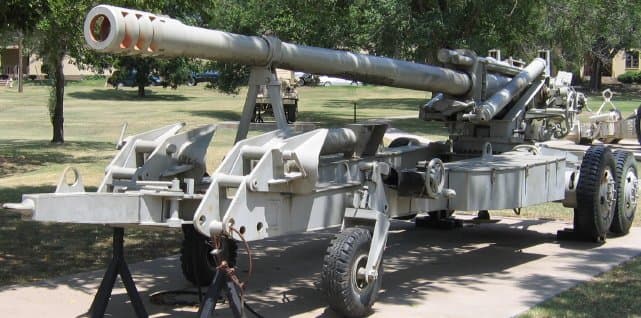
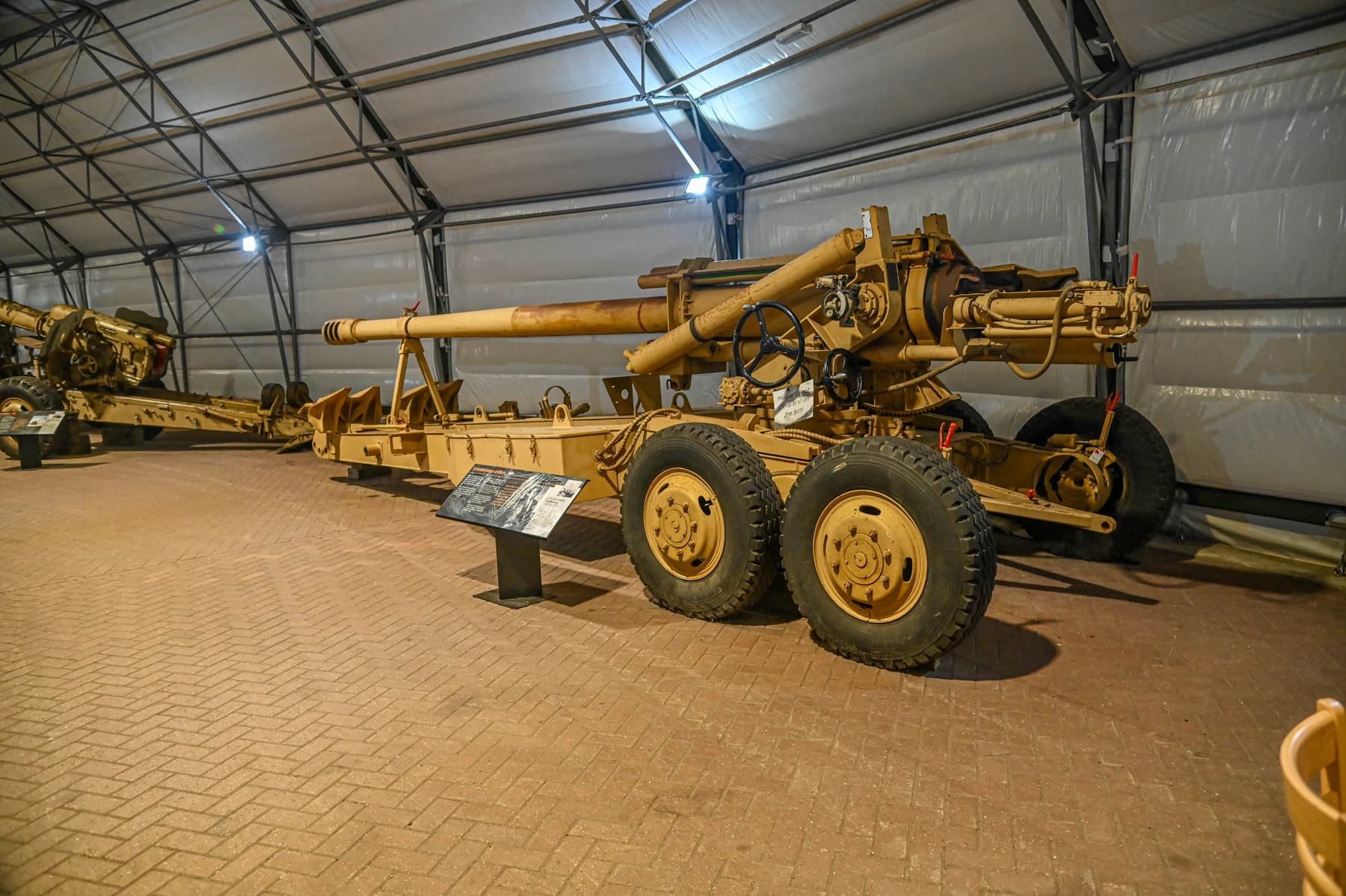
GC-45 howitzer is a howitzer originating in Canada. It was built by Space Research Corporation , Noricum , NORINCO. Reported operators include China, Indonesia, Iran, Iraq, Israel, Jordan, Kuwait, Myanmar, Oman, Pakistan, Saudi Arabia, Singapore, South Africa, Thailand, United Arab Emirates.
 Canada
Howitzer
Canada
1970s-present
See users
Iran–Iraq War Gulf War Cambodian–Thai border dispute 2025 Cambodia–Thailand clashes
Gerald Bull
1970s
Space Research Corporation , Noricum , NORINCO
1980s-Present
GHN-45, PLL01
8,220 kg (18,120 lb)
6.98 meters
155 mm (6.1 in.)
Split trail
-89 to 1,280 mils
Left 534 mils, Right 711 mils
maximum: 5 rpm sustained: 2 rpm
897 metres per second (2,940 ft/s)
39.6 km (24.6 mi) with Base bleed
China
Indonesia
Iran
Iraq
Israel
Jordan
Kuwait
Myanmar
Oman
Pakistan
Saudi Arabia
Singapore
South Africa
Thailand
United Arab Emirates
The GC-45 ( Gun, Canada, 45- calibre ) is a 155 mm howitzer designed by Gerald Bull 's Space Research Corporation (SRC) in the 1970s.
The GC-45 ( Gun, Canada, 45- calibre ) is a 155 mm howitzer designed by Gerald Bull 's Space Research Corporation (SRC) in the 1970s. Versions were produced by a number of companies during the 1980s, notably in Austria and South Africa.
The gun designed to fire it had a 23,000 cm 3 (1,400 cu in) chamber, a 45-calibre rifled barrel with 1/20 right hand twist fitted with a conventional muzzle brake . Its breech was a conventional screw with interrupted thread.
ERFB-BB shell, weight 48.0 kg (105.9 lb), M11 Zone 10 muzzle velocity 897 m/s (2,940 ft/s), QE 898 mils, time of flight 112 s, range 39.6 km (24.6 mi; 130,000 ft). Probable error in range 212 m (696 ft), in line 36 m (118 ft).
ERFB shell, weight 45.5 kg (100.4 lb), M11 Zone 10 muzzle velocity 897 m/s (2,940 ft/s), QE 881 mils, time of flight 99 s, range 29.9 km (18.6 mi; 98,000 ft). Probable error in range 189 metres (620 ft), in line 42 metres (138 ft).
HE M107 shell, weight 43 kg (95 lb), M119 Zone 8 muzzle velocity 675 m/s (2,210 ft/s), QE 764 mils, time of flight 65 s, range 17.8 km (11.1 mi; 58,000 ft). Probable error in range 59 m (194 ft), in line 12 m (39 ft).
The dispersion of the EFRB shell is more than three times that of the FH-70 field howitzer at its maximum range of only 5 km less, and is twice as great as FH-70s at 20 km (66,000 ft; 12 mi). Its maximum range with the M107 projectile is the same as any 39 calibre 155-mm gun and its dispersion about the same. (The "dispersion" figure means that 50% of shells will fall up to the stated distance either side of the mean point of impact, but 100% will fall within 4 times the probable error either side.) Dispersion of this magnitude significantly reduces the tactical value of the equipment.
In 1977, Bull's work put him in touch with (what is today) the Denel SOC Ltd company of South Africa. Denel designed a new mobile mounting that was able to handle the increased recoil. It used a sole-plate to lift the carriage to take the four wheels off the ground. The chassis had the option of being powered by a small diesel engine acting as an auxiliary power unit , driving hydraulics that could set up the gun in two minutes, and move it short distances. This feature had previously been included in the 1960s design FH-70 carriage by Vickers . Bull, meanwhile, started production of $30 million worth of rounds, shipping them via Spain to avoid the international arms embargo against South Africa .
Once out of prison, Bull was soon contacted by China. The Chinese People's Liberation Army also used the Noricum version, producing it as the PLL01, which entered service in 1987. They also mounted it on a locally designed tracked chassis to produce the PLZ-45 (also known as the Type 88), along with an ammo-carrier based on the same chassis. The PLZ-45 did not enter service with the PLA primarily because their existing artillery was all based on Soviet-standard 152 mm ammunition. However, two major batches of PLZ-45s were sold to the Kuwait and Saudi Arabia .
In Iraq the guns had a similar effect on the ongoing Iran–Iraq War as the G5 had in Angola, stopping any push by the Iranians deeper into Iraq. They became desperate to get more of these guns into the field as soon as possible, and requested that Bull improve deliveries any way he could. Bull then arranged a deal to deliver the G5, which fired the same ammunition as the GHN-45, from South Africa. By the time of the Gulf War, about 124 of these weapons had been added to the Iraqi long-range artillery, supplanting their older 130 mm M-46s and chaotic mix of other weapons. Bull and Saddam Hussein became partners in a number of future ventures . These ventures are generally believed to be the cause of Bull's assassination , for which the Israeli Mossad or Iranian agencies are the prime suspects .
Bull continued work on the GC-45, producing a much more practical version known as the FGH-155 . In addition to a number of detail changes and deeper rifling, the FGH-155 allowed standard M107 ammunition to be fired using a plastic adaptor ring. Bull also felt that the FGH-155's carriage was suitable for a larger gun, and worked on the FGH-203 , an 8" (203 mm) gun adapted from U.S. standards in a fashion similar to the original GC-45 work. The increase in projectile weight gave the new weapon a range of over 50,000 meters with normal ERFB-BB ammunition, making it one of the longest-range artillery pieces in the world. The gun was also purchased by the Iraqis, who mounted it in a self-propelled form to create the Al-Fao .
The Denel G5 version has also seen continued development. The gun has been placed on an OMC 6x6 chassis as the G6 howitzer , and won major export sales to the United Arab Emirates and Oman . In response to an Indian requirement, the G5 was mounted on a 4x4 truck, resulting in the T5 , though as of 2012 none had been ordered. It is also fitted into a turret that can fit on any suitable vehicle. The turret is marketed as the T6 which has already been fitted on the T-72 . Denel also used the basic ERFB ammunition concept to develop a 105 mm gun, the G7 howitzer , which allows artillery to be downsized to improve mobility.
Bharat Forge , an Indian firm of Kalyani Group , has recently purchased Noricum and brought the entire manufacturing workshop to India. It has made Bharat-52 , a 52 caliber variant of the 155mm howitzer to meet the Indian Army 's long delayed field artillery requirement.
Crew 6
Reference text from Wikipedia contributors, used under CC BY-SA 4.0.
Visual reference
Points represent sourced observations, including revisions. Revisions on the same effective date are not separate inventory events. Ranges appear in the table and are not plotted as exact points.
| Observation / report period | Value | Source | Claim state |
|---|---|---|---|
| 28 Sept 2026 | 6.98 m | Wikipedia contributors | superseded |
| 28 Sept 2026 | 6.98 m | Wikipedia contributors | superseded |
| 28 Sept 2026 | 6.98 m | Wikipedia contributors | superseded |
| 28 Sept 2026 | 6.98 m | Wikipedia contributors | approved |
GC-45 howitzer equipment records. Variants, orders and quantities are shown as reported in each inventory source; coverage is incomplete.
 China
 Indonesia
 Iran
Army exact named equipment holdings: GHN-45. Active, operational-reserve and training units excluding equipment in store; November 2025 IISS assessment. Named service only; no parent-force or national total inferred. Source role: ARTILLERY / 155mm. Original estimates, ranges, reporting names, reserve, lease and employment scopes retained; nested included counts are not added. Missile-system quantities mean launchers, not rounds. No readiness, crew, carried weapon, payload, factory-production or future order count inherited.
 Israel
 Jordan
 Kuwait
 Myanmar
 Oman
 Pakistan
 Saudi Arabia
 Singapore
 South Africa
 Thailand
Marines exact named equipment holdings: GC-45. Active, operational-reserve and training units excluding equipment in store; November 2025 IISS assessment. Named service only; no parent-force or national total inferred. Source role: ARTILLERY / 155mm. Original estimates, ranges, reporting names, reserve, lease and employment scopes retained; nested included counts are not added. Missile-system quantities mean launchers, not rounds. No readiness, crew, carried weapon, payload, factory-production or future order count inherited.
 United Arab Emirates
China, Indonesia, Iran, Iraq, Israel, Jordan, Kuwait, Myanmar, Oman, Pakistan, Saudi Arabia, Singapore, South Africa, Thailand, United Arab Emirates
Equipment reference ↗Reported count for GHN-45. Service scope: Royal Thai Army; does not replace a national total. 1 distinct count cell(s) from the same source list; shared rowspan cells counted once. Excludes retired/reserve/on-order rows. Count column(s): quantity: 92. Origin: Canada. The listed variants/roles are the scope, not an immediately deployable count. The components do not establish one inventory census date; the stored date is the retrieved source snapshot.
 France
 Sweden
 South Korea
 United States