FORCETALLY
Loading the evidence…
Preparing your view.


Preparing your view.
Engineering & recoveryIn service
Armoured combat engineering vehicle
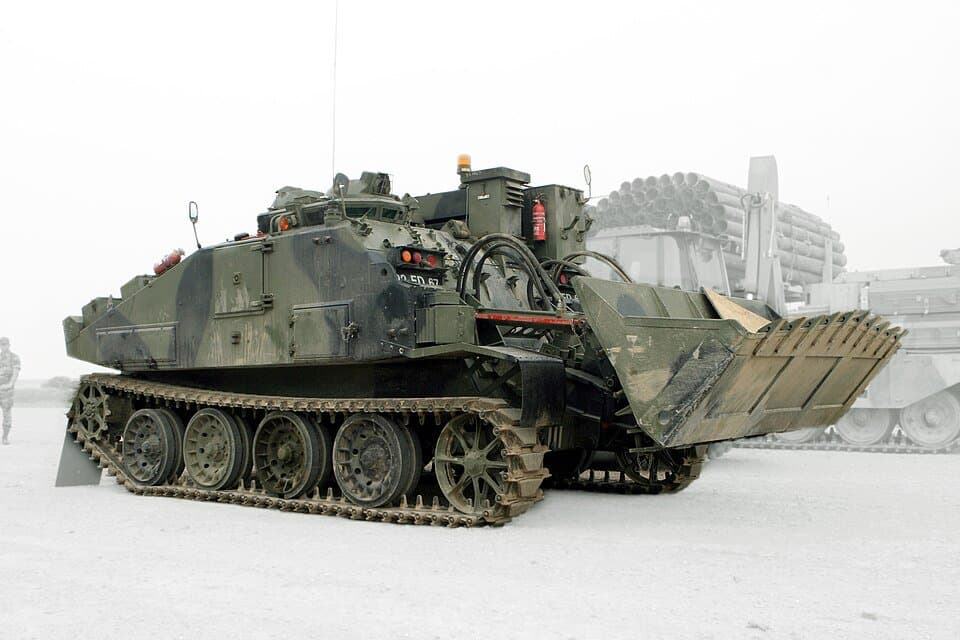
FV180 Combat Engineer Tractor is a armoured combat engineering vehicle originating in United Kingdom. Reported operators include India, Singapore, Ukraine.
 United Kingdom
FV180 Combat Engineer Tractor
CET_02.jpg : davric derivative work: Hohum ( talk ) · Public domain · Resized · Public domain · Source ↗ · ModifiedArmoured combat engineering vehicle
United Kingdom
British Army , Indian Army , Singapore Army
17.5 tonnes (19.3 short tons ; 17.2 long tons )
7.54 m (24 ft 9 in)
2.94 m (9 ft 8 in)
2.67 m (8 ft 9 in)
2
Honeycombed twin skin aluminium alloy
None (Crew armed with personal weapons only)
Rolls-Royce C6TFR 320 hp (240 kW)
19 hp/tonne
Torsion bar
480 km (300 mi)
56 km/h (35 mph) (road) 8 knots (15 km/h; 9.2 mph) (water)
India
Singapore
Ukraine
United Kingdom
The two crew sit in tandem positions on the left hand side of the vehicle, each with a set of driving controls facing opposite directions. A large earthmoving bucket is fitted at the rear of the vehicle and a rocket-propelled anchor on a 100m hawser attached to an 8 tonne winch can be fitted to the front. When operated from the rear seat the bucket is used for earth moving; clearing obstacles, paths or digging tank or gun pits and anti-tank ditches. When operated from the front-facing seat it can be driven on the road, and the anchor can be used to pull the CET up steep obstacles such as riverbanks. The winch rope can be deployed to the front or the rear of the vehicle with a maximum pull of 8 tonnes in both configurations.
An Auxiliary Lifting Attachment (ALA) - a davit with a winch rope roller - fitted to the inside of the earthmoving bucket was used for lifting loads of up to 4tonnes. Loads such as Medium Girder Bridge pallets could be lifted vertically to a height of 1.8m. This then allowed a cargo vehicle to back under the suspended load, the CET could not travel or turn with a suspended load on the ALA due to lateral weakness of the ALA and the proximity of the load to the earthmoving bucket. Use of the ALA was discontinued in the 1990s due to difficulties in annual testing of the safe working load, and a reduced requirement for its use.
The amphibious propulsion is provided by two Dowty water impellers, one mounted on each side of the vehicle and controlled by the commander in the rear seat facing forwards. The water jets are used to steer the vehicle when swimming, this is with the use of movable cowls directing the flow of water. When not in use, the propulsion unit water intakes are closed off with armoured covers to prevent damage during digging operations. Flotation aids are required to trim the vehicle for swimming and a "wash board" is fitted to the front of the vehicle to prevent the bow wave flooding the crew compartment when entering water. Maximum speed in water is 8.5 knots, the vehicle will wade in 1.8m of water and requires preparation for operating in deeper water than this as it achieves buoyancy. FV180 can tow a "Giant Viper" anti-mine system. It can be airlifted by a C-130 Hercules aircraft.
In 2013 the CET was replaced in British service by a new, larger vehicle: the 30 tonne Terrier armoured digger . This is better protected, equipped with night vision and can be remotely operated if required in more hazardous circumstances.
Производитель Royal Ordnance Nottingham
Reference text from Wikipedia contributors, used under CC BY-SA 4.0.
True scale
Sourced dimensions beside a 1.75 m human reference.
See it in your room. Scan with your phone to open this model in 3D, then place it in your space.
Points represent sourced observations, including revisions. Revisions on the same effective date are not separate inventory events. Ranges appear in the table and are not plotted as exact points.
| Observation / report period | Value | Source | Claim state |
|---|---|---|---|
| 28 Sept 2026 | 2 people | Wikipedia contributors | superseded |
FV180 Combat Engineer Tractor equipment records. Variants, orders and quantities are shown as reported in each inventory source; coverage is incomplete.
 India
 Singapore
Army exact named equipment holdings: FV180. Active, operational-reserve and training units excluding equipment in store; November 2025 IISS assessment. Named service only; no parent-force or national total inferred. Source role: ENGINEERING & MAINTENANCE VEHICLES / AEV. Original estimates, ranges, reporting names, reserve, lease and employment scopes retained; nested included counts are not added. Missile-system quantities mean launchers, not rounds. No readiness, crew, carried weapon, payload, factory-production or future order count inherited.
 Ukraine
Keep exploring
Combat engineering vehicle
 United StatesCompare with FV180 Combat Engineer Tractor
Combat engineering vehicle
United KingdomCompare with FV180 Combat Engineer Tractor Combat engineering vehicle Armoured personnel carrier
Heavy combat engineering vehicle
Compare with FV180 Combat Engineer TractorCombat engineer vehicle
United KingdomCompare with FV180 Combat Engineer Tractor Military engineering vehicle
United States