Role and design
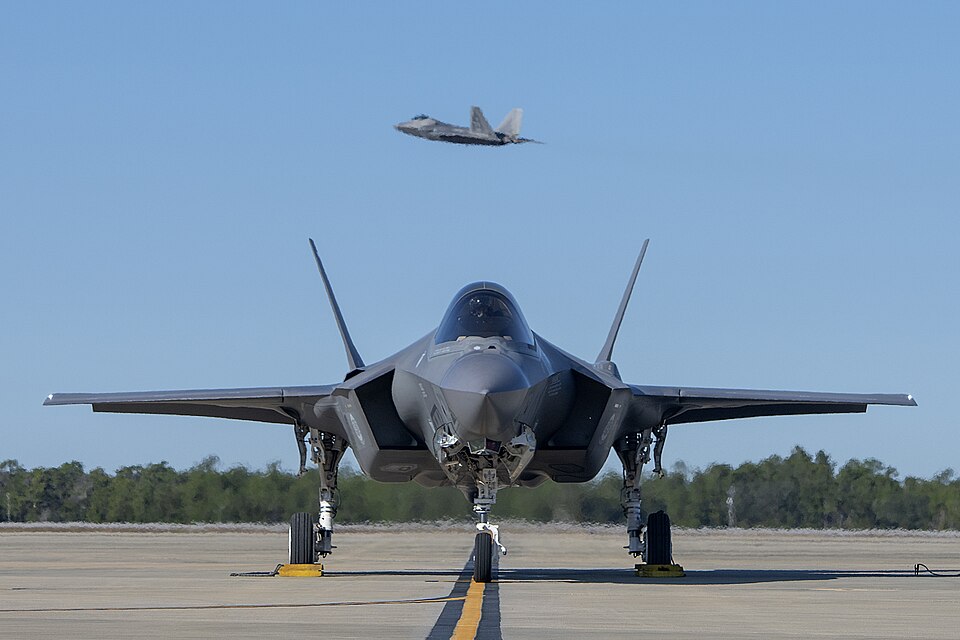
The F-35A is the conventional-runway member of the Lightning II family. It combines a low-observable airframe with integrated sensing and weapons carriage for air-to-air and air-to-surface missions. Its role includes gathering and sharing information, so a comparison based only on speed or weapon capacity misses an important part of the design.128
The A designation identifies the airframe configuration. It does not describe the complete mission capability of an individual aircraft: software, national integration, maintenance condition and available weapons all matter. The aircraft should therefore be compared with a specified configuration of another fighter, rather than with the most ambitious advertised features of an entire family.
Airframe and low observability
The F-35 uses its external shaping, surface treatments and internal installation of sensors, fuel and weapons to reduce observability. Lockheed Martin describes these as complementary design measures. Low observability is not invisibility, and the manufacturer does not provide an independently verifiable public radar-signature figure on the referenced overview.101
Internal carriage allows the aircraft to retain its intended outer shape for a particular mission configuration. External stores change that configuration. Consequently, a headline payload figure does not tell a reader how much can be carried internally or whether the aircraft retains the same signature in every loadout. This page makes no numerical radar-cross-section or detection-distance claim.
Propulsion and flight performance
The F135-PW-100 is the F-35A engine identified in the USAF and Australian fact sheets. It is an afterburning turbofan from the wider F135 engine family. Pratt & Whitney also describes a continuing engine upgrade effort intended to support the aircraft programme’s changing power and cooling needs.1268
Published top speed, maximum mass and range figures describe different operating conditions. A maximum speed is not a sustained cruise speed; a range figure is not automatically a combat radius. Fuel reserves, stores, flight profile and aerial refuelling assumptions are necessary context when comparing aircraft. Where the official USAF and Australian pages publish different mass, thrust or fuel figures, those entries require their source definitions to remain visible rather than being silently combined.
Radar and infrared sensors
Northrop Grumman identifies the AN/APG-81 as an active electronically scanned array radar for the F-35. Its published description includes air-to-air, air-to-surface, reconnaissance and electronic-warfare functions. These are manufacturer descriptions of the radar’s intended functions, not independent measurements of detection performance against a specified target.341
EOTS is the integrated electro-optical targeting system beneath the forward fuselage. Lockheed Martin describes forward-looking infrared and infrared search-and-track functions, linked to the aircraft’s central processing system. EOTS supports observation and targeting without requiring a conventional external targeting pod. The separate DAS provides surrounding infrared imagery and warning functions. Their different names should not be treated as interchangeable descriptions of one sensor.
Lockheed Martin also advertises Advanced EOTS as an upgrade offering associated with further capability development. An upgrade being offered is not proof that every operational F-35A already has it.
Electronic warfare, cockpit and information sharing
BAE Systems describes AN/ASQ-239 as the F-35’s integrated electronic-warfare system. Its published purpose is to support situational awareness and protection using the aircraft’s wider mission-system architecture. Public product descriptions do not establish a defensible numerical jamming range or an assured result against a particular threat.51
The helmet-mounted display presents flight and mission information in the pilot’s field of view. The USAF also identifies tactical data links as part of the aircraft’s information-sharing capability. The useful distinction is between sensing, presenting and sharing information: fitting a sensor does not by itself establish what a pilot can see, what is fused by the software, or what another platform can receive. Configuration and interoperability evidence remain important.
Armament and configuration limits
The Australian operator page lists AMRAAM and Sidewinder air-to-air missiles, JDAM and laser-guided bombs, and the internal GAU-22/A cannon. This documents the categories of weapons associated with the Australian F-35A description. It does not establish that every weapon subvariant is cleared on every software standard or that every listed weapon is carried at the same time.218
Internal and external carriage are separate configurations. A maximum total payload should not be mistaken for the capacity of the internal bays, a normal operational load or a measure of combat effectiveness. New weapons announced for a future software or capability block belong in an upgrade record until their integration and service release are documented.
F-35A, F-35B and F-35C differences
The F-35A is the conventional take-off and landing variant described here. The F-35B is designed around short take-off and vertical landing, while the F-35C is the carrier variant. They share a programme and many mission-system concepts, but their airframe and operating requirements are not interchangeable.101
The A page must not inherit the B’s vertical-landing description or use a carrier-specific C configuration as its baseline. Equally, a photograph of one family member is not sufficient evidence for another member’s equipment fit. The variant links above keep these records separate; comparisons should retain that separation for mass, dimensions, fuel and service history.
Development and operational milestones
The USAF announced the F-35A’s initial operational capability in August 2016. Its contemporary release describes a specific readiness milestone for the first operational unit, including trained personnel, support arrangements and a defined initial set of missions. It did not mean that all planned programme capabilities were complete.7112
Australian F-35A aircraft arrived at RAAF Base Williamtown in December 2018. The RAAF’s aircraft page distinguishes acceptance into Australian service from the later operational milestone for its first squadron. Those are separate events, and neither should be replaced by the original development programme’s first-flight date.
A service-entry field needs an operator and a definition: first delivery, first arrival in-country, initial operational capability and full operational capability answer different historical questions.
Modernisation: TR-3 and Block 4
Technology Refresh 3 and Block 4 are related but different parts of F-35 modernisation. GAO describes TR-3 as updated hardware and software, including processing and memory improvements, that enables additional capabilities. Block 4 is the broader capability-development effort involving further mission-system and weapons changes.8
GAO’s 2025 review documented hardware and software problems, delayed deliveries and programme schedule risks. It also discussed power and thermal-management demands associated with future capabilities. These dated findings should not be rewritten as a claim that an individual aircraft received every planned upgrade. For a particular operator, the relevant questions are which aircraft standard was delivered, what functions were released and when the operator accepted them.
Support, availability and programme limitations
The 2026 GAO sustainment review reports that the programme continued to miss performance goals and faced persistent support problems. Its discussion includes spare parts, maintenance arrangements, contractor dependence, financial management and risks to the revised support strategy. This is a necessary counterweight to promotional descriptions of the aircraft.9
Fleet ownership and usable capability are different measurements. An aircraft can be delivered, assigned to a unit, capable of some missions, or capable of all assigned missions; these states should not be collapsed into one inventory number. GAO’s fleet-wide and service-specific readiness measures also should not be applied indiscriminately to a different national fleet.
A balanced assessment therefore considers maintenance, training, weapons availability, software and support alongside the airframe. This profile does not award a combat score or imply that the presence of the aircraft alone determines an operational outcome.
Operators and how to read national records
The USAF and Royal Australian Air Force sources establish national F-35A service contexts. Australia’s history page also describes its participation in mission-data work with allies and the importance of updating aircraft software. These sources explain why the operator and its support arrangements are part of an equipment record, not just a flag attached to a manufacturer specification.71110
The wider F-35 programme includes different airframe variants and national configurations. A country listed as a programme partner, customer or future recipient is not automatically an operator of combat-ready F-35As on the same date. The separate inventory section below is reserved for sourced quantities with a defined status and date.


 United States
 Australia
 Belgium
 Canada
 Denmark
 Finland
 Germany
 Israel
 Italy
Italy Japan
Japan Netherlands
 Norway
 Poland
 Saudi Arabia
 South Korea
 United Kingdom