FORCETALLY
Loading the evidence…
Preparing your view.


Preparing your view.
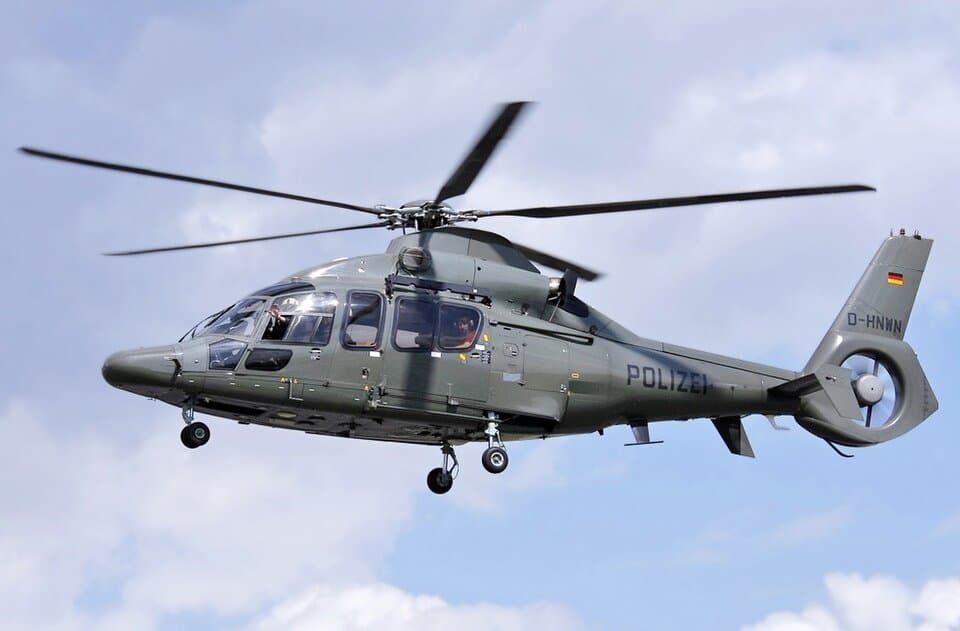
HelicoptersIn service
Passenger transport helicopter
Eurocopter EC155 is a passenger transport helicopter originating in Multinational. It was built by Eurocopter Airbus Helicopters.
Technical data
Passenger transport helicopter
Multinational
Eurocopter Airbus Helicopters
Active
1997–present
March 1999
17 June 1997
Eurocopter AS365 Dauphin
KAI LCH
Eurocopter X³ KAI LAH-1 Miron
1 or 2 (pilots)
13 passengers or 2,301 kg (5,073 lb) payload
14.3 m (46 ft 11 in)
4.35 m (14 ft 3 in)
True scale
Sourced dimensions beside a 1.75 m human reference.
See it in your room. Scan with your phone to open this model in 3D, then place it in your space.
2,618 kg (5,772 lb)
4,950 kg (10,913 lb)
4,920 kg (10,847 lb)
2 × Turbomeca Arriel 2C2 turboshaft engines, Take-off Power, 697 kW (935 hp) each
12.6 m (41 ft 4 in)
124.7 m 2 (1,342 sq ft)
324 km/h (201 mph, 175 kn)
857 km (533 mi, 463 nmi)
985 km (612 mi, 532 nmi)
4,572 m (15,000 ft)
8.9 m/s (1,750 ft/min)
The Airbus Helicopters H155 (formerly Eurocopter EC155 ) is a long-range medium-lift passenger transport helicopter developed by Eurocopter from its Dauphin family for civil aviation use.
The Airbus Helicopters H155 (formerly Eurocopter EC155 ) is a long-range medium-lift passenger transport helicopter developed by Eurocopter from its Dauphin family for civil aviation use. It is a twin-engined aircraft and can carry up to 13 passengers along with 1 or 2 crew, depending on customer configuration. The helicopter is marketed for passenger transport, offshore support, VIP corporate transport and casualty transport duties. In 2015, the EC155 was formally renamed to the H155, in line with Eurocopter's corporate rebranding as Airbus Helicopters . It was succeeded in the product line by the Airbus Helicopters H160 .
The EC155 B1 was developed with uprated engines, giving it improved performance at high altitude and in hot temperature conditions; this derivative also features a higher maximum take-off weight (10,846 lb vs. 10,580 lb). Deliveries of this model began in November 2002 with the Hong Kong Government Flying Service becoming the first operator. In early 2003, Eurocopter completed studies for an even more powerful version of the EC155 B1, designed to better compete with new rotorcraft such as the AgustaWestland AW139 and to better meet military customer's requirements.
Several major elements of the EC155, such its rotor system (albeit modified to operate at slower rotational speeds), were used in the Eurocopter X3 , an experimental high-speed compound helicopter which set an unofficial speed record of 255 knots (293 mph; 472 km/h) in 2013. In 2015, an EC155 was also used by Airbus Helicopters as a flying testbed for new aerodynamic features, such as the rotor blades, biplane stabilizer and canted fenestron, for the developing Airbus Helicopters H160 helicopter.
In 2015, Airbus Helicopters and Korean Aerospace Industries (KAI) formed an agreement to transfer principle manufacturing activity for the EC155 to South Korea ; KAI shall become the sole manufacturer of the type after 2018, and both firms shall be jointly involved in the international marketing and further development of the type. The EC155 is to serve as the basis for KAI's Light Civil Helicopter (LCH) and Light Armed Helicopter (LAH) , featuring numerous changes including a new cockpit, improved gearbox and rotor blades; the LAH shall have a chin-mounted 20 mm cannon and side-mounted guided rockets, countermeasures systems, and be able to carry 6–10 combat troops. The LCH is to enter service in 2020, and the LAH will follow in 2022 to replace the MD 500 Defender and AH-1J/S Cobra . Airbus foresees a South Korean demand for 100 LCHs and 214 LAHs, and estimates an international market of 300–400 LAH versions to replace legacy attack helicopters.
The EC155 B is powered by two 635 kW (851 shp) Turbomeca Arriel 2C1 turboshaft engines which feature a dual-channel Full Authority Digital Engine Control (FADEC) system.
The EC155 B1 features uprated 697 kW (935 shp) Arriel 2C2s.
Eurocopter designed the EC155 originally with three configurations, however, another two configurations were added in 2005. The Passenger Transport version can carry 12 passengers in comfort seats or 13 passengers in utility seats, along with 1 or 2 crew. The VIP or Corporate Transport version has a VIP lounge with working space accommodating up to 8 executives. The Casualty Transport version can carry 2 stretchered patients with up to 4 seated medical staff, or 4 patients on stretchers plus 2 seated medical staff. The configurations added in 2005 were for offshore operation and police and parapublic missions ranging from patrol, airborne surveillance, SAR and EMS , the helicopter being fitted with specific mission equipment for these duties.
Capacity: 13 passengers or 2,301 kg (5,073 lb) payload
Length: 14.3 m (46 ft 11 in)
Height: 4.35 m (14 ft 3 in)
Empty weight: 2,618 kg (5,772 lb)
Gross weight: 4,950 kg (10,913 lb)
Max takeoff weight: 4,920 kg (10,847 lb)
Powerplant: 2 × Turbomeca Arriel 2C2 turboshaft engines, Take-off Power, 697 kW (935 hp) each
Main rotor diameter: 12.6 m (41 ft 4 in)
Main rotor area: 124.7 m 2 (1,342 sq ft)
Never exceed speed : 324 km/h (201 mph, 175 kn)
Range: 857 km (533 mi, 463 nmi)
Ferry range: 985 km (612 mi, 532 nmi)
Service ceiling: 4,572 m (15,000 ft)
Rate of climb: 8.9 m/s (1,750 ft/min)
Legacy Aircraft (Cont.) H155 Seating Empty Weight Useful Load Max Gross Wt (int/ext) Engine Type Take-Off Power Usable Fuel (std tanks) Max Speed Vne Fast Cruise Speed Hover OGE / IGE (MTOW, ISA) Max Range (std tanks) Max Endurance (std tanks) 1+12 5,780 lb 5,066 lb 10,846 lb 2x Safran HE Arriel 2C2 943 shp / eng. 332 US gal. 175 kt 144 kt n/a / 7,050 ft 428 NM 4.2 hr
Reference text from Wikipedia contributors, used under CC BY-SA 4.0.
Eurocopter EC155 equipment records. Variants, orders and quantities are shown as reported in each inventory source; coverage is incomplete.
 Argentina
Gendarmerie exact named equipment holdings: H155. Active, operational-reserve and training units excluding equipment in store; November 2025 IISS assessment. Named service only; no parent-force or national total inferred. Source role: HELICOPTERS / Light. Original estimates, ranges, reporting names, reserve, lease and employment scopes retained; nested included counts are not added. Missile-system quantities mean launchers, not rounds. No readiness, crew, carried weapon, payload, factory-production or future order count inherited.
 Dominican Republic
Air Force exact named equipment holdings: H155 (VIP). Active, operational-reserve and training units excluding equipment in store; November 2025 IISS assessment. Named service only; no parent-force or national total inferred. Source role: HELICOPTERS / Light. Original estimates, ranges, reporting names, reserve, lease and employment scopes retained; nested included counts are not added. Missile-system quantities mean launchers, not rounds. No readiness, crew, carried weapon, payload, factory-production or future order count inherited.
 Tanzania
Reported count for Airbus H155. Service scope: Tanzania Air Force Command; does not replace a national total. 1 distinct quantity component(s) from the same source list; shared rowspan cells counted once. Explicit source inventory scope: active; no other stock status or total inferred. Count column(s): in service: 2. Origin: France. The listed variants/roles are the scope, not an immediately deployable count. Dates are the count-cell citations' stated source period (2025), not the article revision. 2025 cited publication year. Edition or publication years do not claim an exact inventory census day.
 Thailand
Gendarmerie & Paramilitary holdings of the exact named H155 component; active, operational-reserve and training equipment excluding equipment in store. November 2025 IISS assessment, not a combat-readiness count. Named-service scope only, not a national total. No heading aggregate, other model or carried weapon quantity inherited. H155 is the formally renamed EC155, not an inherited Dauphin, H160 or LAH child total.
Police Aviation exact named equipment holdings: H155. Active, operational-reserve and training units excluding equipment in store; November 2025 IISS assessment. Named service only; no parent-force or national total inferred. Source role: HELICOPTERS / None. Original estimates, ranges, reporting names, reserve, lease and employment scopes retained; nested included counts are not added. Missile-system quantities mean launchers, not rounds. No readiness, crew, carried weapon, payload, factory-production or future order count inherited.
Keep exploring
Passenger transport helicopter
Compare with Eurocopter EC155Transport helicopter
Compare with Eurocopter EC155Transport helicopter
 FranceCompare with Eurocopter EC155
Transport helicopter
 United StatesCompare with Eurocopter EC155
Transport helicopter
United StatesCompare with Eurocopter EC155 Transport helicopter
 China