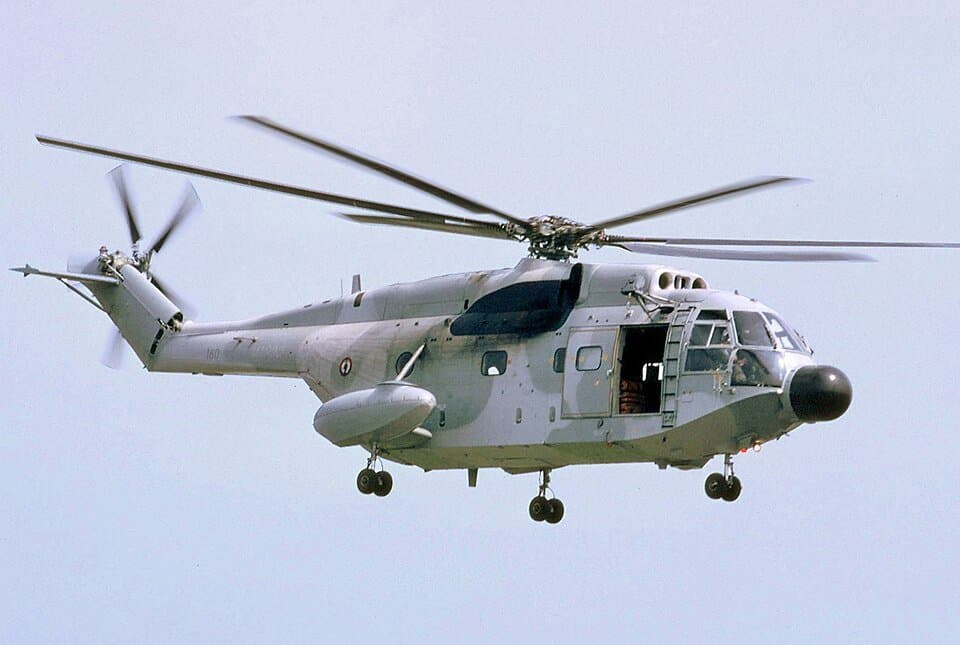

Credit
Rob Schleiffert · CC BY-SA 2.0 · Resized · CC BY-SA 2.0 · Source ↗ · Modified


Preparing your view.
At a glance
True scale
Side by side. From every angle. A human reference for perspective.
3.31 MB · Loads when you open it| Model | Length | Width / span | Height |
|---|---|---|---|
| Aérospatiale SA 321 Super Frelon | ≈ 18.75 m | ≈ 18.76 m (Width) | ≈ 5.44 m |
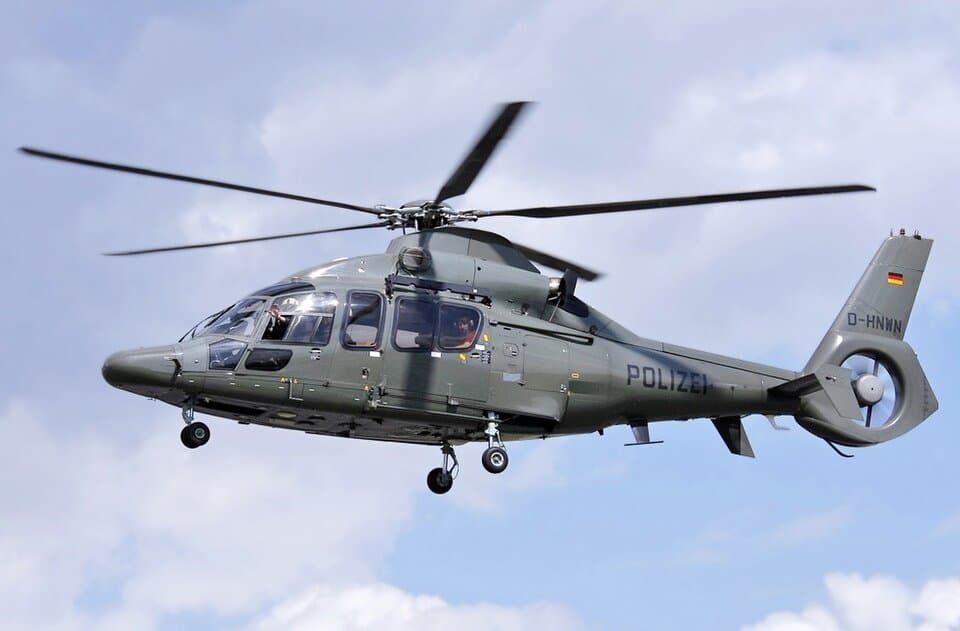
| Eurocopter EC155 | ≈ 14.3 m | ≈ 12.14 m (Width) | ≈ 4.35 m |
Scaled uniformly so that the main rotor matches the sourced 18.9 m rotor diameter. The shape was turned square to the axes. Not an official model or a measured survey.
ForceTally · All rights reserved
Scaled uniformly to the sourced length of 14.3 m. The height was fitted to the sourced 4.35 m. Not an official model or a measured survey.
ForceTally · All rights reserved
The human reference is a generic 1.75 m figure. Models describe external size, not combat performance.
Measured figures
Naval Super Frelon · overall, rotors turning
Single source23.03 m (75 ft 7 in) (overall, rotors turning)[source]
Configuration
| Specification | Aérospatiale SA 321 Super Frelon | Eurocopter EC155 |
|---|---|---|
| Type | Transport helicopter[source] | Passenger transport helicopter[source] |
| National origin | France[source] | Multinational[source] |
| Manufacturer | Sud Aviation Aérospatiale[source] | Eurocopter Airbus Helicopters[source] |
| Status | In service with the People's Liberation Army Naval Air Force[source] |
EC155 B1 · Length
Single source14.3 m (46 ft 11 in)[source]
Cruise; Naval Super Frelon · at sea level
Single source249 km/h (155 mph, 134 kn) at sea level[source]
Maximum; H155 only · maximum speed VNE, not fast cruise and not adjacent AS365 N3+ / SA330J columns · H155 only · maximum speed VNE, not fast cruise and not adjacent AS365 N3+ / SA330J columns · H155
Manufacturer claim175 kt[source]H155 only · maximum speed VNE, not fast cruise and not adjacent AS365 N3+ / SA330J columns
Naval Super Frelon · 3 × Turboméca Turmo IIIC turboshafts (1,550 shp) each
Single source3 × Turboméca Turmo IIIC turboshafts , 1,160 kW (1,550 shp) each[source]
EC155 B1 · 2 × Turbomeca Arriel 2C2 turboshaft engines, Take-off Power each
Single source2 × Turbomeca Arriel 2C2 turboshaft engines, Take-off Power, 697 kW (935 hp) each[source]
Bars compare reported quantities only. A larger figure does not make a system better; configurations and test conditions differ.
Active[source] |
| Primary users | French Navy People's Liberation Army Air Force South African Air Force Iraqi Air Force[source] | — |
|---|
| Number built | 110[source] | — |
|---|
| Manufactured | 1962–1981[source] | 1997–present[source] |
|---|
| Introduction date | 1966[source] | March 1999[source] |
|---|
| First flight | 7 December 1962[source] | 17 June 1997[source] |
|---|
| Developed from | SNCASE SE.3200 Frelon[source] | Eurocopter AS365 Dauphin[source] |
|---|
| Developed into | Changhe Z-8[source] | Eurocopter X³ KAI LAH-1 Miron[source] |
|---|
| Capacity | 27 passengers or 15 stretchers[source] | 13 passengers or 2,301 kg (5,073 lb) payload[source] |
|---|
| Fuel capacity | 3,975 L (1,050 US gal; 874 imp gal) (normal)[source] | — |
|---|
| Endurance | four hours[source] | — |
|---|
| Fuselage length | 19.40 m (63 ft 8 in)[source] | — |
|---|
| Main rotor area | 280.6 m 2 (3,020 sq ft)[source] | 124.7 m 2 (1,342 sq ft)[source] |
|---|
| Never exceed speed | 275 km/h (171 mph, 148 kn)[source] | 324 km/h (201 mph, 175 kn)[source] |
|---|
| Variant | — | KAI LCH[source] |
|---|
| Role | — | long-range medium-lift passenger transport helicopter[source] |
|---|
| Source measurement | — | The Airbus Helicopters H155 (formerly Eurocopter EC155 ) is a long-range medium-lift passenger transport helicopter developed by Eurocopter from its Dauphin family for civil aviation use. It is a twin-engined aircraft and can carry up to 13 passengers along with 1 or 2 crew, depending on customer configuration. The helicopter is marketed for passenger transport, offshore support, VIP corporate transport and casualty transport duties. In 2015, the EC155 was formally renamed to the H155, in line with Eurocopter's corporate rebranding as Airbus Helicopters . It was succeeded in the product line by the Airbus Helicopters H160 .[source]Eurocopter EC155 · Lead; only the objects and conditions stated in this passage The EC155 B1 was developed with uprated engines, giving it improved performance at high altitude and in hot temperature conditions; this derivative also features a higher maximum take-off weight (10,846 lb vs. 10,580 lb). Deliveries of this model began in November 2002 with the Hong Kong Government Flying Service becoming the first operator. In early 2003, Eurocopter completed studies for an even more powerful version of the EC155 B1, designed to better compete with new rotorcraft such as the AgustaWestland AW139 and to better meet military customer's requirements.[source]Eurocopter EC155 · Development; only the objects and conditions stated in this passage Several major elements of the EC155, such its rotor system (albeit modified to operate at slower rotational speeds), were used in the Eurocopter X3 , an experimental high-speed compound helicopter which set an unofficial speed record of 255 knots (293 mph; 472 km/h) in 2013. In 2015, an EC155 was also used by Airbus Helicopters as a flying testbed for new aerodynamic features, such as the rotor blades, biplane stabilizer and canted fenestron, for the developing Airbus Helicopters H160 helicopter.[source]Eurocopter EC155 · Development; only the objects and conditions stated in this passage In 2015, Airbus Helicopters and Korean Aerospace Industries (KAI) formed an agreement to transfer principle manufacturing activity for the EC155 to South Korea ; KAI shall become the sole manufacturer of the type after 2018, and both firms shall be jointly involved in the international marketing and further development of the type. The EC155 is to serve as the basis for KAI's Light Civil Helicopter (LCH) and Light Armed Helicopter (LAH) , featuring numerous changes including a new cockpit, improved gearbox and rotor blades; the LAH shall have a chin-mounted 20 mm cannon and side-mounted guided rockets, countermeasures systems, and be able to carry 6–10 combat troops. The LCH is to enter service in 2020, and the LAH will follow in 2022 to replace the MD 500 Defender and AH-1J/S Cobra . Airbus foresees a South Korean demand for 100 LCHs and 214 LAHs, and estimates an international market of 300–400 LAH versions to replace legacy attack helicopters.[source]Eurocopter EC155 · Development; only the objects and conditions stated in this passage The EC155 B is powered by two 635 kW (851 shp) Turbomeca Arriel 2C1 turboshaft engines which feature a dual-channel Full Authority Digital Engine Control (FADEC) system.[source]Eurocopter EC155 · Design; only the objects and conditions stated in this passage The EC155 B1 features uprated 697 kW (935 shp) Arriel 2C2s.[source]Eurocopter EC155 · Design; only the objects and conditions stated in this passage Eurocopter designed the EC155 originally with three configurations, however, another two configurations were added in 2005. The Passenger Transport version can carry 12 passengers in comfort seats or 13 passengers in utility seats, along with 1 or 2 crew. The VIP or Corporate Transport version has a VIP lounge with working space accommodating up to 8 executives. The Casualty Transport version can carry 2 stretchered patients with up to 4 seated medical staff, or 4 patients on stretchers plus 2 seated medical staff. The configurations added in 2005 were for offshore operation and police and parapublic missions ranging from patrol, airborne surveillance, SAR and EMS , the helicopter being fitted with specific mission equipment for these duties.[source]Eurocopter EC155 · Design; only the objects and conditions stated in this passage Capacity: 13 passengers or 2,301 kg (5,073 lb) payload[source]Eurocopter EC155 · Specifications (EC155 B1); only the objects and conditions stated in this passage Length: 14.3 m (46 ft 11 in)[source]Eurocopter EC155 · Specifications (EC155 B1); only the objects and conditions stated in this passage Height: 4.35 m (14 ft 3 in)[source]Eurocopter EC155 · Specifications (EC155 B1); only the objects and conditions stated in this passage Empty weight: 2,618 kg (5,772 lb)[source]Eurocopter EC155 · Specifications (EC155 B1); only the objects and conditions stated in this passage Gross weight: 4,950 kg (10,913 lb)[source]Eurocopter EC155 · Specifications (EC155 B1); only the objects and conditions stated in this passage Max takeoff weight: 4,920 kg (10,847 lb)[source]Eurocopter EC155 · Specifications (EC155 B1); only the objects and conditions stated in this passage Powerplant: 2 × Turbomeca Arriel 2C2 turboshaft engines, Take-off Power, 697 kW (935 hp) each[source]Eurocopter EC155 · Specifications (EC155 B1); only the objects and conditions stated in this passage Main rotor diameter: 12.6 m (41 ft 4 in)[source]Eurocopter EC155 · Specifications (EC155 B1); only the objects and conditions stated in this passage Main rotor area: 124.7 m 2 (1,342 sq ft)[source]Eurocopter EC155 · Specifications (EC155 B1); only the objects and conditions stated in this passage Never exceed speed : 324 km/h (201 mph, 175 kn)[source]Eurocopter EC155 · Specifications (EC155 B1); only the objects and conditions stated in this passage Range: 857 km (533 mi, 463 nmi)[source]Eurocopter EC155 · Specifications (EC155 B1); only the objects and conditions stated in this passage Ferry range: 985 km (612 mi, 532 nmi)[source]Eurocopter EC155 · Specifications (EC155 B1); only the objects and conditions stated in this passage Service ceiling: 4,572 m (15,000 ft)[source]Eurocopter EC155 · Specifications (EC155 B1); only the objects and conditions stated in this passage Rate of climb: 8.9 m/s (1,750 ft/min)[source]Eurocopter EC155 · Specifications (EC155 B1); only the objects and conditions stated in this passage |
|---|
Maximum take-off; EC155 B1 · Max takeoff weight
Single source