FORCETALLY
Loading the evidence…
Preparing your view.


Preparing your view.
Engineering & recoveryIn service
Amphibious float bridge
EFA (mobile bridge) is a amphibious float bridge originating in France. It was built by Chaudronnerie et Forges d'Alsace (CEFA). Reported operators include United Arab Emirates, France, Ukraine.
 France
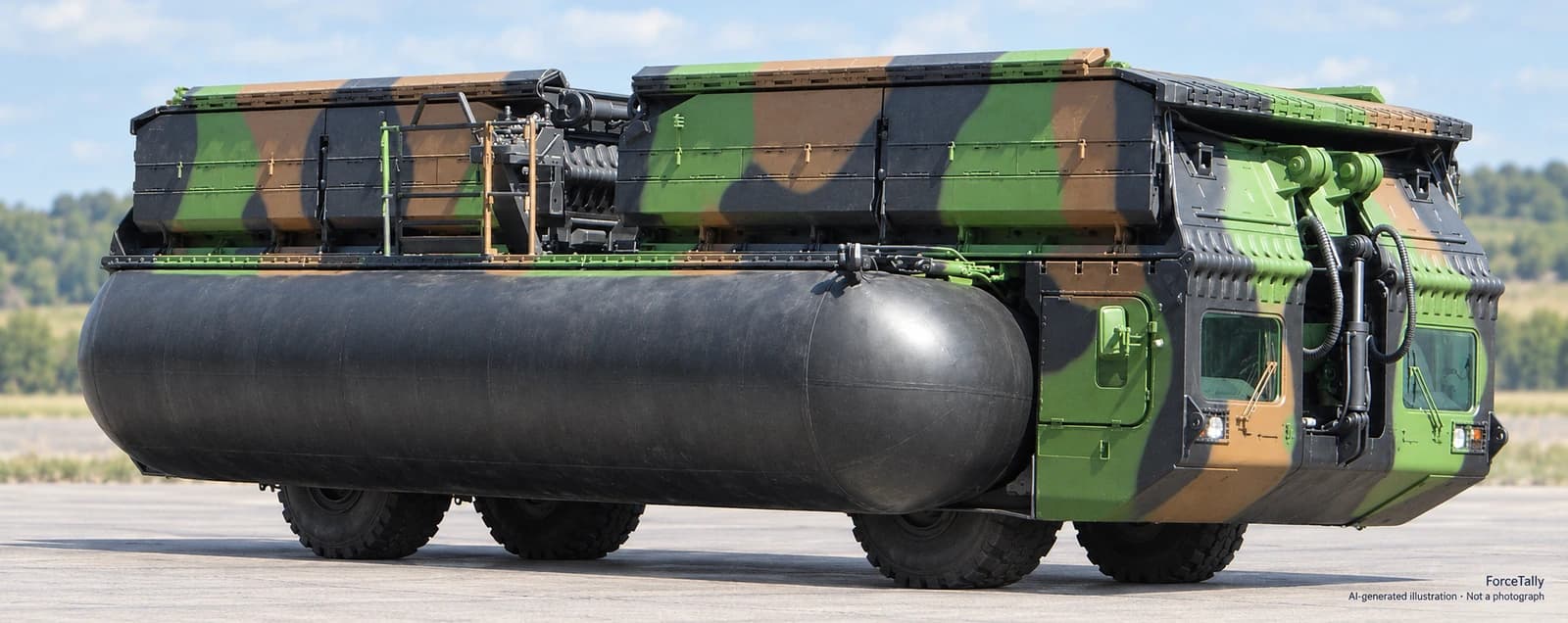
AI-generated illustration · Not a photograph — French EFA amphibious bridging vehicle in the folded road transport configuration pictured in the 2003 reference photograph. Source-visible exterior and proportions are illustrated; fine and obscured details remain unverified. This is not the deployed ferry configuration.
ForceTally · AI-generated illustration · Not a photograph · Adapted from French army EFA DSC00859.jpg by David Monniaux, CC BY-SA 1.0 (https://creativecommons.org/licenses/by-sa/1.0/), https://commons.wikimedia.org/wiki/File:French_army_EFA_DSC00859.jpg. Changes: reference-based illustration with people and parade background removed, neutral setting and disclosure added; fine or obscured details simplified. This adaptation is licensed CC BY-SA 1.0. · CC BY-SA 1.0 · Source ↗ · ModifiedTechnical data
Amphibious float bridge
France
1993–present
Chaudronnerie et Forges d'Alsace (CEFA)
34.55 meters
none
United Arab Emirates : Contract for 10 units of more than 60 million euros signed in 2006 for EFA X1 motorized with Friedrichshafen MTU of 760 hp. Delivery from September 2008
France : 39 units built for the French army since 1989, in active service since 1993. As of December 31, 2013, 30 units were in service with an average age of 25 years. They are assigned to the following units: 3rd engineer regiment, 6th engineer regiment, 19th engineer regiment, School of Engineering, Champagne Training Park.
Ukraine
A single EFA, in ferry configuration, has a length of 34.55m on a loading surface of 96 m 2 is ready in less than five minutes for the transportation of up to 70 tons of goods. In one hour it is able to make about 10-12 crossings over a of 100 m length and eight to 10 crossings over a length of 200 m . Two EFA coupled together at the ramp allow the carriage of up to 150 ton cargo, and a floating bridge with four EFA for example offers, in less than 10 minutes, a crossing capacity of 100 m long with an estimated flow of 200 vehicles an hour.
True scale
Sourced dimensions beside a 1.75 m human reference.
The crew consists of four people:
The EFA is the heir to the first self-propelled bridging ferry invented in 1955 by the French military engineer and general Jean Gillois (born in Châteaubriant 1909). Called the "Amphibious Bac" or "Gillois", it entered service with the French army in 1963. A version modified by EWK was successively adopted by the German, British and to a limited extent American militaries, and was used by Israel in the 1973 Yom Kippur War . At the time of its introduction it was able to carry vehicles up to a maximum weight of 25 tons and while configured as a bridge it could support loads of about 50 tons. It takes between 45 and 65 minutes to form a bridge 100 meters long. It allows an armed force to avoid the heavy and bulky convoys that barges brought in by road, which are sensitive to enemy attacks.
The crew consists of four people:
Masse : 42,6t
Longueur : 12,60m
Largeur : 4,05m
Hauteur : 4,20m
Autonomie : 630km environ
Engine performance: 560 kw MTU Diesel engine;
Crew: 2 soldiers minimum;
Reference text from Wikipedia contributors, used under CC BY-SA 4.0.
EFA (mobile bridge) equipment records. Variants, orders and quantities are shown as reported in each inventory source; coverage is incomplete.
FranceArmy holdings of the exact named EFA component; active, operational-reserve and training equipment excluding equipment in store. November 2025 IISS assessment, not a combat-readiness count. No heading aggregate, other model or carried weapon quantity inherited. Named-service scope only, not a national total.
 Ukraine
 United Arab Emirates
Keep exploring
Amphibious bridging vehicle
 Germany
Amphibious armoured bulldozer
armored vehicle-launched bridge vehicle
 United States
Armored vehicle-launched bridge
United StatesArmored vehicle-launched bridge
United StatesArmoured vehicle-launched bridge