FORCETALLY
Loading the evidence…
Preparing your view.


Preparing your view.
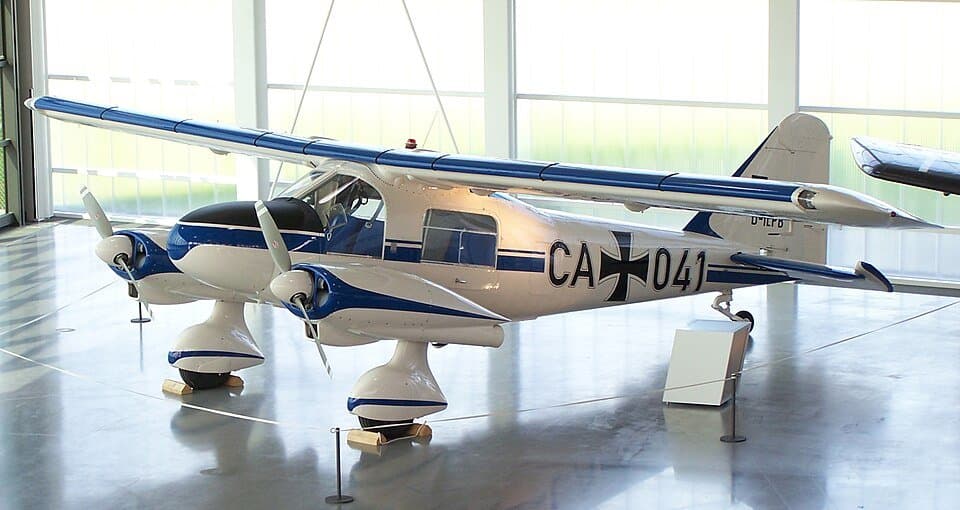
Support aircraftIn service
STOL light utility aircraft
Dornier Do 28 is a sTOL light utility aircraft. It was built by Dornier Flugzeugbau GmbH. Reported operators include German Air Force.
 Germany
STOL light utility aircraft
Dornier Flugzeugbau GmbH
In civilian and military use
German Air Force
Do 28 - 1 Do 28A-1 - 60 Do 28B-1 - 60 Do 28D-1 - 54 Do 28D-2 - 172 Dornier 128-6 - 6
29 April 1959 (Do 28 A/B) 23 February 1966 (Do 28D)
Dornier Do 27
Dornier 228
1 or 2
12 or 13 passengers
11.41 m (37 ft 5 in)
15.55 m (51 ft 0 in)
3.90 m (12 ft 10 in)
29.00 m 2 (312.2 sq ft)
8.3:1
NACA 23018 (modified)
2,304 kg (5,079 lb)
4,015 kg (8,852 lb)
893 L (236 US gal; 196 imp gal)
2 × Lycoming IGSO-540-A1E air-cooled flat-six engines, 280 kW (380 hp) each
3-bladed Hartzell constant-speed propellers
325 km/h (202 mph, 175 kn) at 3,000 m (10,000 ft)
241 km/h (150 mph, 130 kn) at 10,000 ft (3,000 m) (econ cruise, 50% power)
104 km/h (65 mph, 56 kn) (power off, flaps down)
65 km/h (40 mph, 35 kn) (power on, flaps down)
2,950 km (1,830 mi, 1,590 nmi) (with max fuel)
7,680 m (25,200 ft)
5.3 m/s (1,050 ft/min)
The Do 28 was developed from the single-engine Do 27 at the end of the 1950s. The design shared the high-wing cantilever layout and the lift augmentation devices of the Do 27, together with the rear fuselage which seated six passengers.
The Dornier company was given financial assistance from the German government to develop a larger STOL transport to carry up to 13 passengers. The type was designated the Do 28D and later named Skyservant . The Do 28D was a complete redesign and shared only the basic layout and wing construction of the earlier versions. The fuselage and engine nacelles were rectangular, unlike the rounded Do 28A/B. The aim was to develop a simple and rugged aircraft for use under arduous conditions, which could be easily maintained. With a crew of two pilots, the cabin accommodated up to 12 passengers; freight could be loaded easily through large double doors and with the seats removed the cabin gave 283 sq ft (26.3 m 2 ) of unobstructed space. The first flight of a Do 28D took place on 23 February 1966 and the type was publicly exhibited at the Paris Air Show at Le Bourget airport in June 1967.
A total of 121 Dornier Do 28D-2 s were built between 1971 and 1974 at Oberpfaffenhofen for the Bundeswehr (German Federal Armed Forces) where they replaced aging Percival Pembrokes . They served until the introduction of the Dornier 228 in 1994, predominantly as a transportation and communications aircraft. 20 aircraft were transferred to the Marineflieger , 10 served from 1978 in the maritime reconnaissance role, additional underwing fuel tanks were fitted for extended endurance (see photo).
Prototype, first flew 29 April 1959 with two 180 hp (130 kW) Lycoming O-360-A1A engines and fixed pitch two-blade propellers ; one built.
Designation of production aircraft with 250 hp (190 kW) Lycoming O-540-A1A engines and a 7 ft increase in wingspan , 60 built. First flown on 20 March 1960 at Oberpfaffenhofen . One aircraft was used for the personal transport of the German Defense Minister, Franz Josef Strauss ; 60 built.
Do 28A with enlarged nose, additional fuel tanks, increased tailplane area and powered by 290 hp (220 kW) Lycoming IO-540 fuel injected engines and three-blade constant speed propellers , 60 built.
Redesigned aircraft with box fuselage, larger wing, new tail and two 380 hp (280 kW) IGSO-540 engines, seven built.
Production version of the Do 28D, with 0.5 m (1 ft 7½ in) greater wingspan and higher gross weight. 54 built.
Prototype version powered by Lycoming LTP-101-600 turboprops rated at 298 kW (400 shp) each. One built, first flying on 9 April 1978. Also known as the TurboSky .
Prototype version powered by PT6A-110 turboprops, also rated at 298 kW (400 shp) each. One built, first flying on 4 March 1980 later redesignated Dornier 128-6.
A Do 28D fitted with a new, high technology wing ( Tragflügel Neuer Technologie – New Technology Wing) of 19.97 m (55 ft 8 in) span for trials, powered by two 533 kW (715 shp) Garrett TPE331 -5-252D mounted on the wing. One built, first flown on 14 June 1979. Wing later used in the Dornier 228 .
Do 28 G.92
1995 conversion of Do 28D powered by two Walter M601 -D2 750 hp turboprops used for skydiving operations, seven built. Several now reengined with General Electric H75 to allow 750hp at higher altitudes than the Walter M601
Improved version of Do 28D-2, replaced D-2 in 1980.
Military of Mozambique 3 Dornier 28 in service
Capacity: 12 or 13 passengers
Length: 11.41 m (37 ft 5 in)
Wingspan: 15.55 m (51 ft 0 in)
Height: 3.90 m (12 ft 10 in)
Wing area: 29.00 m 2 (312.2 sq ft)
Empty weight: 2,304 kg (5,079 lb)
Max takeoff weight: 4,015 kg (8,852 lb)
Powerplant: 2 × Lycoming IGSO-540-A1E air-cooled flat-six engines, 280 kW (380 hp) each
Maximum speed: 325 km/h (202 mph, 175 kn) at 3,000 m (10,000 ft)
Cruise speed: 241 km/h (150 mph, 130 kn) at 10,000 ft (3,000 m) (econ cruise, 50% power)
Stall speed: 104 km/h (65 mph, 56 kn) (power off, flaps down)
Minimum control speed : 65 km/h (40 mph, 35 kn) (power on, flaps down)
Range: 2,950 km (1,830 mi, 1,590 nmi) (with max fuel)
Service ceiling: 7,680 m (25,200 ft)
Rate of climb: 5.3 m/s (1,050 ft/min)
{"datatype": "wikibase-item", "datavalue": {"type": "wikibase-entityid", "value": {"entity-type": "item", "id": "Q183", "numeric-id": 183}}, "hash": "7ace969f65f42c75665109850278ffa517cedf3e", "property": "P495", "snaktype": "value"}
Reference text from Wikipedia contributors, used under CC BY-SA 4.0.
True scale
Sourced dimensions beside a 1.75 m human reference.
See it in your room. Scan with your phone to open this model in 3D, then place it in your space.
Points represent sourced observations, including revisions. Revisions on the same effective date are not separate inventory events. Ranges appear in the table and are not plotted as exact points.
| Observation / report period | Value | Source | Claim state |
|---|---|---|---|
| 1 Oct 2026 | 3.9 m | Wikipedia contributors | superseded |
| 1 Oct 2026 | 3.9 m | Wikipedia contributors | superseded |
| 1 Oct 2026 | 3.9 m | Wikipedia contributors | approved |
Dornier Do 28 equipment records. Variants, orders and quantities are shown as reported in each inventory source; coverage is incomplete.
 Kenya
Stored Air Force exact named equipment holdings: Do-28D-2. Explicit source inventory scope: stored; independently counted whole stock in store. November 2025 IISS assessment. Named service only; no operational holding, readiness or parent-force total inferred. Source role: AIRCRAFT / Light. Original estimates, ranges, reporting names and exact storage declarations retained. Stored quantities earn no operational index points.
 Morocco
Air Force exact named equipment holdings: Do-28. Active, operational-reserve and training units excluding equipment in store; November 2025 IISS assessment. Named service only; no parent-force or national total inferred. Source role: AIRCRAFT / Light. Original estimates, ranges, reporting names, reserve, lease and employment scopes retained; nested included counts are not added. Missile-system quantities mean launchers, not rounds. No readiness, crew, carried weapon, payload, factory-production or future order count inherited.
 Niger
Air Force exact named equipment holdings: Do-28 Skyservant. Active, operational-reserve and training units excluding equipment in store; November 2025 IISS assessment. Named service only; no parent-force or national total inferred. Source role: AIRCRAFT / Light. Original estimates, ranges, reporting names, reserve, lease and employment scopes retained; nested included counts are not added. Missile-system quantities mean launchers, not rounds. No readiness, crew, carried weapon, payload, factory-production or future order count inherited.
 Türkiye
Gendarmerie exact named equipment holdings: Do-28D. Active, operational-reserve and training units excluding equipment in store; November 2025 IISS assessment. Named service only; no parent-force or national total inferred. Source role: AIRCRAFT / Light. Original estimates, ranges, reporting names, reserve, lease and employment scopes retained; nested included counts are not added. Missile-system quantities mean launchers, not rounds. No readiness, crew, carried weapon, payload, factory-production or future order count inherited.
 Zambia
Air Force exact named equipment holdings: Do-28. Active, operational-reserve and training units excluding equipment in store; November 2025 IISS assessment. Named service only; no parent-force or national total inferred. Source role: AIRCRAFT / Light. Original estimates, ranges, reporting names, reserve, lease and employment scopes retained; nested included counts are not added. Missile-system quantities mean launchers, not rounds. No readiness, crew, carried weapon, payload, factory-production or future order count inherited.
Keep exploring
Light utility aircraft
 Australia
Light utility aircraft
 United StatesCompare with Dornier Do 28
Light utility aircraft
United StatesCompare with Dornier Do 28 Utility aircraft
 BrazilCompare with Dornier Do 28
Utility aircraft
 IndonesiaCompare with Dornier Do 28
Utility aircraft
United StatesCompare with Dornier Do 28