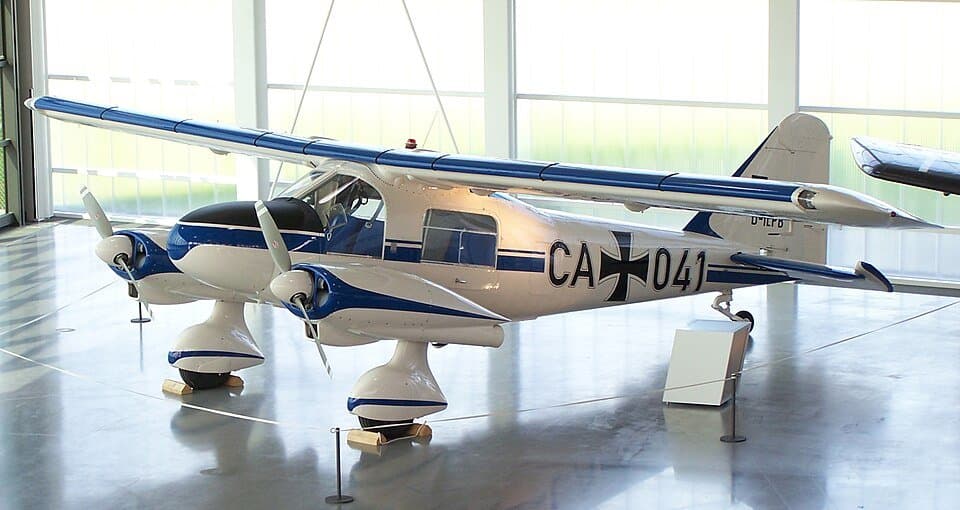

Credit
Bergfalke2 · CC BY-SA 3.0 · Resized · CC BY-SA 3.0 · Source ↗ · Modified


Preparing your view.

At a glance
True scale
Side by side. From every angle. A human reference for perspective.
3.56 MB · Loads when you open it| Model | Length | Width / span | Height |
|---|---|---|---|
| Dornier Do 28 | ≈ 11.41 m | ≈ 15.55 m (Width) | ≈ 4.3 m |
| Indonesian Aerospace N219 | ≈ 16.49 m | ≈ 19.5 m (Width) | ≈ 6.18 m |
Scaled uniformly to the sourced length of 11.41 m. The shape was turned square to the axes; the width was fitted to the sourced 15.55 m. Not an official model or a measured survey.
ForceTally · All rights reserved
Scaled uniformly to the sourced length of 16.49 m. The shape was turned square to the axes; the height was fitted to the sourced 6.18 m; the width was fitted to the sourced 19.5 m. Not an official model or a measured survey.
ForceTally · All rights reserved
The human reference is a generic 1.75 m figure. Models describe external size, not combat performance.
Measured figures
Do 28D-2 Skyservant · Length
Single source11.41 m (37 ft 5 in)[source]
Configuration
| Specification | Dornier Do 28 | Indonesian Aerospace N219 |
|---|---|---|
| Type | STOL light utility aircraft[source] | Utility aircraft[source] |
| Manufacturer | Dornier Flugzeugbau GmbH[source] | Indonesian Aerospace[source] |
| Status | In civilian and military use[source] | In production[source] |
| Primary user | German Air Force[source] |
Length
16.49 m (54 ft 1 in)[source]
Cruise; Do 28D-2 Skyservant · at 10,000 ft (3,000 m) (econ cruise, 50% power)
Single sourceMaximum; Do 28D-2 Skyservant · at 3,000 m (10,000 ft)
Single source325 km/h (202 mph, 175 kn) at 3,000 m (10,000 ft)[source]
241 km/h (150 mph, 130 kn) at 10,000 ft (3,000 m) (econ cruise, 50% power)[source]
Cruise; Economical
Single sourceMaximum; Maximum speed
Single sourceDo 28D-2 Skyservant · 2 × Lycoming IGSO-540-A1E air-cooled flat-six engines each
Single source2 × Lycoming IGSO-540-A1E air-cooled flat-six engines, 280 kW (380 hp) each[source]
2 × Pratt & Whitney Canada PT6A-42 turboprop engines (850 shp) each
Single source2 × Pratt & Whitney Canada PT6A-42 turboprop engines, 630 kW (850 shp) each[source]
Bars compare reported quantities only. A larger figure does not make a system better; configurations and test conditions differ.
| Number built | Do 28 - 1 Do 28A-1 - 60 Do 28B-1 - 60 Do 28D-1 - 54 Do 28D-2 - 172 Dornier 128-6 - 6[source] | 2 prototypes (December 2024)[source] |
|---|
| First flight | 29 April 1959 (Do 28 A/B) 23 February 1966 (Do 28D)[source] | 16 August 2017[source] |
|---|
| Developed from | Dornier Do 27[source] | — |
|---|
| Developed into | Dornier 228[source] | — |
|---|
| Capacity | 12 or 13 passengers[source] | 19 passengers[source] |
|---|
| Aspect ratio | 8.3:1[source] | — |
|---|
| Airfoil | NACA 23018 (modified)[source] | — |
|---|
| Fuel capacity | 893 L (236 US gal; 196 imp gal)[source] | 1,600 kg[source] |
|---|
| Propellers | 3-bladed Hartzell constant-speed propellers[source] | 4-bladed Hartzell Propeller aluminum autofeathering or 5-bladed MT-Propeller CFRP autofeathering[source] |
|---|
| Stall speed | 104 km/h (65 mph, 56 kn) (power off, flaps down)[source] | 109 km/h (68 mph, 59 kn)[source] |
|---|
| Minimum control speed | 65 km/h (40 mph, 35 kn) (power on, flaps down)[source] | — |
|---|
| Source measurement | The Do 28 was developed from the single-engine Do 27 at the end of the 1950s. The design shared the high-wing cantilever layout and the lift augmentation devices of the Do 27, together with the rear fuselage which seated six passengers.[source]Dornier Do 28 · Design and development / Dornier Do 28 A/B; only the objects and conditions stated in this passage The Dornier company was given financial assistance from the German government to develop a larger STOL transport to carry up to 13 passengers. The type was designated the Do 28D and later named Skyservant . The Do 28D was a complete redesign and shared only the basic layout and wing construction of the earlier versions. The fuselage and engine nacelles were rectangular, unlike the rounded Do 28A/B. The aim was to develop a simple and rugged aircraft for use under arduous conditions, which could be easily maintained. With a crew of two pilots, the cabin accommodated up to 12 passengers; freight could be loaded easily through large double doors and with the seats removed the cabin gave 283 sq ft (26.3 m 2 ) of unobstructed space. The first flight of a Do 28D took place on 23 February 1966 and the type was publicly exhibited at the Paris Air Show at Le Bourget airport in June 1967.[source]Dornier Do 28 · Design and development / Dornier Do 28 D Skyservant; only the objects and conditions stated in this passage A total of 121 Dornier Do 28D-2 s were built between 1971 and 1974 at Oberpfaffenhofen for the Bundeswehr (German Federal Armed Forces) where they replaced aging Percival Pembrokes . They served until the introduction of the Dornier 228 in 1994, predominantly as a transportation and communications aircraft. 20 aircraft were transferred to the Marineflieger , 10 served from 1978 in the maritime reconnaissance role, additional underwing fuel tanks were fitted for extended endurance (see photo).[source]Dornier Do 28 · Operational history; only the objects and conditions stated in this passage Prototype, first flew 29 April 1959 with two 180 hp (130 kW) Lycoming O-360-A1A engines and fixed pitch two-blade propellers ; one built.[source]Dornier Do 28 · Variants / Dornier Do 28 A/B/C; only the objects and conditions stated in this passage Designation of production aircraft with 250 hp (190 kW) Lycoming O-540-A1A engines and a 7 ft increase in wingspan , 60 built. First flown on 20 March 1960 at Oberpfaffenhofen . One aircraft was used for the personal transport of the German Defense Minister, Franz Josef Strauss ; 60 built.[source]Dornier Do 28 · Variants / Dornier Do 28 A/B/C; only the objects and conditions stated in this passage Do 28A with enlarged nose, additional fuel tanks, increased tailplane area and powered by 290 hp (220 kW) Lycoming IO-540 fuel injected engines and three-blade constant speed propellers , 60 built.[source]Dornier Do 28 · Variants / Dornier Do 28 A/B/C; only the objects and conditions stated in this passage Redesigned aircraft with box fuselage, larger wing, new tail and two 380 hp (280 kW) IGSO-540 engines, seven built.[source]Dornier Do 28 · Variants / Dornier Do 28 D Skyservant and derivatives; only the objects and conditions stated in this passage Production version of the Do 28D, with 0.5 m (1 ft 7½ in) greater wingspan and higher gross weight. 54 built.[source]Dornier Do 28 · Variants / Dornier Do 28 D Skyservant and derivatives; only the objects and conditions stated in this passage Prototype version powered by Lycoming LTP-101-600 turboprops rated at 298 kW (400 shp) each. One built, first flying on 9 April 1978. Also known as the TurboSky .[source]Dornier Do 28 · Variants / Dornier Do 28 D Skyservant and derivatives; only the objects and conditions stated in this passage Prototype version powered by PT6A-110 turboprops, also rated at 298 kW (400 shp) each. One built, first flying on 4 March 1980 later redesignated Dornier 128-6.[source]Dornier Do 28 · Variants / Dornier Do 28 D Skyservant and derivatives; only the objects and conditions stated in this passage A Do 28D fitted with a new, high technology wing ( Tragflügel Neuer Technologie – New Technology Wing) of 19.97 m (55 ft 8 in) span for trials, powered by two 533 kW (715 shp) Garrett TPE331 -5-252D mounted on the wing. One built, first flown on 14 June 1979. Wing later used in the Dornier 228 .[source]Dornier Do 28 · Variants / Dornier Do 28 D Skyservant and derivatives; only the objects and conditions stated in this passage Do 28 G.92[source]Dornier Do 28 · Variants / Dornier Do 28 D Skyservant and derivatives; only the objects and conditions stated in this passage 1995 conversion of Do 28D powered by two Walter M601 -D2 750 hp turboprops used for skydiving operations, seven built. Several now reengined with General Electric H75 to allow 750hp at higher altitudes than the Walter M601[source]Dornier Do 28 · Variants / Dornier Do 28 D Skyservant and derivatives; only the objects and conditions stated in this passage Improved version of Do 28D-2, replaced D-2 in 1980.[source]Dornier Do 28 · Variants / Dornier Do 28 D Skyservant and derivatives; only the objects and conditions stated in this passage Military of Mozambique 3 Dornier 28 in service[source]Dornier Do 28 · Operators / Military operators; only the objects and conditions stated in this passage Capacity: 12 or 13 passengers[source]Dornier Do 28 · Specifications (Do 28D-2 Skyservant); only the objects and conditions stated in this passage Length: 11.41 m (37 ft 5 in)[source]Dornier Do 28 · Specifications (Do 28D-2 Skyservant); only the objects and conditions stated in this passage Wingspan: 15.55 m (51 ft 0 in)[source]Dornier Do 28 · Specifications (Do 28D-2 Skyservant); only the objects and conditions stated in this passage Height: 3.90 m (12 ft 10 in)[source]Dornier Do 28 · Specifications (Do 28D-2 Skyservant); only the objects and conditions stated in this passage Wing area: 29.00 m 2 (312.2 sq ft)[source]Dornier Do 28 · Specifications (Do 28D-2 Skyservant); only the objects and conditions stated in this passage Empty weight: 2,304 kg (5,079 lb)[source]Dornier Do 28 · Specifications (Do 28D-2 Skyservant); only the objects and conditions stated in this passage Max takeoff weight: 4,015 kg (8,852 lb)[source]Dornier Do 28 · Specifications (Do 28D-2 Skyservant); only the objects and conditions stated in this passage Powerplant: 2 × Lycoming IGSO-540-A1E air-cooled flat-six engines, 280 kW (380 hp) each[source]Dornier Do 28 · Specifications (Do 28D-2 Skyservant); only the objects and conditions stated in this passage Maximum speed: 325 km/h (202 mph, 175 kn) at 3,000 m (10,000 ft)[source]Dornier Do 28 · Specifications (Do 28D-2 Skyservant); only the objects and conditions stated in this passage Cruise speed: 241 km/h (150 mph, 130 kn) at 10,000 ft (3,000 m) (econ cruise, 50% power)[source]Dornier Do 28 · Specifications (Do 28D-2 Skyservant); only the objects and conditions stated in this passage Stall speed: 104 km/h (65 mph, 56 kn) (power off, flaps down)[source]Dornier Do 28 · Specifications (Do 28D-2 Skyservant); only the objects and conditions stated in this passage Minimum control speed : 65 km/h (40 mph, 35 kn) (power on, flaps down)[source]Dornier Do 28 · Specifications (Do 28D-2 Skyservant); only the objects and conditions stated in this passage Range: 2,950 km (1,830 mi, 1,590 nmi) (with max fuel)[source]Dornier Do 28 · Specifications (Do 28D-2 Skyservant); only the objects and conditions stated in this passage Service ceiling: 7,680 m (25,200 ft)[source]Dornier Do 28 · Specifications (Do 28D-2 Skyservant); only the objects and conditions stated in this passage Rate of climb: 5.3 m/s (1,050 ft/min)[source]Dornier Do 28 · Specifications (Do 28D-2 Skyservant); only the objects and conditions stated in this passage | — |
|---|
| Country of origin | Germany[source] | — |
|---|
| National origin | — | Indonesia[source] |
|---|
| Manufactured | — | 2017–present[source] |
|---|
| g limits | — | -1.2 g to +3.0 g (flaps retracted)[source] |
|---|
| Takeoff distance | — | 435 meters (1,427 feet)[source] |
|---|
| Landing distance | — | 509 meters (1,670 feet)[source] |
|---|
| Alternative designation | — | N219[source] |
|---|