FORCETALLY
Loading the evidence…
Preparing your view.


Preparing your view.
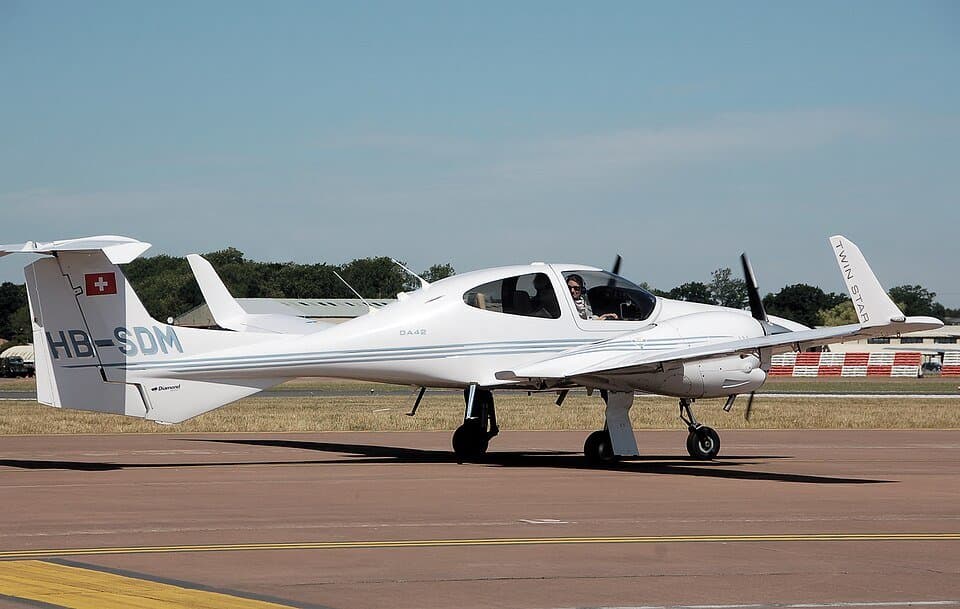
Trainer aircraftIn service
Light twin-engined utility and trainer aircraft
Diamond DA42 Twin Star is a light twin-engined utility and trainer aircraft originating in Austria. It was built by Diamond Aircraft Industries.
 Austria
Diamond DA42 Twin Star
Photographed by myself (Adrian Pingstone) · Public domain · Resized · Public domain · Source ↗ · ModifiedTechnical data
Light twin-engined utility and trainer aircraft
Austria
Diamond Aircraft Industries
In production
600+ (2010)
2002–present
2004
9 December 2002
Aeronautics Defense Dominator
1 pilot
3 passengers
8.56 m (28 ft 1 in)
13.55 m (44 ft 5 in)
2.49 m (8 ft 2 in)
16.29 m 2 (175.3 sq ft)
True scale
Sourced dimensions beside a 1.75 m human reference.
See it in your room. Scan with your phone to open this model in 3D, then place it in your space.
Points represent sourced observations, including revisions. Revisions on the same effective date are not separate inventory events. Ranges appear in the table and are not plotted as exact points.
| Observation / report period | Value | Source | Claim state |
|---|---|---|---|
| 28 Sept 2026 | 1 people | Wikipedia contributors | superseded |
| 28 Sept 2026 | 1 people | Wikipedia contributors | superseded |
| 28 Sept 2026 | 1 people | Wikipedia contributors | superseded |
| 28 Sept 2026 | 1 people | Wikipedia contributors | superseded |
| 28 Sept 2026 | 1 people | Wikipedia contributors | superseded |
| 28 Sept 2026 | 1 people | Wikipedia contributors | approved |
1,420 kg (3,131 lb)
1,999 kg (4,407 lb)
289 litres (64 imp gal; 76 US gal)
2 × Austro Engine E4 turbocharged diesel engine , 125 kW (168 hp) each
365 km/h (227 mph, 197 kn)
326 km/h (203 mph, 176 kn)
2,250 km (1,400 mi, 1,210 nmi)
5,486 m (18,000 ft)
7.9 m/s (1,280 ft/min)
During August 2004, the DA42 Twin Star piloted by Gérard Guillaumaud became the first diesel-powered fixed-wing aircraft to perform a non-stop crossing of the North Atlantic, taking 12.5 hours while operating with an average fuel consumption of 21.73 litres (4.78 imp gal; 5.74 US gal) per hour (10.86 litres (2.39 imp gal; 2.87 US gal) per hour per engine). In June 2010, a DA42 powered by Austro AE300 engines became the first aircraft to be publicly flown on algae -derived jet fuel.
The DA42 typically accommodates four people in two rows of seating. All of the seats have been designed for crashworthiness and are complete with automotive-style three-point seat belts; while the seats themselves are fixed in position, the position of the rudder-pedals is adjustable. The front pair of seats are accessed via a front-hinged canopy while a top-hinged door located on the left side provides access to the rear seats. The pilots are housed under a sizable canopy which provides generous external visibility, save for the use of a large fixed sunscreen. Additionally, separate baggage compartments, which are accessible via external hatches, are contained within internal space in the aircraft's nose.
The stall characteristics are also relatively benign, being described by Flight International as "probably the most docile of any aircraft I can remember". On the DA42, stall conditions are forewarned by the sounding of a warning horn at 5 to 7 kn (9 to 13 km/h) above stall, as well as by elevating levels of airframe buffeting and a 5–10° drop of the nose. The aircraft is relatively difficult to stall outside of substantial mishandling or deliberate intention. Both longitudinal and lateral stability can be maintained with a relatively low level of effort, not necessitating continuous trimming while the aircraft is accelerating. Active use of the rudder is necessary for effective turns and counteracting sideslip tendencies.
While the DA42 is a twin-engined aircraft, this is predominantly a measure for safety. It is readily capable of sustained flight using only a single engine. DA42 NG climbs at up to 270 ft/min at sea level in standard conditions on a single engine, with performance degrading with higher altitudes and temperatures. The DA42 possesses considerable endurance, being capable of performing 13 hour-long flights without carrying additional fuel tanks; this is partially due to its high fuel efficiency of its Austro engines, which consume 13.6 US gallons per hour when operated at 75 per cent power, lower than some of its single-engined rivals. The digital FADEC (full authority digital engine controls) serves to lower operational difficulty, constantly performing tasks such as managing rpm and fault-checking. The propellers are clockwise-rotating as viewed by the pilot, so the left engine is the critical engine .
The original model of the DA42 was powered by a pair of Thielert Aircraft Engines-built TAE 125-01 Centurion 1.7 engines. However, Thielert ended its production of the 1.7 litre Centurion engines in favour of a new 2.0 litre engine, marketed as the TAE 125-02-99; as a result of the engine production change, Diamond began installing the TAE 125-02-99 engine during early 2007. Although engine displacement had increased, it was deliberately de-rated in order to produce the same power 101 kW (135 hp) and torque 409 N⋅m (302 lbf⋅ft) as the earlier 1.7 L. engine.
The DA42NG "New Generation" is powered by Diamond's third generation Austro AE 300 turbo diesel engine. The Lycoming IO-360 engine is also available as an option. The 125 kW (168 hp) AE 300 engine replaces the earlier Thielert Centurion 1.7 and 2.0 engines and is known for its good fuel efficiency, using 12.1 litres (2.7 imp gal; 3.2 US gal) per hour while loitering at maximum endurance or 30 litres (7 imp gal; 8 US gal) per hour at maximum continuous power (92%). It is also available with optional "on top" exhaust mufflers that reduce noise levels to below 59 decibels at a height of 500 feet (150 m). The Austro engine produces 20% more power than the previous Thielert engines and also results in a higher gross weight and increased performance. Diamond has claimed that the Austro engine is about 46% more fuel efficient than its gasoline rivals. It runs on diesel fuel or jet fuel , both of which are typically cheaper than aviation gasoline .
The DA42, particularly its use in the surveillance sector, became Diamond's most important business. A dedicated surveillance model of the aircraft, designated as the DA 42 MPP , was developed; during 2008, Diamond delivered 17 DA 42 MPPs and anticipated a demand for between 50 and 60 such aircraft per year. During the latter part of 2008 and early 2009, a pair of Royal Air Force DA42 MPPs were deployed for eight months to provide combat support to coalition forces operating in Iraq ; during the deployment, these aircraft flew a combined 2,000h in the surveillance role, for which it had been outfitted with Cineflex high-definition cameras, Riegl laser scanners and Scotty satellite communications kit.
Lycoming IO-360 134 kW (180 hp) equipped version using 100LL fuel instead of Jet-A1 . This model is intended for the North American flight training market.
Austro Engine AE 300 127 kW (170 hp) equipped version. EASA certified March 2009; FAA certified April 2010; Transport Canada certified 16 April 2012. Production aircraft have been built in Austria, Canada, China and Russia.
Aurora Flight Sciences developed an Optionally Piloted Aircraft (OPA) as an Intelligence, Surveillance and Reconnaissance (ISR) platform and can be operated as either unmanned or with pilots on board. One in service with the Swiss military procurement agency Armasuisse .
Aeronautics Defense Systems Ltd developed an UAV version of the DA42, designated as the Aeronautics Defense Dominator and first flown in July 2009. Has an endurance of 28 hours with a 408 kg (899 lb) payload and speed of 140–354 km/h (75–190 knots) to a maximum altitude of 9,144 m (30,000 ft).
Royal Air Force – 2 x DA42MPP operated in 2008 and 2009 in surveillance role.
Capacity: 3 passengers
Length: 8.56 m (28 ft 1 in)
Wingspan: 13.55 m (44 ft 5 in)
Height: 2.49 m (8 ft 2 in)
Wing area: 16.29 m 2 (175.3 sq ft)
Empty weight: 1,420 kg (3,131 lb)
Gross weight: 1,999 kg (4,407 lb)
Fuel capacity: 289 litres (64 imp gal; 76 US gal)
Powerplant: 2 × Austro Engine E4 turbocharged diesel engine , 125 kW (168 hp) each
Maximum speed: 365 km/h (227 mph, 197 kn)
Cruise speed: 326 km/h (203 mph, 176 kn)
Range: 2,250 km (1,400 mi, 1,210 nmi)
Service ceiling: 5,486 m (18,000 ft)
Rate of climb: 7.9 m/s (1,280 ft/min)
Max. take off mass 1,999 kg 4,407 lbs
Reference text from Wikipedia contributors, used under CC BY-SA 4.0.
Diamond DA42 Twin Star equipment records. Variants, orders and quantities are shown as reported in each inventory source; coverage is incomplete.
 Argentina
Number column of the Wikipedia list table under "Aircraft". The list's own wording applies; it is a compiled secondary source, not an official census.
 Burkina Faso
Number column of the Wikipedia list table under "Reconnaissance". The list's own wording applies; it is a compiled secondary source, not an official census.
 Ghana
Air Force exact named equipment holdings: DA42. Active, operational-reserve and training units excluding equipment in store; November 2025 IISS assessment. Named service only; no parent-force or national total inferred. Source role: AIRCRAFT / Light. Original estimates, ranges, reporting names, reserve, lease and employment scopes retained; nested included counts are not added. Missile-system quantities mean launchers, not rounds. No readiness, crew, carried weapon, payload, factory-production or future order count inherited.
 Jamaica
Dated directory active-fleet estimate for DA42, grouped under Diamond DA42 Twin Star. Only the explicitly listed service/role Active cells are included. Ordered, stored and upgrade aircraft are excluded. This is the directory coverage of these source types, not a national total, complete owned-fleet census or readiness count.
 Niger
Approximate count for DA42 MPP Twin Star. Service scope: Air Force; does not replace a national total. 1 distinct count cell(s) from the same source list; shared rowspan cells counted once. Retired, wholly reserve and on-order rows are excluded; the reported count retains any explicitly mixed stock scope in the quoted row. Count column(s): quantity: ~1. Origin: Austria. The listed variants/roles are the scope, not an immediately deployable count. The components do not establish one inventory census date; the stored date is the retrieved source snapshot.
 Poland
Directory active-fleet estimate for the source types DA42, grouped under Diamond DA42 Twin Star. Sums only the listed service and role rows; includes training and special-mission versions where explicitly listed. Excludes the separate Ordered column, aircraft in storage, aircraft undergoing or awaiting upgrades, and the directory's other exclusions. This is the dated directory coverage of these types, not a complete owned-fleet census or a readiness count.
 Russia
Aerospace Forces exact named equipment holdings: DA42T. Active, operational-reserve and training units excluding equipment in store; November 2025 IISS assessment. Named service only; no parent-force or national total inferred. Source role: AIRCRAFT / TRG. Original estimates, ranges, reporting names, reserve, lease and employment scopes retained; nested included counts are not added. Missile-system quantities mean launchers, not rounds. No readiness, crew, carried weapon, payload, factory-production or future order count inherited.
 Rwanda
Dated directory active-fleet estimate for DA42, grouped under Diamond DA42 Twin Star. Only the explicitly listed service/role Active cells are included. Ordered, stored and upgrade aircraft are excluded. This is the directory coverage of these source types, not a national total, complete owned-fleet census or readiness count.
 Senegal
Dated directory active-fleet estimate for DA42, grouped under Diamond DA42 Twin Star. Only the explicitly listed service/role Active cells are included. Ordered, stored and upgrade aircraft are excluded. This is the directory coverage of these source types, not a national total, complete owned-fleet census or readiness count.
 Switzerland
Reported count for Diamond DA42 Twin Star · MPP Centaur OPA. Service scope: Swiss Air Force; does not replace a national total. 1 distinct quantity component(s) from the same source list; shared rowspan cells counted once. Explicit source inventory scope: active; no other stock status or total inferred. Count column(s): in service: 1. Origin: Austria / United States. The listed variants/roles are the scope, not an immediately deployable count. Explicitly named source subset; this is not a whole-family total and does not cover other listed designs. Dates are the count-cell citations' stated source period (2024), not the article revision. Cited source 2024-10-07. Edition or publication years do not claim an exact inventory census day.
 Thailand
Reported count for Diamond DA42 Twin Star. Service scope: Royal Thai Air Force; does not replace a national total. 2 distinct count cell(s) from the same source list; shared rowspan cells counted once. Retired, wholly reserve and on-order rows are excluded; the reported count retains any explicitly mixed stock scope in the quoted row. Count column(s): total: 11 / total: 18. Origin: Austria. The listed variants/roles are the scope, not an immediately deployable count. Dates are the count-cell citations' stated source period (2025), not the article revision. 2025 cited source edition. Edition or publication years do not claim an exact inventory census day.
 Venezuela
National Guard (Fuerzas Armadas de Cooperacion) exact named equipment holdings: DA42 MPP. Active, operational-reserve and training units excluding equipment in store; November 2025 IISS assessment. Named service only; no parent-force or national total inferred. Source role: AIRCRAFT / Light. Original estimates, ranges, reporting names, reserve, lease and employment scopes retained; nested included counts are not added. Missile-system quantities mean launchers, not rounds. No readiness, crew, carried weapon, payload, factory-production or future order count inherited.
Reported count for DA42VI. Service scope: Air Force; does not replace a national total. 1 distinct count cell(s) from the same source list; shared rowspan cells counted once. Excludes retired/reserve/on-order rows. Count column(s): quantity: 6. Origin: Austria. The listed variants/roles are the scope, not an immediately deployable count. The components do not establish one inventory census date; the stored date is the retrieved source snapshot.
Keep exploring
Light twin-engine utility aircraft / multi-engine trainer
 ItalyCompare with Diamond DA42 Twin Star
Trainer , transport aircraft and utility aircraft
 United StatesCompare with Diamond DA42 Twin Star
Trainer and light attack aircraft
 BrazilCompare with Diamond DA42 Twin Star
Light military trainer aircraft
 FranceCompare with Diamond DA42 Twin Star
Advanced trainer and light attack aircraft
 RomaniaCompare with Diamond DA42 Twin Star
Advanced trainer and light attack aircraft
ItalyCompare with Diamond DA42 Twin Star