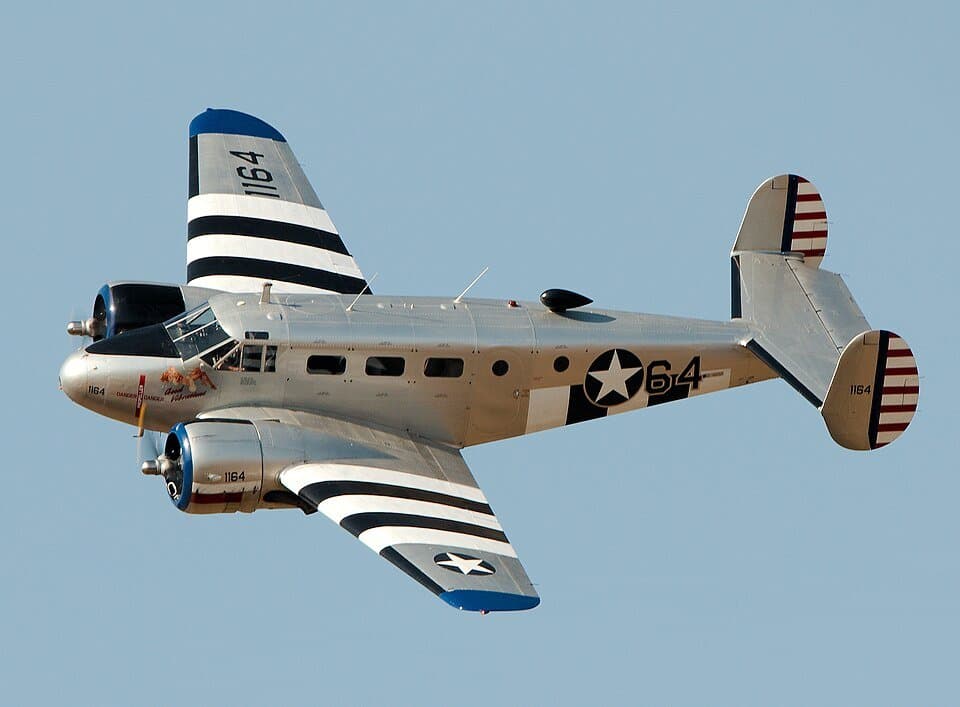

Credit
Airwolfhound · CC BY-SA 2.0 · Resized · CC BY-SA 2.0 · Source ↗ · Modified


Preparing your view.

At a glance
True scale
Side by side. From every angle. A human reference for perspective.
3.08 MB · Loads when you open it| Model | Length | Width / span | Height |
|---|---|---|---|
| Beechcraft Model 18 | ≈ 10.44 m | ≈ 14.53 m (Wingspan) | ≈ 3.84 m |
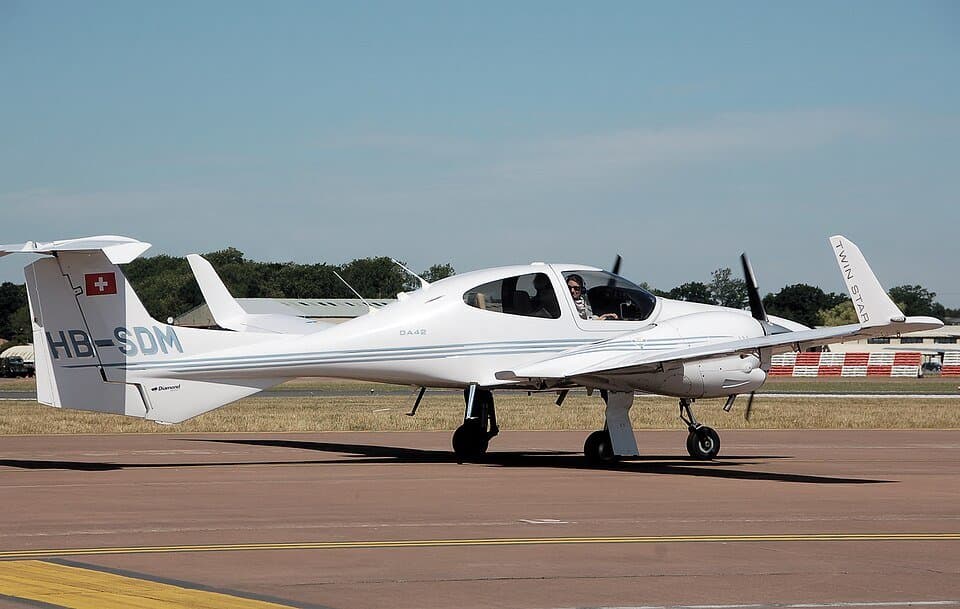
| Diamond DA42 Twin Star | ≈ 8.56 m | ≈ 13.55 m (Wingspan) | ≈ 2.49 m |
Scaled uniformly to the sourced length of 10.44 m. The shape was turned square to the axes; the width was fitted to the sourced 14.53 m wingspan. Not an official model or a measured survey.
ForceTally · All rights reserved
Scaled uniformly to the sourced length of 8.56 m. The shape was turned square to the axes; the height was fitted to the sourced 2.49 m; the width was fitted to the sourced 13.55 m wingspan. Not an official model or a measured survey.
ForceTally · All rights reserved
The human reference is a generic 1.75 m figure. Models describe external size, not combat performance.
Measured figures
UC-45 Expeditor · Length
Single source34 ft 3 in (10.44 m)[source]
Configuration
| Specification | Beechcraft Model 18 | Diamond DA42 Twin Star |
|---|---|---|
| Type | Trainer , transport aircraft and utility aircraft[source] | Light twin-engined utility and trainer aircraft[source] |
| National origin | United States[source] | Austria[source] |
| Manufacturer | Beech Aircraft Corporation[source] | Diamond Aircraft Industries[source] |
| Status | In service[source] |
DA42 Twin Star · Length
8.56 m (28 ft 1 in)[source]
Empty; UC-45 Expeditor · Empty weight
Single sourceGross; UC-45 Expeditor · Gross weight
Single sourceMaximum take-off; Beechcraft Model 18 · Conrad Ten-Twos · stated modified aircraft maximum takeoff weight
Single sourceMaximum take-off; Beechcraft Model 18 · Model 18A · maximum takeoff weight exactly as stated
Single sourceMaximum take-off; Beechcraft Model 18 · Model 18D · maximum takeoff weight exactly as stated
Single sourceMaximum take-off; Beechcraft Model 18 · Model A18A · maximum takeoff weight exactly as stated
Single sourceMaximum take-off; Beechcraft Model 18 · Model A18D · maximum takeoff weight exactly as stated
Single sourceMaximum take-off; Beechcraft Model 18 · Model D18C · maximum takeoff weight exactly as stated
Single sourceMaximum take-off; Beechcraft Model 18 · Model D18S · maximum takeoff weight exactly as stated
Single sourceMaximum take-off; Beechcraft Model 18 · Model E18S-9700 · maximum takeoff weight exactly as stated
Single sourceMaximum take-off; Beechcraft Model 18 · Model E18S · maximum takeoff weight exactly as stated
Single sourceMaximum take-off; Beechcraft Model 18 · Model G18S-9150 · maximum takeoff weight exactly as stated
Single sourceMaximum take-off; Beechcraft Model 18 · Model G18S · maximum takeoff weight exactly as stated
Single sourceMaximum take-off; Beechcraft Model 18 · Model H18 · maximum takeoff weight exactly as stated
Single sourceMaximum take-off; Beechcraft Model 18 · Model S18A · maximum takeoff weight exactly as stated
Single sourceMaximum take-off; Beechcraft Model 18 · Model S18D · maximum takeoff weight exactly as stated
Single sourceMaximum take-off; Beechcraft Model 18 · Model SA18A · maximum takeoff weight exactly as stated
Single sourceMaximum take-off; Beechcraft Model 18 · Volpar Turbo Beeches · stated modified aircraft maximum takeoff weight
Single source5,420 lb (2,458 kg)[source]
7,500 lb (3,402 kg)[source]
6,700 lb (3,000 kg)[source]Beechcraft Model 18 · Model 18A · maximum takeoff weight exactly as stated
7,200 lb (3,300 kg)[source]Beechcraft Model 18 · Model S18A · maximum takeoff weight exactly as stated
7,500 lb (3,400 kg)[source]Beechcraft Model 18 · Model A18A · maximum takeoff weight exactly as stated
7,170 lb (3,250 kg)[source]Beechcraft Model 18 · Model SA18A · maximum takeoff weight exactly as stated
7,200 lb (3,300 kg)[source]Beechcraft Model 18 · Model 18D · maximum takeoff weight exactly as stated
7,170 lb (3,250 kg)[source]
Empty; DA42 Twin Star · Empty weight
Single sourceGross; DA42 Twin Star · Gross weight
Single sourceUC-45 Expeditor · 2 × Pratt & Whitney R-985-AN-1 "Wasp Junior" radial engines each
Single source2 × Pratt & Whitney R-985-AN-1 "Wasp Junior" radial engines , 450 hp (340 kW) each[source]
DA42 Twin Star · 2 × Austro Engine E4 turbocharged diesel engine each
Single source2 × Austro Engine E4 turbocharged diesel engine , 125 kW (168 hp) each[source]
Bars compare reported quantities only. A larger figure does not make a system better; configurations and test conditions differ.
In production[source]
| Primary users | United States Army Air Forces United States Navy Royal Air Force Royal Canadian Air Force[source] | — |
|---|
| Number built | 9,000+[source] | 600+ (2010)[source] |
|---|
| Manufactured | 1937–1970[source] | 2002–present[source] |
|---|
| Introduction date | 1937[source] | 2004[source] |
|---|
| First flight | 15 January 1937[source] | 9 December 2002[source] |
|---|
| Capacity | 6 passengers[source] | 3 passengers[source] |
|---|
| Role | 6- to 11-seat, twin-engined, low-wing, tailwheel light aircraft[source] | — |
|---|
| Source measurement | During the mid 1930s, Beechcraft management speculated that sufficient demand would exist for a new design, referred to as the Model 18 . It was envisioned as a twin-engine transport aircraft, capable of seating between six and eight passengers dependent upon configuration, that would be suitable both as a business aircraft and a small regional airliner , the latter being viewed as a relatively small niche of the market due to few feeder lines existing at that time. Furthermore, the Model 18 would be designed so that it could be readily converted to be used for several military applications as well as to haul cargo. The decisions to proceed was issued in late 1935 and preliminary works commenced thereafter, which was headed by aeronautical engineer Theodore Wells. To accommodate the anticipated volume, the company's main production facilities were expanded around this time.[source]Beechcraft Model 18 · Design and development; only the objects and conditions stated in this passage Early production aircraft were powered either by a pair of 330-hp (250-kW) Jacobs L-6s or 350-hp (260-kW) Wright R-760 Es; at the time, these were the only engines available that satisfied the designer's requirements. Many aircraft, such as the D18S variant, were powered by two 450-hp (336-kW) Pratt & Whitney R-985 "Wasp Junior" nine-cylinder radial engines , paired with Hamilton Standard constant speed propellers . The Model 18 has used a variety of engines and has been subject to a number of airframe modifications to increase both gross weight and speed. At least one aircraft was modified to use 600-hp (447-kW) Pratt & Whitney R-1340 "Wasp" powerplants. With the added weight of about 200 lb (91 kg) per engine, the concept of a Model 18 fitted with R-1340 engines was deemed unsatisfactory due to the weakest structural area of the aircraft being the engine mounts.[source]Beechcraft Model 18 · Design and development; only the objects and conditions stated in this passage On 10 December 1953, the prototype of the improved Super 18 made its first flight. In 1955, deliveries of the Model E18S commenced; the E18S featured a fuselage that was extended 6 in (150 mm) higher for more headroom in the passenger cabin. All later Beech 18s (sometimes called Super 18s) featured this taller fuselage, and some earlier models (including one AT-11) have had this modification. The Model H18, introduced in 1963, featured optional tricycle undercarriage . Unusually, the undercarriage was developed for earlier-model aircraft under an supplemental type certificate by Volpar , and installed in H18s at the factory during manufacture. A total of 109 H18s was built with tricycle undercarriage, and another 240 earlier-model aircraft were modified with this.[source]Beechcraft Model 18 · Design and development; only the objects and conditions stated in this passage Existing naval Twin Beeches were subsequently modified into the SNB-2H air ambulance, SNB-2P reconnaissance trainer, and SNB-3Q electronic countermeasures trainer.[source]Beechcraft Model 18 · Operational history; only the objects and conditions stated in this passage Beech 18s were used extensively by Air America during the Vietnam War ; initially more-or-less standard ex-military C-45 examples were used, but then the airline had 12 aircraft modified by Conrad Conversions in 1963 and 1964 to increase performance and payload. The modified aircraft were known as Conrad Ten-Twos, as the maximum takeoff weight (MTOW) was increased to 10,200 lb (4,600 kg). The increase was achieved by several airframe modifications, including increased horizontal stabilizer angle-of-incidence, redesigned undercarriage doors, and aerodynamically improved wingtips. Air America then had Volpar convert 14 aircraft to turboprop power, fitted with Garrett AiResearch TPE-331 engines; modified aircraft were called Volpar Turbo Beeches, and also had a further increase in MTOW to 10,286 lb (4,666 kg).[source]Beechcraft Model 18 · Operational history; only the objects and conditions stated in this passage First production model with seating for two pilots and seven or eight passengers, fitted with Wright R-760 E-2 engines of 350 horsepower (260 kW), MTOW: 6,700 lb (3,000 kg) Four built.[source]Beechcraft Model 18 · Variants / Manufacturer models; only the objects and conditions stated in this passage Version of Model 18A capable of being fitted with skis or Edo 55-7170 floats ; MTOW: 7,200 lb (3,300 kg)[source]Beechcraft Model 18 · Variants / Manufacturer models; only the objects and conditions stated in this passage Version fitted with Wright R-760E-2 engines, MTOW: 7,500 lb (3,400 kg)[source]Beechcraft Model 18 · Variants / Manufacturer models; only the objects and conditions stated in this passage Seaplane version of Model A18A, MTOW: 7,170 lb (3,250 kg)[source]Beechcraft Model 18 · Variants / Manufacturer models; only the objects and conditions stated in this passage Version powered with 285 hp (213 kW) Jacobs L-5 engines. Four built.[source]Beechcraft Model 18 · Variants / Manufacturer models; only the objects and conditions stated in this passage Variant with seating for two pilots and nine passengers, fitted with Jacobs L-6 engines of 330 horsepower (250 kW), MTOW: 7,200 lb (3,300 kg). Twelve aircraft built.[source]Beechcraft Model 18 · Variants / Manufacturer models; only the objects and conditions stated in this passage Version of Model 18D capable of being fitted with skis or Edo 55-7170 floats , MTOW: 7,170 lb (3,250 kg)[source]Beechcraft Model 18 · Variants / Manufacturer models; only the objects and conditions stated in this passage Variant of 18D with MTOW increased by 300 lb (140 kg) to 7,500 lb (3,400 kg).[source]Beechcraft Model 18 · Variants / Manufacturer models; only the objects and conditions stated in this passage Model with Pratt and Whitney R-985 -A1 engines with dual-stage blower for increased power at higher operating altitudes , 420 horsepower (310 kW), seven built, one to Sweden as an air ambulance , six to Nationalist China as M18R light bombers[source]Beechcraft Model 18 · Variants / Manufacturer models; only the objects and conditions stated in this passage Nine-passenger pre-World War II civil variant, powered by 450 hp (340 kW) served as basis for USAAF C-45C[source]Beechcraft Model 18 · Variants / Manufacturer models; only the objects and conditions stated in this passage Variant of B18S with seating for eight passengers, and equipment and minor structural changes[source]Beechcraft Model 18 · Variants / Manufacturer models; only the objects and conditions stated in this passage First post-World War II variant introduced in 1945, with seating for eight passengers and MTOW of 8,750 lb (3,970 kg), 1,035 built[source]Beechcraft Model 18 · Variants / Manufacturer models; only the objects and conditions stated in this passage Variant with Continental R9-A engines of 525 horsepower (391 kW) and MTOW of 9,000 lb (4,100 kg), introduced in 1947, 31 built.[source]Beechcraft Model 18 · Variants / Manufacturer models; only the objects and conditions stated in this passage Variant with redesigned wing and MTOW of 9,300 lb (4,200 kg); 403 built[source]Beechcraft Model 18 · Variants / Manufacturer models; only the objects and conditions stated in this passage Variant of E18S with MTOW of 9,700 lb (4,400 kg); 57 built[source]Beechcraft Model 18 · Variants / Manufacturer models; only the objects and conditions stated in this passage Superseded E18S, MTOW of 9,700 lb (4,400 kg); 155 built[source]Beechcraft Model 18 · Variants / Manufacturer models; only the objects and conditions stated in this passage Lightweight version of G18, MTOW of 9,150 lb (4,150 kg); one built[source]Beechcraft Model 18 · Variants / Manufacturer models; only the objects and conditions stated in this passage Last production version, fitted with optional tricycle undercarriage developed by Volpar and MTOW of 9,900 lb (4,500 kg); 149 built, of which 109 were manufactured with tricycle undercarriage[source]Beechcraft Model 18 · Variants / Manufacturer models; only the objects and conditions stated in this passage C-45G[source]Beechcraft Model 18 · Variants / Military versions / USAAC/USAAF designations; only the objects and conditions stated in this passage TC-45G[source]Beechcraft Model 18 · Variants / Military versions / USAAC/USAAF designations; only the objects and conditions stated in this passage Multiengine crew trainer variant of C-45G; AT-7s and AT-11s remanufactured in the early 1950s for the USAF to similar standard as civil D18S, 96 aircraft rebuilt[source]Beechcraft Model 18 · Variants / Military versions / USAAC/USAAF designations; only the objects and conditions stated in this passage C-45H[source]Beechcraft Model 18 · Variants / Military versions / USAAC/USAAF designations; only the objects and conditions stated in this passage TC-45H[source]Beechcraft Model 18 · Variants / Military versions / USAAC/USAAF designations; only the objects and conditions stated in this passage In 1962, all surviving U.S. Navy SNB-5Ps were redesignated RC-45J[source]Beechcraft Model 18 · Variants / Military versions / USAAC/USAAF designations; only the objects and conditions stated in this passage Navigation trainer based on C18S, with an astrodome and positions for three students, powered by 450-hp Pratt & Whitney R-985-25 engines; 577 built[source]Beechcraft Model 18 · Variants / Military versions / USAAC/USAAF designations; only the objects and conditions stated in this passage SNB-2H[source]Beechcraft Model 18 · Variants / Military versions / US Navy designations; only the objects and conditions stated in this passage Modification increasing the gross weight to 9,800 pounds with a single piece windshield[source]Beechcraft Model 18 · Variants / Conversions; only the objects and conditions stated in this passage Stretched airliner conversion. Similar to Dumod I but with forward fuselage stretched by 6 feet 3 inches (1.91 m), allowing up to 15 passengers to be carried. Originally named Infinité II .[source]Beechcraft Model 18 · Variants / Conversions; only the objects and conditions stated in this passage Stretched conversion powered by two 840-hp PT6As , and with accommodation for up to 17 passengers[source]Beechcraft Model 18 · Variants / Conversions; only the objects and conditions stated in this passage two 579-hp PT6A-20s or 630-hp PT6A-27s or 630-hp Lycoming LTS101s .[source]Beechcraft Model 18 · Variants / Conversions; only the objects and conditions stated in this passage two 570-hp Lycoming LTP101s or 680-hp PT6A-28s or 750-hp PT6A-34s or 1020-hp PT6A-45s[source]Beechcraft Model 18 · Variants / Conversions; only the objects and conditions stated in this passage Built as C-45F 44-47231, this aircraft was re-manufactured at Wichita by Beech in 1952, to become TC-45G 51-11544. From 1959 Rausch Engineering Inc. of South San Francisco, California, converted N8186H to tricycle undercarriage, using forward retracting main gear from a P-51 and rearward-retracting nose-leg from a T-28, adding a 3 ft (0.91 m) nose extension, 4 ft (1.22 m) rear fuselage extension, re-roofed fuselage for increased headroom and enlarged cabin windows. The modifications did not obtain FAA certification despite 58 hours of flight testing, with the aircraft eventually being broken up at Antioch, CA, in 1978.[source]Beechcraft Model 18 · Variants / Conversions; only the objects and conditions stated in this passage Beech Model 18s fitted with the Volpar MkIV tricycle undercarriage and powered by two 705-hp Garrett TPE331-1-101B turboprop engines, flat-rated to 605 hp (451 kW), driving Hartzell HC-B3TN-5 three-bladed, reversible-pitch, constant-speed feathering propellers[source]Beechcraft Model 18 · Variants / Conversions; only the objects and conditions stated in this passage 2x 705 hp (526 kW) Garrett TPE331[source]Beechcraft Model 18 · Variants / Conversions; only the objects and conditions stated in this passage Volpar (Beechcraft) C-45G[source]Beechcraft Model 18 · Variants / Conversions; only the objects and conditions stated in this passage C-45G aircraft modified with tricycle undercarriage[source]Beechcraft Model 18 · Variants / Conversions; only the objects and conditions stated in this passage 15-passenger version of the Turbo 18 with extended fuselage, powered by 2 705-hp Garrett TPE331-1-101Bs[source]Beechcraft Model 18 · Variants / Conversions; only the objects and conditions stated in this passage 25 April 1951: Cubana de Aviación Flight 493 , a Douglas DC-4 bound from Miami to Havana, registration CU-T188 , collided with a U.S. Navy SNB-1, bureau number 39939 , which was performing a practice instrument approach to Naval Air Station Key West . The collision and ensuing crashes killed all 34 passengers and five crew aboard the DC-4 and all five crew aboard the SNB. The accident occurred at midday, weather was clear with unlimited visibility, and both flight crews had been cleared to fly under visual flight rules , being expected to "see and avoid" other aircraft; the student flying the SNB was wearing view-limiting goggles, but the other SNB crew were not, and were expected to keep watch. Ground witnesses said that neither aircraft took evasive action prior to the collision, and the Civil Aeronautics Board attributed the accident to the failure of both flight crews to see and avoid conflicting air traffic.[source]Beechcraft Model 18 · Accidents and incidents; only the objects and conditions stated in this passage 19 September 1965: During the India–Pakistan war of 1965 , eight people including Chief Minister Balwantrai Mehta of Gujarat, India, were killed when their civilian-registered Beechcraft 18 was shot down southwest of Bhuj by an F-86 Sabre of the Pakistan Air Force , which had concluded that the Indian Army had been conducting reconnaissance of a nearby conflict zone using civil aircraft.[source]Beechcraft Model 18 · Accidents and incidents; only the objects and conditions stated in this passage 1967: Mohammed bin Awad bin Laden was killed in the crash of a Beechcraft 18 in Saudi Arabia.[source]Beechcraft Model 18 · Accidents and incidents; only the objects and conditions stated in this passage 20 September 1973: American folk rock singer-songwriter Jim Croce , four members of his entourage, and the pilot were killed when their chartered E18S, registration N50JR , crashed into a tree shortly after takeoff from Natchitoches Regional Airport in Louisiana. The NTSB attributed the accident to reduced visibility due to fog, and to physical impairment of the pilot, who had severe coronary artery disease and had run 3 mi (4.8 km) to the airport. An investigation conducted for a lawsuit against the charter company attributed the accident solely to pilot error , citing his downwind takeoff into a "black hole" of severe darkness, causing him to experience spatial disorientation .[source]Beechcraft Model 18 · Accidents and incidents; only the objects and conditions stated in this passage 26 September 1978: Air Caribbean Flight 309 , an air taxi flight by a D18S, registration N500L , crashed on approach to Isla Verde International Airport in Puerto Rico, killing the pilot and the five passengers aboard the aircraft and causing substantial property damage and injuries to bystanders on the ground. The pilot could not communicate with approach control and was following directions relayed by local tower controllers, who told the pilot to make a turn and maintain separation from a Lockheed L-1011 that was overtaking the flight, but the pilot did not turn, and the D18S passed underneath and very close to the L-1011. Both the NTSB and a U.S. District Court ruling attributed the crash to the D18S pilot's failure to correctly follow visual flight rules and air traffic control instructions to maintain separation from the much larger L-1011, causing a loss of aircraft control due to wake turbulence . A contributing factor was the pilot's difficulties in communication with controllers.[source]Beechcraft Model 18 · Accidents and incidents; only the objects and conditions stated in this passage 4 July 1987: Ten people, including all then-current members of The Montana Band , were killed when the pilot of their chartered D18S, N132E , failed to clear a hillside near Lakeside, Montana , while performing a flypast of the venue where the band had performed earlier. The pilot performed an "abrupt" climb and performed a " hammerhead stall " maneuver, reversing direction and entering a dive. The accident was attributed to the pilot's poor judgment and failure to maintain altitude during unauthorized attempted aerobatics .[source]Beechcraft Model 18 · Accidents and incidents; only the objects and conditions stated in this passage 5621 – C-45H at the Museo Nacional de Aeronáutica de Argentina in Buenos Aires.[source]Beechcraft Model 18 · Aircraft on display / Argentina; only the objects and conditions stated in this passage AF-555 – C-45H at the Museo Nacional de Aeronáutica de Argentina in Buenos Aires.[source]Beechcraft Model 18 · Aircraft on display / Argentina; only the objects and conditions stated in this passage 459 – C-45H at the Canadian Bushplane Heritage Centre in Sault Ste. Marie, Ontario . Tail code CF-MJY[source]Beechcraft Model 18 · Aircraft on display / Canada; only the objects and conditions stated in this passage 8304 – C-45H under restoration at the Malta Aviation Museum in Ta' Qali, Malta .[source]Beechcraft Model 18 · Aircraft on display / Malta; only the objects and conditions stated in this passage 51-11665 – C-45G at the Aviodrome in Lelystad, Netherlands .[source]Beechcraft Model 18 · Aircraft on display / Netherlands; only the objects and conditions stated in this passage AF-752 – C-45H at Fundación Infante de Orleans in Madrid, Spain .[source]Beechcraft Model 18 · Aircraft on display / Spain; only the objects and conditions stated in this passage 51-11467 – C-45G at the EAA Chapter 1241 Air Museum at the Florida Keys Marathon Airport in Marathon, Florida .[source]Beechcraft Model 18 · Aircraft on display / United States; only the objects and conditions stated in this passage 51-11529 – TC-45H at the Tri-State Warbird Museum in Batavia, Ohio .[source]Beechcraft Model 18 · Aircraft on display / United States; only the objects and conditions stated in this passage 51-11696 – C-45H at the Museum of Flight in Seattle, Washington .[source]Beechcraft Model 18 · Aircraft on display / United States; only the objects and conditions stated in this passage 51-11795 – C-45G at the Air Mobility Command Museum in Dover, Delaware .[source]Beechcraft Model 18 · Aircraft on display / United States; only the objects and conditions stated in this passage 51-11897 – C-45G at the Castle Air Museum in Atwater, California .[source]Beechcraft Model 18 · Aircraft on display / United States; only the objects and conditions stated in this passage 52-10539 – C-45H at the 1941 Historical Aircraft Group Museum in Geneseo, New York .[source]Beechcraft Model 18 · Aircraft on display / United States; only the objects and conditions stated in this passage 52-10865 – C-45H at the Travis Air Force Base Heritage Center at Travis AFB, California.[source]Beechcraft Model 18 · Aircraft on display / United States; only the objects and conditions stated in this passage 52-10893 – C-45H at the National Museum of the United States Air Force in Dayton, Ohio .[source]Beechcraft Model 18 · Aircraft on display / United States; only the objects and conditions stated in this passage AF-824 – C-45H at the Beechcraft Heritage Museum in Tullahoma, Tennessee.[source]Beechcraft Model 18 · Aircraft on display / United States; only the objects and conditions stated in this passage Capacity: 6 passengers[source]Beechcraft Model 18 · Specifications (UC-45 Expeditor); only the objects and conditions stated in this passage Length: 34 ft 3 in (10.44 m)[source]Beechcraft Model 18 · Specifications (UC-45 Expeditor); only the objects and conditions stated in this passage Wingspan: 47 ft 8 in (14.53 m)[source]Beechcraft Model 18 · Specifications (UC-45 Expeditor); only the objects and conditions stated in this passage Height: 9 ft 9 in (2.97 m)[source]Beechcraft Model 18 · Specifications (UC-45 Expeditor); only the objects and conditions stated in this passage Wing area: 349 sq ft (32.4 m 2 )[source]Beechcraft Model 18 · Specifications (UC-45 Expeditor); only the objects and conditions stated in this passage Empty weight: 5,420 lb (2,458 kg)[source]Beechcraft Model 18 · Specifications (UC-45 Expeditor); only the objects and conditions stated in this passage Gross weight: 7,500 lb (3,402 kg)[source]Beechcraft Model 18 · Specifications (UC-45 Expeditor); only the objects and conditions stated in this passage Powerplant: 2 × Pratt & Whitney R-985-AN-1 "Wasp Junior" radial engines , 450 hp (340 kW) each[source]Beechcraft Model 18 · Specifications (UC-45 Expeditor); only the objects and conditions stated in this passage Maximum speed: 225 mph (362 km/h, 196 kn)[source]Beechcraft Model 18 · Specifications (UC-45 Expeditor); only the objects and conditions stated in this passage Range: 1,200 mi (1,900 km, 1,000 nmi) at 160 mph (260 km/h; 140 kn) and 5,000 ft (1,500 m)[source]Beechcraft Model 18 · Specifications (UC-45 Expeditor); only the objects and conditions stated in this passage Service ceiling: 26,000 ft (7,900 m)[source]Beechcraft Model 18 · Specifications (UC-45 Expeditor); only the objects and conditions stated in this passage Rate of climb: 1,850 ft/min (9.4 m/s)[source]Beechcraft Model 18 · Specifications (UC-45 Expeditor); only the objects and conditions stated in this passage | During August 2004, the DA42 Twin Star piloted by Gérard Guillaumaud became the first diesel-powered fixed-wing aircraft to perform a non-stop crossing of the North Atlantic, taking 12.5 hours while operating with an average fuel consumption of 21.73 litres (4.78 imp gal; 5.74 US gal) per hour (10.86 litres (2.39 imp gal; 2.87 US gal) per hour per engine). In June 2010, a DA42 powered by Austro AE300 engines became the first aircraft to be publicly flown on algae -derived jet fuel.[source]Diamond DA42 Twin Star · Development / Origins; only the objects and conditions stated in this passage The DA42 typically accommodates four people in two rows of seating. All of the seats have been designed for crashworthiness and are complete with automotive-style three-point seat belts; while the seats themselves are fixed in position, the position of the rudder-pedals is adjustable. The front pair of seats are accessed via a front-hinged canopy while a top-hinged door located on the left side provides access to the rear seats. The pilots are housed under a sizable canopy which provides generous external visibility, save for the use of a large fixed sunscreen. Additionally, separate baggage compartments, which are accessible via external hatches, are contained within internal space in the aircraft's nose.[source]Diamond DA42 Twin Star · Design / Overview; only the objects and conditions stated in this passage The stall characteristics are also relatively benign, being described by Flight International as "probably the most docile of any aircraft I can remember". On the DA42, stall conditions are forewarned by the sounding of a warning horn at 5 to 7 kn (9 to 13 km/h) above stall, as well as by elevating levels of airframe buffeting and a 5–10° drop of the nose. The aircraft is relatively difficult to stall outside of substantial mishandling or deliberate intention. Both longitudinal and lateral stability can be maintained with a relatively low level of effort, not necessitating continuous trimming while the aircraft is accelerating. Active use of the rudder is necessary for effective turns and counteracting sideslip tendencies.[source]Diamond DA42 Twin Star · Design / Performance; only the objects and conditions stated in this passage |
|---|
| Variant | — | Aeronautics Defense Dominator[source] |
|---|
| Fuel capacity | — | 289 litres (64 imp gal; 76 US gal)[source] |
|---|
7,500 lb (3,400 kg)[source]Beechcraft Model 18 · Model A18D · maximum takeoff weight exactly as stated
Seaplane version of Model A18D, but same MTOW as S18D[source]Beechcraft Model 18 · Model SA18D · literal source cross-reference; no quantity inferred
8,750 lb (3,970 kg)[source]Beechcraft Model 18 · Model D18S · maximum takeoff weight exactly as stated
9,000 lb (4,100 kg)[source]Beechcraft Model 18 · Model D18C · maximum takeoff weight exactly as stated
9,300 lb (4,200 kg)[source]Beechcraft Model 18 · Model E18S · maximum takeoff weight exactly as stated
9,700 lb (4,400 kg)[source]Beechcraft Model 18 · Model E18S-9700 · maximum takeoff weight exactly as stated
9,700 lb (4,400 kg)[source]Beechcraft Model 18 · Model G18S · maximum takeoff weight exactly as stated
9,150 lb (4,150 kg)[source]Beechcraft Model 18 · Model G18S-9150 · maximum takeoff weight exactly as stated
9,900 lb (4,500 kg)[source]Beechcraft Model 18 · Model H18 · maximum takeoff weight exactly as stated
10,200 lb (4,600 kg)[source]Beechcraft Model 18 · Conrad Ten-Twos · stated modified aircraft maximum takeoff weight
10,286 lb (4,666 kg)[source]Beechcraft Model 18 · Volpar Turbo Beeches · stated modified aircraft maximum takeoff weight
Maximum take-off; Manufacturer standard equipped DA42 specifications on page illustrated as DA42-VI; source states approximately specifications and may change without notice · Manufacturer standard equipped DA42 specifications on page illustrated as DA42-VI; source states approximately specifications and may change without notice · source measurement 1
Single sourceMaximum take-off; Manufacturer standard equipped DA42 specifications on page illustrated as DA42-VI; source states approximately specifications and may change without notice · Manufacturer standard equipped DA42 specifications on page illustrated as DA42-VI; source states approximately specifications and may change without notice · source measurement 2
Single source1,420 kg (3,131 lb)[source]
1,999 kg (4,407 lb)[source]
1,999 kg 4,407 lbs[source]Manufacturer standard equipped DA42 specifications on page illustrated as DA42-VI; source states approximately specifications and may change without notice
While the DA42 is a twin-engined aircraft, this is predominantly a measure for safety. It is readily capable of sustained flight using only a single engine. DA42 NG climbs at up to 270 ft/min at sea level in standard conditions on a single engine, with performance degrading with higher altitudes and temperatures. The DA42 possesses considerable endurance, being capable of performing 13 hour-long flights without carrying additional fuel tanks; this is partially due to its high fuel efficiency of its Austro engines, which consume 13.6 US gallons per hour when operated at 75 per cent power, lower than some of its single-engined rivals. The digital FADEC (full authority digital engine controls) serves to lower operational difficulty, constantly performing tasks such as managing rpm and fault-checking. The propellers are clockwise-rotating as viewed by the pilot, so the left engine is the critical engine .[source]Diamond DA42 Twin Star · Design / Performance; only the objects and conditions stated in this passage
The original model of the DA42 was powered by a pair of Thielert Aircraft Engines-built TAE 125-01 Centurion 1.7 engines. However, Thielert ended its production of the 1.7 litre Centurion engines in favour of a new 2.0 litre engine, marketed as the TAE 125-02-99; as a result of the engine production change, Diamond began installing the TAE 125-02-99 engine during early 2007. Although engine displacement had increased, it was deliberately de-rated in order to produce the same power 101 kW (135 hp) and torque 409 N⋅m (302 lbf⋅ft) as the earlier 1.7 L. engine.[source]Diamond DA42 Twin Star · Design / Powerplants; only the objects and conditions stated in this passage
The DA42NG "New Generation" is powered by Diamond's third generation Austro AE 300 turbo diesel engine. The Lycoming IO-360 engine is also available as an option. The 125 kW (168 hp) AE 300 engine replaces the earlier Thielert Centurion 1.7 and 2.0 engines and is known for its good fuel efficiency, using 12.1 litres (2.7 imp gal; 3.2 US gal) per hour while loitering at maximum endurance or 30 litres (7 imp gal; 8 US gal) per hour at maximum continuous power (92%). It is also available with optional "on top" exhaust mufflers that reduce noise levels to below 59 decibels at a height of 500 feet (150 m). The Austro engine produces 20% more power than the previous Thielert engines and also results in a higher gross weight and increased performance. Diamond has claimed that the Austro engine is about 46% more fuel efficient than its gasoline rivals. It runs on diesel fuel or jet fuel , both of which are typically cheaper than aviation gasoline .[source]Diamond DA42 Twin Star · Design / Powerplants; only the objects and conditions stated in this passage
The DA42, particularly its use in the surveillance sector, became Diamond's most important business. A dedicated surveillance model of the aircraft, designated as the DA 42 MPP , was developed; during 2008, Diamond delivered 17 DA 42 MPPs and anticipated a demand for between 50 and 60 such aircraft per year. During the latter part of 2008 and early 2009, a pair of Royal Air Force DA42 MPPs were deployed for eight months to provide combat support to coalition forces operating in Iraq ; during the deployment, these aircraft flew a combined 2,000h in the surveillance role, for which it had been outfitted with Cineflex high-definition cameras, Riegl laser scanners and Scotty satellite communications kit.[source]Diamond DA42 Twin Star · Operational history / DA42 MPP; only the objects and conditions stated in this passage
Lycoming IO-360 134 kW (180 hp) equipped version using 100LL fuel instead of Jet-A1 . This model is intended for the North American flight training market.[source]Diamond DA42 Twin Star · Variants; only the objects and conditions stated in this passage
Austro Engine AE 300 127 kW (170 hp) equipped version. EASA certified March 2009; FAA certified April 2010; Transport Canada certified 16 April 2012. Production aircraft have been built in Austria, Canada, China and Russia.[source]Diamond DA42 Twin Star · Variants; only the objects and conditions stated in this passage
Aurora Flight Sciences developed an Optionally Piloted Aircraft (OPA) as an Intelligence, Surveillance and Reconnaissance (ISR) platform and can be operated as either unmanned or with pilots on board. One in service with the Swiss military procurement agency Armasuisse .[source]Diamond DA42 Twin Star · Variants; only the objects and conditions stated in this passage
Aeronautics Defense Systems Ltd developed an UAV version of the DA42, designated as the Aeronautics Defense Dominator and first flown in July 2009. Has an endurance of 28 hours with a 408 kg (899 lb) payload and speed of 140–354 km/h (75–190 knots) to a maximum altitude of 9,144 m (30,000 ft).[source]Diamond DA42 Twin Star · Variants; only the objects and conditions stated in this passage
Royal Air Force – 2 x DA42MPP operated in 2008 and 2009 in surveillance role.[source]Diamond DA42 Twin Star · Operators / Military operators; only the objects and conditions stated in this passage
Capacity: 3 passengers[source]Diamond DA42 Twin Star · Specifications (DA42 Twin Star); only the objects and conditions stated in this passage
Length: 8.56 m (28 ft 1 in)[source]Diamond DA42 Twin Star · Specifications (DA42 Twin Star); only the objects and conditions stated in this passage
Wingspan: 13.55 m (44 ft 5 in)[source]Diamond DA42 Twin Star · Specifications (DA42 Twin Star); only the objects and conditions stated in this passage
Height: 2.49 m (8 ft 2 in)[source]Diamond DA42 Twin Star · Specifications (DA42 Twin Star); only the objects and conditions stated in this passage
Wing area: 16.29 m 2 (175.3 sq ft)[source]Diamond DA42 Twin Star · Specifications (DA42 Twin Star); only the objects and conditions stated in this passage
Empty weight: 1,420 kg (3,131 lb)[source]Diamond DA42 Twin Star · Specifications (DA42 Twin Star); only the objects and conditions stated in this passage
Gross weight: 1,999 kg (4,407 lb)[source]Diamond DA42 Twin Star · Specifications (DA42 Twin Star); only the objects and conditions stated in this passage
Fuel capacity: 289 litres (64 imp gal; 76 US gal)[source]Diamond DA42 Twin Star · Specifications (DA42 Twin Star); only the objects and conditions stated in this passage
Powerplant: 2 × Austro Engine E4 turbocharged diesel engine , 125 kW (168 hp) each[source]Diamond DA42 Twin Star · Specifications (DA42 Twin Star); only the objects and conditions stated in this passage
Maximum speed: 365 km/h (227 mph, 197 kn)[source]Diamond DA42 Twin Star · Specifications (DA42 Twin Star); only the objects and conditions stated in this passage
Cruise speed: 326 km/h (203 mph, 176 kn)[source]Diamond DA42 Twin Star · Specifications (DA42 Twin Star); only the objects and conditions stated in this passage
Range: 2,250 km (1,400 mi, 1,210 nmi)[source]Diamond DA42 Twin Star · Specifications (DA42 Twin Star); only the objects and conditions stated in this passage
Service ceiling: 5,486 m (18,000 ft)[source]Diamond DA42 Twin Star · Specifications (DA42 Twin Star); only the objects and conditions stated in this passage
Rate of climb: 7.9 m/s (1,280 ft/min)[source]Diamond DA42 Twin Star · Specifications (DA42 Twin Star); only the objects and conditions stated in this passage