FORCETALLY
Loading the evidence…
Preparing your view.


Preparing your view.
Support aircraftIn service
STOL utility transport
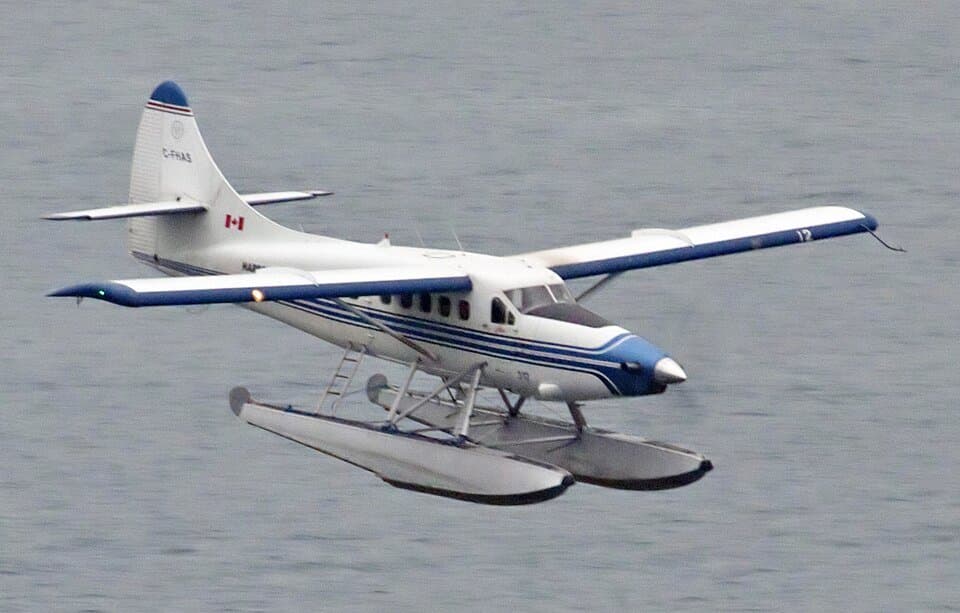
De Havilland Canada DHC-3 Otter is a sTOL utility transport. It was built by de Havilland Canada.
 Canada
Technical data
STOL utility transport
de Havilland Canada
In service
466
1951–1967
1953
12 December 1951
DHC-6 Twin Otter
1 or 2
9–11 passengers (optional 10th seat in main cabin) / 6 stretchers with 4 seats / 2-3 stretchers with 7 seats
41 ft 10 in (12.75 m)
58 ft 0 in (17.68 m)
12 ft 7 in (3.84 m)
375 sq ft (34.8 m 2 )
4,108 lb (1,863 kg)
8,000 lb (3,629 kg)
Total fuel 178 imp gal (214 US gal; 809 L) in :- 51 imp gal (61 US gal; 232 L) front tank ; 85 imp gal (102 US gal; 386 L) middle tank group (two cells) ; 42 imp gal (50 US gal; 191 L) rear tank
1 × Pratt & Whitney R-1340-S1H1-G Wasp 9-cylinder air-cooled radial piston engine, 600 hp (450 kW)
160 mph (260 km/h, 140 kn) at 5,000 ft (1,524 m)
138 mph (222 km/h, 120 kn) 66% power at 5,000 ft (1,524 m)
960 mi (1,540 km, 830 nmi) full internal fuel at 5,000 ft (1,524 m)
9 hours 24 minutes at 5,000 ft (1,524 m)
18,800 ft (5,700 m) S1H1-G engine
735 ft/min (3.73 m/s) at sea level
15 ft 0 in (5 m)
16 ft 5 in (5 m)
5 ft 2 in (2 m)
4 ft 11 in (1 m)
272 cu ft (7.7 m 3 )
38 cu ft (1.1 m 3 )
8.97
NACA 63A516 mod
4,361 lb (1,978 kg)
4,475 lb (2,030 kg)
3-bladed Hamilton Standard , 10 ft 10 in (3.30 m) diameter constant-speed propeller
158 mph (137 kn; 254 km/h) at 5,000 ft (1,524 m)
304 m) S3H1-G engine
aplane S1H1-G engine
aplane S3H1-G engine
iplane S1H1-G engine
iplane S3H1-G engine
1,310 ft (399 m)
975 ft (297 m)
The rugged single-engined, high-wing, propeller-driven DHC-3 Otter was conceived in January 1951 by de Havilland Canada as a larger, more powerful version of its highly successful DHC2 Beaver STOL utility transport. Dubbed the "King Beaver" during design, it would be the veritable "one-ton truck" to the Beaver's "half-ton" role.
The Otter received Canadian certification in November 1952 and entered production shortly thereafter. Using the same overall configuration as the Beaver, the new, much heavier design incorporated a longer fuselage, greater-span wing, and cruciform tail . Seating in the main cabin expanded from six to 10 or 11. Power was supplied by a 450-kW (600 hp) Pratt & Whitney R-1340 geared radial . The version used in the Otter was geared for lower propeller revolutions and consequently lower airspeed. The electrical system was 28 volts D.C.
Otters were used by Qantas from 1958 to 1960 in Papua New Guinea . The Qantas aircraft were then transferred to Trans Australian Airlines (TAA), a major Australian domestic airline, which operated the Otters in Papua New Guinea until 1966 when they were withdrawn from use. TAA was merged with Qantas in 1990.
Stolairus Aviation of Kelowna , BC , has developed several modifications for the DHC-3 including a STOL Kit, which modifies the wing with a contoured leading edge and drooped wingtips for increased performance. Stolairus has also developed a 180 kilograms (400 lb) "upgross" kit which increases the gross weight of the DHC-3 to 3,795 kilograms (8,367 lb) on floats.
A Polish PZL radial engine has also been fitted. Re-engined aircraft have been offered since the 1980s by Airtech Canada as the DHC-3/1000 using current-production 1,000 hp (745 kW) PZL ASz-62 IR radials.
Turbine conversion powered by a 900 shp (671 kW) Garret TPE331 turboprop engine
Ghana Air Force – acquired twelve Otters (G300 – G311), in service 1961-1973 (serial number: 413, 414, 416, 418, 420, 422, 424, 425, 426, 428, 430, 431). Four aircraft had to be written off, eight aircraft were sold in 1973. G300 (s/n 413) crashed on 21 June 1968 in the jungle in the Brong Ahafo region of Ghana and was destroyed. G301 (s/n 414) crashed on 31 August 1961 at Kintampo in the Brong Ahafo region of Ghana and was destroyed. G302 (s/n 416) crashed on the beach near Takoradi on a date unknown and was destroyed. It was on floats at the time, on a training detail. G308 (s/n 426) was written off in service.
As the aircraft neared Nipishish Lake, 47 miles north of Goose Bay , the pilot reported experiencing engine problems again, and that he would follow the Crooked River towards the airport as a precautionary measure for if an emergency landing was needed.
Three minutes later, the pilot called dispatch to inform them he would be making an emergency landing on the river due to a smoke odour in the cockpit.
Three passengers and the pilot were killed, while one passenger survived the crash with serious injuries.
On 22 June 1994, a DHC-3 Otter floatplane, N13GA, registered to and operated by Wings of Alaska of Juneau, Alaska , crashed into the Taku Inlet , 12 miles east of Juneau. The air taxi flight had departed the Taku Lodge located on the Taku River bound for the Juneau downtown dock. Instrument meteorological conditions prevailed at the time of the accident. Six passengers were killed, one passenger was missing and presumed dead, and the pilot and three passengers received serious injuries. The National Transportation Safety Board (NTSB) attributed the accident to continued VFR into IMC and the pilot's consequent failure to maintain altitude above the water surface.
On 9 August 2010, a DHC-3T registered to Anchorage-based GCI crashed about 17 miles (27 km) north of Dillingham, Alaska , while en route to a private fishing lodge. Five of the nine people on board were killed, including former Alaska Senator Ted Stevens . Surviving passengers included former NASA administrator Sean O'Keefe and his teenage son, both of whom sustained injuries.
On 23 September 2011, a DHC-3T Turbine Otter floatplane, N361TT, sustained substantial damage during a go-around and subsequent low-altitude maneuver at Heitman Lake, about 5 miles south-southwest of Kodiak, Alaska , killing the pilot and injuring the two passengers. One of the passengers reported that during the go-around, the airplane struck a tree on the shoreline and crashed.
Debris of 2015 Promech Air crash near Ketchikan, Alaska On 25 June 2015, a Promech Air DHC-3 Otter crashed into the face of a granite cliff near Ella Lake, Alaska , 20 miles (32 km) northeast of Ketchikan . The aircraft carried a pilot and eight passengers who were tourists on a sightseeing excursion from a Holland America Line coastal cruise aboard the cruise ship MS Westerdam . All nine people on board died. The NTSB determined that the pilot had a history of poor decision making and that the company had a compromised culture that resulted in an "operation in which safety competed with performance and revenue".
On 15 September 2015, a DHC-3 Turbine Otter floatplane carrying ten people and belonging to Rainbow King Lodge crashed on takeoff at Eastwind Lake, 1 mi (1.6 km) mile north of Iliamna, 175 mi (282 km) southwest of Anchorage. Three people were killed in the crash.
On 13 May 2019, in the 2019 Alaska mid-air collision , a Taquan Air DHC-3 Turbine Otter floatplane, N959PA, collided with a Mountain Air Service DHC-2 Beaver, N952DB, over George Inlet , Alaska, with the loss of one passenger aboard the DHC-3 and five passengers and crew aboard the DHC-2. The NTSB attributed the accident to " 'the inherent limitations of the see-and-avoid concept, along with the absence of alerts from both airplanes' traffic display systems." Due to the angle of approach, both pilots' viewpoints were partially blocked by the aircraft structure or seated passengers. The NTSB identified Taquan's inadequate preflight checklist and the Federal Aviation Administration 's failure to require Taquan to implement a safety management system as contributing factors.
On 23 July 2026, Kenmore Air Flight 140 , a DHC-3 Turbine Otter floatplane, N709KA, made an emergency landing and crashed into the shore of Sucia Island in the San Juan Islands . The aircraft subsequently caught fire and burned. All ten passengers and the pilot survived the crash, however several occupants suffered injuries.
Capacity: 9–11 passengers (optional 10th seat in main cabin) / 6 stretchers with 4 seats / 2-3 stretchers with 7 seats
Length: 41 ft 10 in (12.75 m)
Wingspan: 58 ft 0 in (17.68 m)
Height: 12 ft 7 in (3.84 m)
seaplane 15 ft 0 in (5 m)
Cabin length: 16 ft 5 in (5 m)
Cabin width: 5 ft 2 in (2 m)
Cabin height: 4 ft 11 in (1 m)
Cabin volume: 272 cu ft (7.7 m 3 )
Stowage compartment volume: 38 cu ft (1.1 m 3 )
Wing area: 375 sq ft (34.8 m 2 )
Empty weight: 4,108 lb (1,863 kg)
seaplane 4,620 lb (2,096 kg) fixed skis 4,361 lb (1,978 kg) wheel/ski 4,475 lb (2,030 kg)
Gross weight: 8,000 lb (3,629 kg)
seaplane 7,967 lb (3,614 kg)
Powerplant: 1 × Pratt & Whitney R-1340-S1H1-G Wasp 9-cylinder air-cooled radial piston engine, 600 hp (450 kW)
Propellers: 3-bladed Hamilton Standard , 10 ft 10 in (3.30 m) diameter constant-speed propeller
Maximum speed: 160 mph (260 km/h, 140 kn) at 5,000 ft (1,524 m)
seaplane 153 mph (133 kn; 246 km/h) at 5,000 ft (1,524 m) skiplane 158 mph (137 kn; 254 km/h) at 5,000 ft (1,524 m)
Cruise speed: 138 mph (222 km/h, 120 kn) 66% power at 5,000 ft (1,524 m)
seaplane 129 mph (112 kn; 208 km/h) at 5,000 ft (1,524 m) skiplane 133 mph (116 kn; 214 km/h) at 5,000 ft (1,524 m)
Range: 960 mi (1,540 km, 830 nmi) full internal fuel at 5,000 ft (1,524 m)
seaplane 863 mi (750 nmi; 1,389 km) full internal fuel at 5,000 ft (1,524 m) seaplane
Endurance: 9 hours 24 minutes at 5,000 ft (1,524 m)
seaplane 8 hours 54 minutes at 5,000 ft (1,524 m)
Service ceiling: 18,800 ft (5,700 m) S1H1-G engine
17,400 ft (5,304 m) S3H1-G engine Seaplane 17,900 ft (5,456 m) seaplane S1H1-G engine 16,400 ft (4,999 m) seaplane S3H1-G engine Skiplane 18,600 ft (5,669 m) skiplane S1H1-G engine 17,100 ft (5,212 m) skiplane S3H1-G engine
Rate of climb: 735 ft/min (3.73 m/s) at sea level
seaplane 650 ft/min (3.3 m/s) at sea level skiplane 690 ft/min (3.5 m/s) at sea level
Take-off distance to 50 ft (15 m): 1,310 ft (399 m)
seaplane 1,980 ft (604 m)
Landing distance from 50 ft (15 m): 975 ft (297 m)
seaplane 1,510 ft (460 m)
{"datatype": "wikibase-item", "datavalue": {"type": "wikibase-entityid", "value": {"entity-type": "item", "id": "Q16", "numeric-id": 16}}, "hash": "8ce7020b3a7cc8df1fb419a989a1c88db64e49e8", "property": "P495", "snaktype": "value"}
country of origin Canada 1 reference stated in Jane's Pocket Book of Military Transport and Training Aircraft, First Collier Books Edition page(s) 81
mass 3,629 kilogram object of statement has role maximum takeoff weight
Reference text from Wikipedia contributors, used under CC BY-SA 4.0.
True scale
Sourced dimensions beside a 1.75 m human reference.
See it in your room. Scan with your phone to open this model in 3D, then place it in your space.
Points represent sourced observations, including revisions. Revisions on the same effective date are not separate inventory events. Ranges appear in the table and are not plotted as exact points.
| Observation / report period | Value | Source | Claim state |
|---|---|---|---|
| 28 Sept 2026 | 9.4 h | Wikipedia contributors | superseded |
| 28 Sept 2026 | 9.4 h | Wikipedia contributors | superseded |
| 28 Sept 2026 | 9.4 h | Wikipedia contributors | superseded |
| 28 Sept 2026 | 9.4 h | Wikipedia contributors | superseded |
| 28 Sept 2026 | 9.4 h | Wikipedia contributors | superseded |
| 28 Sept 2026 | 9.4 h | Wikipedia contributors | superseded |
| 28 Sept 2026 | 9.4 h | Wikipedia contributors | approved |
De Havilland Canada DHC-3 Otter equipment records. Variants, orders and quantities are shown as reported in each inventory source; coverage is incomplete.
 Bangladesh
Number column of the Wikipedia list table under "Fixed Wing Aircraft". The list's own wording applies; it is a compiled secondary source, not an official census.
 United States
Directory active-fleet estimate for the source types DHC-3, grouped under De Havilland Canada DHC-3 Otter. Sums only the listed service and role rows; includes training and special-mission versions where explicitly listed. Excludes the separate Ordered column, aircraft in storage, aircraft undergoing or awaiting upgrades, and the directory's other exclusions. This is the dated directory coverage of these types, not a complete owned-fleet census or a readiness count.
Keep exploring
STOL utility transport
CanadaCompare with De Havilland Canada DHC-3 Otter Light utility transport
 RussiaCompare with De Havilland Canada DHC-3 Otter
Utility aircraft/Transport
 AustraliaCompare with De Havilland Canada DHC-3 Otter
STOL transport aircraft
CanadaCompare with De Havilland Canada DHC-3 Otter multi-role utility transport aircraft
 United KingdomCompare with De Havilland Canada DHC-3 Otter
Light STOL Transport aircraft
 IsraelCompare with De Havilland Canada DHC-3 Otter