


Preparing your view.

At a glance
True scale
Side by side. From every angle. A human reference for perspective.
3.22 MB · Loads when you open it| Model | Length | Width / span | Height |
|---|---|---|---|
| De Havilland Canada DHC-3 Otter | ≈ 12.75 m | ≈ 17.68 m (Width) | ≈ 4.68 m |
| De Havilland Canada DHC-4 Caribou | ≈ 22.12 m | ≈ 29.15 m (Width) | ≈ 9.68 m |
Scaled uniformly to the sourced length of 12.75 m. The shape was turned square to the axes; the width was fitted to the sourced 17.68 m. Not an official model or a measured survey.
ForceTally · All rights reserved
Scaled uniformly to the sourced length of 22.12 m. The shape was turned square to the axes; the height was fitted to the sourced 9.68 m; the width was fitted to the sourced 29.147 m. Not an official model or a measured survey.
ForceTally · All rights reserved
The human reference is a generic 1.75 m figure. Models describe external size, not combat performance.
Measured figures
landplane · Length
Single source41 ft 10 in (12.75 m)[source]
Configuration
| Specification | De Havilland Canada DHC-3 Otter | De Havilland Canada DHC-4 Caribou |
|---|---|---|
| Type | STOL utility transport[source] | STOL transport aircraft[source] |
| Manufacturer | de Havilland Canada[source] | de Havilland Canada[source] |
| Status | In service[source] | In limited service[source] |
| Number built | 466[source] |
DHC-4A · Length
72 ft 7 in (22.12 m)[source]
Empty; landplane · Empty weight
Single sourceGross; landplane · Gross weight
Single sourceMaximum take-off; DHC-3 Otter · explicitly maximum takeoff weight-qualified Wikidata mass statement
Single source4,108 lb (1,863 kg)[source]
8,000 lb (3,629 kg)[source]
3,629 kilogram[source]DHC-3 Otter · explicitly maximum takeoff weight-qualified Wikidata mass statement
Maximum take-off; DHC-4A · Max takeoff weight
Single source28,500 lb (12,927 kg)[source]
Cruise; landplane · 66% power at 5,000 ft (1,524 m)
Single sourceMaximum; landplane · at 5,000 ft (1,524 m)
Single source160 mph (260 km/h, 140 kn) at 5,000 ft (1,524 m)[source]
138 mph (222 km/h, 120 kn) 66% power at 5,000 ft (1,524 m)[source]
Cruise; DHC-4A · at 7,500 ft (2,300 m) (maximum & econ)
Single sourceMaximum; DHC-4A · at 6,500 ft (2,000 m)
Single sourcelandplane · 1 × Pratt & Whitney R-1340-S1H1-G Wasp 9-cylinder air-cooled radial piston engine
Single source1 × Pratt & Whitney R-1340-S1H1-G Wasp 9-cylinder air-cooled radial piston engine, 600 hp (450 kW)[source]
DHC-4A · 2 × Pratt & Whitney R-2000-7M2 Twin Wasp 14-cylinder air-cooled radial piston engines each
Single source2 × Pratt & Whitney R-2000-7M2 Twin Wasp 14-cylinder air-cooled radial piston engines, 1,450 hp (1,080 kW) each[source]
landplane · at 5,000 ft (1,524 m)
Single source9 hours 24 minutes at 5,000 ft (1,524 m)[source]
DHC-4A · Maximum payload
Single source8,740 lb (3,964 kg)[source]
Bars compare reported quantities only. A larger figure does not make a system better; configurations and test conditions differ.
307[source] |
| Manufactured | 1951–1967[source] | 1958–1968[source] |
|---|
| Introduction date | 1953[source] | 1961[source] |
|---|
| First flight | 12 December 1951[source] | 30 July 1958[source] |
|---|
| Developed into | DHC-6 Twin Otter[source] | de Havilland Canada DHC-5 Buffalo[source] |
|---|
| Capacity | 9–11 passengers (optional 10th seat in main cabin) / 6 stretchers with 4 seats / 2-3 stretchers with 7 seats[source] | 30 pax (civil) / 32 troops / 26 fully-equipped paratroops / 22 stretchers, 4 sitting patients and 4 attendants[source] |
|---|
| Fuel capacity | Total fuel 178 imp gal (214 US gal; 809 L) in :- 51 imp gal (61 US gal; 232 L) front tank ; 85 imp gal (102 US gal; 386 L) middle tank group (two cells) ; 42 imp gal (50 US gal; 191 L) rear tank[source] | 690 imp gal (830 US gal; 3,100 L)[source] |
|---|
| seaplane | 15 ft 0 in (5 m)[source] | — |
|---|
| Cabin length | 16 ft 5 in (5 m)[source] | — |
|---|
| Cabin width | 5 ft 2 in (2 m)[source] | — |
|---|
| Cabin height | 4 ft 11 in (1 m)[source] | — |
|---|
| Cabin volume | 272 cu ft (7.7 m 3 )[source] | — |
|---|
| Stowage compartment volume | 38 cu ft (1.1 m 3 )[source] | — |
|---|
| Aspect ratio | 8.97[source] | 10[source] |
|---|
| Airfoil | NACA 63A516 mod[source] | centre-section: NACA 64 3 A417.5 ; tip: NACA 63 2 A615[source] |
|---|
| fixed skis | 4,361 lb (1,978 kg)[source] | — |
|---|
| wheel/ski | 4,475 lb (2,030 kg)[source] | — |
|---|
| Propellers | 3-bladed Hamilton Standard , 10 ft 10 in (3.30 m) diameter constant-speed propeller[source] | 3-bladed Hamilton Standard type 43D50-7107A fully-feathering constant-speed reversible-pitch propellers[source] |
|---|
| skiplane | 158 mph (137 kn; 254 km/h) at 5,000 ft (1,524 m)[source] | — |
|---|
| S3H1-G engine | 304 m) S3H1-G engine[source] | — |
|---|
| seaplane S1H1-G engine | aplane S1H1-G engine[source] | — |
|---|
| seaplane S3H1-G engine | aplane S3H1-G engine[source] | — |
|---|
| skiplane S1H1-G engine | iplane S1H1-G engine[source] | — |
|---|
| skiplane S3H1-G engine | iplane S3H1-G engine[source] | — |
|---|
| Take-off distance to 50 ft (15 m) | 1,310 ft (399 m)[source] | — |
|---|
| Landing distance from 50 ft (15 m) | 975 ft (297 m)[source] | — |
|---|
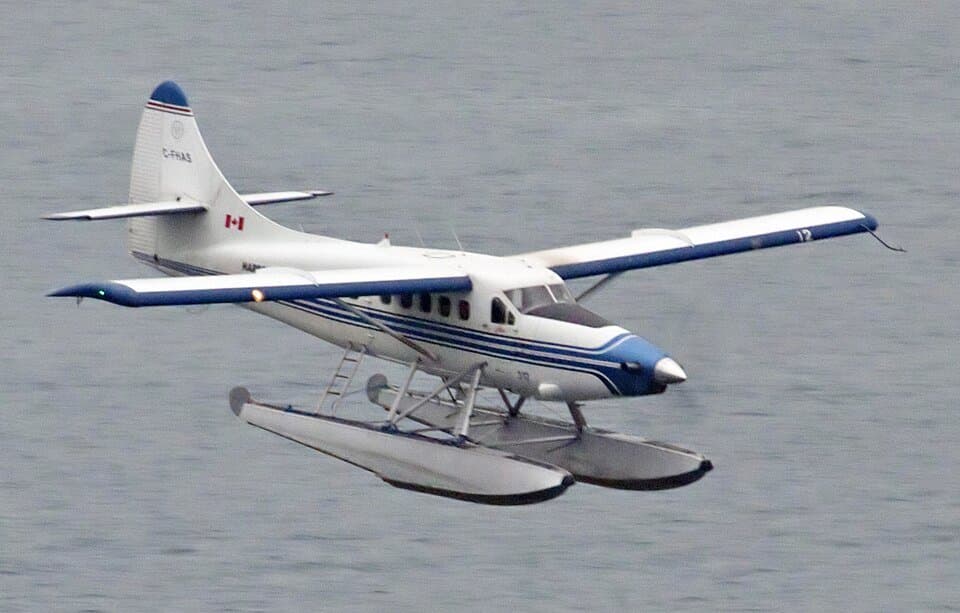
| Source measurement | The rugged single-engined, high-wing, propeller-driven DHC-3 Otter was conceived in January 1951 by de Havilland Canada as a larger, more powerful version of its highly successful DHC2 Beaver STOL utility transport. Dubbed the "King Beaver" during design, it would be the veritable "one-ton truck" to the Beaver's "half-ton" role.[source]De Havilland Canada DHC-3 Otter · Design and development; only the objects and conditions stated in this passage The Otter received Canadian certification in November 1952 and entered production shortly thereafter. Using the same overall configuration as the Beaver, the new, much heavier design incorporated a longer fuselage, greater-span wing, and cruciform tail . Seating in the main cabin expanded from six to 10 or 11. Power was supplied by a 450-kW (600 hp) Pratt & Whitney R-1340 geared radial . The version used in the Otter was geared for lower propeller revolutions and consequently lower airspeed. The electrical system was 28 volts D.C.[source]De Havilland Canada DHC-3 Otter · Design and development; only the objects and conditions stated in this passage Otters were used by Qantas from 1958 to 1960 in Papua New Guinea . The Qantas aircraft were then transferred to Trans Australian Airlines (TAA), a major Australian domestic airline, which operated the Otters in Papua New Guinea until 1966 when they were withdrawn from use. TAA was merged with Qantas in 1990.[source]De Havilland Canada DHC-3 Otter · Operational use; only the objects and conditions stated in this passage Stolairus Aviation of Kelowna , BC , has developed several modifications for the DHC-3 including a STOL Kit, which modifies the wing with a contoured leading edge and drooped wingtips for increased performance. Stolairus has also developed a 180 kilograms (400 lb) "upgross" kit which increases the gross weight of the DHC-3 to 3,795 kilograms (8,367 lb) on floats.[source]De Havilland Canada DHC-3 Otter · Operational use / Modifications; only the objects and conditions stated in this passage A Polish PZL radial engine has also been fitted. Re-engined aircraft have been offered since the 1980s by Airtech Canada as the DHC-3/1000 using current-production 1,000 hp (745 kW) PZL ASz-62 IR radials.[source]De Havilland Canada DHC-3 Otter · Operational use / Modifications; only the objects and conditions stated in this passage Turbine conversion powered by a 900 shp (671 kW) Garret TPE331 turboprop engine[source]De Havilland Canada DHC-3 Otter · Variants; only the objects and conditions stated in this passage Ghana Air Force – acquired twelve Otters (G300 – G311), in service 1961-1973 (serial number: 413, 414, 416, 418, 420, 422, 424, 425, 426, 428, 430, 431). Four aircraft had to be written off, eight aircraft were sold in 1973. G300 (s/n 413) crashed on 21 June 1968 in the jungle in the Brong Ahafo region of Ghana and was destroyed. G301 (s/n 414) crashed on 31 August 1961 at Kintampo in the Brong Ahafo region of Ghana and was destroyed. G302 (s/n 416) crashed on the beach near Takoradi on a date unknown and was destroyed. It was on floats at the time, on a training detail. G308 (s/n 426) was written off in service.[source]De Havilland Canada DHC-3 Otter · Military operators; only the objects and conditions stated in this passage As the aircraft neared Nipishish Lake, 47 miles north of Goose Bay , the pilot reported experiencing engine problems again, and that he would follow the Crooked River towards the airport as a precautionary measure for if an emergency landing was needed.[source]De Havilland Canada DHC-3 Otter · Accidents; only the objects and conditions stated in this passage Three minutes later, the pilot called dispatch to inform them he would be making an emergency landing on the river due to a smoke odour in the cockpit.[source]De Havilland Canada DHC-3 Otter · Accidents; only the objects and conditions stated in this passage Three passengers and the pilot were killed, while one passenger survived the crash with serious injuries.[source]De Havilland Canada DHC-3 Otter · Accidents; only the objects and conditions stated in this passage On 22 June 1994, a DHC-3 Otter floatplane, N13GA, registered to and operated by Wings of Alaska of Juneau, Alaska , crashed into the Taku Inlet , 12 miles east of Juneau. The air taxi flight had departed the Taku Lodge located on the Taku River bound for the Juneau downtown dock. Instrument meteorological conditions prevailed at the time of the accident. Six passengers were killed, one passenger was missing and presumed dead, and the pilot and three passengers received serious injuries. The National Transportation Safety Board (NTSB) attributed the accident to continued VFR into IMC and the pilot's consequent failure to maintain altitude above the water surface.[source]De Havilland Canada DHC-3 Otter · Accidents; only the objects and conditions stated in this passage On 9 August 2010, a DHC-3T registered to Anchorage-based GCI crashed about 17 miles (27 km) north of Dillingham, Alaska , while en route to a private fishing lodge. Five of the nine people on board were killed, including former Alaska Senator Ted Stevens . Surviving passengers included former NASA administrator Sean O'Keefe and his teenage son, both of whom sustained injuries.[source]De Havilland Canada DHC-3 Otter · Accidents; only the objects and conditions stated in this passage On 23 September 2011, a DHC-3T Turbine Otter floatplane, N361TT, sustained substantial damage during a go-around and subsequent low-altitude maneuver at Heitman Lake, about 5 miles south-southwest of Kodiak, Alaska , killing the pilot and injuring the two passengers. One of the passengers reported that during the go-around, the airplane struck a tree on the shoreline and crashed.[source]De Havilland Canada DHC-3 Otter · Accidents; only the objects and conditions stated in this passage Debris of 2015 Promech Air crash near Ketchikan, Alaska On 25 June 2015, a Promech Air DHC-3 Otter crashed into the face of a granite cliff near Ella Lake, Alaska , 20 miles (32 km) northeast of Ketchikan . The aircraft carried a pilot and eight passengers who were tourists on a sightseeing excursion from a Holland America Line coastal cruise aboard the cruise ship MS Westerdam . All nine people on board died. The NTSB determined that the pilot had a history of poor decision making and that the company had a compromised culture that resulted in an "operation in which safety competed with performance and revenue".[source]De Havilland Canada DHC-3 Otter · Accidents; only the objects and conditions stated in this passage On 15 September 2015, a DHC-3 Turbine Otter floatplane carrying ten people and belonging to Rainbow King Lodge crashed on takeoff at Eastwind Lake, 1 mi (1.6 km) mile north of Iliamna, 175 mi (282 km) southwest of Anchorage. Three people were killed in the crash.[source]De Havilland Canada DHC-3 Otter · Accidents; only the objects and conditions stated in this passage On 13 May 2019, in the 2019 Alaska mid-air collision , a Taquan Air DHC-3 Turbine Otter floatplane, N959PA, collided with a Mountain Air Service DHC-2 Beaver, N952DB, over George Inlet , Alaska, with the loss of one passenger aboard the DHC-3 and five passengers and crew aboard the DHC-2. The NTSB attributed the accident to " 'the inherent limitations of the see-and-avoid concept, along with the absence of alerts from both airplanes' traffic display systems." Due to the angle of approach, both pilots' viewpoints were partially blocked by the aircraft structure or seated passengers. The NTSB identified Taquan's inadequate preflight checklist and the Federal Aviation Administration 's failure to require Taquan to implement a safety management system as contributing factors.[source]De Havilland Canada DHC-3 Otter · Accidents; only the objects and conditions stated in this passage On 23 July 2026, Kenmore Air Flight 140 , a DHC-3 Turbine Otter floatplane, N709KA, made an emergency landing and crashed into the shore of Sucia Island in the San Juan Islands . The aircraft subsequently caught fire and burned. All ten passengers and the pilot survived the crash, however several occupants suffered injuries.[source]De Havilland Canada DHC-3 Otter · Accidents; only the objects and conditions stated in this passage Capacity: 9–11 passengers (optional 10th seat in main cabin) / 6 stretchers with 4 seats / 2-3 stretchers with 7 seats[source]De Havilland Canada DHC-3 Otter · Specifications (landplane); only the objects and conditions stated in this passage Length: 41 ft 10 in (12.75 m)[source]De Havilland Canada DHC-3 Otter · Specifications (landplane); only the objects and conditions stated in this passage Wingspan: 58 ft 0 in (17.68 m)[source]De Havilland Canada DHC-3 Otter · Specifications (landplane); only the objects and conditions stated in this passage Height: 12 ft 7 in (3.84 m)[source]De Havilland Canada DHC-3 Otter · Specifications (landplane); only the objects and conditions stated in this passage seaplane 15 ft 0 in (5 m)[source]De Havilland Canada DHC-3 Otter · Specifications (landplane); only the objects and conditions stated in this passage Cabin length: 16 ft 5 in (5 m)[source]De Havilland Canada DHC-3 Otter · Specifications (landplane); only the objects and conditions stated in this passage Cabin width: 5 ft 2 in (2 m)[source]De Havilland Canada DHC-3 Otter · Specifications (landplane); only the objects and conditions stated in this passage Cabin height: 4 ft 11 in (1 m)[source]De Havilland Canada DHC-3 Otter · Specifications (landplane); only the objects and conditions stated in this passage Cabin volume: 272 cu ft (7.7 m 3 )[source]De Havilland Canada DHC-3 Otter · Specifications (landplane); only the objects and conditions stated in this passage Stowage compartment volume: 38 cu ft (1.1 m 3 )[source]De Havilland Canada DHC-3 Otter · Specifications (landplane); only the objects and conditions stated in this passage Wing area: 375 sq ft (34.8 m 2 )[source]De Havilland Canada DHC-3 Otter · Specifications (landplane); only the objects and conditions stated in this passage Empty weight: 4,108 lb (1,863 kg)[source]De Havilland Canada DHC-3 Otter · Specifications (landplane); only the objects and conditions stated in this passage seaplane 4,620 lb (2,096 kg) fixed skis 4,361 lb (1,978 kg) wheel/ski 4,475 lb (2,030 kg)[source]De Havilland Canada DHC-3 Otter · Specifications (landplane); only the objects and conditions stated in this passage Gross weight: 8,000 lb (3,629 kg)[source]De Havilland Canada DHC-3 Otter · Specifications (landplane); only the objects and conditions stated in this passage seaplane 7,967 lb (3,614 kg)[source]De Havilland Canada DHC-3 Otter · Specifications (landplane); only the objects and conditions stated in this passage Powerplant: 1 × Pratt & Whitney R-1340-S1H1-G Wasp 9-cylinder air-cooled radial piston engine, 600 hp (450 kW)[source]De Havilland Canada DHC-3 Otter · Specifications (landplane); only the objects and conditions stated in this passage Propellers: 3-bladed Hamilton Standard , 10 ft 10 in (3.30 m) diameter constant-speed propeller[source]De Havilland Canada DHC-3 Otter · Specifications (landplane); only the objects and conditions stated in this passage Maximum speed: 160 mph (260 km/h, 140 kn) at 5,000 ft (1,524 m)[source]De Havilland Canada DHC-3 Otter · Specifications (landplane); only the objects and conditions stated in this passage seaplane 153 mph (133 kn; 246 km/h) at 5,000 ft (1,524 m) skiplane 158 mph (137 kn; 254 km/h) at 5,000 ft (1,524 m)[source]De Havilland Canada DHC-3 Otter · Specifications (landplane); only the objects and conditions stated in this passage Cruise speed: 138 mph (222 km/h, 120 kn) 66% power at 5,000 ft (1,524 m)[source]De Havilland Canada DHC-3 Otter · Specifications (landplane); only the objects and conditions stated in this passage seaplane 129 mph (112 kn; 208 km/h) at 5,000 ft (1,524 m) skiplane 133 mph (116 kn; 214 km/h) at 5,000 ft (1,524 m)[source]De Havilland Canada DHC-3 Otter · Specifications (landplane); only the objects and conditions stated in this passage Range: 960 mi (1,540 km, 830 nmi) full internal fuel at 5,000 ft (1,524 m)[source]De Havilland Canada DHC-3 Otter · Specifications (landplane); only the objects and conditions stated in this passage seaplane 863 mi (750 nmi; 1,389 km) full internal fuel at 5,000 ft (1,524 m) seaplane[source]De Havilland Canada DHC-3 Otter · Specifications (landplane); only the objects and conditions stated in this passage Endurance: 9 hours 24 minutes at 5,000 ft (1,524 m)[source]De Havilland Canada DHC-3 Otter · Specifications (landplane); only the objects and conditions stated in this passage seaplane 8 hours 54 minutes at 5,000 ft (1,524 m)[source]De Havilland Canada DHC-3 Otter · Specifications (landplane); only the objects and conditions stated in this passage Service ceiling: 18,800 ft (5,700 m) S1H1-G engine[source]De Havilland Canada DHC-3 Otter · Specifications (landplane); only the objects and conditions stated in this passage 17,400 ft (5,304 m) S3H1-G engine Seaplane 17,900 ft (5,456 m) seaplane S1H1-G engine 16,400 ft (4,999 m) seaplane S3H1-G engine Skiplane 18,600 ft (5,669 m) skiplane S1H1-G engine 17,100 ft (5,212 m) skiplane S3H1-G engine[source]De Havilland Canada DHC-3 Otter · Specifications (landplane); only the objects and conditions stated in this passage Rate of climb: 735 ft/min (3.73 m/s) at sea level[source]De Havilland Canada DHC-3 Otter · Specifications (landplane); only the objects and conditions stated in this passage seaplane 650 ft/min (3.3 m/s) at sea level skiplane 690 ft/min (3.5 m/s) at sea level[source]De Havilland Canada DHC-3 Otter · Specifications (landplane); only the objects and conditions stated in this passage Take-off distance to 50 ft (15 m): 1,310 ft (399 m)[source]De Havilland Canada DHC-3 Otter · Specifications (landplane); only the objects and conditions stated in this passage seaplane 1,980 ft (604 m)[source]De Havilland Canada DHC-3 Otter · Specifications (landplane); only the objects and conditions stated in this passage Landing distance from 50 ft (15 m): 975 ft (297 m)[source]De Havilland Canada DHC-3 Otter · Specifications (landplane); only the objects and conditions stated in this passage seaplane 1,510 ft (460 m)[source]De Havilland Canada DHC-3 Otter · Specifications (landplane); only the objects and conditions stated in this passage | — |
|---|
| Country of origin | Canada[source] Canada[source] | — |
|---|
| National origin | — | Canada[source] |
|---|
| Primary users | — | Royal Canadian Air Force United States Army United States Air Force Royal Australian Air Force[source] |
|---|
| Retired | — | RAAF (2009)[source] |
|---|
| Basic operating weight | — | 18,260 lb (8,283 kg)[source] |
|---|
| Maximum zero fuel weight | — | 27,000 lb (12,247 kg)[source] |
|---|
| Maximum permissible weight for ferry missions | — | 31,300 lb (14,197 kg)[source] |
|---|
| Maximum landing weight | — | 28,500 lb (12,927 kg)[source] |
|---|
| Stall speed | — | 59 kn (68 mph, 109 km/h)[source] |
|---|
| Never exceed speed | — | 208 kn (239 mph, 385 km/h)[source] |
|---|
| Service ceiling on one engine | — | 8,800 ft (2,700 m)[source] |
|---|
| Wing loading | — | 31.2 lb/sq ft (152 kg/m 2 ) maximum[source] |
|---|
| Power/mass | — | 0.102 hp/lb (0.168 kW/kg)[source] |
|---|