FORCETALLY
Loading the evidence…
Preparing your view.


Preparing your view.
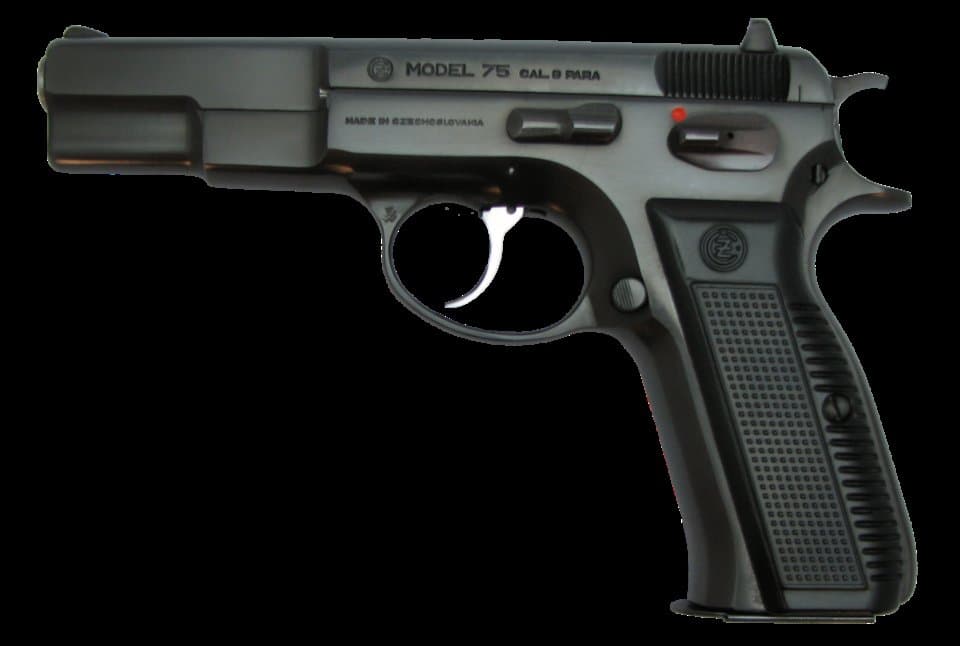
Small armsIn service
Semi-automatic pistol Machine pistol ( select-fire variants)
CZ 75 is a semi-automatic pistol Machine pistol ( select-fire variants) originating in Czechoslovakia. It was built by Česká zbrojovka. Reported operators include Argentina, Bangladesh, Chile, Czech Republic, Egypt, El Salvador, France, Georgia, Guatemala, Honduras, Kazakhstan, Libya, Malaysia, Mexico, Mongolia, North Korea, North Macedonia, Poland, Serbia, Singapore, Slovakia, Sudan, Thailand, Türkiye, Ukraine, United States.
Semi-automatic pistol Machine pistol ( select-fire variants)
Czechoslovakia
1976–present
See Users
Lebanese Civil War
Josef and František Koucký
1975
Česká zbrojovka
1976–present
1,000,000+ (October 12, 2007)
see Variants and Derivatives
1.12 kg (2.5 lb)
206.3 mm (8.12 in)
120 mm (4.7 in)
32.6 mm (1.28 in)
138 mm (5.4 in)
9×19mm Parabellum 9×21mm
short recoil , tilting barrel, double/single
semi-automatic CZ 75 Automatic: 1,000 RPM
100 m
detachable box magazine, 10–26 rds depending on version and caliber
Front blade, rear square notch
9×19mm Parabellum
Argentina : CZ 75 and CZ 75 Automatic used by Federal Police.
Bangladesh
Chile : Produced in licence as FAMAE FN-750.
Czech Republic : Used by the Czech Armed Forces . Also used by Czech police forces.
Egypt : Primary firearm of law enforcement since 2013.
El Salvador : Used by the National Civil Police .
France : Duty handgun of the Municipal police of Toulouse .
Georgia
Guatemala : Use by army and police
Honduras : National Police of Honduras
Kazakhstan : 75 pistols CZ-75B and 30 pistols CZ-75D were bought in 1998.
Libya : NZ75 found in Libya.
Malaysia : CZ P07 used by Malaysia Coast Guard .
Mexico : CZ P09 used by selected units of Federal Police since 2014
Mongolia : Replacing the Makarov PM as the standard-issue pistol of the Mongolian Armed Forces .
North Korea : Produces an unlicensed copy of the pistol, called Baek-Du San.
North Macedonia : CZ 75 Used by Army of the Republic of North Macedonia .
Poland : Polish police (Military Services-Limited used).
Serbia : SP-01 Shadow is used by Special Forces of Police.
Singapore : Singapore Police Force
Slovakia : Slovak rail police, military police and the elite paramilitary tactical unit ( Slovak : Kukláči ).
Sudan : Manufactured as the Marra and Lado by Military Industry Corporation .
Thailand : Used by Royal Thai Army special units
Turkey : General Directorate of Security .
Ukraine : CZ 75B
United States : On the approved list of many American police departments and Delta Force .
The CZ 75 is a semi-automatic pistol made by Czech firearm manufacturer ČZUB .
By 1969, František Koucký was freshly retired, however the company offered him a job on designing a new 9×19mm Parabellum pistol. Unlike during his previous work, this time he had a complete freedom in designing the whole gun from scratch. The design he developed was in many ways new and innovative (see Design details ).
Although the model was developed for export purposes (the standard pistol cartridge of the Czechoslovak armed forces was the Soviet 7.62×25mm Tokarev , which was later replaced with the Warsaw Pact standard 9mm Makarov pistol cartridge), Koucký's domestic patents regarding the design were classified as "secret patents". Effectively, nobody could learn about their existence, but also nobody could register the same design in Czechoslovakia. At the same time Koucký as well as the company were prohibited from filing for patent protection abroad. Consequently, a large number of other manufacturers began offering pistols based on CZ 75 design (see Clones, copies, and variants by other manufacturers ).
The increasing popularity of the IPSC competitions in the Czech Republic led to the inception of CZUB 's factory team in 1992. Initially, the sport shooters were using CZ 75s and CZ 85s . Stanislav Křižík designed a new version called CZ 75 Champion already in 1992. This version had a SA trigger , a muzzle brake and adjustable weights. 150 weapons were initially made in 9×19mm Parabellum , .40 S&W and 9×21mm . The design was further modified (i.e. the adjustable weights were eliminated, a new compensator was developed), however its main shortcoming of the same capacity as the standard CZ 75 magazines (15/16 in 9mm, 12 in .40 S&W) remained.
The CZ 75 ST (Standard) and CZ 75 M (Modified) were introduced in 1998. These had a different frame from standard versions allowing for more modifications. While the ST had become very successful, M was not initially designed for use with red-dot sights, the use of which led to limited lifespan of its frame.
The popular ST version was further developed mostly with aim of prolonging its lifespan, which led to introduction of CZ 75 TS (Tactical Sports) in 2005. It uses a longer barrel (132 mm) and has also a higher weight (1,285 g) compared to the standard model. High-capacity magazines may use either 20 of the 9mm rounds or 17 of the .40 rounds. As of 2013, the model is used by the CZUB's factory shooters in the IPSC Standard division, with a custom-made version CZ 75 Tactical Sports Open being also available.
In 2009, the sale of CZ 75 TS Czechmate began. The model is a development of the CZ 75 TS Open, available in 9×19mm Parabellum and 9×21mm with magazine capacity of 20 or 26 rounds. As standard, the gun is sold with US made C-More Systems' red-dot sight. CZUB claims that its factory shooter Martin Kameníček had shot 150,000 rounds through the gun in five years, in which time he only needed to change the barrel once in order to maintain precision.
The CZ 75's slide rides inside its frame rails rather than outside, similar to the SIG P210 . The original models produced from 1975 to 1980 featured a distinctively shorter, 115mm long slide rails. The frames on these first model or "short rail" pistols were forged. Starting in 1980, CZUB modified the design by lengthening the slide rails to 140mm, transitioned to lower cost cast frames, and introduced a "half-cock" safety notch on the hammer to prevent it from inadvertently striking the firing pin during manual manipulation. These changes resulted in the basic mold of all subsequent CZ 75 models.
A CZ-75 which has a single action trigger mechanism. It was available chambered for 9mm or .40 S&W. Discontinued in 2018.
A version of the CZ 75 B with a factory-reworked trigger group, the "Omega" system, introduced with the P-07. It is available chambered for 9 mm or .40 S&W. It has a manual safety that is not ambidextrous.
A standard CZ 75 with a slightly shortened grip and 3.75-inch barrel. There is a version available chambered for the .40 S&W cartridge.
Very compact – similar to the P-01 in size, with an aluminum alloy frame also but lacks an M3 rail frame and features a smaller muzzle point and snag free sights.
Combines the frame, grip and capacity of the full size CZ 75 with the shortened (by 20mm) barrel and slide of the CZ 75 Compact.
A subcompact version of the CZ 75 intended for concealed carry . Features a 3-inch barrel, aluminum frame and low-profile sights. Available in 9×19mm or .40 S&W, with standard magazine capacities of 10 (9×19mm) and 8 (.40 S&W) rounds, respectively. An optional 14-round magazine is available for the 9 mm version.
Replacing the ST IPSC was the tactical sports model, which featured minor improvements over its very similar predecessor. Available in 9×19mm (20 rounds) or .40 S&W (17 rounds). Discontinued in 2018.
The CZ P-07 is a compact, polymer-framed CZ 75 variant notable for having a redesigned trigger mechanism. The redesign has reduced the number of parts as well as improved the trigger pull. The exterior restyling was greatly influenced by the SPHINX 3000 design (itself being an enhanced Swiss CZ 75 clone). Chambered in 9mm Luger and .40 S&W, the CZ P-07 also includes the ability to change the manual safety to a decocking lever and vice versa through an exchange of parts. Original version was introduced in 2009, with a Gen2 version arriving in 2014 offering front-slide serrations, interchangeable backstraps, metal three-dot sights, and other minor improvements; this model was replaced by the P-09C Nocturne in 2024.
Full-size version of the P-07 boasting 19 round capacity in 9mm; introduced in 2013. It was followed by the "Nocturne" series introduced in 2024 which offered significant ergonomic improvements along with an optics-ready slide.
A polymer framed variant currently manufactured by LUVO Arms (Originally manufactured under ČZ Stojírna s.r.o.) in Strakonice . The CZ-TT features a Tanfoglio polymer frame, a shorter barrel and a modified locking system. Later models also come with an under-barrel accessory rail. Chambered in 9×19mm Parabellum, .40 S&W and .45 ACP. The TT in the name stands for Tůma-Tanfoglio, the former referring to the name of the original designer, Martin Tůma.
A polymer framed CZ 75 clone manufactured by ALFA-proj s.r.o. from 2002 to around 2023. Just like the CZ-TT, the Combat uses Tanfoglio polymer frames and is chambered in 9×19mm Parabellum, .40 S&W and .45 ACP. A compact version called Defender was also offered.
Reference text from Wikipedia contributors, used under CC BY-SA 4.0.
True scale
Sourced dimensions beside a 1.75 m human reference.
See it in your room. Scan with your phone to open this model in 3D, then place it in your space.
Points represent sourced observations, including revisions. Revisions on the same effective date are not separate inventory events. Ranges appear in the table and are not plotted as exact points.
| Observation / report period | Value | Source | Claim state |
|---|---|---|---|
| 28 Sept 2026 | 0.12 m | Wikipedia contributors | superseded |
| 28 Sept 2026 | 0.12 m | Wikipedia contributors | superseded |
| 28 Sept 2026 | 0.12 m | Wikipedia contributors | superseded |
| 28 Sept 2026 | 0.12 m | Wikipedia contributors | approved |
CZ 75 equipment records. Variants, orders and quantities are shown as reported in each inventory source; coverage is incomplete.
 Argentina
 Bangladesh
 Chile
 China
 Czechia
 Egypt
 El Salvador
 France
 Georgia
 Guatemala
 Honduras
 Hungary
 Iran
 Kazakhstan
 Kenya
 Libya
 Malaysia
 Mexico
 Mongolia
 Namibia
 North Korea
 North Macedonia
 Poland
 Serbia
 Singapore
 Slovakia
 Sudan
 Thailand
 Türkiye
 Ukraine
 United States
Argentina, Bangladesh, Chile, Czech Republic, Egypt, El Salvador, France, Georgia, Guatemala, Honduras, Kazakhstan, Libya, Malaysia, Mexico, Mongolia, North Korea, North Macedonia, Poland, Serbia, Singapore, Slovakia, Sudan, Thailand, Türkiye, Ukraine, United States
Equipment reference ↗ Austria
 South Korea