FORCETALLY
Loading the evidence…
Preparing your view.


Preparing your view.
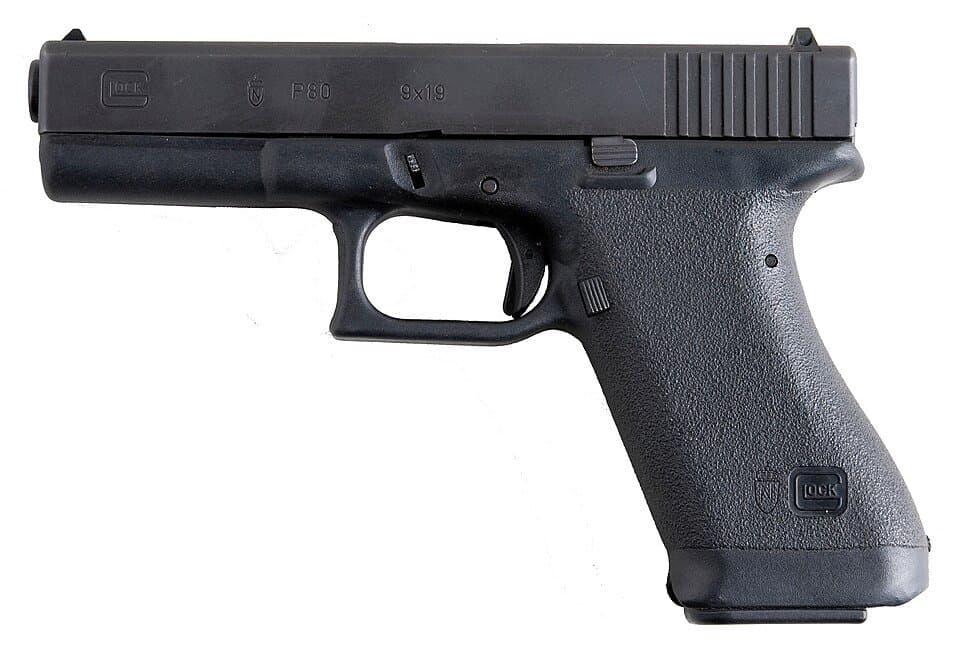
Small armsIn service
Semi-automatic pistol Machine pistol (Glock 18)
Glock is a semi-automatic pistol Machine pistol (Glock 18) originating in Austria. It was built by Glock GmbH.
 Austria
Technical data
True scale
Sourced dimensions beside a 1.75 m human reference.
Points represent sourced observations, including revisions. Revisions on the same effective date are not separate inventory events. Ranges appear in the table and are not plotted as exact points.
| Observation / report period | Value | Source | Claim state |
|---|---|---|---|
| 29 Sept 2026 | 0.0825–0.153 m | Wikipedia contributors | superseded |
| 29 Sept 2026 | 0.0825–0.153 m | Wikipedia contributors | superseded |
| 29 Sept 2026 | 0.0825–0.153 m | Wikipedia contributors | superseded |
| 29 Sept 2026 | 0.0825–0.153 m | Wikipedia contributors | superseded |
| 29 Sept 2026 | 0.0825–0.153 m | Wikipedia contributors | superseded |
| 29 Sept 2026 | 0.0825–0.153 m | Wikipedia contributors | superseded |
| 29 Sept 2026 | 0.0825–0.153 m | Wikipedia contributors | superseded |
| 29 Sept 2026 | 0.0825–0.153 m | Wikipedia contributors | approved |
Semi-automatic pistol Machine pistol (Glock 18)
Austria
1982–present
See Users
Gaston Glock
1979–1982
Glock GmbH
1982–present
20,000,000 as of 2020
See Variants
9×19mm Parabellum 10mm Auto .22 LR .357 SIG .380 ACP .40 S&W .45 ACP .45 GAP
Short recoil , locked breech, tilting barrel ( straight blowback for Glock 25, 28, and 44)
6-, 10-, 13-, 15-, 17-, 19-, 24-, 25-, 31-, 33-, or 40-round detachable box magazine , or 50- or 100-round detachable drum magazine
Iron sights
Glock ( German: [ˈglɔk] ; stylized as GLOCK ) is a brand of polymer -framed, short- recoil-operated , locked-breech semi-automatic pistols (as well as some rifles and one machine pistol ) designed and produced by Austrian manufacturer Glock GmbH .
Glock pistols have become the company's most profitable line of products. They are supplied to national armed forces , security agencies, and police forces in at least 48 countries, including the Federal Bureau of Investigation (FBI) and the majority of police agencies in the United States. The product line has evolved through six generations of design changes ("Gen 1" through "Gen 6"). It is available in a wide variety of calibers , including 9×19mm Parabellum , .40 S&W , 10mm Auto , and .45 ACP , as well as various sizes ranging from the full-sized Glock 17 to the subcompact Glock 26 and "slimline" Glock 43.
In 1980, the Austrian Armed Forces announced that it would seek tenders for a new, modern duty pistol to replace their World War II –era Walther P38 handguns. The Federal Ministry of Defence of Austria formulated a list of 17 criteria for the new generation service pistol, including requirements that it would be self loading ; fire the NATO -standard 9×19mm Parabellum round; the magazines would not require any means of assistance for loading; not be subject to accidental discharge from shock, strike, and drop from a height of 2 m (6 ft 7 in) onto a steel plate. After firing 15,000 rounds of standard ammunition, the pistol was to be inspected for wear. The pistol was to be then used to fire an overpressure test cartridge generating 5,000 bar (500 MPa; 73,000 psi). The normal maximum operating pressure (P max ) for the 9 mm NATO is 2,520 bar (252 MPa; 36,500 psi).
In 1985, after joint Norwegian and Swedish trials from 1983 to 1985, the Glock 17 was accepted into service as the P80 in Norway and, in 1988, as the Pistol 88 in Sweden, where it surpassed all prior NATO durability standards. As a result, the Glock 17 became a standard NATO-classified sidearm and was granted a NATO Stock Number (1005-25-133-6775). By 1992, some 350,000 pistols had been sold in more than 45 countries, including 250,000 in the United States alone.
Starting in 2013, the British Armed Forces began replacing the Browning Hi-Power pistol with the Glock 17 Gen 4, due to concerns about weight and the external safety of the Hi-Power. The British preferred the Glock 17 Gen 4 over the Beretta Px4 Storm , FN FNP , Heckler & Koch P30 , SIG Sauer P226 , Smith & Wesson M&P , and Steyr M 9A1 of which 19 pistols each, all chambered in 9×19 mm Parabellum, were entered in the R9GSP trials.
Many of the first-generation Glocks were shipped and sold in the iconic " Tupperware " style plastic boxes. The earliest Glock boxes had ammunition storage compartments that allowed for 17 rounds of 9mm to be stored with the pistol. Glock later changed this box design to meet BATF import requirements, and removed the ammunition storage compartments.
At the 2010 SHOT Show , Glock presented the "fourth generation", now dubbed "Gen4" by Glock itself. Updates centered on ergonomics and the recoil spring assembly. The initial two fourth-generation models announced were the full-sized Glock 17 and Glock 22, chambered for the 9×19mm Parabellum and .40 S&W cartridges, respectively. The pistols were displayed with a modified rough-textured frame (RTF-4), front grip strap with finger grooves, interchangeable backstraps of different sizes, and an accessory rail. "Gen4" is rollmarked on the slide next to the model number to identify the fourth-generation pistols.
The basic grip size of the fourth-generation Glock pistols is slightly smaller than that of the previous design. A punch is provided to remove the standard trigger housing pin and replace it with the longer cross pin needed to mount the medium or large backstrap that will increase the trigger distance by 2 mm (0.079 in) or 4 mm (0.16 in). With the medium backstrap installed, the grip size is identical to that of the third-generation pistols. The magazine release catches are enlarged and reversible for left-handed use. To use the exchangeable magazine release feature, fourth-generation Glock magazines have a notch cut on both sides of the magazine body. Earlier versions of the magazines will not lock into Gen4 pistols if the magazine release button has been moved to be operated by a left-handed user. Gen4 magazines will work in older models.
On 29 June 2016, the United States Federal Bureau of Investigation (FBI) awarded a contract to Glock to provide new 9×19mm Parabellum chambered duty pistols. The solicitation specifications deviated from the specifications of Glock's fourth-generation models. Features found in the M series pistols evolved into what would become Glock's Fifth Generation or Gen5 pistols.
In August 2016, the Indianapolis Metro Police Department (IMPD) started training with a batch of Glock 17M pistols. The most obvious difference with the Glock fourth- and fifth-generation models on published images is the omission of finger grooves on the grip. In October of that year, the IMPD issued a 17M voluntary recall following failures encountered while dry firing the pistols during training. According to Major Riddle with the IMPD, "Glock is working to correct the problem and we hope to begin issuing the new [17Ms] as soon as December."
The two fifth-generation models announced were the Glock 17 and Glock 19, chambered for the 9×19mm Parabellum.
On December 6, 2025, Glock announced the "sixth generation" or "Gen6" of its pistol line, with commercial availability starting January 20, 2026, coinciding with the pistols' public debut at SHOT Show 2026 in Las Vegas.
The initial U.S. lineup consists of three models chambered in 9×19mm Parabellum: the Glock 17 Gen6, Glock 19 Gen6, and Glock 45 Gen6, with the Glock 49 Gen6 offered internationally.
The Glock 17 is a short recoil –operated, locked-breech semi-automatic pistol that uses a modified Browning cam-lock system adapted from the Hi-Power pistol. The firearm's locking mechanism uses a linkless, vertically tilting barrel with a rectangular breech that locks into the ejection port cut-out in the slide (the SIG Sauer system ). During the recoil stroke, the barrel initially moves rearward, locked together with the slide about 3 mm (0.12 in), until the bullet leaves the barrel and the chamber pressure drops to a safe level. A ramped lug extension at the base of the barrel then interacts with a tapered locking block integrated into the frame, forcing the barrel down and unlocking it from the slide. This camming action terminates the barrel's movement while the slide continues back under recoil, extracting and ejecting the spent cartridge casing. The slide's uninterrupted rearward movement and counter-recoil cycle are characteristic of the Browning system.
The factory-standard firing pin spring is rated at 24 N (5.4 lb f ), but by using a modified firing pin spring, it can be increased to 28 N (6.3 lb f ) or to 31 N (7.0 lb f ).
The factory-standard, two-stage trigger has a trigger travel of 12.5 mm (0.49 in) and is rated at 25 N (5.6 lb f ), but by using a modified connector, it can be increased to 35 N (7.9 lb f ) or lowered to 20 N (4.5 lb f ). In response to requests from American law enforcement agencies for a two-stage trigger with increased trigger pull, Glock introduced the NY1 (New York) trigger module, which features a flat spring in a plastic housing that replaces the trigger bar's standard coil spring. This trigger modification is available in two versions: NY1 and NY2 that are rated at 25 N (5.6 lb f ) to 40 N (9.0 lb f ) and 32 N (7.2 lb f ) to 50 N (11.2 lb f ), respectively, which require about 20 N (4.5 lb f ) to 30 N (6.7 lb f ) of force to disengage the safeties and another 10 N (2.2 lb f ) to 20 N (4.5 lb f ) in the second stage to fire a shot.
The grip has an angle of 109° and a nonslip, stippled surface on the sides and both the front and rear straps.
The frame houses the locking block, which is an investment casting that engages a 45° camming surface on the barrel's lower camming lug.
The Glock pistol has a relatively low slide profile, which holds the barrel axis close to the shooter's hand, making the pistol more comfortable to fire by reducing muzzle rise and allowing faster aim recovery in rapid-fire sequences. The rectangular slide is milled from a single block of ordnance-grade steel using CNC machinery. The barrel and slide undergo two hardening processes before treatment with a proprietary nitriding process called Tenifer . The Tenifer treatment is applied in a 500 °C (932 °F) nitrate bath. The Tenifer finish is between 0.04 and 0.05 mm (0.0016 and 0.0020 in) in thickness, and is characterized by extreme resistance to wear and corrosion; it penetrates the metal, and treated parts have similar properties even below the surface to a certain depth.
A fourth-generation Glock 17 consists of 34 parts. For maintenance, the pistol disassembles into five main groups: the barrel, slide, frame, magazine, and recoil-spring assembly. The firearm is designed for the NATO-standard 9×19mm Parabellum cartridge, but can use high-power (increased pressure) +P ammunition with either full-metal-jacket or jacketed hollow-point projectiles.
More commonly today, the Glock 17 has a fixed polymer combat-type sighting arrangement that consists of a ramped front sight and a notched rear sight with white contrast elements painted on for increased acquisition speed – a white dot on the front post and a rectangular border on the rear notch. Some newer rear sights can be adjusted for windage (on certain models, due to the windage sights not being included as a factory default), as they have a degree of lateral movement in the dovetail they are mounted in. Three other factory rear sight configurations are available in addition to the standard 6.5 mm (0.26 in) height sight: a lower impact 6.1 mm (0.24 in) sight, and two higher impact versions – 6.9 mm (0.27 in) and 7.3 mm (0.29 in).
Magazine floor plates (or +2 baseplates), which expand the capacity of the standard magazines by two rounds, are available for models chambered for the 9×19mm Parabellum, .45 GAP, .40 S&W, .357 SIG , and .380 ACP cartridges. In addition to the standard nonadjustable polymer sight line, Glock offers three alternative sight lines. These consist of steel, adjustable, and self-illuminating tritium night rear sights and factory steel and self-illuminating tritium contrast pointer steel front sights.
Currently, the available chamberings for all five form factors are 9mm Parabellum (9×21mm in certain countries) and .40 Smith & Wesson.
Recently, so-called "crossover" versions in 9mm Parabellum pair short (front-to-back) "compact" frames with longer "standard" grip lengths.
There are also the wider double-stack "large frame" Glock pistols for use with larger calibers, currently in 10mm Auto and .45 ACP.
These come in only "standard", "subcompact", "competition" (.45 ACP only), and "long slide" (10mm only).
These models incorporate a 2.5 mm (0.098 in) reduction in trigger reach, and full-sized models feature a 4 mm (0.16 in) reduction in heel depth, which corresponds to an overall reduction in length for those models.
Glock also produces single-stack "slimline" models, targeting the concealed carry market. The first was introduced with Gen 3 in .45 ACP as the Glock 36. More recently, after the introduction of Gen 5, came the Glock 42 in .380 ACP, followed by the Glock 43 in 9mm Parabellum. The most recent additions to the "slimline" series, the 43X and 48, were introduced together in 9mm Parabellum. These have longer grips that allow for a full three-finger hold and a 10-round capacity. The 43X is a long grip "crossover" 43, while the 48 has a longer slide to provide a "slimline" version of the "compact" Glock 19.
Glock 17 : The Glock 17 is the original 9×19mm Parabellum model, with a standard magazine capacity of 17 rounds, introduced in 1982.
Glock 17M : Introduced in 2016, the 17M was created in response to an FBI solicitation for a new full-size 9mm pistol.
The Glock 17M also abandons the polygonal rifling of previous models in favor of conventional rifling.
The P80 is a throwback to the original Glock 17 Gen 1 type pistol chambered in 9×19mm with an original Gen 1 frame and stippling and Gen 2/Gen 3 internals.
Man firing a fully automatic 9×19mm Glock 18C machine pistol with a shoulder stock
With the selector lever in the bottom position, the pistol fires fully automatically at a cyclic rate of 1,100–1,400 RPM (rounds per minute), and with the selector lever in the top position, the pistol fires semi-automatically.
The rate of fire in fully automatic mode is around 1,100–1,200 rounds per minute.
The Glock 19's barrel and pistol grip are shorter by about 12 mm (0.5 in) than the Glock 17, and it uses a magazine with a standard capacity of 15 rounds.
Glock 19M : Introduced in 2016, the 19M was created in response to an FBI solicitation for a new compact 9mm pistol.
The Glock 19M also abandons the polygonal rifling of previous models in favor of conventional rifling.
The US Marine Corps fielded the Glock 19M, designated as the M007, to CID (Criminal Investigation Division) and Marine One personnel.
Glock 19 Canadian : The limit for Restricted Class firearms in Canada is a 105mm barrel, so, due to its 102mm barrel, the standard Glock 19 is too short to be legal.
Starting in 2017, a market-specific Glock 19 has been sold in Canada with a 106mm barrel and a distinctive laser-engraved hollow maple leaf on the right side of the slide.
The subcompact Glock 26 with factory adjustable sights in 9×19mm Parabellum
Glock 26 : The Glock 26 is a 9×19mm " subcompact " variant designed for concealed carry and was introduced in 1995, mainly for the civilian market.
Glock 34 : The Glock 34 is a competition version of the Glock 17. It is similar to its predecessor, the Glock 17L, but with a slightly shorter slide and barrel, to meet the maximum size requirements for many sanctioned action pistol sporting events. It was developed and produced in 1998, and compared to the Glock 17, features a 21 mm (0.8 in) longer barrel and slide. It has an extended magazine release, extended slide stop lever, 20 N (4.5 lb f ) trigger pull, and an adjustable rear sight. The sides at the front of the slide are slanted instead of squared. Further, the top of the slide and parts of its inside are milled out, creating a conspicuous hole at the top designed to reduce front-end muzzle weight to better balance the pistol and reduce the overall weight of the slide. The Glock 34 can accept any magazine the Glock 17 can accept. Glock 43X
The Glock 43 is the first Glock pistol to be manufactured with a single-stack 9×19mm Parabellum magazine, which has a standard capacity of six rounds and is unique to the model.
At least three aftermarket sources manufacture 15-round flush-fit magazines for the Glock 43X and Glock 48, which make the Glock 43X and Glock 48 match the standard capacity of the Glock 19 in a narrower pistol.
Glock 48 : The Glock 48 is a "slimline" version similar to the subcompact Glock 43 and 43X. All components of the Glock 48 are identical to those of the Glock 43X, except the slide and barrel, which are longer. The slides for the Glock 43, Glock 43X, and Glock 48 are functional on any of those three frames. The G48 features a 4.17-inch-long barrel, front slide serrations, a built-in extended beaver tail, a reversible magazine catch (similar to Gen 5 models), GMB rifling (again similar to Gen 5 models), a two-tone finish (silver slide/black receiver), and a magazine capacity of 10 rounds. In the EU, Glock offers the 48 and the 43X with a rail. At least three aftermarket sources manufacture 15-round flush-fit magazines for the Glock 43X and Glock 48, which make the Glock 43X and Glock 48 match the standard capacity of the Glock 19 in a narrower pistol.
The 9×21mm pistol cartridge was adopted and commercialized by Israel Military Industries for those markets (such as in France, Italy, and Mexico) where military service cartridges like the 9×19mm Parabellum are banned for civilian use. Glock produces 9×21mm-chambered versions of the Model 17, and other 9mm Parabellum models, for these markets. These alternative caliber versions are marked with the same model number as the 9mm Parabellum version only differing in the barrel and caliber marking. Glock does not export or produce the 9×21mm pistols for the United States commercial market. This makes any 9×21mm Glock model a unique and highly desirable item for US firearm collectors. A limited number of 9×21mm Glocks have found their way into the US and are mostly held by collectors and gun enthusiasts.
Glock 20 : The Glock 20, introduced in 1991, was developed for the then-growing law enforcement and security forces market for the 10mm Auto .
Due to the longer cartridge and higher pressures, the pistol is slightly larger than the Glock 17, having a roughly 2.5 mm (0.1 in) greater width and 7 mm (0.3 in) greater length.
In 2009, Glock announced that it would offer a 152 mm (6.0 in)-barrel as a drop-in option.
Glock 20SF : The 20SF is a version of the Glock 20 that uses the Short Frame (SF) which is based on the standard G20 frame (same width), but reduces the trigger reach from the back of the grip by 2.5 mm (0.098 in) and the heel of the pistol is shortened by 4 mm (0.16 in) so the trigger can be reached and operated better by users with relatively small hands.
Glock 29 : The Glock 29 is a 10mm Auto equivalent of the subcompact Glock 26 introduced in 1997, along with the Glock 30 (.45 ACP). The pistol features a 96 mm (3.8 in) barrel and a standard magazine capacity of 10 rounds. Like other subcompact Glock pistols, the Glock 29 uses factory magazines from its full-size counterpart, offering an optional 15-round capacity. Glock 29SF : The 29SF version of the Glock 29 uses the SF, which is based on the standard G29 frame (same width), but reduces the trigger reach from the back of the grip by 2.5 mm (0.098 in).
Glock 40 : The Glock 40, introduced in 2015, is a 10mm Auto equivalent of the long-slide Glock 17L. The Glock 40 is only made with the "Gen4" frame and "MOS" (Modular Optic System) configuration. The Glock 40 uses the same magazine as the Glock 20.
Glock 21 : The Glock 21 is a .45 ACP version of the Glock 20 designed primarily for the American market. Compared to the Glock 20 chambered in 10mm Auto, the slide of the Glock 21 is lighter to compensate for the lower-energy .45 ACP cartridge. The standard Glock 21 magazine is of the single-position-feed, staggered-column type with a capacity of 13 rounds. While there is no other factory magazine, a "+1" base plate is available to make the magazine 14-round. The .45 ACP Glock 21 is capable of firing .45 Super ammunition. Glock 21SF : The 21SF is a version of the Glock 21 that uses a Short Frame lower which is based on the standard G21 frame (same width), but reduces trigger reach from the back of the grip by 2.5 mm (0.098 in), and the heel of the pistol is shortened by 4 mm (0.16 in) so the trigger can be reached and operated better by users with smaller hands.
Glock 30 : The Glock 30 is a .45 ACP version of the subcompact Glock 29, with a standard magazine capacity of 10 rounds. The standard magazine includes a "+1" base plate, and can be made into a 9-round magazine by swapping in a flush base plate. The factory magazine from the Glock 21, with a capacity of 13 rounds (14 rounds with the +1 base plate), will function in the Glock 30. Glock 30SF : The 30SF is a version of the Glock 30 that uses a Short Frame lower, which is based on the standard G30 frame (same width), but reduces trigger reach from the back of the grip by 2.5 mm (0.098 in). The G30SF accepts the same double-stack .45ACP magazines as the G30 and G21. Glock 30S : The 30S is a version of the Glock 30 that features a thin slide (same slide as the G36), a Short Frame lower, and the same double stack magazines as the Glock 30 and 21. Like the G30, G30S magazines holds 10 rounds.
Glock 41 : The Glock 41 is a competition version of the Glock 21, much like what the G34 is in relation to the G17; it features a 5.3-inch barrel and an elongated slide. The Glock 41 is only made with the "Gen4" frame.
In 1990, Smith & Wesson and Winchester developed the .40 Smith & Wesson by shortening the 10mm case. This created a round that was more powerful than the 9mm Parabellum but with more manageable recoil. The round was also still operable in the smaller frame size used for Glock 9mm models. As is typical of many pistols chambered in .40 S&W, each of the standard Glock models (22, 23, and 27) may be easily converted to the corresponding .357 SIG chambering (Glock 31, 32, and 33, respectively) simply by replacing the barrel. No other parts need to be replaced, as the .40 S&W magazines will feed the .357 SIG rounds.
Glock 35 : The Glock 35 is a .40 S&W version of the competition Glock 34. The Glock Model 35 was the service pistol for the Kentucky State Police , but by the summer of 2017, they had reverted from the Glock 35 back to 9mm weapons because of penetration improvements in the 9mm bullets, noting some officers had never been able to make the switch from 9mm to .40 S&W in the first place due to their struggles in mastering the higher caliber. The Glock 35 can use any magazine made for the Glock 22.
The first two .380 ACP models (Glock 25 and 28) were released in 1995 to provide a less powerful alternative to the 9mm Parabellum and 9×21mm, primarily intended for markets such as Brazil that prohibit civilian ownership of firearms chambered in more powerful calibers. Made in Austria, import restrictions ban civilian importation into the United States, but a limited Glock 28 run was manufactured in Glock's US plant for US sale. The Glock 25 and 28 are banned in Canada as they do not meet the minimum handgun barrel length requirements.
Glock 25 : The Glock 25 , introduced in 1995, is a blowback derivative of the compact (102 mm (4.0 in) barrel) Glock 19. The magazine capacity is 15 rounds. Standard fixed sight elevation is 6.9 mm, unlike the 6.5 mm elevation used for the 9×19mm models.
Glock 28 : The Glock 28 , introduced in 1997, is a blowback derivative of the subcompact (87 mm (3.4 in) barrel) Glock 26. The standard magazine capacity is 10 rounds, but the 15-round Glock 25 magazine will function in the Glock 28. Standard fixed-sight elevation is 6.9 mm, unlike the 6.5 mm elevation used for the 9×19mm Parabellum models.
Glock 42 : The Glock 42 , introduced in 2014, is a locked-breech "slimline" (83 mm (3.3 in) barrel) design, the smallest model Glock made. The single-stack magazine holds six rounds. US-manufactured Glock 42s may be sold for civilian use in the US.
In 1994, SIG and Federal developed the .357 SIG to match the ballistics of typical .357 Magnum loads. This was done by necking down a shortened 10mm case to .357, which made it easy for Glock to alter their .40 Smith & Wesson models to the new caliber. As is typical of pistols chambered in .357 SIG, each of the standard Glock models (31, 32, and 33) may be easily converted to the corresponding .40 S&W chambering (Glock 22, 23, and 27, respectively) simply by replacing the barrel. The .357 SIG magazines differ from the .40 S&W counterpart by adding an internal rib on each side of the magazine body, with cutouts for the follower. This guides the bottlenecked cartridges through the feeding process. While it is possible to load .40 S&W into these magazines, the friction causes the larger rounds to lock up inside the magazine body, which can induce malfunctions. .40 S&W magazines do not have this feature and can load both .357 SIG and .40 S&W respectively.
Vietnam : At the Vietnam Defence Expo 2024 in December 2024, Z111 Factory unveiled a new series of Glock clone pistols known as the SN19 (Glock 17 Gen 5), the SN19-T (Steel Frame version) and the SN7VN-M24 chambered in 7.62x25 Tokarev .
In December 2024, the states of Minnesota and New Jersey sued Glock over the design of the 9-millimeter semiautomatic pistol, claiming that the company had failed to make changes to prevent the easy conversion of the pistol into an illegal and much more dangerous machine gun. The conversion is done using a small, illegal device known as a Glock switch .
Lauflänge 82,5 mm–153 mm
Lauflänge 82,5 mm–153 mm
Lauflänge 82,5 mm–153 mm
Length (Overall)** 202 mm | 7.95 inch
Weight without magazine 625 g | 22.05 oz
Weight with empty magazine 705 g | 24.87 oz
Weight with loaded magazine 945 g | 33.33 oz
Reference text from Wikipedia contributors, used under CC BY-SA 4.0.
Glock equipment records. Variants, orders and quantities are shown as reported in each inventory source; coverage is incomplete.
 Philippines
Lower-bound count for Glock 21 · G21 SF. Service scope: Philippine Marine Corps; does not replace a national total. 1 distinct quantity component(s) from the same source list; shared rowspan cells counted once. Explicit source inventory scope: active; no other stock status or total inferred. Count column(s): in service: 200+. Origin: United States. The listed variants/roles are the scope, not an immediately deployable count. The components do not establish one inventory census date; the stored date is the retrieved source snapshot.
Egypt, France, Germany, Greece, Iran, Israel, Italy, Pakistan, Saudi Arabia, South Korea, Taiwan, Türkiye, Ukraine, United Kingdom, United States
Equipment reference ↗Keep exploring
 Albania
 Algeria
 Argentina
 Azerbaijan
 Belarus
 Belgium
 Bhutan
 Chile
 China
 Czechia
 Ecuador
 Egypt
 El Salvador
 Estonia
 France
 Georgia
 Germany
 Greece
 Guyana
 Haiti
 Hungary
 Indonesia
 Iran
 Iraq
 Israel
 Italy
 Jamaica
 Jordan
 Kazakhstan
 Kenya
 Kosovo
 Latvia
 Lebanon
 Libya
 Lithuania
 Luxembourg
 Malaysia
 Malta
 Mexico
 Moldova
 Monaco
 Montenegro
 Morocco
 New Zealand
 North Macedonia
 Norway
 Pakistan
 Peru
 Portugal
 Romania
 Saudi Arabia
 Serbia
 Slovakia
 South Korea
 Spain
 Sweden
 Switzerland
 Taiwan
 Thailand
 Tonga
 Tunisia
 Türkiye
 Ukraine
 United Kingdom
 United States
 Uruguay
 Vatican City
 Vietnam
 Russia