FORCETALLY
Loading the evidence…
Preparing your view.


Preparing your view.
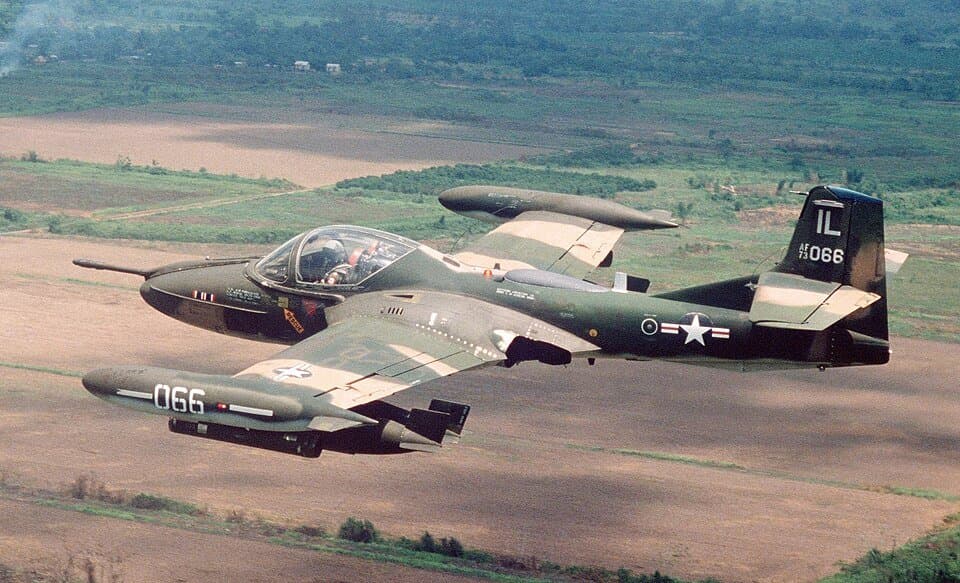
Combat aircraftIn service
Light ground-attack aircraft
Cessna A-37 Dragonfly is a light ground-attack aircraft originating in United States. It was built by Cessna. Reported operators include United States Air Force (historical) Republic of Vietnam Air Force (historical) Chilean Air Force (historical) Peruvian Air Force.
 United States
Cessna A-37 Dragonfly
TSGT KEN HAMMOND · Public domain · Resized · Public domain · Source ↗ · ModifiedTechnical data
Light ground-attack aircraft
United States
Cessna
Limited service in Central American and South American air forces
United States Air Force (historical) Republic of Vietnam Air Force (historical) Chilean Air Force (historical) Peruvian Air Force
577
1963–1975
October 1964
Cessna T-37 Tweet
2
28 ft 3 + 1 ⁄ 4 in (8.617 m)
35 ft 10 + 1 ⁄ 2 in (10.935 m) (over tip tanks)
True scale
Sourced dimensions beside a 1.75 m human reference.
See it in your room. Scan with your phone to open this model in 3D, then place it in your space.
Points represent sourced observations, including revisions. Revisions on the same effective date are not separate inventory events. Ranges appear in the table and are not plotted as exact points.
| Observation / report period | Value | Source | Claim state |
|---|---|---|---|
| 1 Oct 2026 | 740 km | Wikipedia contributors | superseded |
| 2 Oct 2026 | 740 km | Wikipedia contributors | approved |
8 ft 10 + 1 ⁄ 2 in (2.705 m)
183.9 sq ft (17.08 m 2 )
6.2:1
NACA 2418 (modified) at root, NACA 2412 (modified) at tip
6,211 lb (2,817 kg)
14,000 lb (6,350 kg)
507 US gal (422 imp gal; 1,920 L) usable internal fuel (including tip tanks)
2 × General Electric J85 -GE-17A turbojet , 2,850 lbf (12.7 kN) thrust each
507 mph (816 km/h, 441 kn)
489 mph (787 km/h, 425 kn) (max. cruise)
113 mph (182 km/h, 98 kn) at maximum landing weight, wheels and flaps down
524 mph (843 km/h, 455 kn)
460 mi (740 km, 400 nmi) (with maximum payload)
1,012 mi (1,629 km, 879 nmi) (with 4× 100 US gal (83 imp gal; 380 L) drop tanks
41,765 ft (12,730 m)
6,990 ft/min (35.5 m/s)
1 × 7.62 mm (0.300 in) GAU-2B/A minigun in nose with 1500 rounds Provision for SUU-11/A gun pods under wings
8 with a capacity of inner four: 860 lb (390 kg), two intermediate: 600 lb (270 kg), two outer: 500 lb (230 kg)
LAU-3/A rocket pods
AIM-9 Sidewinder
250 lb (110 kg) Mark 81 , 500 lb (230 kg) Mark 82 or 750 lb (340 kg) M117 bombs BLU-32B or BLU-1C/B fire bombs CBU-12, CBU-22 or CBU-24 cluster bombs SUU-14 bomb dispenser
The Cessna A-37 Dragonfly , or Super Tweet , is a jet-powered, light attack aircraft that was designed and produced by American aircraft manufacturer Cessna .
The USAF determined the T-37 to be a promising COIN aircraft and expressed its interest in a prospective improved version that would be able to carry a much larger payload along with greater endurance and better short-field performance. These requirements meant the aircraft would have to be considerably heavier and thus necessitate the use of more powerful engines . To account for the drastic increase in airframe weight along with the need to a significant payload, as well, Cessna opted to double the aircraft's engine power by replacing its twin Continental J-69 engines with General Electric J85 -J2/5 turbojet engines, each capable of generating up to 2,400 lbf (11 kN) of thrust. During 1963, the USAF awarded a contract to Cessna to produce two prototype aircraft, designated YAT-37D; these were essentially heavily modified T-37s.
Specific alterations made for the YAT-37D included the adoption of strengthened wings, the use of larger wingtip fuel tanks of 360 litres (95 US gal) capacity, additional avionics suitable for battlefield communications, navigation, and targeting, toughened landing gear that was suitable for rough-field operation, and the fitting of a General Electric -supplied GAU-2B/A 7.62 mm (0.300 in) "Minigun" Gatling-style machine gun capable of a rate of fire of 3,000 rounds/minute and 1,500 rounds of ammunition that was installed in the right side of the aircraft's nose behind a large access panel, along with an accompanying gunsight and gun camera . Perhaps most importantly, three stores pylons were installed on each wing that were compatible with a wide range of munitions.
The A-37A had a gross takeoff weight of 12,000 lb (5,400 kg), of which 2,700 lb (1,200 kg) were ordnance. It was a relatively simple aircraft, avoiding any advanced weapon systems or the need for a complex training program to operate. The A-37A retained the dual controls of its T-37B ancestor, allowing it to be used as an operational trainer. In combat FAC operations, the second seat was occupied by an observer. Only a single crewman normally flew in the aircraft for close-support missions, which permitted a slight increase in ordnance.
The A-37Bs were all newly built airframes that were considerably stronger than those of the A-37A, capable of pulling six g instead of five, and were built to have a longer fatigue life of 4,000 hours. Field experience would demonstrate that 7,000 hours between overhauls could be tolerated. The A-37B weighed almost twice as much as the T-37C; a remarkable fraction of the loaded weight, 5,800 lb (2,600 kg), could be external stores. In practice, the A-37B usually operated with at least two and sometimes four underwing fuel tanks to improve combat endurance. The A-37B added a refueling probe to the nose, leading to pipes wrapped around the lower lip of the canopy, for probe-and-drogue aerial refueling . This was an unusual fit for USAF aircraft, which traditionally are configured for boom refueling. Other improvements included updated avionics, a redesigned instrument panel to make the aircraft easier to fly from either seat, an automatic engine inlet de-icing system, and revised landing gear. Like its predecessors, the A-37B was not pressurized.
To accommodate the increased weight, the A-37B was powered by General Electric J85-GE-17A engines, providing 2,850 lbf (12.7 kN) thrust each. These engines were canted slightly outward and downward to improve single-engine handling. Air commando pilots in Vietnam operating the A-37A had found single-engine cruise an effective means of improving their flight endurance. Modifications were made to control surfaces to improve handling. To improve aircraft and crew survivability, the A-37B was fitted with redundant elevator control runs that were placed as far apart as possible. The ejection seats were armored, the cockpit was lined with nylon flak curtains, and foam-filled self-sealing fuel tanks were installed. To extend endurance, pilots were authorized to fly the A-37 on only one active engine, an uncommon practice outside of emergency situations at that time.
The 20 mm (0.787 in) GPU-2/A and AMD 30 mm (1.18 in) cannon pods were tested with favorable results on the A-37B, but reports indicate that such pods were either seldom or never used in operation.
The A-37 proved to excel at the close air support mission. It was able to engage targets at speeds roughly 100 miles per hour slower than swept-wing fighters, which improved its bombing accuracy; pilots were reportedly able to achieve an average accuracy of 45 feet (14 m). While the aircraft's slow speed was feared to make it more vulnerable to hostile ground fire, the A-37's relatively small size, atypical speeds, and relatively low altitudes combined to make it somewhat hard to hit effectively with gunfire. The A-37 required a relatively low level of maintenance compared to contemporary fighters—only two hours of maintenance for each hour of flight time, one-sixth as much as that of the McDonnell F-101 Voodoo , partially due to the convenient placement of multiple access panels at strategic locations.
The Guatemalan Air Force flew the A-37 in extensive counter-insurgency operations throughout the 1970s-1990s, losing one aircraft in action in 1985. The type has also been widely used for counter-narcotics operations.
(Cessna Model 318D) T-37B rebuilt with two J-85-GE-5 engines, a 7.62 mm Minigun in nose and eight underwing stores pylons, 39 conversions.
Salvadoran Air Force - 13 in service as of December 2022.
Length: 28 ft 3 + 1 ⁄ 4 in (8.617 m)
Wingspan: 35 ft 10 + 1 ⁄ 2 in (10.935 m) (over tip tanks)
Height: 8 ft 10 + 1 ⁄ 2 in (2.705 m)
Wing area: 183.9 sq ft (17.08 m 2 )
Empty weight: 6,211 lb (2,817 kg)
Max takeoff weight: 14,000 lb (6,350 kg)
Powerplant: 2 × General Electric J85 -GE-17A turbojet , 2,850 lbf (12.7 kN) thrust each
Maximum speed: 507 mph (816 km/h, 441 kn)
Cruise speed: 489 mph (787 km/h, 425 kn) (max. cruise)
Stall speed: 113 mph (182 km/h, 98 kn) at maximum landing weight, wheels and flaps down
Never exceed speed : 524 mph (843 km/h, 455 kn)
Combat range: 460 mi (740 km, 400 nmi) (with maximum payload)
Ferry range: 1,012 mi (1,629 km, 879 nmi) (with 4× 100 US gal (83 imp gal; 380 L) drop tanks
Service ceiling: 41,765 ft (12,730 m)
Rate of climb: 6,990 ft/min (35.5 m/s)
Guns: 1 × 7.62 mm (0.300 in) GAU-2B/A minigun in nose with 1500 rounds Provision for SUU-11/A gun pods under wings
Hardpoints: 8 with a capacity of inner four: 860 lb (390 kg), two intermediate: 600 lb (270 kg), two outer: 500 lb (230 kg)
Bombs: 250 lb (110 kg) Mark 81 , 500 lb (230 kg) Mark 82 or 750 lb (340 kg) M117 bombs BLU-32B or BLU-1C/B fire bombs CBU-12, CBU-22 or CBU-24 cluster bombs SUU-14 bomb dispenser
Reference text from Wikipedia contributors, used under CC BY-SA 4.0.
Cessna A-37 Dragonfly equipment records. Variants, orders and quantities are shown as reported in each inventory source; coverage is incomplete.
 El Salvador
Air Force exact named equipment holdings: OA-37B Dragonfly*. Active, operational-reserve and training units excluding equipment in store; November 2025 IISS assessment. Named service only; no parent-force or national total inferred. Source role: AIRCRAFT / ISR. Original estimates, ranges, reporting names, reserve, lease and employment scopes retained; nested included counts are not added. Missile-system quantities mean launchers, not rounds. No readiness, crew, carried weapon, payload, factory-production or future order count inherited.
Air Force exact named equipment holdings: A-37B Dragonfly. Active, operational-reserve and training units excluding equipment in store; November 2025 IISS assessment. Named service only; no parent-force or national total inferred. Source role: AIRCRAFT / ATK. Original estimates, ranges, reporting names, reserve, lease and employment scopes retained; nested included counts are not added. Missile-system quantities mean launchers, not rounds. No readiness, crew, carried weapon, payload, factory-production or future order count inherited.
 Guatemala
Reported count for A-37 Dragonfly. Service scope: Guatemalan Air Force; does not replace a national total. 1 distinct quantity component(s) from the same source list; shared rowspan cells counted once. Explicit source inventory scope: active; no other stock status or total inferred. Count column(s): in service: 3. Origin: United States. The listed variants/roles are the scope, not an immediately deployable count. Dates are the count-cell citations' stated source period (2024), not the article revision. 2024 cited publication year. Edition or publication years do not claim an exact inventory census day.
 Honduras
Air Force exact named equipment holdings: A-37B Dragonfly. Active, operational-reserve and training units excluding equipment in store; November 2025 IISS assessment. Named service only; no parent-force or national total inferred. Source role: AIRCRAFT / ATK. Original estimates, ranges, reporting names, reserve, lease and employment scopes retained; nested included counts are not added. Missile-system quantities mean launchers, not rounds. No readiness, crew, carried weapon, payload, factory-production or future order count inherited.
 Peru
Reported count for Cessna A-37 · A-37B. Service scope: Peruvian Air Force; does not replace a national total. 1 distinct quantity component(s) from the same source list; shared rowspan cells counted once. Explicit source inventory scope: active; no other stock status or total inferred. Count column(s): in service: 20. Origin: United States. The listed variants/roles are the scope, not an immediately deployable count. Dates are the count-cell citations' stated source period (2023), not the article revision. 2023 cited publication year. Edition or publication years do not claim an exact inventory census day.
 Uruguay
Air Force exact named equipment holdings: A-37B Dragonfly. Active, operational-reserve and training units excluding equipment in store; November 2025 IISS assessment. Named service only; no parent-force or national total inferred. Source role: AIRCRAFT / ATK. Original estimates, ranges, reporting names, reserve, lease and employment scopes retained; nested included counts are not added. Missile-system quantities mean launchers, not rounds. No readiness, crew, carried weapon, payload, factory-production or future order count inherited.
United States Air Force (historical) Republic of Vietnam Air Force (historical) Chilean Air Force (historical) Peruvian Air Force
Equipment reference ↗Keep exploring
Ground-attack aircraft
 ChinaCompare with Cessna A-37 Dragonfly
Ground-attack aircraft
Compare with Cessna A-37 DragonflyLight attack aircraft
Compare with Cessna A-37 DragonflyFighter and fighter-bomber / ground-attack aircraft
Compare with Cessna A-37 DragonflyAttack aircraft
Compare with Cessna A-37 DragonflyFighter Fighter-bomber / Ground attack Reconnaissance aircraft
 United KingdomCompare with Cessna A-37 Dragonfly