FORCETALLY
Loading the evidence…
Preparing your view.


Preparing your view.
Support aircraftIn service
American six or seven seat twin-engined light transport aircraft,
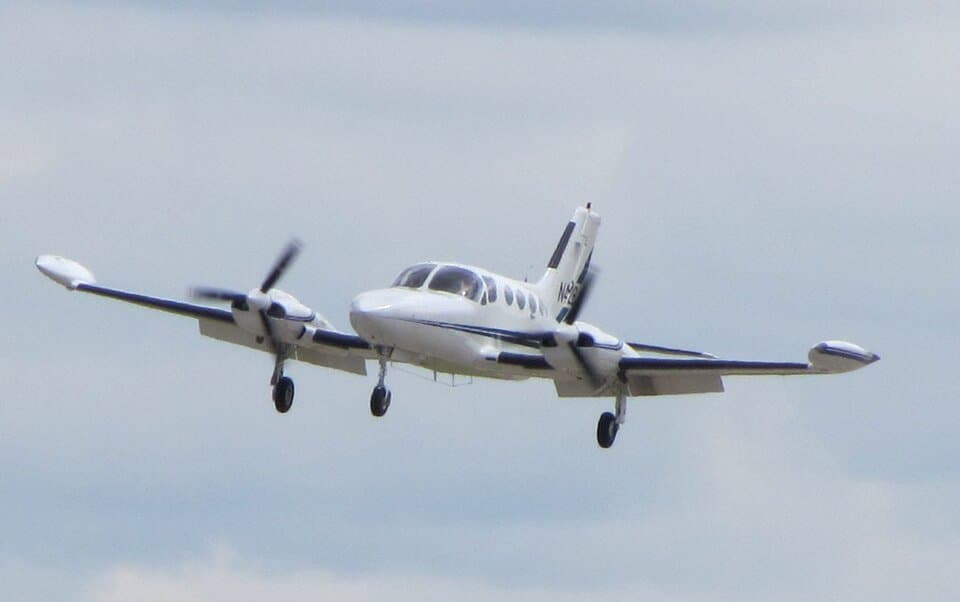
Cessna 421 Golden Eagle is a american six or seven seat twin-engined light transport aircraft, originating in United States. It was built by Cessna.
 United States
Technical data
Light transport
United States
Cessna
1,916
1967–1985
1968
October 14, 1965
Cessna 411
Cessna 425
One or two
Six passengers
36 ft 4 + 5 ⁄ 8 in (11.09 m)
41 ft 1 + 1 ⁄ 2 in (12.53 m)
11 ft 5 + 3 ⁄ 8 in (3.49 m)
215 sq ft (20.0 m 2 )
4,501 lb (2,042 kg)
7,450 lb (3,379 kg)
206 US gal (172 imp gal; 780 L) normal (usable capacity), 262 US gal (218 imp gal; 990 L) with optional wing tanks
2 × Continental GTSIO-520-L turbocharged, fuel injected and geared flat-six engines, 375 hp (280 kW) each
3-bladed McCauley constant-speed propellers
256 kn (295 mph, 474 km/h) at 20,000 ft (6,100 m)
240 kn (280 mph, 440 km/h) at 25,000 ft (7,600 m) (75% power)
1,487 nmi (1,711 mi, 2,754 km) at 25,000 ft (7,600 m), econ cruise speed
30,200 ft (9,200 m)
1,940 ft/min (9.9 m/s)
2,323 ft (708 m)
2,293 ft (699 m)
The Cessna 421 Golden Eagle is an American six or seven seat twin-engined light transport aircraft, developed in the 1960s by Cessna as a pressurized version of the earlier Cessna 411 .
The next year, 1969, the design was refined, with a three-inch stretch of the fuselage, five more gallons of fuel capacity, and a 40-pound increase in gross weight. The plane was redesignated the Cessna 421A.
In 1971, the design was again improved. Both empty and gross weight increased, the wingspan was increased by two feet, raising the service ceiling by 5,000 feet. The nose was stretched two feet to accommodate a larger nose baggage section. This new plane is designated the Cessna 421B.
Type approved 1 May 1967, powered by two Continental GTSIO-520-Ds of 375 hp (280 kW) each, maximum takeoff weight 6,800 lb (3,084 kg). 200 built.
Type approved 19 November 1968, powered by two Continental GTSIO-520-Ds of 375 hp (280 kW) each, maximum takeoff weight 6,840 lb (3,103 kg). 158 built.
Eight-seat light passenger transport aircraft. Type approved 28 April 1970, powered by two Continental GTSIO-520-Hs of 375 hp (280 kW) each, maximum takeoff weight 7,250 lb (3,289 kg), later models 7,450 lb (3,379 kg). 699 built.
Model with new wing and landing gear. Type approved 28 October 1975, powered by two Continental GTSIO-520-Ls or Continental GTSIO-520-Ns of 375 hp (280 kW) each, maximum takeoff weight 7,450 lb (3,379 kg). 859 built.
Conversion of Cessna 421C aircraft by fitting two 750hp Pratt & Whitney Canada PT6A -135 turboprop engines. Formal designation R421CP .
Pakistan Army at least one 421 in use.
On December 16, 1972, a private Cessna 421 crashed into the homes at 116 and 121 Diane Drive in Cheektowaga near Buffalo Niagara International Airport . The crash killed three on board and three on the ground, and at least four people on the ground were injured.
On 4 December 1980, a Cessna 421 carrying Prime Minister of Portugal Francisco de Sá Carneiro and other government officials, crashed into buildings in Camarate seconds after takeoff, killing all 7 persons on board.
On 5 March 1984, the pilot and five passengers in a Cessna 421B, registration number N3291Q , were killed when the aircraft impacted trees 1 mile (1.6 km) northeast of Folsom Field, Alabama during an incorrectly executed nighttime instrument approach in IMC conditions. The NTSB attributed the accident to the pilot's failure to initiate a missed approach , his failure to maintain altitude, his lack of recent instrument flying experience, and his history of heart problems; contributing factors were poor visibility and adverse weather.
On June 24, 1992, a Cessna 421 VGAB (tail number N628RJ), the 40-year-old pilot and two passengers took off from Monterey. About three minutes after takeoff the Cessna collided with a hill about three miles east of the airport. The investigation revealed that ground fog and overconfidence in the pilot caused the accident. All three were killed. The pilot had about 75 hours of flight experience.
On January 30, 2006, an eight-seat twin engine Cessna 421B with four passengers crashed about 1 mile (1,600 m) south of the airport. The aircraft was heading from Kansas to Palwaukee. There were no survivors.
On April 17, 2009, a Cessna 421 crashed shortly after take-off from Fort Lauderdale Executive Airport around 11:20 a.m. Local authorities stated the aircraft crashed into a vacant home located about two miles (3.2 km) from the airport. The aircraft was en route to Fernandina Beach, Florida near Jacksonville and was due to arrive at 13:00. The Federal Aviation Administration indicated that one person was on board the aircraft, and was killed in the accident. Sebring Air Charter of Tamarac, Florida was listed on FAA records as the owner of the aircraft. The probable cause of the accident was determined to be pilot error, with an inflight fire of the right engine as a contributing factor.
On December 9, 2011, a Cessna 421C aircraft crashed shortly after takeoff less than a mile from the airport into an open field. All 4 passengers on board were killed when the aircraft burst into flames upon crashing.
On August 27, 2013, a Cessna 421C crashed just after takeoff. The aircraft had engine issues on takeoff and impacted a tree a mile after takeoff. Witnesses reported that the aircraft's takeoff run appeared slower than normal, and the aircraft was found to have used the entire runway and traveled through two different 300-foot fields.
On November 22, 2017, the left-hand engine of a Cessna 421, registration N421RX , caught fire soon after takeoff from Presque Isle; the pilot attempted to return to the airport but was unable to maintain altitude and performed a forced landing in an adjacent field. Two persons aboard the aircraft suffered minor injuries and two others were uninjured; the aircraft was badly damaged. The NTSB attributed the accident to a fuel leak onto the hot turbocharger .
On July 13, 2021, at around 10:42 am, a Cessna 421C (tail number N678SW), piloted by Mary Ellen Carlin crashed into a suburban residential area killing the pilot, passenger and a pet. Investigators found that the Cessna 421C diverged from its flight plan, resulting in a crash less than five minutes after departure.
On April 30, 2026, around 11:25pm in Wimberly Texas, a Cessna 421C crashed while carrying 5 passengers to a Pickleball tournament near Austin Texas. Officials claimed the plane went down near Round Rock Road in Hays County. The 5 passengers on board were Brooke Skypala, Glen Appling, Seren Wilson, Hayden Dillard, and Stacy Hedrick. Unfortunately, none survived and were announced deceased on arrival. The second aircraft that was coming with them made it safely to its destination.
Capacity: Six passengers
Length: 36 ft 4 + 5 ⁄ 8 in (11.09 m)
Wingspan: 41 ft 1 + 1 ⁄ 2 in (12.53 m)
Height: 11 ft 5 + 3 ⁄ 8 in (3.49 m)
Wing area: 215 sq ft (20.0 m 2 )
Empty weight: 4,501 lb (2,042 kg)
Max takeoff weight: 7,450 lb (3,379 kg)
Powerplant: 2 × Continental GTSIO-520-L turbocharged, fuel injected and geared flat-six engines, 375 hp (280 kW) each
Maximum speed: 256 kn (295 mph, 474 km/h) at 20,000 ft (6,100 m)
Cruise speed: 240 kn (280 mph, 440 km/h) at 25,000 ft (7,600 m) (75% power)
Range: 1,487 nmi (1,711 mi, 2,754 km) at 25,000 ft (7,600 m), econ cruise speed
Service ceiling: 30,200 ft (9,200 m)
Rate of climb: 1,940 ft/min (9.9 m/s)
Takeoff distance to 50 ft (15m): 2,323 ft (708 m)
Landing distance from 50 ft (15 m): 2,293 ft (699 m)
Reference text from Wikipedia contributors, used under CC BY-SA 4.0.
True scale
Sourced dimensions beside a 1.75 m human reference.
See it in your room. Scan with your phone to open this model in 3D, then place it in your space.
Points represent sourced observations, including revisions. Revisions on the same effective date are not separate inventory events. Ranges appear in the table and are not plotted as exact points.
| Observation / report period | Value | Source | Claim state |
|---|---|---|---|
| 28 Sept 2026 | 3.49 m | Wikipedia contributors | approved |
| 1 Oct 2026 | 3.49 m | Wikipedia contributors | superseded |
Cessna 421 Golden Eagle equipment records. Variants, orders and quantities are shown as reported in each inventory source; coverage is incomplete.
 Montenegro
Reported count for Cessna 421 · Cessna 421 Golden Eagle. Service scope: Montenegrin Air Force; does not replace a national total. 1 distinct quantity component(s) from the same source list; shared rowspan cells counted once. Explicit source inventory scope: active; no other stock status or total inferred. Count column(s): in service: 1. Origin: United States. The listed variants/roles are the scope, not an immediately deployable count. The components do not establish one inventory census date; the stored date is the retrieved source snapshot.
Reported count for Cessna 421 Golden Eagle · Cessna 421B Golden Eagle. Service scope: Air Force; does not replace a national total. 1 distinct count cell(s) from the same source list; shared rowspan cells counted once. Retired, wholly reserve and on-order rows are excluded; the reported count retains any explicitly mixed stock scope in the quoted row. Count column(s): quantity: 1. Origin: unstated. The listed variants/roles are the scope, not an immediately deployable count. The components do not establish one inventory census date; the stored date is the retrieved source snapshot.
 Philippines
Army exact named equipment holdings: Cessna 421. Active, operational-reserve and training units excluding equipment in store; November 2025 IISS assessment. Named service only; no parent-force or national total inferred. Source role: AIRCRAFT / Light. Original estimates, ranges, reporting names, reserve, lease and employment scopes retained; nested included counts are not added. Missile-system quantities mean launchers, not rounds. No readiness, crew, carried weapon, payload, factory-production or future order count inherited.
 Sri Lanka
Air Force exact named equipment holdings: Cessna 421C Golden Eagle. Active, operational-reserve and training units excluding equipment in store; November 2025 IISS assessment. Named service only; no parent-force or national total inferred. Source role: AIRCRAFT / Light. Original estimates, ranges, reporting names, reserve, lease and employment scopes retained; nested included counts are not added. Missile-system quantities mean launchers, not rounds. No readiness, crew, carried weapon, payload, factory-production or future order count inherited.
 Türkiye
Army exact named equipment holdings: Cessna 421. Active, operational-reserve and training units excluding equipment in store; November 2025 IISS assessment. Named service only; no parent-force or national total inferred. Source role: AIRCRAFT / Light. Original estimates, ranges, reporting names, reserve, lease and employment scopes retained; nested included counts are not added. Missile-system quantities mean launchers, not rounds. No readiness, crew, carried weapon, payload, factory-production or future order count inherited.
Keep exploring
Twin engine light aircraft
 AustriaCompare with Cessna 421 Golden Eagle
Light STOL Transport aircraft
 IsraelCompare with Cessna 421 Golden Eagle
Transport aircraft
 ChinaCompare with Cessna 421 Golden Eagle
Transport aircraft
 United KingdomCompare with Cessna 421 Golden Eagle
Transport aircraft
United KingdomCompare with Cessna 421 Golden Eagle Transport aircraft