FORCETALLY
Loading the evidence…
Preparing your view.


Preparing your view.
Armoured vehiclesIn service
Infantry fighting vehicle
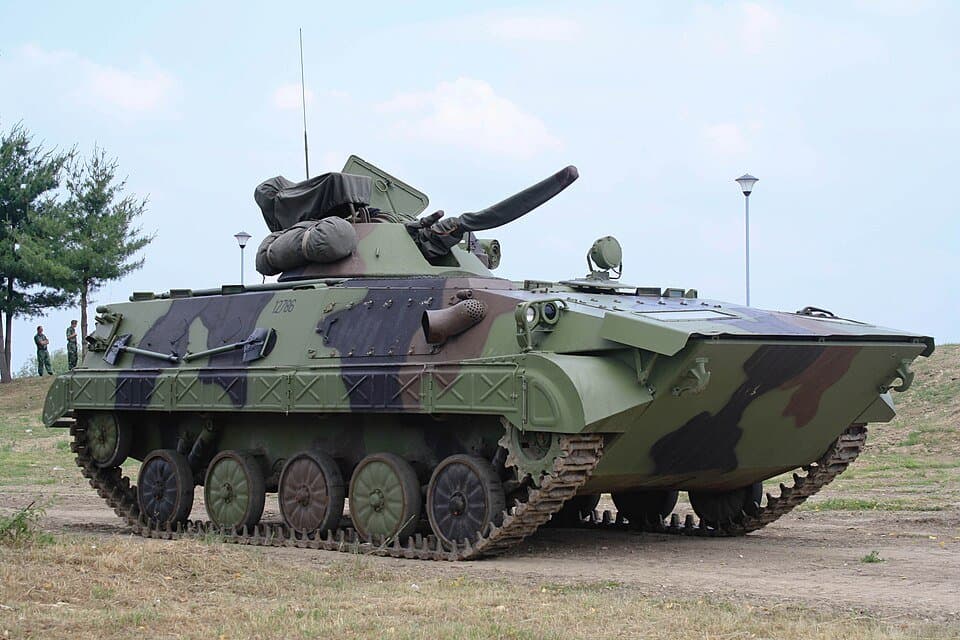
BVP M-80 is a infantry fighting vehicle originating in Yugoslavia.
True scale
See it in your room. Scan with your phone to open this model in 3D, then place it in your space.
Points represent sourced observations, including revisions. Revisions on the same effective date are not separate inventory events. Ranges appear in the table and are not plotted as exact points.
| Observation / report period | Value | Source | Claim state |
|---|---|---|---|
| 28 Sept 2026 | 2.2 m | Wikipedia contributors | superseded |
Infantry fighting vehicle
Yugoslavia
1979–present
Yugoslav Wars Russo-Ukrainian War Russian invasion of Ukraine
Military Technical Institute
1971
13,850 kg
6.42 meters
2.9 meters
2.2 meters
3+7
Steel armour
20 mm M-55 cannon 1 ATGM launcher, 2 missiles
coaxial 7.62 machine-gun 2,000 rounds
Daimler Benz OM-403 320 hp
22.6 hp/ton
torsion bar
500 km
65 km/h on land 8 km/h in water
Croatia
Serbia
Ukraine
Yugoslavia – Passed on to successor states.
Bosnia and Herzegovina – 30+ in 1998
North Macedonia – 2 in 1998
Slovenia – 62 in 1998, 52 in 2002, 35 vehicles were donated in 2022 and 3 in 2023 as donation to Ukraine.
Serbia and Montenegro – 568 in 1998.
The BVP M-80 ( Serbo-Croatian : Borbeno vozilo pešadije М-80 ) is a Yugoslav tracked infantry fighting vehicle , produced from the 1980s until the country's collapse in the 1990s.
The first production variant was the M-80, which was only made in small numbers. It used a French-built engine with an output of 260 hp, the same engine as used in the AMX-10P . After only one year, the Yugoslav company FAMOS began licensed production of Daimler-Benz 's 315 hp engine. Vehicles powered by this engine received the new designation M-80A. Around 1,000 such vehicles were produced before the breakup of the country.
At the time of its production, the M-80A was comparable to existing IFVs, such as the Soviet BMP-1 and the French AMX-10P. Although many foreign observers compared the M-80A to the BMP-1, the Yugoslav IFV was an original design. Unlike the BMP-1, which had six road wheels and was armed with a 73 mm gun, the M-80A had five road wheels and had a 20 mm gun. The M-80A incorporated many elements from the AMX-10P, giving it more power and better protection over its counterpart. All M-80s are amphibious and equipped with twin 9K11 Malyutka (AT-3 Sagger) anti-tank guided missile launchers.
The M-80A is armed with one 20 mm gun, co-axial machine gun 7.62 mm and twin launcher for wire-guided anti-tank missiles. It is NBC protected, fire suppression system, inside heating and water ejecting system. It is fully amphibious and can perform crossing of any water barrier without previous preparations. Max. speed at water is 7 km/h. Crew consist of three, driver, commander and gun operator and in the after compartment, there is space for six fully equipped infantrymen who can engage the enemy with personal armament through six gun slits on both vehicle sides and back doors and one squad leader who commands infantry upon exiting the vehicle. Infantry leaves IFV through two doors at the back of the vehicle.
The standard BVP M-80 and M-80A variants mount a Hispano-Suiza HS.804 20mm autocannon that has an effective range of about 1,500 meters and, depending on ammunition type, is able to penetrate around 20mm RHAe (rolled homogeneous armour equivalency).
In 1978, the technical-military council of Yugoslav People's Army decided that a larger caliber gun would be necessary to counter the increasingly heavy armor of possible enemy armored fighting vehicles and began development of a new turret to house the larger weapon. This requirement led to the development of the Zastava M86 30mm autocannon in 1985 and a new turret called Vidra, which was later designated the M91. In addition to the new gyrostabilized 30mm autocannon, the new turret was equipped with smoke grenade launchers, improved day/night sights, and the ability to fire Malyutka ATGMs. The turret is rotated by servo-hydraulics and the main gun is elevated and depressed using an electric motor.
Incremental improvements were made to the design of the Vidra turret throughout the late 1990s and early 2000s. These improvements would eventually be standardized and incorporated into a thoroughly updated turret and designated M91E. Besides being able to mount the original M86 30mm autocannon , the M91E-I and MM91E-II turrets able to accommodate the dual feed Zastava M89 30mm autocannon.
M-80 – first production model with 260 hp engine, replaced after one year.
M-80A – improved version with 320 hp engine; serial production.
M-80AK/M-98A – equipped with turret with 30 mm M86 cannon or 30 mm dual feed M89 cannon.
SPAT 30/2 – self-propelled anti-aircraft gun. New turret model called "Foka" with two Zastava 30 mm autocannons with elevation from -5 to +85 degrees. The aim-scan gear is J-171 or Motorola 6800. Included receiver of radar data gathered from external observations radar. Three crew members and four soldiers could be transported. Planned as successor of M-53/59 Praga – 4 models produced.
Bosnia and Herzegovina – 30+ in 1998 North Macedonia – 2 in 1998 Slovenia – 62 in 1998, 52 in 2002, 35 vehicles were donated in 2022 and 3 in 2023 as donation to Ukraine. Serbia and Montenegro – 568 in 1998.
• Manufacturer FAMOS factory
Reference text from Wikipedia contributors, used under CC BY-SA 4.0.
Sourced dimensions beside a 1.75 m human reference.
BVP M-80 equipment records. Variants, orders and quantities are shown as reported in each inventory source; coverage is incomplete.
 Croatia
Army exact named equipment holdings: M-80. Active, operational-reserve and training units excluding equipment in store; November 2025 IISS assessment. Named service only; no parent-force or national total inferred. Source role: ARMOURED FIGHTING VEHICLES / IFV. Original estimates, ranges, reporting names, reserve, lease and employment scopes retained; nested included counts are not added. Missile-system quantities mean launchers, not rounds. No readiness, crew, carried weapon, payload, factory-production or future order count inherited.
 Serbia
Army exact named equipment holdings: M-80; M-80AB1. Active, operational-reserve and training units excluding equipment in store; November 2025 IISS assessment. Named service only; no parent-force or national total inferred. Source role: ARMOURED FIGHTING VEHICLES / IFV. Original estimates, ranges, reporting names, reserve, lease and employment scopes retained; nested included counts are not added. Missile-system quantities mean launchers, not rounds. No readiness, crew, carried weapon, payload, factory-production or future order count inherited.
 Ukraine
Army exact named equipment holdings: BVP M-80A. Active, operational-reserve and training units excluding equipment in store; November 2025 IISS assessment. Named service only; no parent-force or national total inferred. Source role: ARMOURED FIGHTING VEHICLES / IFV. Original estimates, ranges, reporting names, reserve, lease and employment scopes retained; nested included counts are not added. Missile-system quantities mean launchers, not rounds. No readiness, crew, carried weapon, payload, factory-production or future order count inherited.
Keep exploring
 Sweden
 Italy
 United Kingdom
 South Korea
 Canada