Design and configuration
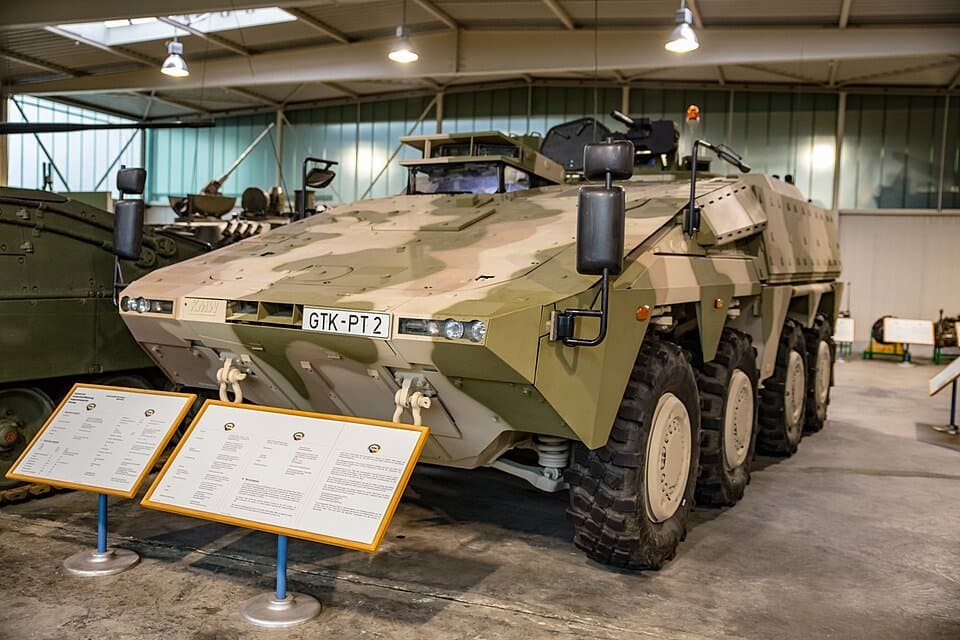
The driver and powerpack occupy the forward section. A raised rear module provides protected working or troop space, with access through the rear.1


Preparing your view.
Armoured vehiclesIn production
Armoured fighting vehicle
Boxer (armoured fighting vehicle) is a armoured fighting vehicle originating in Germany / Netherlands /. It was built by Rheinmetall KNDS Deutschland.
 Germany /
 Netherlands
Armoured fighting vehicle
Germany / Netherlands /
Since 2011
See Operators
Afghanistan war (ISAF) Russo-Ukrainian War
ARTEC GmbH
1998–2009
Rheinmetall KNDS Deutschland
APC €4 – 5 million IFV €7 – 9 million
2009–present
1,866 as of February (deliveries and confirmed orders for which quantities are given:See Operators )
See Boxer variants and mission modules
See Boxer variants and mission modules
The UK Ministry of Defence announced its intention to withdraw from the Boxer programme and focus on the Future Rapid Effect System (FRES) in July 2003. In October 2003, the first Dutch prototype was delivered. In October 2006 the Netherlands confirmed the procurement of 200 Boxers to replace the M577 and the support variants of the YPR-765 in the Royal Netherlands Army . Deliveries were scheduled to run from 2013 through to 2018, and within the RNLA the baseline Boxer is called the Pantserwielvoertuig (PWV), “Armour[ed] Wheel[ed] Vehicle“.
On 13 December 2006 the German parliament approved the procurement of 272 Boxers for the German Army , to replace some of its M113 and TPz 1 Fuchs vehicles, although as of Q2 2024 no TPz 1 Fuchs have been replaced by delivered Boxer. Production of Boxers had been scheduled to commence in 2004, but production was delayed and the first production example was delivered to the German Army in September 2009. Over seven years, prototypes accrued over 90,000 km of reliability trials and over 90,000 km of durability trials. At this time there were three confirmed production facilities for Boxer, one in the Netherlands (Rheinmetall) and two in Germany (Krauss-Maffei Wegmann and Rheinmetall). The original German Boxer order covered 125 APC, 65 command vehicles, 72 ambulance, and 12 driver training vehicles.
The reconnaissance variant will account for 133 of the 211 vehicles and is equipped with Rheinmetall's Lance Medium Calibre Turret, previously known as the Lance Modular Turret System (MTS), which has a 30 mm automatic cannon.
The ARM has an approximate weight of 13 tonnes, is manned by two personnel and connects to the Boxer using standard mechanical interfaces.
In January 2020 in an interview with Shaun Connors of Janes, Stefan Lischka, MD of ARTEC, stated that only 8% of UK Boxers (the original 523) would be manufactured in Germany with the remainder being assembled at and delivered from two sites in the UK, Rheinmetall BAE Systems Land (RBSL) at Telford and KMW subsidiary WFEL at Stockport. Production began in early 2023.
In June 2020 the Bundeswehr repeated an earlier statement that it would replace the Wiesel weapon carrier with a Kampfboxer mission module bringing the combination of a 30 mm cannon and Spike-LR anti-tank guided missile to the wheeled platform. This requirement would develop to become the Schwerer Waffenträger Infanterie (sWaTrg Inf) HWC infantry vehicle.
During the Future Armoured Vehicles Survivability (FAVS) conference held in November 2023, a representative from the German Army explained that the service intended to field four medium brigades. These brigades were planned to be equipped with new Boxer variants, including a Boxer variant referred to as Armoured Infantry Fighting Vehicle (AIFV). Like the Boxer Heavy Weapons Carrier, this AIFV variant was expected to be based on or around the Australian Boxer Combat Reconnaissance Vehicle (CRV). Rheinmetall and KNDS Deutschland are understood to have proposed different turret options, with the former understood to have offered its two-person Lance turret as fitted to the Combat Reconnaissance Vehicle (CRV) and Schwerer Waffenträger Infanterie (sWaTrg Inf) HWC infantry vehicle, with KNDS Deutschland proposing its Remote Controlled Turret 30 mm (RCT30).
The turret will be equipped with a 30 × 173 mm KCE revolver gun firing programmable ABM, two Stinger surface-to-air missiles, and a sensor suite.
The latter will comprise a Hensoldt Spexer X-band radar with three panels each providing 120° azimuth coverage integrated into the turret and an electro-optical tracking sensor with a thermal camera, day camera, and laser rangefinder for target identification and tracking.
On 24 April 2024, the UK announced its selection of the Boxer-based Remote-Controlled Howitzer 155mm (RCH 155) for the British Army's Mobile Fires Platform programme, as a successor for the AS90 . The vehicles will be built in both Germany and the UK with over 100 UK-based suppliers manufacturing components. The platform will be in service with the Royal Artillery by the end of the decade.
While not confirmed, it was reported in May 2024 that the Bundeswehr had selected the RCT30 turret option for the 148 Boxer it had identified it required for its new medium forces. The choice is understood to have been role-driven, the RCT30 turret permitting the transport of a fully equipped grenadier squads, while the Lance turret-equipped sWaTrgInf Heavy Weapons Carrier does not, this vehicle optimised for direct tactical fire in support of infantry forces, not as a transport for them. The project was scheduled for German parliamentary approval during Q4 2024, with sources suggesting at the time that the Netherlands could also order a batch of RCT30-fitted Boxer. The Lance and RCT30 turrets are both fitted with Rheinmetall's 30 mm cannon. The RCT30 turret is essentially that fitted to the PSM Puma IFV.
In September 2024 it was confirmed that the Dutch would acquire the RCT30 Boxer. The Dutch 13th Light Brigade announced on September 17 that its two infantry battalions would be reinforced with Boxer RCT30 infantry fighting vehicles (IFVs). No contract, acquisition timeline details or similar were given. Also in September 2024, Rheinmetall in partnership with Patria presented a Boxer with a NEMO 120 mm mortar turret. The concept demonstrator was built in response to the Armoured Mortar requirement from the British Army and was shown using an existing British Army drive module.
An additional 48 platforms are scheduled to be manufactured over the course of 2025 in command post, special carrier, ambulance and infantry carrier variants.
In recent years the size/weight differences between Boxer and its contemporaries has reduced considerably, with Boxer quoted to have a combat weight of 36.5 tonnes in 2016 in A1 and A2 configurations, while vehicles such as ST Kinetics ' Terrex 3 had a quoted combat weight of 35 tonnes, and Nexter 's VBCI , Patria 's AMV and General Dynamics ' Piranha V all weighing in around the 32 to 33 tonne mark.
Current combat weight of the Boxer in A3 configuration is quoted as up to 38.5 tonnes.
However, ARTEC conducted trials in December 2021 with a Boxer weighing 41 tonnes.
The vehicle, which was ballasted and without a mission module, traversed gaps up to 2.2 m, climbed a 60° slope, and surmounted a 1 m vertical step during trials.
The heaviest current version is the remote-controlled howitzer (RCH) version at 39 tonnes.
The drive module is also known as the platform or the drive-line module. It consists of the hull mounting the drive axles, and is enclosed over the frontal arc where the powerpack and driver is located. The A (Alteration) iterations applied to the Boxer are specific to the drive module. The drive module locates the driver front right (right-hand drive), with the powerpack to the left. The powerpack can be replaced under field conditions in about 30 minutes and can, if required, be run outside of the vehicle for test purposes.
There are currently three main lines of drive modules: the A, the B0 and C0 models. The initial production model was A0 with fewer than 60 delivered. It was followed by the A1 and subsequently by the A2 model in 2015. Current production standard depending on user is either A2 or A3. Australia is receiving an A2/A3 hybrid, in that it will receive the latest A3 drive module (rated at 38,500 kg) but with the A2 standard engine rating of 530 kW (711 hp ).
In 2024, the states participating in OCCAR's Boxer program defined the B0 drive module as Future Common Drive Module , offering advantages such as easier scalability of production , reducing the training required by the users and maintainers, improving interoperability and flexibility while also reducing parts and lead times. The B0 module is based on the A3 model and has a gross vehicle mass of 40 tonnes (39 long tons; 44 short tons), new tires and a modified chassis. The hull has been altered so that mission modules rest on six instead of four connection points. The German IFV variant of the Boxer will be based on the B0 drive module.
Internal protected volume of the baseline mission module is 14m³, this increasing to 17.5 m 3 for higher roof configurations such as an ambulance configuration. While variable depending on protection levels and equipment fit/configuration, payload is stated to be 13.5 tonnes.
In service Boxers are fitted with a variety of armament ranging from a 7.62 mm light machine gun in a remote weapon station to a 30 mm cannon in a turret. Numerous other armament options are offered and these include missiles, mortars, a 105 mm main gun, and a 155 mm howitzer.
Most in-service Boxers are equipped with a remote weapon station for self-defense. Dutch vehicles are fitted with the Protector M151 RWS from Kongsberg fitted with a 12.7 mm heavy machine gun. German vehicles are usually fitted with the FLW-200 from KMW, which can be fitted with either a 7.62 mm MG3 machine gun, a 12.7 mm M3M HMG or a 40 mm GMW automatic grenade launcher . The FLW-200 has dual-axis stabilization and incorporates a laser rangefinder and a thermal imager. The Bundeswehr's Joint Fire Support Team, schwer (heavy), programme Boxers will be fitted with Kongsberg's Protector RS4 RWS, as will the C-UAS Boxer's if delivery occurs. British vehicles will also be fitted with Kongsberg's Protector RS4 RWS, the £180 million contract award announced in February 2021.
Lithuanian Boxers are fitted with the Israeli-made RAFAEL Advanced Defense Systems Samson Mk II RCT turret, mounting a fully stabilised Orbital ATK Mk 44 30 mm dual-feed cannon, 7.62 mm co-axial MG, and Spike-LR missiles. The turret is fitted with an independent commander's sight with both commander and gunner provided with thermal and daylight channels.
Australian Boxers are fitted with either Rheinmetall Defense's Lance Medium Calibre Turret or an EOS Defence Systems R400S-Mk2 D-HD RWS. 133 Combat Reconnaissance Vehicle (CRV) Reconnaissance variants will be fitted with the Lance 30 mm two-man turret, this armed with the Rheinmetall Mauser MK 30-2/ABM (air-bursting munition) dual-feed stabilised cannon and 7.62 mm coaxial machine gun.
Turret traverse is all electric through a full 360° with weapon elevation from -15° to +45°.
Germany will also receive Boxer fitted with the Skyranger 30 air defence system turret mission module. The Skyranger 30 turret is fitted with a modified version of the Oerlikon KCA 30 mm cannon. Rate of fire of is 1,200 rounds per minute and the gun has the ability to elevate 85° to combat terminal diving targets. 252 ready rounds are carried. The gun fires a 30 mm airburst munition based on the 35 mm AHEAD ammunition carrying 160 tungsten cylinders, each weighing 1.25 grams for a total payload of 200 grams, which is time-programmed upon leaving the muzzle to open up in front of a target to form a lethal cone. The system is capable of integrating a selection of very short range missiles, and for Germany these were supposed to FIM-92 Stingers , however due to its high costs and the planned Stinger version not being available yet for integration, Germany plans to instead adopt the MBDA Small Anti-Drone Missile in a 9 or 12 missile launcher instead.
Exact details of Boxer protection levels are classified. According to ARTEC, the vehicle will withstand anti-personnel and large anti-tank mines of an undisclosed type under the wheel, platform or side attack. It has previously been stated that Boxer's baseline armour is all-round resistant to 14.5 mm armour-piercing ammunition in accordance with STANAG 4569 Level 4. The advantageous shape of the frontal armour results in protection against medium calibre weapons. The vehicle is protected against the blast and fragments of artillery rounds and improvised explosive devices . Its hull is constructed with a triple-layered floor incorporating composite materials and forming a v-over-v hull providing protection against anti-tank mines. Additional armour plates can be installed under the vehicles to further improve mine protection.
A newer, weight-optimized armour kit was developed by IBD Deisenroth for the Dutch A2 model, offering the same level of protection as the original one at a 500 kilograms (1,100 lb) lower weight. German Boxers retained their original armour kit.
The Boxer drive module A1 (as designated by the German BWB) is an upgraded version of the baseline A0 version of the Boxer drive module, with the primary difference being the installation of mine protection plates fitted to the belly and wheel stations of the vehicle. The additional armour package is focused on protecting against side and underbody IEDs threats, in particular EFP -IEDs and the shrapnel of IEDs consisting of stacks of artillery rounds. This consists of the AMAP-M and AMAP-IED packages. An unspecified electronic countermeasure (ECM) system was also fitted to counter IEDs. These changes result in a 1,058 kg weight increase for the A1 over the baseline A0 APC variant. For the A2 and A3 Boxer protection is reported to have been increased further.
The powerpack of the Boxer consists of a MTU 8V199 TE20 water-cooled diesel engine developing (originally) 720 hp and coupled to an Allison HD4070 fully automatic transmission with seven forward and three reverse gears. The powerpack can be replaced under field conditions in approximately 30 minutes. The MTU 8V199 TE20 engine is a militarised development of the Mercedes-Benz OM 500 truck engine, modified by MTU to produce increased power via changes to the turbocharger, fuel injection and cooling systems. To maintain mobility levels at increased weights, the 8V199 TE20 is now available developing either 530 kW (711 hp ) or 600 kW (805 hp ), and when the drive module is fitted with the 600 kW version of this engine it is designated A3. The Boxer is fitted with three fuel tanks containing a total of 562 litres, divided between a 280-litre front tank, 238-litre rear tank, and a 44-litre reserve tank.
Boxer has full-time 8×8 drive with differential locks on all axles and the front four wheels steer. Tyres are 415/80R 27 Michelin XML on German and Dutch Boxers. The Land 400 prototypes were fitted with 415/80R 685 Michelin XForce 2 tyres, these having a 500 kg per wheel greater load rating than the XML and being more 'all-terrain' in design than the rocks/mud-optimised XML. Standard tyre fit for Australian and UK Boxers will be 415/80R 685 Michelin XForce ZL rated to carry 5,600 kg each.
A central tire inflation system (CTIS) is fitted, and run-flat inserts allow for 30 km travel at up to 50 km/h in the event of a puncture. Braking is provided by Knott pneumatic ABS on all wheels with main braking power actuated on the front two axles. Suspension is fully independent double wishbone with coil springs.
The Boxer can be transported in the Airbus A400M tactical airlifter, albeit not in one piece. With a capacity of around 32-tonnes, the loading ramp of an A400M cannot accommodate a complete Boxer so the drive and mission modules need to be separated for transport. Two Boxers can be transported by three A400Ms, two for the drive modules and a third for the mission modules.
Bridge system 14 m
Bridge system 22 m
Mortar 120 mm
Mortar 120 mm NEMO
Main gun 105 mm
The German Army received 72 ambulance modules as part of the initial 272-vehicle order; the Dutch Army ordered 52 ambulance modules. The German and Dutch Boxer ambulance variant utilise a mission module with a raised roofline providing an internal height of 1.85 m and volume of 17.5 m 3 . In Dutch service the Boxer ambulance replaced the YPR-765 prgwt variant of the AIFV ( Armored Infantry Fighting Vehicle ) casualty transport and it can accommodate seven casualties that are seated or three lying down on stretchers, or one of the following combinations: three seated and two lying down, or four seated and a single casualty lying down. The crew consists of driver, commander and, in Dutch version a nurse; in the German version a doctor or 'Rettungshelfer' (rescue assistant). The Dutch vehicle, a medical evacuation vehicle, differs from the German medical treatment vehicle. The UK has ordered ambulance modules, and Australia has an option for 11 of these.
The Boxer Cargo is a Dutch-specific variant that replaced the YPR-765 prv variant of the AIFV ( Armored Infantry Fighting Vehicle ). It is equipped with a special loading floor to secure cargo during transport and can transport a maximum of two standard one tonne army pallets (max. load 2,5 t ). The interior design of the vehicle allows adaptation as necessary for different kinds of missions. For conducting peace-keeping missions or other peacetime operations the set of vehicle equipment can be changed and tailored to suit as required. Crew consists of commander/gunner and driver. 27 cargo examples were originally ordered, this later revised to 12. A cargo variant was the final Dutch Boxer produced.
As part of Land 400 Phase 2 deliveries, Australia will receive 11 CRV-REP (Combat Reconnaissance Vehicle - Repair) and 10 CRV-REC (Combat Reconnaissance Vehicle - Recovery). The repair variant will be fitted with a crane, the recovery variant a winch. The recovery variant will be fitted with a R400S-MK2-D-HD RWS remote weapon station mounting an unspecified weapon. Both variants have a crew of three. Of the additional 12 mission modules ordered, one will be in repair configuration, and two in recovery. Australia's choice of separate repair and recovery modules is believed to be due to the difficulties of achieving the required lift (crane) and pull (winch) capabilities required within module size and weight constraints of a single module.
The UK will receive 60 modules in Engineer Section Vehicle (ESV) configuration, and 50 in ES Repair (Rep) configuration. Germany is evaluating recovery options for Boxer.
Boxer was first shown fitted with the Skyranger 30 air defence system turret mission module in March 2021. The Skyranger 30 turret has an autocannon firing time fuzed 30 x 173 mm ammunition and two short range missiles like Stinger or Mistral. It has five AESA radar arrays for 360 degrees coverage and a day and night electro-optical sight for target engagement. Skyranger 30 was ordered by the Bundeswehr in 2024 and will be a key component of the Bundeswehr's Nah- und Nächstbereichsschutz (short- and very-short-range air defence: NNbS).
The Boxer Remote-Controlled Howitzer 155 mm (RCH 155) mounts a version of the KNDS Deutschland Artillery Gun Module (AGM).
This is a further development of the tracked Panzerhaubitze 2000 155 mm 52-calibre artillery system.
In December 2020 the then Krauss-Maffei Wegmann (KMW) announced in a press release that it planned to begin developmental testing of the Remote Controlled Howitzer (RCH) 155 mm gun in 2021, this a remotely controllable version of the original RCH 155.
The Combat Reconnaissance Vehicle (CRV) is a development of the baseline Boxer designed to fulfil the Australian Land 400 Phase 2 requirement. The chassis selected is rated at a GVW of 38.5-tonnes and is a hybrid of Boxer A2 and A3 configurations. The Combat Reconnaissance Vehicle (CRV) Reconnaissance variant, or simply reconnaissance is the main CRV variant, 133 of the 211 vehicles ordered in this configuration. The Combat Reconnaissance Vehicle (CRV) Reconnaissance variant is fitted with the Rheinmetall Defense Lance Medium Calibre Turret.
Vilkas/Wolf is a Lithuanian designation for Boxer fitted with a Rafael Advanced Defense Systems Samson Mk II RCT turret. ARTEC refer to this configuration as IFV Samson. 89 of 91 Lithuania's Vilkas/Wolf order are fitted with the Samson Mk II RCT turret, this mounting a fully stabilised Orbital ATK Mk 44S 30 mm dual-feed cannon, 7.62 mm co-axial MG, and Spike-LR missiles. A range of turret options were bid including the unmanned turret from the PSM Puma IFV . Lithuania received four variants of the IFV, 55 IFV squad leader, 18 IFV platoon leader; 12 IFV company leader; 4 IFV command post. Variants vary by mission fit primarily in the areas of additional voice and data communication equipment as well as modified BMS.
Boxer Mobile LWS The Boxer Mobile LWS (laser weapon system) demonstrator was a version of the Boxer armoured medical treatment vehicle that was fitted with a RWS coupled to a Rheinmetall RMG 12.7 mm HMG, integrated with an unmanned protected turret and fitted with a fully-automated MANTIS turret. No further development or production has taken place.
Boxer C-UAS As of 2024 ARTEC does not list a Counter UAS mission module configuration as an option for Boxer. However, previously in December 2019 Germany's BAAINBw ordered 10 Boxer C-UAS (Counter UAS) systems, placing contracts with Kongsberg and Hensoldt, with delivery to be completed within 24 months. The vehicle was stated to be equipped with combination of Kongsberg's Protector RWS armed with 40 mm grenade launcher with airburst ammunition and Hensoldt's Spexer 2000 3D radar. Delivery of the first systems to the Bundeswehr was scheduled by the close of 2020, with these used to protect the NATO Response Force Very High Readiness Joint Task Force (VJTF) when Germany took leadership of the service in 2023. As of early 2024 there is no evidence this requirement came to fruition, despite a May 2023 statement by Lieutenant Colonel Karlheinz Boehnke, Multi-Role Armoured Vehicle (MRAV) Boxer representative in the German Army Concept and Capabilities Development Centre, that deliveries would occur 2023–2024.
Boxer Skyranger 35 Boxer has been shown fitted with the Oerlikon Skyranger 35 air defence system turret. This is armed with Rheinmetall's 35mm x 228 calibre Revolver Gun, this having the option of a dual ammunition feeding system that allows the choice of two types of shell. It would primarily fire the 35 mm Advanced Hit Efficiency And Destruction (AHEAD) ammunition, which although optimised for the air defence role is also effective against ground targets including lightly protected vehicles. The secondary nature would be Frangible Armour-Piercing Discarding Sabot (FAPDS) ammunition. The gun has a cyclic rate of fire of 1,000 rounds a minute, with a typical aerial target being engaged by a burst of 20 to 24 rounds. Skyranger 35 is heavier than the Skyranger 30 variant which has been ordered by Germany.
Boxer Overwatch A demonstrator of a Boxer Overwatch was unveiled at the DVD 2022 event (Defence Vehicle Dynamics). The Overwatch is a mission module equipped with a Brimstone missiles launcher. This variant was developed by RBSL in collaboration with MBDA with the aim to meet the requirement for the "Mounted Close Combat Overwatch" programme. The requirements for the programme are to provide an anti-armour capability at a range of 10 km or more, with missiles weighing up to 50 kg. It is a modern and more capable variant of the retired Swingfire anti-tank guided missile (ATGM) mounted on the FV102 Striker . In its concept form, the Boxer Overwatch mission module carries a single eight-cell launcher for 53 kg Brimstone 3 missiles facing towards the left side of the vehicle. The launcher is lowered to a horizontal position for travelling and raised before a fire mission.
Boxer WFEL bridging module concept The Boxer WFEL bridging module concept is a configuration designed by WFEL and KMW as a private venture, to meet the need to integrate the Leguan bridging system onto medium-sized vehicles. The modules can deploy various bridges: a 14 meters long bridge, capable of a MLC (load class) of 80 or 100. a 22 meters long bridge, capable of a MLC (load class) of 50
Boxer Mortar Mission Module This module was developed by RBSL, and integrates the Mortar Weapon System of Rheinmetall Norway with an automated aiming capability. It was tested in September 2022 with a 120mm mortar, but a smaller calibre could be used on the system.
Boxer, direct fire support In April 2020 John Cockerill Defense revealed that it was supplying a C3105 two-person turret armed with 105 mm rifled gun to KMW so that it could be incorporated onto Boxer. The company stated that the development was funded by internal R&D budgets. ARTEC's mission module range includes a Main gun 105 mm configuration.
KMW RCT120 KMW presented a tracked variant of the Boxer at Eurosatory 2022. It is designed to be compatible with the mission modules of the wheeled Boxer. The mission module presented is the RCT120 which includes a remote controlled turret equipped with a 120mm smoothbore tank gun, 2 Spike LR missiles, a hard-kill Trophy APS and a 12.7mm RCWS Natter. It also offers a coaxial 30 mm gun as an option.
The first 25 CRVs were manufactured in Germany through to 2021 to meet an early Australian capability requirement for familiarisation and training. The first CRVs were formally handed over to the Australian Army in September 2019. Prior to delivery the Boxers were modified locally with Australian-specific communications and battlefield management systems and fitted temporarily with the Kongsberg Protector RWS that previously equipped Australian ASLAVs deployed to Iraq and Afghanistan. Training with the first-delivered vehicles commenced by October 2020. The first 25 'Block I' vehicles consisted of 13 in Multi-Purpose Vehicle (MPV) configuration and 12 in CRV Reconnaissance configuration.
The 186 Block II CRVs are made up of 121 in the Combat Reconnaissance Vehicle (CRV) Reconnaissance variant, 29 in a joint fires support configuration (CRV-JFS), 15 in a command and control configuration (CRV-C2), 10 in a repair configuration (with crane) (CRV-REP), and 11 in a recovery configuration (with winch) (CRV-REC). Also included are 12 additional mission modules: 5 CRV-JFS; 4 CRV-C2; 2 CRV-REC; 1 CRV-REP. Also included are 20 frames for mission modules that allow these to be transported by truck, and within ISO dimensions. The contract includes an option for 11 ambulance mission modules.
The original German Army order consisted of 272 drive modules and 272 accompanying mission modules. Configurations ordered were 125 in armoured personnel carrier (APC) configuration, 72 in 72 armoured medical treatment vehicle configuration (ambulance), 65 in command configuration, and 12 driver training vehicles. First production example delivered in 2009. All the vehicles chassis were modernised to the A2 standard by 2025.
The sixth German order is related to the purchase of 48 Boxer, 38 in the heavy medical variant, and 10 for driver training.
The eighth order is for 232 Boxer - RCH-155, budget approved in December 2025 that includes: 3 prototypes for Germany 80 production systems 149 planned orders for 2026
In September 2022 it was announced that Ukraine would purchase 18 Boxer RCH-155 for €216m, funded from German aid. In February 2024, 18 additional RCH-155 were decided as additional support from Germany to Ukraine. In June 2024, KNDS revealed that 54 were on order in total for Ukraine, meaning that 18 additional RCH-155 had been ordered. The first RCH 155 delivery took place in January 2025, and that same month the delivery of nine Boxer RCT30 IFVs designated AiTO30 FDC and equipped with systems specifically designed for counter-drone operations to protect artillery units from aerial threats was confirmed.
As part of the Mobile Fire Platform programme, the British Army ordered 72 RCH-155 in May 2026.
Lengte 7,93 m
Gewicht 35 ton (maximaal)
Lengte 7,93 m
Gewicht 35 ton (maximaal)
Besatzung 11 gesamt 3 (Fahrer, Kommandant, Richtschütze) 8 Infanterie (APC)
Breite 2,99 m
Höhe 2,38 m
Antrieb Turbodiesel MTU 8V199 TE20 530 kW (720 PS )
Geschwindigkeit 103 km/h (Straße)
Reichweite 1050 km (Straße)
Besatzung 11 gesamt 3 (Fahrer, Kommandant, Richtschütze) 8 Infanterie (APC)
Breite 2,99 m
Höhe 2,38 m
Antrieb Turbodiesel MTU 8V199 TE20 530 kW (720 PS )
Geschwindigkeit 103 km/h (Straße)
Reichweite 1050 km (Straße)
Reference text from Wikipedia contributors, used under CC BY-SA 4.0.
True scale
Sourced dimensions beside a 1.75 m human reference.
The system in detail
The driver and powerpack occupy the forward section. A raised rear module provides protected working or troop space, with access through the rear.1
The APC carries a remote weapon station rather than the large cannon turret seen on some Boxer derivatives. Communications and protection equipment vary between customers.1
The modular architecture does not make all Boxer versions equivalent. Ambulance, command, reconnaissance and artillery vehicles require separate payload and height figures.1
Compare the same mission module and protection level. Gross vehicle mass is not troop-carrying payload, and advertised modularity does not establish changeover time in every field condition.1
Boxer equipment records. Variants, orders and quantities are shown as reported in each inventory source; coverage is incomplete.
 Australia Germany
Support Command exact named equipment holdings: Boxer (amb). Active, operational-reserve and training units excluding equipment in store; November 2025 IISS assessment. Named service only; no parent-force or national total inferred. Source role: ARMOURED FIGHTING VEHICLES / APC (W). Original estimates, ranges, reporting names, reserve, lease and employment scopes retained; nested included counts are not added. Missile-system quantities mean launchers, not rounds. No readiness, crew, carried weapon, payload, factory-production or future order count inherited.
 Lithuania
Army exact named equipment holdings: Boxer (Vilkas) (incl 2 trg). Active, operational-reserve and training units excluding equipment in store; November 2025 IISS assessment. Named service only; no parent-force or national total inferred. Source role: ARMOURED FIGHTING VEHICLES / IFV. Original estimates, ranges, reporting names, reserve, lease and employment scopes retained; nested included counts are not added. Missile-system quantities mean launchers, not rounds. No readiness, crew, carried weapon, payload, factory-production or future order count inherited.
NetherlandsArmy exact named equipment holdings: Boxer (8 driver trg; 52 amb; 36 CP; 92 engr; 12 log). Active, operational-reserve and training units excluding equipment in store; November 2025 IISS assessment. Named service only; no parent-force or national total inferred. Source role: ARMOURED FIGHTING VEHICLES / APC (W). Original estimates, ranges, reporting names, reserve, lease and employment scopes retained; nested included counts are not added. Missile-system quantities mean launchers, not rounds. No readiness, crew, carried weapon, payload, factory-production or future order count inherited.
 Qatar
Reported count for Boxer - RCT-30. Country-wide list; no individual service specified. 1 distinct count cell(s) from the same source list; shared rowspan cells counted once. Retired, wholly reserve and on-order rows are excluded; the reported count retains any explicitly mixed stock scope in the quoted row. Count column(s): quantity: 6. Origin: Germany Netherlands. The listed variants/roles are the scope, not an immediately deployable count. The components do not establish one inventory census date; the stored date is the retrieved source snapshot.
 United Kingdom
Reported land equipment holdings; excludes vehicles used exclusively for training or ceremonial use. Does not distinguish active, stored or maintenance status. Not assessed as Accredited Official Statistics. Platforms included: Boxer.
Army exact named equipment holdings: Boxer (inc variants). Active, operational-reserve and training units excluding equipment in store; November 2025 IISS assessment. Named service only; no parent-force or national total inferred. Source role: ARMOURED FIGHTING VEHICLES / APC (W). Original estimates, ranges, reporting names, reserve, lease and employment scopes retained; nested included counts are not added. Missile-system quantities mean launchers, not rounds. No readiness, crew, carried weapon, payload, factory-production or future order count inherited.
Reported count for GTK Boxer CRV Combar Reconnaissance Vehicle - schwerer Waffenträger Infanterie (sWaTrInf) / GTK Boxer Boxer A2 (drive module). Service scope: modern equipment of the German Army; does not replace a national total. 2 distinct quantity component(s) from the same source list; shared rowspan cells counted once. Explicit source inventory scope: ordered; no other stock status or total inferred. Count column(s): quantity: + 122 / quantity: + 48. Origin: Australia Germany Netherlands. The listed variants/roles are the scope, not an immediately deployable count. The components do not establish one inventory census date; the stored date is the retrieved source snapshot.
Keep exploring
 Malaysia
 Canada