Design and configuration
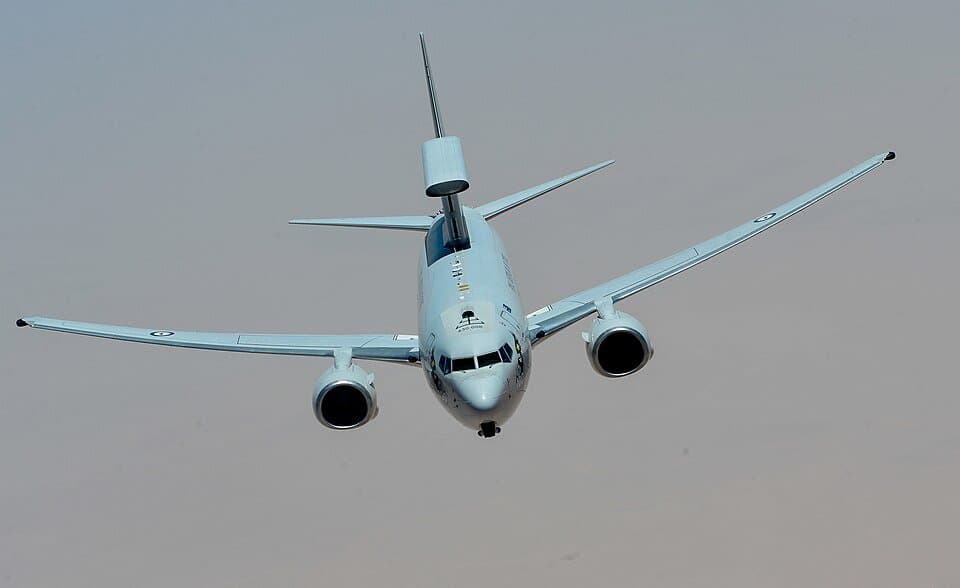
The dorsal MESA array replaces the rotating circular radome associated with older early-warning aircraft. The airliner-derived structure supports transit, endurance and a large mission cabin.1


Preparing your view.
Support aircraftIn service
Airborne early warning and control (AEW&C)
Boeing E-7 Wedgetail is a airborne early warning and control (AEW&C) originating in Australia United States. It was built by Boeing Defense, Space & Security. Reported operators include Royal Australian Air Force Turkish Air Force Republic of Korea Air Force Royal Air Force.
 Australia /
 United States
Boeing E-7 Wedgetail
U.S. Air Force photo by Staff Sgt. Michael Battles · Public domain · Resized · Public domain · Source ↗ · ModifiedTechnical data
Airborne early warning and control (AEW&C)
Australia United States
Boeing Defense, Space & Security
In service
Royal Australian Air Force Turkish Air Force Republic of Korea Air Force Royal Air Force
15
November 2012
2004
Boeing 737 Next Generation
Flight crew: 2; mission crew: 19
43,720 lb (19,830 kg)
110 ft 4 in (33.6 m)
117 ft 2 in (35.8 m)
41 ft 2 in (12.5 m)
980 sq ft (91 m 2 )
102,750 lb (46,606 kg)
171,000 lb (77,600 kg)
2 × CFM International CFM56-7B27A turbofan engines, 27,300 lbf (121 kN) thrust each
530 mph (853 km/h, 460 kn)
4,000 mi (6,500 km, 3,500 nmi)
41,000 ft (12,500 m)
B737D
Reference text from Wikipedia contributors, used under CC BY-SA 4.0.
True scale
Sourced dimensions beside a 1.75 m human reference.
The system in detail
The dorsal MESA array replaces the rotating circular radome associated with older early-warning aircraft. The airliner-derived structure supports transit, endurance and a large mission cabin.1
Radar, communications and operator consoles form an integrated mission system. Communications standards and software are important national configuration differences.1
This record uses the E-7A baseline. Australian, Turkish, South Korean and later customer aircraft should not be treated as identically equipped; the linked reference remains subject to review.1
Radar detection depends on target, altitude and conditions. Compare coverage geometry and mission endurance with equivalent assumptions rather than assigning one unrestricted detection radius.1
Visual reference
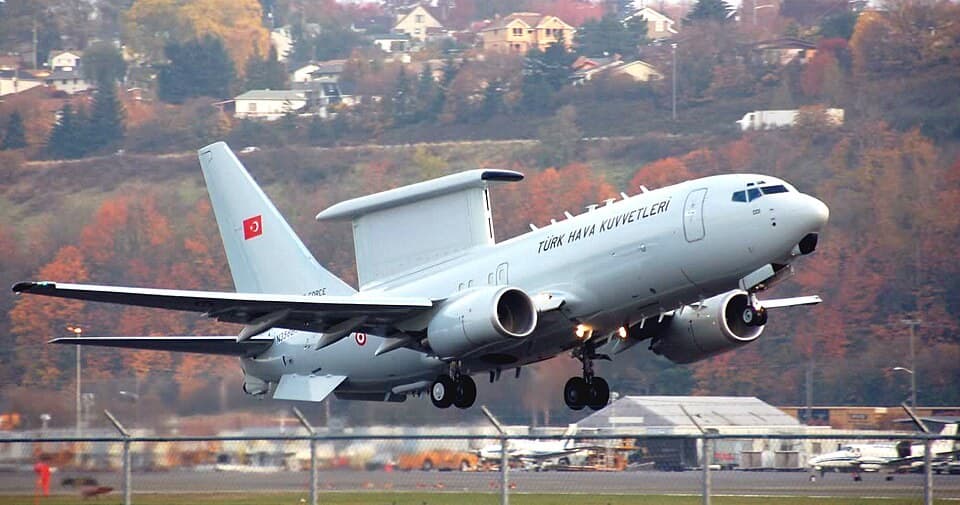 Reference photograph · Configuration may differ
Boeing 737 AEW&C MESA Peace Eagle in Seattle, September 6, 2007. Historical equipment reference photograph. It does not establish current availability or every detail of the named variant.
Seattle Aviator · CC BY-SA 3.0 · Wikimedia Commons · CC BY-SA 3.0 · Source ↗ · ModifiedE-7 Wedgetail equipment records. Variants, orders and quantities are shown as reported in each inventory source; coverage is incomplete.
AustraliaAir Force exact named equipment holdings: E-7A Wedgetail. Active, operational-reserve and training units excluding equipment in store; November 2025 IISS assessment. Named service only; no parent-force or national total inferred. Source role: AIRCRAFT / AEW&C. Original estimates, ranges, reporting names, reserve, lease and employment scopes retained; nested included counts are not added. Missile-system quantities mean launchers, not rounds. No readiness, crew, carried weapon, payload, factory-production or future order count inherited.
 Luxembourg
 South Korea
Reported count for E-7 Wedgetail · E-737. Service scope: Republic of Korea Air Force; does not replace a national total. 1 distinct count cell(s) from the same source list; shared rowspan cells counted once. Excludes retired/reserve/on-order rows. Count column(s): in service: 4. Origin: United States. The listed variants/roles are the scope, not an immediately deployable count. Dates are the count-cell citations' stated source period (2025), not the article revision. 2025 cited source edition. Edition or publication years do not claim an exact inventory census day.
 Türkiye
's four E-7T Peace Eagle aircraft identified in Boeing's current sustainment statement. Observed on retrieval 29 September 2026; underlying inventory count date is unknown. Family holdings, not sortie readiness.
Royal Australian Air Force Turkish Air Force Republic of Korea Air Force Royal Air Force
Equipment reference ↗Keep exploring
Airborne early warning and control (AEW&C)
Airborne early warning and control (AEW&C)
 China
Airborne early warning and control (AEW&C)
United StatesCompare with Boeing E-7 Wedgetail Airborne early warning and control
ChinaAirborne early warning and control
ChinaAirborne early warning and control
 RussiaCompare with Boeing E-7 Wedgetail