FORCETALLY
Loading the evidence…
Preparing your view.


Preparing your view.
Armoured vehiclesIn service
Airborne infantry fighting vehicle
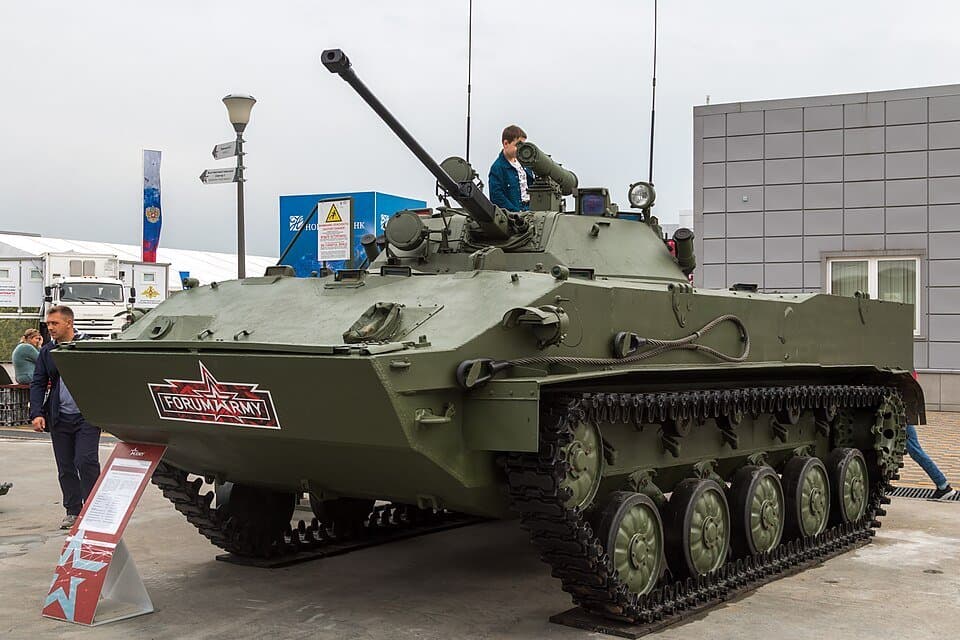
BMD-3 is a airborne infantry fighting vehicle originating in Soviet Union. It was built by Volgograd Tractor Factory. Reported operators include Ukraine, Russia.
Airborne infantry fighting vehicle
Soviet Union
1990 – present
Volgograd Tractor Factory
137
BMD-4 , 2S25 Sprut-SD
12.9 tonnes
6 metres (20 ft)
3.13 m (10.3 ft)
2.25 m (7 ft 5 in)
3 (+4 passengers)
Turret: Steel Hull: Aluminium alloy
2A42 30mm autocannon with coaxial 7.62mm PK machine gun , 9K11 or 9M111 ATGMs from turret mounted launcher
Bow-mounted AGS-17 Plamya 30 mm automatic grenade launcher and 5.45-mm RPK machine-gun
2V-06-2 water-cooled diesel 450 hp
34 hp/ton
Hydroneumatic with variable height control, 130–530 mm (5.1–20.9 in)
500 km (310 mi)
70 km/h (43 mph) off-road: 45 km/h (28 mph) water: 10 km/h (6.2 mph)
Ukraine - 8 BTR-MDM "Rakushkas" have been captured from Russian forces during the Russian invasion of Ukraine .
Russia - Originally approved for serial production in 1990, under the Soviet Union, with up to 700 vehicles planned. Ultimately, only 137 vehicles were completed in eight years of production. The BMD-3 is no longer in service anymore, with production favouring the BMD-4M and BTR-MDM. In 2016 Russia had only 10 BMD-3 in service, alongside 100 BMD-1, 1,000 BMD-2, 42 BMD-4/4M, and 12 BTR-MDM. In 2022, prior to the Russian invasion of Ukraine , Russia had approximately 1,000 BMD-2, 351 BMD-4M, and 122 BTR-MDM vehicles in active service. During the War in Ukraine, Russia is visually confirmed to have lost at least 315 BMD-2, 149 BMD-4M and 45 BTR-MDM.
China - The BMD-3 served in the Chinese Air Force Airborne Corps with limited numbers. Replaced by ZBD-03 .
Angola - small number Ex-Russian BMD-3s exported to Angola
Even before the start of the BMD-2 's production, a new model of airborne infantry fighting vehicle was already envisaged by the Soviet military planners. This new type would first replace the BMD-1 , and later the BMD-2. Two configurations were considered: one using the same armament as the future BMP-3 , and another equipped with the BMP-2 's turret. The latter option was chosen, because it would allow for a lighter vehicle (12.5 tonnes, compared to 18 tonnes for the other one). Six Object 950 prototypes were built in 1985 and 1986. The vehicle was manufactured at the Volgograd Tractor Factory in Volgograd , starting in 1990, the last year before the fall of the Soviet Union . While orders for several hundreds of BMD-3s were originally planned, the poor financial situation of the 1990s resulted in severe reductions of these orders. Only 137 BMD-3s were manufactured, with production stopping in 1997. The BMD-3 may not be in service anymore, or only with a very limited number of vehicles.
The BMD-3 is armed with one stabilised 30 mm 2A42 autocannon with 500 rounds, with elevation angles up to 75°, and one coaxial 7.62 mm PKT machine gun . It also has a 9P135M missile launcher for 9K111 Fagot and 9M113 Konkurs ATGMs. An RPK-74 5.45 mm machine gun is placed on the right-hand side of the hull, while an AGS-17 automatic grenade launcher is placed on the left-hand side.
The BMD-3 is powered by a 450 hp 2V-06-2 engine. Its maximum speed is 70 km/h on roads, and 45 km/h cross-country. The BMD-3 is amphibious, with a maximum speed of 10 km/h on water. A new parachute system was specifically designed for the BMD-3, in order to cope with its higher weight.
The BMD-3 is amphibious, with a maximum speed of 10 km/h on water.
BMD-4 (Object 960) - Modified chassis with new turret "Bakhcha-U" comprising: 100 mm main gun 2A70, 30mm autocannon 2A72, 7.62 mm machine gun, and new fire control system "Ramka". The bow-mounted AGS-17 has been removed. The armament is similar to that of the BMP-3 . BMD-4s are new-build or upgraded BMD-3s. The prototype was known as BMD-3M . The BMD-4 is no longer being purchased for the Russian troops, in favor of the BMD-4M.
BTR-MD “Rakushka” (Object 955) - Multi-role transport vehicle with bigger hull and no turret. This type can be used to transport troops, fuel, ammunition and wounded personnel. It also serves as the basis for a new range of specialised vehicles for the Russian airborne forces, including a mortar platform, an ambulance BMM-D , a command post vehicle and a recovery vehicle. Some of the variants will have a longer chassis with 7 road wheels and probably the same 510 hp engine as the 2S25.
2S25 Sprut-SD (Object 952) - Self-propelled anti-tank gun, armed with a 125 mm gun 2A75 that has similar ballistics as the main gun of the 2A46 series and can also fire the ATGM 9M119 Svir . The chassis has 7 instead of 5 road wheels on each side and the engine is now the 2V-06-2S of 510 hp. The 2S25 has a combat weight of 18 tonnes and a crew of 3. It entered service in 2007.
Reference text from Wikipedia contributors, used under CC BY-SA 4.0.
True scale
Sourced dimensions beside a 1.75 m human reference.
See it in your room. Scan with your phone to open this model in 3D, then place it in your space.
Points represent sourced observations, including revisions. Revisions on the same effective date are not separate inventory events. Ranges appear in the table and are not plotted as exact points.
| Observation / report period | Value | Source | Claim state |
|---|---|---|---|
| 28 Sept 2026 | 3 people | Wikipedia contributors | superseded |
| 28 Sept 2026 | 3 people | Wikipedia contributors | superseded |
| 28 Sept 2026 | 3 people | Wikipedia contributors | approved |
BMD-3 equipment records. Variants, orders and quantities are shown as reported in each inventory source; coverage is incomplete.
Keep exploring
Airborne Infantry fighting vehicle
 RussiaCompare with BMD-3
Airborne infantry fighting vehicle
Compare with BMD-3Airborne infantry fighting vehicle
Compare with BMD-3Infantry fighting vehicle
Compare with BMD-3Infantry fighting vehicle
 BulgariaCompare with BMD-3
Infantry fighting vehicle
RussiaCompare with BMD-3  Ukraine