FORCETALLY
Loading the evidence…
Preparing your view.


Preparing your view.
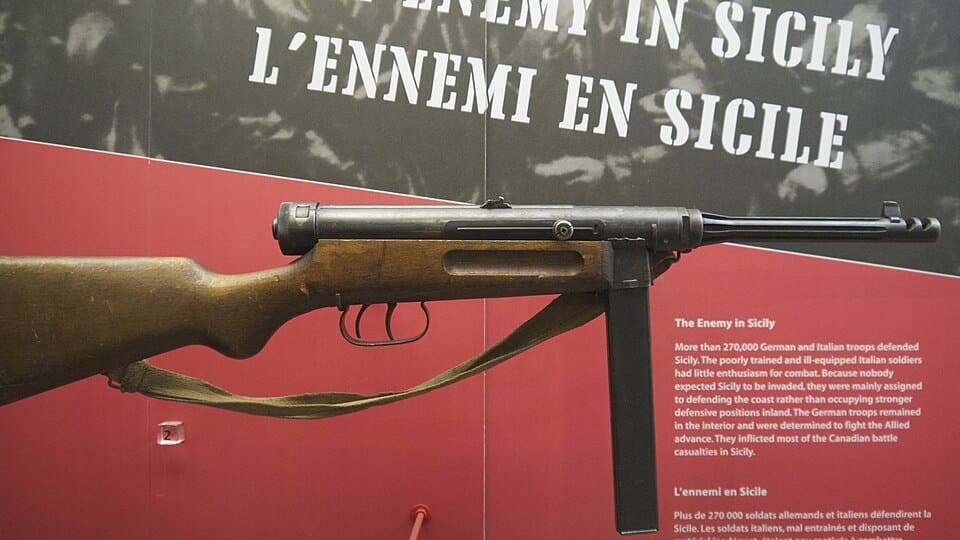
Small armsIn service
Submachine gun
Beretta Model 38 is a submachine gun originating in Kingdom of Italy. Reported operators include Argentina, Albania, Algeria, Bangladesh, Bulgaria, Costa Rica, Dominican Republic, Cyprus, Empire of Japan, Egypt, Ethiopia, Finland, Greece, Nazi Germany, West Germany, Hungary, Indonesia, Iran, Iraq, Italy, Italian Social Republic, Italian Resistance, Lebanon, Libya, Morocco, Pakistan, Poland, Romania, Saudi Arabia, Somalia, Syria, Syrian National Coalition, Thailand, Tunisia, Yemen, Yugoslavia.
Technical data
Submachine gun
Kingdom of Italy
1938–present
See Users
World War II Reprisal operations Algerian War 1958 Lebanon Crisis Portuguese Colonial War Dominican Civil War Bangladesh Liberation War Congo Crisis Ogaden War
1935
1938–1975
1,000,000
1938A 1938/42 1938/43 1938/44 1938/44 Special - Model 1 1938/49 - M2, M3 & M4 Model 5
MAB 38A: 4.2 kilograms (9.3 lb) (empty) MAB 38/42: 3.27 kilograms (7.2 lb) (empty) MAB 38/49: 3.25 kilograms (7.2 lb) (empty)
MAB 38A: 946 millimetres (37.2 in) MAB 38/42: 800 millimetres (31 in) MAB 38/49: 798 millimetres (31.4 in)
MAB 38A: 315 millimetres (12.4 in) MAB 38/42: 213 millimetres (8.4 in) MAB 38/49: 210 millimetres (8.3 in)
True scale
Sourced dimensions beside a 1.75 m human reference.
See it in your room. Scan with your phone to open this model in 3D, then place it in your space.
9x19mm Parabellum
9 mm (0.35 in)
Blowback
MAB 38A: 600 rpm MAS 38/42 and 38/49: 550 rpm
MAB 38A: 420 metres per second (1,378 ft/s) MAS 38/42 and 38/49: 380 metres per second (1,247 ft/s)
200 m (219 yd)
10, 20, 30, or 40-round detachable box magazine
Argentina
Albania : captured by the Albanian Partisans in vast quantities during the war
Algeria : Used by Armée de Libération Nationale
Bangladesh : Used by Mukti Bahini .
Bulgaria : MAB38A
Costa Rica : Models 38/44 and 38/49
Dominican Republic : Model 38/49
Cyprus
Empire of Japan : 350 ordered and 50 MP38/43 delivered in 1943; some were captured by Allied forces in the South Pacific.
Egypt : Models 38/42 and 38/49.
Ethiopia
Finland : Italian surplus MP38s bought in 1958.
Greece
Nazi Germany
West Germany : MP38/49 (Model 4) and Model 5, identified as the MP1. Used by Bundeswehr (until 1959) and Bundesgrenzschutz (replaced at the end of the 1960s).
Hungary : after Italy exited WW2.
Indonesia : MP1938/49 variant. Deployed during the United Nations Operation in the Congo .
Iran
Iraq : Model 38/44
Italy Italian Social Republic Italian Resistance Italian Co-belligerent Army
Italian Social Republic
Italian Resistance
Lebanon : Used by the Lebanese Army , Lebanese Gendarmerie and rebel pan-Arabist militias during the 1958 Lebanon Crisis .
Libya
Morocco
Pakistan : Model 38/44.
Poland : 128 pieces delivered in 1944 to the Home Army by Allied aviation from Italy.
Romania : 5,000 ordered in 1941, which were received during 1942. Those bought included both the Model 38A and the Model 38/42.
Saudi Arabia
Somalia : Used by Western Somali Liberation Front rebels during Ogaden War .
Syria Syrian National Coalition
Syrian National Coalition
Thailand : Model 38/49.
Tunisia : Model 38/49
Yemen : Model 38/49.
Yugoslavia : Captured in vast quantities.
The Beretta Model 38 ( Italian : Moschetto Automatico Beretta Modello 1938 ) is an Italian submachine gun introduced in 1938 and used by the Royal Italian Army during World War II .
The 1938 series was extremely robust and proved very popular with Axis forces as well as Allied troops, who used captured examples. Many German soldiers, including the Waffen-SS and Fallschirmjäger forces, preferred the Beretta 38. Germany manufactured 231,193 Beretta M38s in 1944 and 1945. Firing a more powerful Italian version of the widely distributed 9×19mm Parabellum cartridge, the Cartuccia 9 mm M38 , the Beretta was accurate at longer ranges than most other submachine guns. The MAB could deliver impressive firepower at close range, and at longer distances its size and weight was an advantage, making the weapon stable and easy to control. In expert hands, the Beretta MAB allowed accurate short-burst shooting up to 100 m (110 yd) and its effective range with Italian M38 ammunition was 200 m (220 yd)s, an impressive result for a 9mm submachine gun.
The Model 1938 can be recognized by its machined steel receiver, fine craftsmanship, and finish, and by the perforated cooling jacket over the barrel. It was produced from 1938 to 1950 and fired 9×19mm Parabellum ammunition at 600 rounds per minute. It used 10, 20, 30, or 40-round magazines; the short 10-round magazine, when used in conjunction with the fixed bayonet, was popular with Allied and Axis forces for guarding prisoners or internal security. In combat, the 40-round magazine was the most common. The original MAB 38, first issued to Italian police in 1939, had a bayonet mount and stock rest for the Carcano M91/38 folding bayonet.
It also had a slower rate of fire (550 rpm).
{"datatype": "wikibase-item", "datavalue": {"type": "wikibase-entityid", "value": {"entity-type": "item", "id": "Q324782", "numeric-id": 324782}}, "hash": "d8150e7f5834dfeff5a305e18e985307c2eadafd", "property": "P176", "snaktype": "value"}
Reference text from Wikipedia contributors, used under CC BY-SA 4.0.
Beretta Model 38 equipment records. Variants, orders and quantities are shown as reported in each inventory source; coverage is incomplete.
 Albania
 Algeria
 Argentina
 Bangladesh
 Bulgaria
 Costa Rica
 Cyprus
 Dominican Republic
 Ethiopia
 Finland
 Greece
 Indonesia
 Lebanon
 Libya
 Morocco
 Pakistan
 Poland
 Romania
 Saudi Arabia
 Somalia
 Thailand
 Tunisia
 Yemen
Argentina, Albania, Algeria, Bangladesh, Bulgaria, Costa Rica, Dominican Republic, Cyprus, Empire of Japan, Egypt, Ethiopia, Finland, Greece, Nazi Germany, West Germany, Hungary, Indonesia, Iran, Iraq, Italy, Italian Social Republic, Italian Resistance, Lebanon, Libya, Morocco, Pakistan, Poland, Romania, Saudi Arabia, Somalia, Syria, Syrian National Coalition, Thailand, Tunisia, Yemen, Yugoslavia
Equipment reference ↗ Sweden
 United States
 China