FORCETALLY
Loading the evidence…
Preparing your view.


Preparing your view.
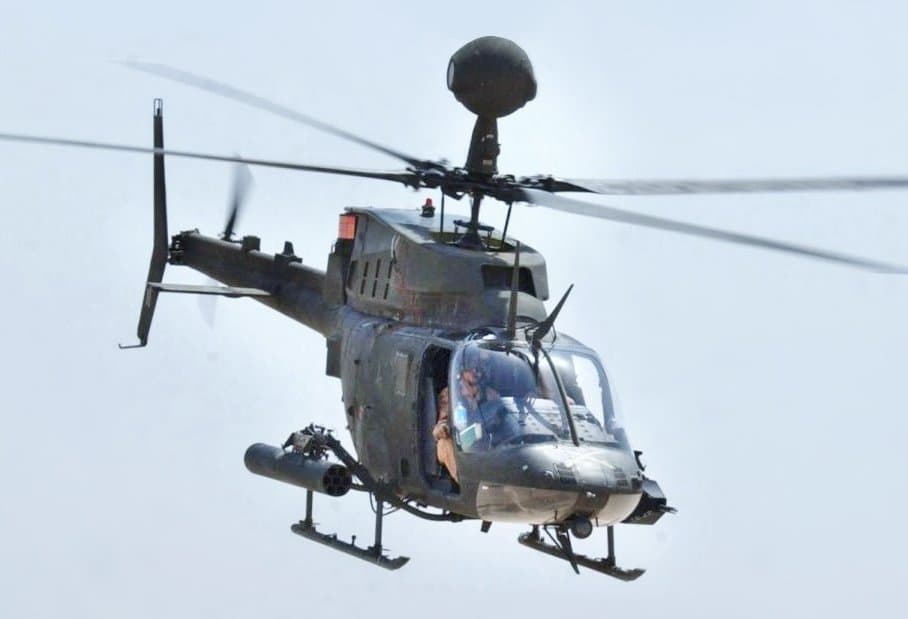
HelicoptersIn service
Observation and reconnaissance helicopter
Bell OH-58 Kiowa is a observation and reconnaissance helicopter originating in United States. The cited manufacturer or builder is Bell Helicopter.
 United States
Technical data
Observation and reconnaissance helicopter
United States
Bell Helicopter
In service
United States Army (historical) Republic of China Army Royal Saudi Land Forces Hellenic Army
2,325 plus 58 206B-1
1966–1989
May 1969
Bell 206A: 10 January 1966 OH-58D: 6 October 1983 OH-58F: 26 April 2013
2020 (U.S. Army)
Bell 206
2 pilots
42 ft 2 in (12.85 m)
12 ft 10 in (3.93 m)
3,829 lb (1,737 kg)
True scale
Sourced dimensions beside a 1.75 m human reference.
See it in your room. Scan with your phone to open this model in 3D, then place it in your space.
Points represent sourced observations, including revisions. Revisions on the same effective date are not separate inventory events. Ranges appear in the table and are not plotted as exact points.
| Observation / report period | Value | Source | Claim state |
|---|---|---|---|
| 28 Sept 2026 | 2 people | Wikipedia contributors | superseded |
5,500 lb (2,495 kg)
1 × Rolls-Royce T703-AD-700A turboshaft , 650 hp (485 kW)
35 ft 0 in (10.67 m)
149 mph (240 km/h, 129 kn)
127 mph (204 km/h, 110 kn)
161 mi (260 km, 140 nmi)
Two hours
15,000 ft (4,575 m)
Two pylons , with provisions to carry combinations of: Rockets: 1x LAU-68 rocket launcher with seven 70 mm (2.75 in) Hydra 70 or APKWS rockets Missiles: 2x AGM-114 Hellfire missiles Other: 1x .50 cal (12.7 mm) M3P (or M296) heavy machine gun
962.11 sq ft (89.42 m 2 )
1x LAU-68 rocket launcher with seven 70 mm (2.75 in) Hydra 70 or APKWS rockets
2x AGM-114 Hellfire missiles
1x .50 cal (12.7 mm) M3P (or M296) heavy machine gun
The Bell OH-58 Kiowa is a family of single-engine single- rotor military helicopters used for observation , utility , and direct fire support .
When the YOH-4A was rejected by the Army, Bell went about solving the problem of marketing the aircraft. In addition to the image problem, the helicopter lacked cargo space and only provided cramped quarters for the planned three passengers in the back. The solution was a fuselage redesigned to be more sleek and aesthetic, adding 16 cubic feet (0.45 cubic metres) of cargo space in the process. The redesigned aircraft was designated as the Model 206A . Bell President Edwin J. Ducayet named it the JetRanger , denoting an evolution from the popular Model 47J Ranger .
The Army's decision to acquire the NTSH resulted in the "Army Helicopter Improvement Program (AHIP)". Both Bell Helicopter and Hughes Helicopters redesigned their scout aircraft to compete for the contract. Bell offered a more robust version of the OH-58 in their Model 406 . Hughes offered an upgraded version of the OH-6. In September 1981, Bell Helicopter Textron was awarded a development contract. On 6 October 1983, the first prototype performed its maiden flight, In 1985, the aircraft entered service as the OH-58D.
The Bell OH-58 Kiowa is a family of single-engine single- rotor military helicopters principally used for observation, utility, and direct fire support. The primary role of the original OH-58A was to identify targets for other platforms, such as the Bell AH-1 Cobra attack helicopter and ground artillery . It lacked any armaments and weighed 1,451 kg (3,200 lb) when fully loaded, being able to carry a small amount of cargo or up to two passengers. While initial examples were reliant on the crew to conduct observations, later models were furnished with sophisticated sensors to precisely determine a target's location. Payload capacity was increased considerably on later-build rotorcraft. The OH-58D Kiowa was designed to carry a maximum load of 2,495 kg, 72% more capacity than the original version.
Early Kiowas were fitted with a flexible twin-bladed main rotor. Starting with the OH-58D, a four-bladed rigid main rotor was used. Entirely composed of composite materials , the OH-58D was the first US Army rotorcraft to incorporate an all-composite main rotor hub. Later models were outfitted as light gunships , equipped with armaments such as Stinger air-to-air missiles , a .50-caliber machine gun , podded 70mm Hydra rockets and AGM-114 Hellfire air to ground missiles .
On 27 March 1970, an OH-58A Kiowa (s/n 68-16785) was shot down over South Vietnam, one of the first OH-58A losses of the war. The pilot, Warrant Officer Ralph Quick Jr., was flying Lieutenant Colonel Joseph Benoski Jr. as an artillery spotter. After completing a battle damage assessment for a previous fire mission, the aircraft was damaged by .51 inch (13 mm) machine gun fire and crashed, killing both crew members. Approximately 45 OH-58A helicopters were destroyed during the Vietnam War due to combat losses and accidents.
During Operation Desert Storm, 130 deployed OH-58D helicopters worked alongside the other Army attack helicopters, 145 AH-1 Cobras and 277 AH-64 Apaches , and participated in a wide variety of critical combat ground forces mission. During Operation Desert Shield and Operation Desert Storm , the Kiowas collectively flew nearly 9,000 hours with a 92 percent fully mission capable rate. The Kiowa Warrior had the lowest ratio of maintenance hours to flight hours of any combat helicopter in the war.
Army attack helicopters also worked jointly with close air support and support aircraft such as the USAF A-10As , F-16A/Cs , EF-111As , EC-130H Compass Call , F-4G Phantom II " Wild Weasel ", and E-8 Joint STARS .
The RAID program's mission has now been expanded to include the war against terrorism and supporting U.S. Border Patrol activities in support of homeland defense. The National Guard RAID units' Area of Operation (AO) is the only one in the Department of Defense that is wholly contained within the borders of the United States .
During Operation Just Cause in 1989, a team consisting of an OH-58 and an AH-1 were part of the Aviation Task Force during the securing of Fort Amador in Panama . The OH-58 was fired upon by Panama Defense Force soldiers and crashed 100 yards (90 m) away, in the Bay of Panama . The pilot was rescued, but the co-pilot was killed in action.
On 17 December 1994, Army Chief Warrant Officers (CWO) David Hilemon and Bobby Hall left Camp Page, South Korea on a routine training mission along the Demilitarized Zone (DMZ). Their flight was intended to be to a point known as Checkpoint 84, south of the DMZ "no-fly zone", but the OH-58C Kiowa strayed nearly four miles (6 km) into the Kangwon Province, inside North Korean airspace, due to errors in navigating the snow-covered, rugged terrain. The helicopter was shot down by North Korean troops and CWO Hilemon was killed. CWO Hall was held captive and the North Korean government insisted that the crew had been spying. Five days of negotiations resulted in the North Koreans turning over Hilemon's body to U.S. authorities. The negotiations failed to secure Hall's immediate release. After 13 days in captivity, Hall was freed on 30 December, uninjured.
In Iraq, OH-58Ds flew 72 hours per month. In Afghanistan, the type flew 80 hours per month. In April 2013, Bell stated that the OH-58 collectively accumulated 820,000 combat hours, and had achieved a 90% mission capable rate.
In December 2013, the U.S. Army had 338 Kiowas in its active-duty force and 30 in the Army National Guard . The Army considered retiring the Kiowa as part of a wider restructuring to cut costs and reduce the variety of helicopters operated. The Analysis of Alternatives for the AAS program found that operating the Kiowa alongside RQ-7 Shadow UAVs was the most affordable and capable solution, while the AH-64E Apache Guardian was the most capable immediate solution. One proposal was to transfer all Army National Guard and Army Reserve AH-64s to the active Army for use as scouts, to divest the OH-58.
The OH-58A Kiowa is a four-place observation helicopter. It has two-place pilot seating, although the controls in the left seat are designed to be removed to carry a passenger up front. During its development for Vietnam War, it was fitted with the M134 Minigun , a 7.62 millimetres (0.300 in) electrically operated machine gun.
The Australian Army leased eight OH-58As in 1971 in South Vietnam for eight months. The Australian government procured the OH-58A for the Australian Army and Royal Australian Navy as the CAC CA-32 . Licensed produced in Australia by Commonwealth Aircraft Corporation , the CA-32 was the equivalent of the 206B-1 (uprated engine and longer rotor blades). The first twelve of 56 were built in the U.S. then partially disassembled and shipped to Australia, where they were reassembled.
The Kiowa Warrior , sometimes referred to by its acronym KW , is the armed version of the OH-58D. A key difference between the Kiowa Warrior and original AHIP aircraft is a universal weapons pylon found mounted on both sides of the fuselage, capable of carrying combinations of AGM-114 Hellfire missiles, air-to-air Stinger (ATAS) missiles, 7-shot 2.75 inches (70 mm) Hydra-70 rocket pods, and an M296 0.50 in (12.7 mm) caliber machine gun. The performance standard of aerial gunnery from an OH-58D is to achieve at least one hit out of 70 shots fired at a wheeled vehicle 800 to 1,200 m (2,600 to 3,900 ft) away. The Kiowa Warrior includes improvements in available power, navigation, communication, survivability, and deployability.
The OH-58F is powered by a Rolls-Royce 250-C30R3 engine rated at 650 shp (480 kW). It has a dual-channel, full-authority digital engine-controller that operates at required power levels in all environments. Rolls-Royce proposed engine tweaks to raise output by 12%.
In October 2012, the first OH-58F was finished. Unlike most military projects, the Army designed and built the new variant itself, which lowered development costs. It weighed 3,590 lb (1,630 kg), 53 lb (24 kg) below the target weight and about 200 lb (91 kg) lighter than the OH-58D. The weight savings are attributed to more efficient wiring and a lighter sensor. The first production aircraft began manufacturing in January 2013 and was handed over to the Army by year end. Low rate production was to start in March 2015, with the first operational squadron being fully equipped by 2016. The Army was to buy 368 OH-58Fs, with older OH-58 variants to be remanufactured. Due to battle damage and combat attrition, total OH-58F numbers were about 321 aircraft. The OH-58F's first flight occurred on 26 April 2013.
Length: 42 ft 2 in (12.85 m)
Height: 12 ft 10 in (3.93 m)
Empty weight: 3,829 lb (1,737 kg)
Gross weight: 5,500 lb (2,495 kg)
Powerplant: 1 × Rolls-Royce T703-AD-700A turboshaft , 650 hp (485 kW)
Main rotor diameter: 35 ft 0 in (10.67 m)
Main rotor area: 962.11 sq ft (89.42 m 2 )
Maximum speed: 149 mph (240 km/h, 129 kn)
Cruise speed: 127 mph (204 km/h, 110 kn)
Range: 161 mi (260 km, 140 nmi)
Endurance: Two hours
Service ceiling: 15,000 ft (4,575 m)
Hardpoints: Two pylons , with provisions to carry combinations of: Rockets: 1x LAU-68 rocket launcher with seven 70 mm (2.75 in) Hydra 70 or APKWS rockets Missiles: 2x AGM-114 Hellfire missiles Other: 1x .50 cal (12.7 mm) M3P (or M296) heavy machine gun
The Kiowa Warrior is a rapidly deployable single-engine, two- man, lightly armed reconnaissance helicopter that features advanced visionics, navigation, communication, weapons, and cockpit integration systems.
The Kiowa Warrior is a rapidly deployable single-engine, two- man, lightly armed reconnaissance helicopter that features advanced visionics, navigation, communication, weapons, and cockpit integration systems.
Höchstgeschwindigkeit ca. 220 km/h
Reichweite ca. 450 km
Dienstgipfelhöhe 6.400 m
max. Abflugmasse 1.450 kg
Länge: 9,80 m
Höhe: 2,92 m
Rotordurchmesser: 10,77 m
Reference text from Wikipedia contributors, used under CC BY-SA 4.0.
Bell OH-58 Kiowa equipment records. Variants, orders and quantities are shown as reported in each inventory source; coverage is incomplete.
 Austria
Air Force exact named equipment holdings: OH-58B Kiowa. Active, operational-reserve and training units excluding equipment in store; November 2025 IISS assessment. Named service only; no parent-force or national total inferred. Source role: HELICOPTERS / ISR. Original estimates, ranges, reporting names, reserve, lease and employment scopes retained; nested included counts are not added. Missile-system quantities mean launchers, not rounds. No readiness, crew, carried weapon, payload, factory-production or future order count inherited.
 Croatia
Air Force and Air Defence exact named equipment holdings: OH-58D Kiowa Warrior. Active, operational-reserve and training units excluding equipment in store; November 2025 IISS assessment. Named service only; no parent-force or national total inferred. Source role: HELICOPTERS / MRH. Original estimates, ranges, reporting names, reserve, lease and employment scopes retained; nested included counts are not added. Missile-system quantities mean launchers, not rounds. No readiness, crew, carried weapon, payload, factory-production or future order count inherited.
 Dominican Republic
Air Force exact named equipment holdings: OH-58 Kiowa (CH-136). Active, operational-reserve and training units excluding equipment in store; November 2025 IISS assessment. Named service only; no parent-force or national total inferred. Source role: HELICOPTERS / ISR. Original estimates, ranges, reporting names, reserve, lease and employment scopes retained; nested included counts are not added. Missile-system quantities mean launchers, not rounds. No readiness, crew, carried weapon, payload, factory-production or future order count inherited.
 Greece
Army exact named equipment holdings: OH-58D Kiowa Warrior. Active, operational-reserve and training units excluding equipment in store; November 2025 IISS assessment. Named service only; no parent-force or national total inferred. Source role: HELICOPTERS / MRH. Original estimates, ranges, reporting names, reserve, lease and employment scopes retained; nested included counts are not added. Missile-system quantities mean launchers, not rounds. No readiness, crew, carried weapon, payload, factory-production or future order count inherited.
 Iraq
Army exact named equipment holdings: OH-58C Kiowa. Active, operational-reserve and training units excluding equipment in store; November 2025 IISS assessment. Named service only; no parent-force or national total inferred. Source role: HELICOPTERS / ISR. Original estimates, ranges, reporting names, reserve, lease and employment scopes retained; nested included counts are not added. Missile-system quantities mean launchers, not rounds. No readiness, crew, carried weapon, payload, factory-production or future order count inherited.
 Israel
Air Force exact named equipment holdings: OH-58B Kiowa. Active, operational-reserve and training units excluding equipment in store; November 2025 IISS assessment. Named service only; no parent-force or national total inferred. Source role: HELICOPTERS / ISR. Original estimates, ranges, reporting names, reserve, lease and employment scopes retained; nested included counts are not added. Missile-system quantities mean launchers, not rounds. No readiness, crew, carried weapon, payload, factory-production or future order count inherited.
 Saudi Arabia
Reported count for Bell OH-58 Kiowa · OH-58D. Service scope: Saudi Arabian Army; does not replace a national total. 1 distinct count cell(s) from the same source list; shared rowspan cells counted once. Retired, wholly reserve and on-order rows are excluded; the reported count retains any explicitly mixed stock scope in the quoted row. Count column(s): quantity: 15. Origin: United States. The listed variants/roles are the scope, not an immediately deployable count. Explicitly named source subset; this is not a whole-family total and does not cover other listed designs. Dates are the count-cell citations' stated source period (2025), not the article revision. 2025 cited publication year. Edition or publication years do not claim an exact inventory census day.
 Taiwan
Army exact named equipment holdings: OH-58D Kiowa Warrior. Active, operational-reserve and training units excluding equipment in store; November 2025 IISS assessment. Named service only; no parent-force or national total inferred. Source role: HELICOPTERS / MRH. Original estimates, ranges, reporting names, reserve, lease and employment scopes retained; nested included counts are not added. Missile-system quantities mean launchers, not rounds. No readiness, crew, carried weapon, payload, factory-production or future order count inherited.
 Tunisia
Air Force exact named equipment holdings: OH-58D Kiowa Warrior. Active, operational-reserve and training units excluding equipment in store; November 2025 IISS assessment. Named service only; no parent-force or national total inferred. Source role: HELICOPTERS / MRH. Original estimates, ranges, reporting names, reserve, lease and employment scopes retained; nested included counts are not added. Missile-system quantities mean launchers, not rounds. No readiness, crew, carried weapon, payload, factory-production or future order count inherited.
United StatesNaval Aviation exact named equipment holdings: OH-58C Kiowa. Active, operational-reserve and training units excluding equipment in store; November 2025 IISS assessment. Named service only; no parent-force or national total inferred. Source role: HELICOPTERS / ISR. Original estimates, ranges, reporting names, reserve, lease and employment scopes retained; nested included counts are not added. Missile-system quantities mean launchers, not rounds. No readiness, crew, carried weapon, payload, factory-production or future order count inherited.
 Uruguay
Naval Aviation exact named equipment holdings: OH-58 Kiowa. Active, operational-reserve and training units excluding equipment in store; November 2025 IISS assessment. Named service only; no parent-force or national total inferred. Source role: HELICOPTERS / ISR. Original estimates, ranges, reporting names, reserve, lease and employment scopes retained; nested included counts are not added. Missile-system quantities mean launchers, not rounds. No readiness, crew, carried weapon, payload, factory-production or future order count inherited.
United States Army (historical) Republic of China Army Royal Saudi Land Forces Hellenic Army
Equipment reference ↗Army exact named equipment holdings: OH-58C Kiowa; OH-58A Kiowa. Active, operational-reserve and training units excluding equipment in store; November 2025 IISS assessment. Named service only; no parent-force or national total inferred. Source role: HELICOPTERS / ISR. Original estimates, ranges, reporting names, reserve, lease and employment scopes retained; nested included counts are not added. Missile-system quantities mean launchers, not rounds. No readiness, crew, carried weapon, payload, factory-production or future order count inherited.
Keep exploring
Reconnaissance and attack helicopter
 ChinaCompare with Bell OH-58 Kiowa
Light attack / reconnaissance helicopter
United StatesCompare with Bell OH-58 Kiowa light attack/reconnaissance helicopter
 IranCompare with Bell OH-58 Kiowa
Scout/observation helicopter
 JapanCompare with Bell OH-58 Kiowa
Light Observation Helicopter /utility
United StatesCompare with Bell OH-58 Kiowa Search and rescue helicopter
Compare with Bell OH-58 Kiowa