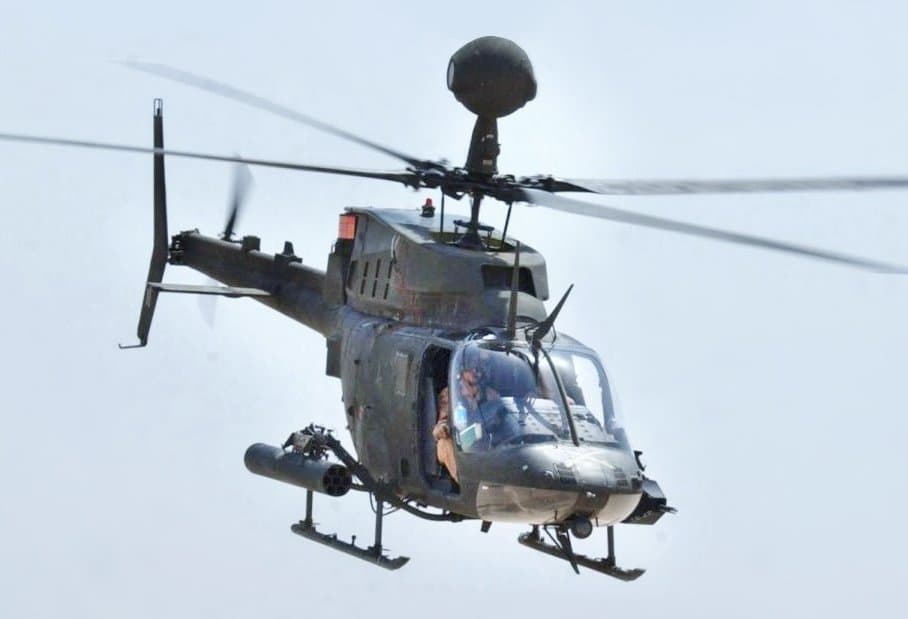

Credit
U.S. Army · Public domain · Resized · Public domain · Source ↗ · Modified


Preparing your view.

At a glance
True scale
Side by side. From every angle. A human reference for perspective.
3.09 MB · Loads when you open it| Model | Length | Width / span | Height |
|---|---|---|---|
| Bell OH-58 Kiowa | ≈ 12.85 m | ≈ 12.21 m (Width) | ≈ 5.1 m |
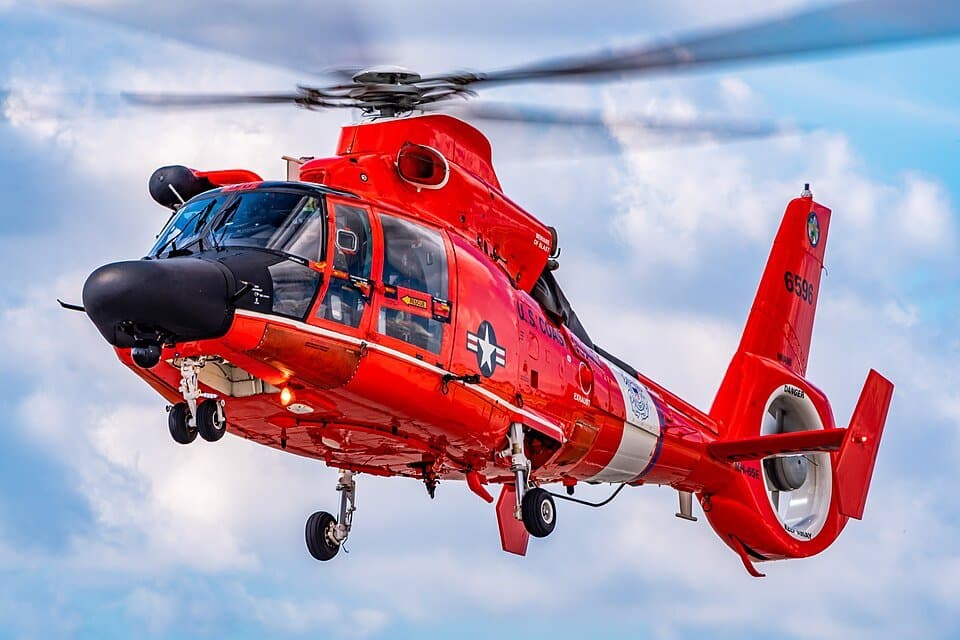
| Eurocopter MH-65 Dolphin | ≈ 11.6 m | ≈ 9.95 m (Width) | ≈ 4.17 m |
Scaled uniformly to the sourced length of 12.85 m. Not an official model or a measured survey.
ForceTally · All rights reserved
Scaled uniformly to the sourced length of 11.6 m. Not an official model or a measured survey.
ForceTally · All rights reserved
The human reference is a generic 1.75 m figure. Models describe external size, not combat performance.
Measured figures
Length
Single sourceOH-58D · Length
Single sourceConfiguration
| Specification | Bell OH-58 Kiowa | Eurocopter MH-65 Dolphin |
|---|---|---|
| Type | Observation and reconnaissance helicopter[source] | Search and rescue helicopter[source] |
| National origin | United States[source] | France/United States[source] |
| Manufacturer | Bell Helicopter[source] | Aérospatiale Helicopter Corporation American Eurocopter[source] |
| Status | In service[source] |
MH-65C · Length
Single source11.6 m (38 ft 1 in)[source]
Empty; OH-58D · Empty weight
Single sourceGross; OH-58D · Gross weight
Single sourceMaximum take-off; max. Abflugmasse · max. Abflugmasse
Single source3,829 lb (1,737 kg)[source]
5,500 lb (2,495 kg)[source]
1.450 kg[source]max. Abflugmasse
Empty; MH-65C · Empty weight
Single sourceMaximum take-off; MH-65C · Max takeoff weight
Single sourceCruise; OH-58D · Cruise speed
Single sourceMaximum; ca
Single sourceMaximum; OH-58D · Maximum speed
Single source149 mph (240 km/h, 129 kn)[source]
127 mph (204 km/h, 110 kn)[source]
ca. 220 km/h[source]
Cruise; MH-65C · Cruise speed
Single sourceMaximum; MH-65C · Maximum speed
Single sourceBars compare reported quantities only. A larger figure does not make a system better; configurations and test conditions differ.
In service[source] |
| Primary users | United States Army (historical) Republic of China Army Royal Saudi Land Forces Hellenic Army[source] | — |
|---|
| Number built | 2,325 plus 58 206B-1[source] | 102[source] |
|---|
| Manufactured | 1966–1989[source] | — |
|---|
| Introduction date | May 1969[source] | 1985[source] |
|---|
| First flight | Bell 206A: 10 January 1966 OH-58D: 6 October 1983 OH-58F: 26 April 2013[source] | 1980[source] |
|---|
| Retired | 2020 (U.S. Army)[source] | — |
|---|
| Developed from | Bell 206[source] | Eurocopter AS365 Dauphin[source] |
|---|
| Endurance | Two hours[source] | — |
|---|
| Hardpoints | Two pylons , with provisions to carry combinations of: Rockets: 1x LAU-68 rocket launcher with seven 70 mm (2.75 in) Hydra 70 or APKWS rockets Missiles: 2x AGM-114 Hellfire missiles Other: 1x .50 cal (12.7 mm) M3P (or M296) heavy machine gun[source] | — |
|---|
| Main rotor area | 962.11 sq ft (89.42 m 2 )[source] | 111.22 m 2 (1,197.2 sq ft)[source] |
|---|
| Rockets | 1x LAU-68 rocket launcher with seven 70 mm (2.75 in) Hydra 70 or APKWS rockets[source] | — |
|---|
| Missiles | 2x AGM-114 Hellfire missiles[source] | — |
|---|
| Other | 1x .50 cal (12.7 mm) M3P (or M296) heavy machine gun[source] | — |
|---|
| Role | family of single-engine single- rotor military helicopters[source] | twin-engined helicopter[source] |
|---|
| Source measurement | When the YOH-4A was rejected by the Army, Bell went about solving the problem of marketing the aircraft. In addition to the image problem, the helicopter lacked cargo space and only provided cramped quarters for the planned three passengers in the back. The solution was a fuselage redesigned to be more sleek and aesthetic, adding 16 cubic feet (0.45 cubic metres) of cargo space in the process. The redesigned aircraft was designated as the Model 206A . Bell President Edwin J. Ducayet named it the JetRanger , denoting an evolution from the popular Model 47J Ranger .[source]Bell OH-58 Kiowa · Development / Light Observation Helicopter (LOH); only the objects and conditions stated in this passage The Army's decision to acquire the NTSH resulted in the "Army Helicopter Improvement Program (AHIP)". Both Bell Helicopter and Hughes Helicopters redesigned their scout aircraft to compete for the contract. Bell offered a more robust version of the OH-58 in their Model 406 . Hughes offered an upgraded version of the OH-6. In September 1981, Bell Helicopter Textron was awarded a development contract. On 6 October 1983, the first prototype performed its maiden flight, In 1985, the aircraft entered service as the OH-58D.[source]Bell OH-58 Kiowa · Development / Army Helicopter Improvement Program (AHIP); only the objects and conditions stated in this passage The Bell OH-58 Kiowa is a family of single-engine single- rotor military helicopters principally used for observation, utility, and direct fire support. The primary role of the original OH-58A was to identify targets for other platforms, such as the Bell AH-1 Cobra attack helicopter and ground artillery . It lacked any armaments and weighed 1,451 kg (3,200 lb) when fully loaded, being able to carry a small amount of cargo or up to two passengers. While initial examples were reliant on the crew to conduct observations, later models were furnished with sophisticated sensors to precisely determine a target's location. Payload capacity was increased considerably on later-build rotorcraft. The OH-58D Kiowa was designed to carry a maximum load of 2,495 kg, 72% more capacity than the original version.[source]Bell OH-58 Kiowa · Design; only the objects and conditions stated in this passage Early Kiowas were fitted with a flexible twin-bladed main rotor. Starting with the OH-58D, a four-bladed rigid main rotor was used. Entirely composed of composite materials , the OH-58D was the first US Army rotorcraft to incorporate an all-composite main rotor hub. Later models were outfitted as light gunships , equipped with armaments such as Stinger air-to-air missiles , a .50-caliber machine gun , podded 70mm Hydra rockets and AGM-114 Hellfire air to ground missiles .[source]Bell OH-58 Kiowa · Design; only the objects and conditions stated in this passage On 27 March 1970, an OH-58A Kiowa (s/n 68-16785) was shot down over South Vietnam, one of the first OH-58A losses of the war. The pilot, Warrant Officer Ralph Quick Jr., was flying Lieutenant Colonel Joseph Benoski Jr. as an artillery spotter. After completing a battle damage assessment for a previous fire mission, the aircraft was damaged by .51 inch (13 mm) machine gun fire and crashed, killing both crew members. Approximately 45 OH-58A helicopters were destroyed during the Vietnam War due to combat losses and accidents.[source]Bell OH-58 Kiowa · Operational history / Vietnam War; only the objects and conditions stated in this passage During Operation Desert Storm, 130 deployed OH-58D helicopters worked alongside the other Army attack helicopters, 145 AH-1 Cobras and 277 AH-64 Apaches , and participated in a wide variety of critical combat ground forces mission. During Operation Desert Shield and Operation Desert Storm , the Kiowas collectively flew nearly 9,000 hours with a 92 percent fully mission capable rate. The Kiowa Warrior had the lowest ratio of maintenance hours to flight hours of any combat helicopter in the war.[source]Bell OH-58 Kiowa · Operational history / Gulf War; only the objects and conditions stated in this passage Army attack helicopters also worked jointly with close air support and support aircraft such as the USAF A-10As , F-16A/Cs , EF-111As , EC-130H Compass Call , F-4G Phantom II " Wild Weasel ", and E-8 Joint STARS .[source]Bell OH-58 Kiowa · Operational history / Gulf War; only the objects and conditions stated in this passage The RAID program's mission has now been expanded to include the war against terrorism and supporting U.S. Border Patrol activities in support of homeland defense. The National Guard RAID units' Area of Operation (AO) is the only one in the Department of Defense that is wholly contained within the borders of the United States .[source]Bell OH-58 Kiowa · Operational history / RAID; only the objects and conditions stated in this passage During Operation Just Cause in 1989, a team consisting of an OH-58 and an AH-1 were part of the Aviation Task Force during the securing of Fort Amador in Panama . The OH-58 was fired upon by Panama Defense Force soldiers and crashed 100 yards (90 m) away, in the Bay of Panama . The pilot was rescued, but the co-pilot was killed in action.[source]Bell OH-58 Kiowa · Operational history / Operation Just Cause and action in the 1990s; only the objects and conditions stated in this passage On 17 December 1994, Army Chief Warrant Officers (CWO) David Hilemon and Bobby Hall left Camp Page, South Korea on a routine training mission along the Demilitarized Zone (DMZ). Their flight was intended to be to a point known as Checkpoint 84, south of the DMZ "no-fly zone", but the OH-58C Kiowa strayed nearly four miles (6 km) into the Kangwon Province, inside North Korean airspace, due to errors in navigating the snow-covered, rugged terrain. The helicopter was shot down by North Korean troops and CWO Hilemon was killed. CWO Hall was held captive and the North Korean government insisted that the crew had been spying. Five days of negotiations resulted in the North Koreans turning over Hilemon's body to U.S. authorities. The negotiations failed to secure Hall's immediate release. After 13 days in captivity, Hall was freed on 30 December, uninjured.[source]Bell OH-58 Kiowa · Operational history / Operation Just Cause and action in the 1990s; only the objects and conditions stated in this passage In Iraq, OH-58Ds flew 72 hours per month. In Afghanistan, the type flew 80 hours per month. In April 2013, Bell stated that the OH-58 collectively accumulated 820,000 combat hours, and had achieved a 90% mission capable rate.[source]Bell OH-58 Kiowa · Operational history / Afghanistan and Iraq; only the objects and conditions stated in this passage In December 2013, the U.S. Army had 338 Kiowas in its active-duty force and 30 in the Army National Guard . The Army considered retiring the Kiowa as part of a wider restructuring to cut costs and reduce the variety of helicopters operated. The Analysis of Alternatives for the AAS program found that operating the Kiowa alongside RQ-7 Shadow UAVs was the most affordable and capable solution, while the AH-64E Apache Guardian was the most capable immediate solution. One proposal was to transfer all Army National Guard and Army Reserve AH-64s to the active Army for use as scouts, to divest the OH-58.[source]Bell OH-58 Kiowa · Operational history / Retirement; only the objects and conditions stated in this passage The OH-58A Kiowa is a four-place observation helicopter. It has two-place pilot seating, although the controls in the left seat are designed to be removed to carry a passenger up front. During its development for Vietnam War, it was fitted with the M134 Minigun , a 7.62 millimetres (0.300 in) electrically operated machine gun.[source]Bell OH-58 Kiowa · Variants / OH-58A; only the objects and conditions stated in this passage The Australian Army leased eight OH-58As in 1971 in South Vietnam for eight months. The Australian government procured the OH-58A for the Australian Army and Royal Australian Navy as the CAC CA-32 . Licensed produced in Australia by Commonwealth Aircraft Corporation , the CA-32 was the equivalent of the 206B-1 (uprated engine and longer rotor blades). The first twelve of 56 were built in the U.S. then partially disassembled and shipped to Australia, where they were reassembled.[source]Bell OH-58 Kiowa · Variants / OH-58A; only the objects and conditions stated in this passage The Kiowa Warrior , sometimes referred to by its acronym KW , is the armed version of the OH-58D. A key difference between the Kiowa Warrior and original AHIP aircraft is a universal weapons pylon found mounted on both sides of the fuselage, capable of carrying combinations of AGM-114 Hellfire missiles, air-to-air Stinger (ATAS) missiles, 7-shot 2.75 inches (70 mm) Hydra-70 rocket pods, and an M296 0.50 in (12.7 mm) caliber machine gun. The performance standard of aerial gunnery from an OH-58D is to achieve at least one hit out of 70 shots fired at a wheeled vehicle 800 to 1,200 m (2,600 to 3,900 ft) away. The Kiowa Warrior includes improvements in available power, navigation, communication, survivability, and deployability.[source]Bell OH-58 Kiowa · Variants / OH-58D; only the objects and conditions stated in this passage The OH-58F is powered by a Rolls-Royce 250-C30R3 engine rated at 650 shp (480 kW). It has a dual-channel, full-authority digital engine-controller that operates at required power levels in all environments. Rolls-Royce proposed engine tweaks to raise output by 12%.[source]Bell OH-58 Kiowa · Variants / OH-58F; only the objects and conditions stated in this passage In October 2012, the first OH-58F was finished. Unlike most military projects, the Army designed and built the new variant itself, which lowered development costs. It weighed 3,590 lb (1,630 kg), 53 lb (24 kg) below the target weight and about 200 lb (91 kg) lighter than the OH-58D. The weight savings are attributed to more efficient wiring and a lighter sensor. The first production aircraft began manufacturing in January 2013 and was handed over to the Army by year end. Low rate production was to start in March 2015, with the first operational squadron being fully equipped by 2016. The Army was to buy 368 OH-58Fs, with older OH-58 variants to be remanufactured. Due to battle damage and combat attrition, total OH-58F numbers were about 321 aircraft. The OH-58F's first flight occurred on 26 April 2013.[source]Bell OH-58 Kiowa · Variants / OH-58F; only the objects and conditions stated in this passage Length: 42 ft 2 in (12.85 m)[source]Bell OH-58 Kiowa · Specifications (OH-58D); only the objects and conditions stated in this passage Height: 12 ft 10 in (3.93 m)[source]Bell OH-58 Kiowa · Specifications (OH-58D); only the objects and conditions stated in this passage Empty weight: 3,829 lb (1,737 kg)[source]Bell OH-58 Kiowa · Specifications (OH-58D); only the objects and conditions stated in this passage Gross weight: 5,500 lb (2,495 kg)[source]Bell OH-58 Kiowa · Specifications (OH-58D); only the objects and conditions stated in this passage Powerplant: 1 × Rolls-Royce T703-AD-700A turboshaft , 650 hp (485 kW)[source]Bell OH-58 Kiowa · Specifications (OH-58D); only the objects and conditions stated in this passage Main rotor diameter: 35 ft 0 in (10.67 m)[source]Bell OH-58 Kiowa · Specifications (OH-58D); only the objects and conditions stated in this passage Main rotor area: 962.11 sq ft (89.42 m 2 )[source]Bell OH-58 Kiowa · Specifications (OH-58D); only the objects and conditions stated in this passage Maximum speed: 149 mph (240 km/h, 129 kn)[source]Bell OH-58 Kiowa · Specifications (OH-58D); only the objects and conditions stated in this passage Cruise speed: 127 mph (204 km/h, 110 kn)[source]Bell OH-58 Kiowa · Specifications (OH-58D); only the objects and conditions stated in this passage Range: 161 mi (260 km, 140 nmi)[source]Bell OH-58 Kiowa · Specifications (OH-58D); only the objects and conditions stated in this passage Endurance: Two hours[source]Bell OH-58 Kiowa · Specifications (OH-58D); only the objects and conditions stated in this passage Service ceiling: 15,000 ft (4,575 m)[source]Bell OH-58 Kiowa · Specifications (OH-58D); only the objects and conditions stated in this passage Hardpoints: Two pylons , with provisions to carry combinations of: Rockets: 1x LAU-68 rocket launcher with seven 70 mm (2.75 in) Hydra 70 or APKWS rockets Missiles: 2x AGM-114 Hellfire missiles Other: 1x .50 cal (12.7 mm) M3P (or M296) heavy machine gun[source]Bell OH-58 Kiowa · Specifications (OH-58D); only the objects and conditions stated in this passage | The HH-65 Dolphin is used for homeland security patrols, cargo , drug interdiction , ice breaking , military readiness, pollution control , and search and rescue missions. The HH-65 is known for its Fenestron tail rotor and its autopilot capabilities, which can complete an unaided approach to the water and bring the aircraft into a stable 50 ft (15 m) hover, or automatically fly search patterns, an ability which allows the crew to engage in other tasks.[source]Eurocopter MH-65 Dolphin · Development; only the objects and conditions stated in this passage The HH-65A's minimum equipment requirements exceeded anything previously packaged into a helicopter weighing less than 10,000 pounds (4,535 kg). Seventy-five percent of the HH-65's structure—including rotorhead, rotor blades and fuselage—consists of corrosion-resistant composite materials.[source]Eurocopter MH-65 Dolphin · Design; only the objects and conditions stated in this passage Also a unique feature of the Dolphin is its computerized flight management system, which integrates state-of-the-art communications and navigation equipment. This system provides automatic flight control. At the pilot's direction, the system will bring the aircraft to a stable hover 50 feet (15 m) above a selected object. This is an important safety feature in darkness or inclement weather. Selected search patterns can be flown automatically, freeing the pilot and copilot to concentrate on sighting & searching the object.[source]Eurocopter MH-65 Dolphin · Design; only the objects and conditions stated in this passage On 16 September 1996 one crashed in the Mediterranean during a joint night training exercise with two squadrons, Eurocopter HH-65 Dolphin helicopter number 905 crashed about 12 miles (19 kilometers) west of the coast of Nahariya .[source]Eurocopter MH-65 Dolphin · Operational history / Israeli Air Force service; only the objects and conditions stated in this passage |
|---|
| Engine | single-engine[source]Kiowa Warrior | — |
|---|
| Primary user | — | United States Coast Guard[source] |
|---|
Initial USCG version, powered by two 734 shp (547 kW) LTS101-750B-2 turboshaft engines and with an 8,900 lb (4,000 kg) MTOW.[source]Eurocopter MH-65 Dolphin · Variants; only the objects and conditions stated in this passage
Avionics upgrade undertaken on a portion of the fleet. Retrofit included an NVG -compatible integrated flight management avionics suite consisting of two GPS-embedded CDU-900G control display units and two MFD-255 multifunction flat panel displays. The HH-65B upgrade was undertaken at the Coast Guard's Aircraft Repair and Supply Center (ARSC) in Elizabeth City , NC, with the first aircraft rolling-off the post-depot maintenance (PDM) line in March 2001.[source]Eurocopter MH-65 Dolphin · Variants; only the objects and conditions stated in this passage
HH-65A/B upgraded with new 934 shp (696 kW) Arriel 2C2-CG engines that provide 40% more power and higher performance, plus an upgraded tail gearbox, long-nose avionics compartment, increased 9,480 lb (4,300 kg) MTOW, expanded lateral flight envelope and Vehicle and Engine Multifunction Display (VEMD) with First Limit Indicator (FLI). First retrofit completed in October 2004.[source]Eurocopter MH-65 Dolphin · Variants; only the objects and conditions stated in this passage
Initially intended only for use by the Multi-Mission Cutter Helicopter (MCH), a further enhancement of the HH-65C within the USCG's Deepwater effort, includes the installation of a 10-blade low-noise Fenestron, relocated avionics, and an Airborne Use of Force (AUF) package (in common with that of the modernized HH-60T) which provides the capability to fire warning and disabling shots from the air. The MH-65C is used in AUF missions, such as the Helicopter Interdiction Tactical Squadron (HITRON) mission taken up by the MH-65C in early 2008. AUF aircraft are armed with the Barrett M107CQ 12.7 mm anti-materiel rifle and M240G 7.62 mm machine gun. The helicopter can also be used for counter terrorism.[source]Eurocopter MH-65 Dolphin · Variants; only the objects and conditions stated in this passage
MH-65C with an upgraded flight navigation system common to Department of Defense helicopters. The first production MH-65D was completed on 20 January 2011 and is fitted with a Honeywell HG7502 radar altimeter, two Honeywell H-764G EGI's (embedded GPS/inertial navigation systems) and two control display units CDU-7000D from Rockwell Collins. 97 HH/MH-65Cs will be upgraded to MH-65D standard.[source]Eurocopter MH-65 Dolphin · Variants; only the objects and conditions stated in this passage
Length: 11.6 m (38 ft 1 in)[source]Eurocopter MH-65 Dolphin · Specifications (MH-65C); only the objects and conditions stated in this passage
Height: 4 m (13 ft 1 in)[source]Eurocopter MH-65 Dolphin · Specifications (MH-65C); only the objects and conditions stated in this passage
Empty weight: 3,128 kg (6,896 lb)[source]Eurocopter MH-65 Dolphin · Specifications (MH-65C); only the objects and conditions stated in this passage
Max takeoff weight: 4,300 kg (9,480 lb)[source]Eurocopter MH-65 Dolphin · Specifications (MH-65C); only the objects and conditions stated in this passage
Powerplant: 2 × Turbomeca Arriel 2C2-CG turboshaft engines, 636 kW (853 hp) each[source]Eurocopter MH-65 Dolphin · Specifications (MH-65C); only the objects and conditions stated in this passage
Main rotor diameter: 11.9 m (39 ft 1 in)[source]Eurocopter MH-65 Dolphin · Specifications (MH-65C); only the objects and conditions stated in this passage
Main rotor area: 111.22 m 2 (1,197.2 sq ft)[source]Eurocopter MH-65 Dolphin · Specifications (MH-65C); only the objects and conditions stated in this passage
Maximum speed: 330 km/h (210 mph, 180 kn)[source]Eurocopter MH-65 Dolphin · Specifications (MH-65C); only the objects and conditions stated in this passage
Cruise speed: 240 km/h (150 mph, 130 kn)[source]Eurocopter MH-65 Dolphin · Specifications (MH-65C); only the objects and conditions stated in this passage
Range: 658 km (409 mi, 355 nmi)[source]Eurocopter MH-65 Dolphin · Specifications (MH-65C); only the objects and conditions stated in this passage
Service ceiling: 5,486 m (17,999 ft)[source]Eurocopter MH-65 Dolphin · Specifications (MH-65C); only the objects and conditions stated in this passage
1 x 7.62 mm M240 machine gun[source]Eurocopter MH-65 Dolphin · Specifications (MH-65C); only the objects and conditions stated in this passage
1 x Barrett M107 0.50 in (12.70 mm) caliber precision rifle[source]Eurocopter MH-65 Dolphin · Specifications (MH-65C); only the objects and conditions stated in this passage