FORCETALLY
Loading the evidence…
Preparing your view.


Preparing your view.
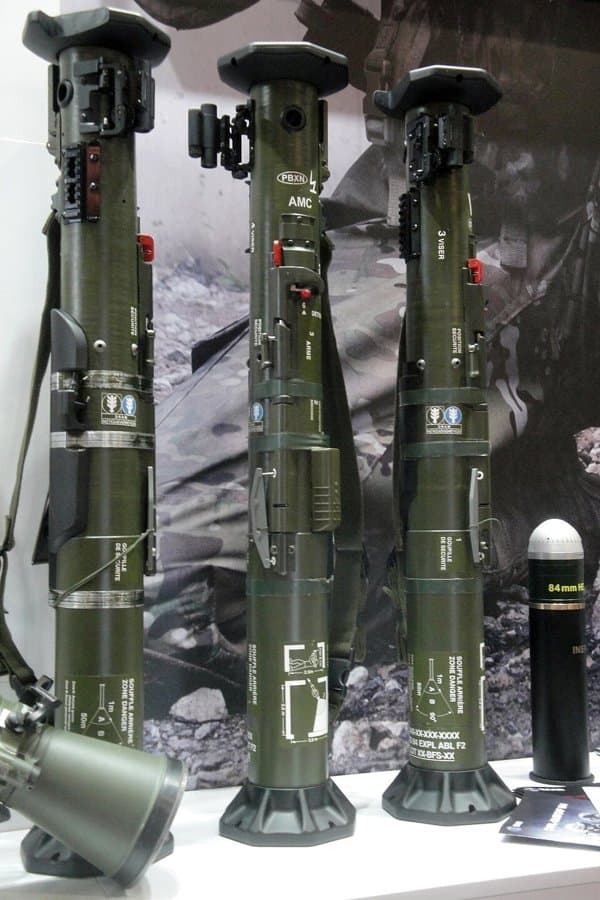
Anti-tank weaponsIn service
Disposable anti-tank launcher
AT4 is a disposable anti-tank launcher originating in Sweden United States. It was built by Saab Bofors Dynamics (Swedish version) Alliant Techsystems (U.S. version).
 Sweden /
 United States
Disposable anti-tank launcher
Sweden United States
1987–present
See Operators
See Wars
Förenade Fabriksverken
Saab Bofors Dynamics (Swedish version) Alliant Techsystems (U.S. version)
US$1,480 (In 1999) US$2,857 (2025)
600,000+
See Variants
6.7 kg (14.8 lb ) (AT4) 8 kg (18 lb) (AT4-CS)
102 cm (40 in)
84 mm
290 m/s (950 ft/s; 1,000 km/h), 220 m/s (720 ft/s; 790 km/h) (CS)
300 m (point target)
500 m (area target) 2,100 m (maximum)
Iron sights , optional AN/PVS-4 night vision unit
Octol
440 g high-explosive anti-tank (HEAT) round
Argentina
Bosnia and Herzegovina
Brazil
Canada
Chile
Colombia
Croatia
Denmark
Dominican Republic
Finland
France
Georgia
Greece
India
Indonesia
Iraq
Israel
Kurdistan
Ireland
Jaysh al-Islam
Kurdistan Workers' Party
Latvia
Lebanon
Lithuania
Malaysia
Mexico
Netherlands
Poland
Sweden
Syrian Democratic Forces
Taiwan (Republic of China)
United Kingdom
Ukraine
United States
Venezuela
man-portable, disposable, shoulder-fired recoilless anti-tank weapon
−40–60 °C (−40–140 °F)
The AT4 is a Swedish 84 mm (3.31 in) unguided, man-portable, disposable, shoulder-fired recoilless anti-tank weapon manufactured by Saab Bofors Dynamics .
The AT4 is a Swedish 84 mm (3.31 in) unguided, man-portable, disposable, shoulder-fired recoilless anti-tank weapon manufactured by Saab Bofors Dynamics . The AT4 is not a rocket launcher strictly speaking, because the explosive warhead is not propelled by a rocket motor . Rather, it is a smooth-bore recoilless gun (as opposed to a recoilless rifle , which has a rifled barrel). Saab has had considerable sales success with the AT4, making it one of the most common light anti-tank weapons in the world. The M136 AT4 and M136A1 AT4CS-RS are the variants used by the United States Army .
The name AT4 is a double entendre on the 84 mm caliber of the weapon, (84) 'eighty four' being a homophone of 'A-T-4'. The name also doubles as an alpha-phonetic word play on the weapon's role, due to "AT" being a common military abbreviation for "anti-tank". The name was created for export purposes as the nickname "eighty-four" was already a common English nickname for the Carl Gustaf 8.4 cm recoilless rifle after its caliber.
The AT4 is a development of the 74-mm Pansarskott m/68 (Miniman) adopted by the Swedish Army in the late 1960s.
FFV began research on a replacement for the m/68 in 1976, deliberately designing an individual anti-armour weapon that would not be able to defeat the heavy armour protection of MBTs (main battle tanks) in frontal engagements, believing that to be counterproductive.
The AT4 may be considered a disposable, lower-cost alternative to a Carl Gustaf 8.4 cm recoilless rifle .
The disadvantage of the recoilless design is that it creates a large back blast area behind the weapon, which can cause severe burns and overpressure injuries to friendly personnel in the vicinity of the user and sometimes even to the users themselves, especially in confined spaces. The back blast may also reveal the user's position to the enemy. The problem of back blast was solved with the AT4-CS (Confined Space) version, specially designed for urban warfare . This version uses a saltwater countermass in the rear of the launcher to absorb the back blast; the resulting spray captures and dramatically slows down the pressure wave, allowing troops to fire from enclosed areas. The AT4-CS version also reduced its muzzle velocity from the original 290 m/s to 220 m/s as part of its effort to be user-safe in a confined space, making the AT4-CS version more difficult to use as the drop is more pronounced. The effectiveness of the HEAT warhead is not dependent on speed.
The AT4 requires little training and is quite simple to use, making it suitable for general issue. However, as the cost of each launcher makes regular live-fire training very expensive, practice versions exist that are identical in operation but fire reloadable 9×19mm or 20mm tracer ammunition . Both practice cartridges are unique to their respective weapons, with their trajectory matched to that of the live round. The 20mm version also has a recoilless weapon effect with the same high noise and back blast as the AT4 firing and is favoured by the Swedish army because of the added realism of the back blast as compared to the "plonk" sound of the 9mm round (similar to the sound of a finger tapping on an empty can).
Time of flight (to 250 metres (820 ft)): less than 1 second
High-explosive anti-tank (HEAT) – Can penetrate up to 45 centimetres (18 in) of rolled homogeneous armour (RHA) with beyond-armour effect .
High-explosive dual purpose (HEDP) 502 – For use against bunkers , buildings, enemy personnel in the open, and light armour. It can be set to detonate on impact or with a brief detonation delay. The heavier nose cap allows either to penetrate light walls or windows before exploding, or to be "skipped" off the ground for an air burst. For use against light armour, there is a smaller-cone HEAT warhead with 15 centimetres (5.9 in) penetration of RHA.
High penetration (HP) – Extra high penetration ability, up to 42–60 centimetres (17–24 in) of RHA.
Extended range (ER) – Anti-armor version with HEAT warhead. Range is extended from 300 to 600 metres (980 to 1,970 ft), with increased penetration up to 46 centimetres (18 in) of RHA. These major improvements add only about 2 kilograms of mass, despite being CS models.
High explosive (HE) – High explosive anti-personnel weapon that can be set for impact or air-burst detonation, with an effective range up to 1,000 metres (3,300 ft).
American variant with a unique bi-metal warhead design, specially developed to maximize behind-armor effects for higher kill probability. The weapon is capable of firing from confined spaces (CS) and features a reduced sensitivity (RS) explosive, with penetration capabilities of up to 500mm of armor. Its effective range is 20–300 m.
In the early 1990s, there were tests of a tandem charge 120mm version (Bofors AT 12-T). The 14kg weapon had a claimed penetration of 90 centimetres (35 in) RHA, and in 1994 was demonstrated to defeat two NATO Single Heavy targets inclined at 68 degrees from vertical with ERA, for a line-of-sight penetration of 600mm. However, the project was cancelled due to the dissolution of the Soviet Union and the subsequent cuts in Western defence budgets.
Reference text from Wikipedia contributors, used under CC BY-SA 4.0.
True scale
Sourced dimensions beside a 1.75 m human reference.
See it in your room. Scan with your phone to open this model in 3D, then place it in your space.
Points represent sourced observations, including revisions. Revisions on the same effective date are not separate inventory events. Ranges appear in the table and are not plotted as exact points.
| Observation / report period | Value | Source | Claim state |
|---|---|---|---|
| 28 Sept 2026 | 84 mm | Wikipedia contributors | superseded |
AT4 equipment records. Variants, orders and quantities are shown as reported in each inventory source; coverage is incomplete.
 Albania
 Argentina
 Azerbaijan
 Bosnia and Herzegovina
 Brazil
 Canada
 Chile
 Colombia
 Croatia
 Denmark
 Dominican Republic
 Egypt
 Finland
 France
 Georgia
 Greece
 India
 Indonesia
 Iraq
 Ireland
 Israel
 Latvia
 Lebanon
 Lithuania
 Malaysia
 Mexico
 Morocco
 Netherlands
 Poland
 Qatar
 South Africa Sweden
 Taiwan
 Ukraine
 United Kingdom United States
 Venezuela
Argentina, Bosnia and Herzegovina, Brazil, Canada, Chile, Colombia, Croatia, Denmark, Dominican Republic, Finland, France, Georgia, Greece, India, Indonesia, Iraq, Israel, Kurdistan, Ireland, Jaysh al-Islam, Kurdistan Workers' Party, Latvia, Lebanon, Lithuania, Malaysia, Mexico, Netherlands, Poland, Sweden, Syrian Democratic Forces, Taiwan (Republic of China), United Kingdom, Ukraine, United States, Venezuela
Equipment reference ↗Keep exploring
Disposable anti-tank rocket launcher
Disposable Anti-tank rocket launcher
 Russia
Anti-tank disposable rocket-propelled grenade launcher
United StatesDisposable anti-tank rocket - propelled grenade launcher
Anti-Tank Missile Launcher
Disposable rocket launcher