FORCETALLY
Loading the evidence…
Preparing your view.


Preparing your view.
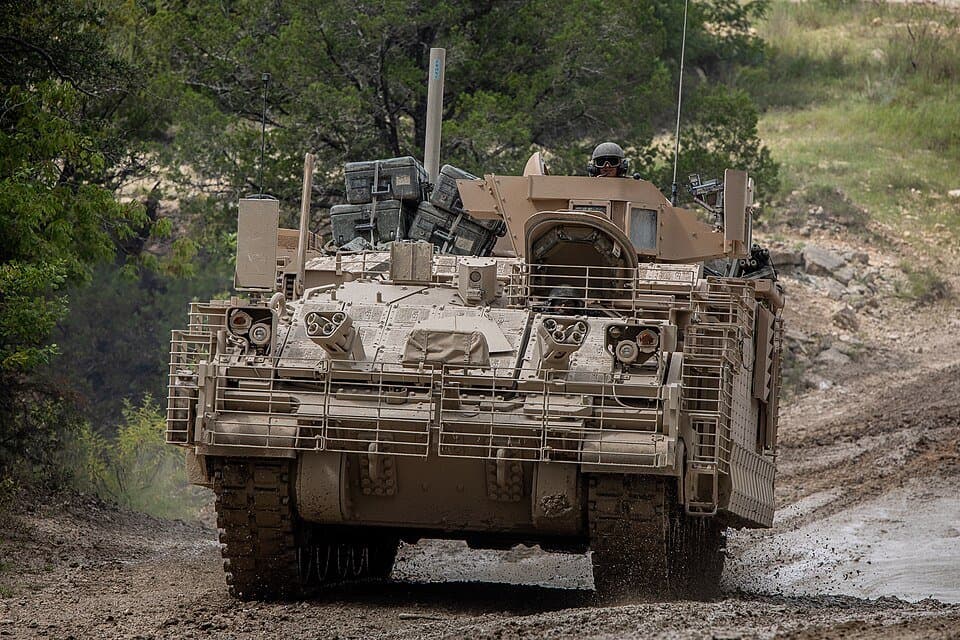
Armoured vehiclesIn service
Tracked armoured fighting vehicle
Armored Multi-Purpose Vehicle is a tracked armoured fighting vehicle originating in United States. It was built by BAE Systems Inc.. Reported operators include United States Army.
 United States
Armored Multi-Purpose Vehicle
Maj. Carson Petry · Public domain · Resized · Public domain · Source ↗ · ModifiedTracked armoured fighting vehicle
United States
United States Army
BAE Systems Inc.
M2 Bradley
US$2.51 million in 2020
Since 2018
Ordered by the US Army: 29 prototypes 551 in LRIP (low-rate initial production) Planned for the US Army: 2,907
M1283 general purpose ( APC ) M1284 medical evacuation vehicle (790 planned) M1285 medical treatment vehicle (216 planned) M1286 mission command (993 planned) M1287 mortar carrier vehicle (386 planned)
36 t (79,000 lb)(GVM)
6.00 m (236 in) (for the general purpose variant - APC )
3.70 m (146 in)
3.10 m (122 in)
Cummins VTA903E-T675 504 kW (676 hp)
Renk HMPT 800
0.40 m (16 in)
362 km (225 mi)
61 km/h (38 mph)
USA
Poland
This variant replaces the M113A3 APC. Requirements are for 2 crew and 4 troops, be configured to carry one litter, and mount a crew served weapon. Tasks include conducting logistics package escort, emergency resupply, casualty evacuation , and security for medical evacuation and 522 vehicles are planned.
This variant replaces the M1064A3 mortar carrier . Requirements are for 2 crew and 2 mortar crew, with a 120 mm mortar and 69 mortar rounds. The task is to provide indirect mortar fire and 386 vehicles are planned. In 2024, trials of the AMPV equipped with a Patria NEMO mortar turret took place in Fort Moore, Georgia.
In April 2026, the 1st Cavalry Division fielded the new AMPV 30mm at Fort Hood, Texas. The AMPV 30mm is equipped with the Kongsberg MCT-30, a remotely operated, unmanned turret. It allows the crew to control the weapon from within the vehicle’s protected hull, reducing their exposure to enemy fire. The unmanned design also removes the need for a turret basket, freeing up internal space.
The 30mm autocannon enables the AMPV to engage lightly armored vehicles and fortified positions and can use programmable airburst ammunition to target small drones and unarmored ground threats. This capability allows the vehicle to provide more direct support to maneuver units, rather than operating solely in support or rear-echelon roles.
In October 2024, BAE Systems presented a variant with a remote controlled turret Kongsberg Protector RT20 (30 mm).
• Weight: 75,000–80,000 pounds
Crew Size: Two to four
The General Purpose variant accommodates two crew, six passengers
The Mortar Carrier variant accommodates two crew, two mortar crew
The Medical Evacuation variant includes room for three crew
The Medical Treatment variant includes room for four crew
Reference text from Wikipedia contributors, used under CC BY-SA 4.0.
True scale
Sourced dimensions beside a 1.75 m human reference.
Points represent sourced observations, including revisions. Revisions on the same effective date are not separate inventory events. Ranges appear in the table and are not plotted as exact points.
| Observation / report period | Value | Source | Claim state |
|---|---|---|---|
| 28 Sept 2026 | 3.1 m | Wikipedia contributors | superseded |
Armored Multi-Purpose Vehicle equipment records. Variants, orders and quantities are shown as reported in each inventory source; coverage is incomplete.
 Poland United States
US Army exact named equipment holdings: M1283 AMPV GP (incl CP and amb variants). Active, operational-reserve and training units excluding equipment in store; November 2025 IISS assessment. Named service only; no parent-force or national total inferred. Source role: ARMOURED FIGHTING VEHICLES / APC (T). Original estimates, ranges, reporting names, reserve, lease and employment scopes retained; nested included counts are not added. Missile-system quantities mean launchers, not rounds. No readiness, crew, carried weapon, payload, factory-production or future order count inherited.
Keep exploring
 Canada
 Malaysia
 United Kingdom