FORCETALLY
Loading the evidence…
Preparing your view.


Preparing your view.
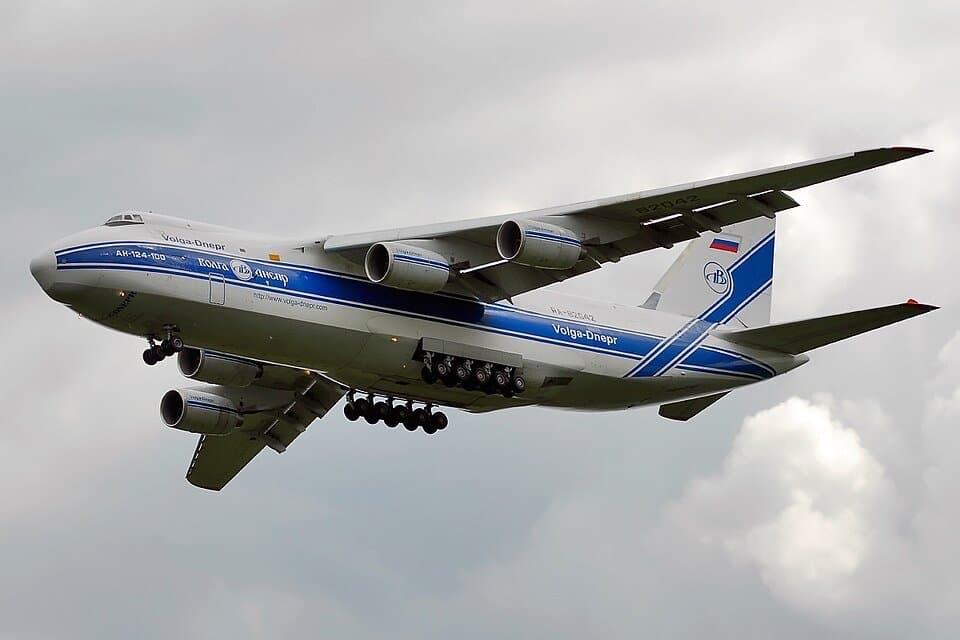
Support aircraftIn service
Heavy transport aircraft
Antonov An-124 Ruslan is a heavy transport aircraft originating in Soviet Union. It was built by Antonov. Reported operators include Russian Aerospace Forces Volga-Dnepr Airlines Antonov Airlines Maximus Air.
Technical data
Heavy transport aircraft
Soviet Union
Antonov
Antonov
Antonov Serial Production Plant Aviastar-SP
In service
Russian Aerospace Forces Volga-Dnepr Airlines Antonov Airlines Maximus Air
57
1982–2004
1986
24 December 1982
Antonov An-225 Mriya
Eight (pilot, copilot, navigator, chief flight engineer, electrical flight engineer, radio operator, two loadmasters)
88 passengers in upper aft fuselage, or the hold can take an additional 350 pax on a palletised seating system / 120,000 kg (264,555 lb)
69.1 m (226 ft 8 in)
73.3 m (240 ft 6 in)
21.08 m (69 ft 2 in)
628 m 2 (6,760 sq ft)
8.6
TsAGI Supercritical
181,000 kg (399,037 lb)
402,000 kg (886,258 lb) * Maximum landing weight: 330,000 kg (727,525 lb)
210,172 kg (463,343 lb) / 262,715.15 L (69,402.00 US gal; 57,789.25 imp gal)
4 × Progress D-18T (D-18 Series 4 on -150 models) high-bypass turbofan engines, 226.8 kN (51,000 lbf) thrust each
865 km/h (537 mph, 467 kn) max
230–260 km/h (140–160 mph; 120–140 kn)
3,700 km (2,300 mi, 2,000 nmi) with max payload
14,000 km (8,700 mi, 7,600 nmi) with max fuel and minimum payload
12,000 m (39,000 ft) max certified altitude
640.1 kg/m 2 (131.1 lb/sq ft)
0.23
3,000 m (9,800 ft)
900 m (3,000 ft)
Assembly of the first aircraft begun in 1979; the An-124 (which was sometimes referred to as the An-40 in the West ) performed its maiden flight on 24 December 1982.
In 1971, design work on the project commenced at the Antonov Design Bureau ; the lead designer of the An-124 (and the enlarged An-225 derivative) was Viktor Tolmachev . During development, it was known as Izdeliye 400 ( Product #400 ) in house, and An-40 in the West . The design produced broadly resembled the Lockheed C-5 Galaxy , an American strategic airlifter, but also incorporated numerous improvements, the greater use of carbon-fibre composites in its construction (comprising around 5% of the aircraft's total weight) and the more extensive use of titanium being amongst these benefits. Aluminium alloys make up the primary material used in its construction, limited use of steel and titanium alloys were also made. The An-124 has a fully-pressurized upper 88-passenger deck, but unlike the C-5, the main cargo deck is only partially-pressurized. The An-124 doesn't have any inflight refuelling capability.
Sales of the An-124 to various commercial operators proceeded throughout the 1990s and into the mid 2000s; many of these were former military aircraft that were refurbished by Antonov prior to delivery, or unfinished fuselages that had been preserved, rather than producing new-build aircraft. During the early 2000s, the cargo operator Volga-Dnepr opted to upgrade its An-124 freighter fleet, these works included engine modifications to conform with chapter four noise regulations, various structural improvements that increased service life, and numerous avionics and systems changes to facilitate four person operations, reducing the crew needed from six or seven.
During April 2008, it was announced that Russia and Ukraine had agreed to resume the production of the An-124 in the third quarter of 2008. One month later, a new variant — the An-124-150 — was announced; it featured several improvements, including a maximum lift capacity of 150 tonnes . However, in May 2009, Antonov's partner, the Russian United Aircraft Corporation announced it did not plan to produce any An-124s in the period 2009–2012. During late 2009, Russian President Dmitry Medvedev ordered production of the aircraft resumed; at this point, Russia was expected to procure 20 new-build An-124s. In August 2014, Jane's reported that, Russian Deputy Minister of Industry and Trade Yuri Slusar announced that production of the An-124 had been stopped as a consequence of the ongoing political tensions between Russia and Ukraine .
At MAKS Air Show in 2017, the Central Aerohydrodynamic Institute (TsAGI) announced its An-124-102 Slon (Elephant) design to replace the similar An-124-100. The design was detailed in January 2019 before wind tunnel testing scheduled for August–September. It is intended to be produced at the Aviastar-SP factory in Ulyanovsk. It should transport 150 t (330,000 lb) over 3,800 nmi (7,000 km) (up from 1,675 nmi, 3,102 km), or 180 t (400,000 lb) over 2,650 nmi (4,910 km) at 460 kn (850 km/h). The Russian MoD wants a range of 4,100 nmi (7,600 km) with five Sprut-SDM-1 light tanks and their 100 crew, or 300 armed soldiers.
The planned An-124-102 is larger at 82.3 m (270 ft) long from 69 m (227 ft), with an 87–88 m (286–290 ft) span versus 73.3 m (240.5 ft) and 24.0 m (78.7 ft) high compared with 21.0 m (68.9 ft). A new higher aspect ratio , composite wing and a 214–222 t (472,000–489,000 lb) airframe would allow a 490–500 t (1,080,000–1,100,000 lb) gross weight . It should be powered by Russian PD-35s developed for the CR929 widebody, producing 35 tf (77,000 lbf) up from 23 tf (51,000 lbf). Two fuselages are planned, one for Volga-Dnepr with a width of 5.3 m (17.4 ft) from the An-124's 4.4 m (14.4 ft), and one for the Russian MoD of 6.4 m (21 ft) wide to carry vehicles in two lines.
On 5 November 2019, the TsAGI released pictures of a 1.63 m (5 ft 4 in) long and 1.75 m (5 ft 9 in) wide model, ahead of windtunnel testing. On 26 March 2020, TsAGI released new pictures of a wind tunnel model, announcing that the researchers of the Institute had completed the first cycle of aerodynamic testing; the results confirmed the characteristics laid down during preliminary studies.
A single An-124 is capable of carrying up to 150 tonnes (150 long tons; 170 short tons) of cargo internally in a standard military configuration; it can also carry 88 passengers in an upper deck behind the wing centre section.
The cargo compartment of the An-124 is 36×6.4×4.4 m (118×21×14 ft), ca. 20% larger than the main cargo compartment of the C-5 Galaxy, which is 36.91×5.79×4.09 m (121.1×19.0×13.4 ft).
The An-124 is powered by four Lotarev D-18 turbofan engines, each capable of generating up to 238–250 kN of thrust.
Other features intended to ease loading including an onboard overhead crane in the cargo deck, capable of lifting up to 30 tonnes, while items up to 120 tonnes can be winched on board.
In May 1987, an An-124 set a world record, covering the distance of 20,151 km (10,881 nmi) without refuelling. The flight took 25 hours and 30 minutes; the takeoff weight was 455,000 kg.
In July 1985, an An-124 carried 171,219 kg (377,473 lb) of cargo to an altitude of 2,000 m (6,600 ft) and 170,000 kg to an altitude of 10,750 m (35,270 ft).
In July 2010, an An-124 was used to transport four 35-foot and three 21-foot skimmer boats from France to the US to assist with the clean-up of the Deepwater Horizon oil spill .
An An-124 was used in May 2018 to transport an 87,000 lb die tool from Eaton Rapids, Michigan, US to Nottingham, England to restart Ford F-150 production after a fire in the Eaton Rapids Magnesium Casting Facility.
On 3 March 2023, an An-124 delivered 101 tons of humanitarian aid for earthquake victims in Turkey and Syria.
An-124-100M-150
Version with a payload increased to 150 tonnes (maximum take-off weight 420 tonnes), with uprated Lotarev D-18T series 4 engines; one An-124-100 converted
An-124-115M
Variant with one seat in the rear and the rest of the cargo area (approx. 1,800 square feet) dedicated to freight
Proposed version with General Electric CF6-80C2 engines, each rated at 59,200 lbf (263 kN)
Joint proposal with Air Foyle to meet UK's Short Term Strategic Airlifter (STSA) requirement, with Rolls-Royce RB211-524H-T engines, each rated 60,600 lbf (264 kN) and Honeywell avionics—STSA competition abandoned in August 1999, reinstated, and won by the Boeing C-17A .
On 15 November 1993, RA-82071, operated by Aviastar Airlines , crashed into a mountain at 11,000 feet (3,400 m) while in a holding pattern at Kerman , Iran. There were 17 fatalities.
On 6 December 1997, RA-82005 , operated by the Russian Air Force , crashed in a residential area after take-off in Irkutsk , Russia. All 23 people on board and 45 people on the ground were killed.
Capacity: 88 passengers in upper aft fuselage, or the hold can take an additional 350 pax on a palletised seating system / 120,000 kg (264,555 lb)
Length: 69.1 m (226 ft 8 in)
Wingspan: 73.3 m (240 ft 6 in)
Height: 21.08 m (69 ft 2 in)
Wing area: 628 m 2 (6,760 sq ft)
Empty weight: 181,000 kg (399,037 lb)
Max takeoff weight: 402,000 kg (886,258 lb) * Maximum landing weight: 330,000 kg (727,525 lb)
Fuel capacity: 210,172 kg (463,343 lb) / 262,715.15 L (69,402.00 US gal; 57,789.25 imp gal)
Powerplant: 4 × Progress D-18T (D-18 Series 4 on -150 models) high-bypass turbofan engines, 226.8 kN (51,000 lbf) thrust each
Cruise speed: 865 km/h (537 mph, 467 kn) max
800–850 km/h (500–530 mph; 430–460 kn) at FL 328-394 (32,800–39,400 ft (9,997–12,009 m) at regional pressure setting)
Approach speed: 230–260 km/h (140–160 mph; 120–140 kn)
Range: 3,700 km (2,300 mi, 2,000 nmi) with max payload
8,400 km (5,200 mi; 4,500 nmi) with 80,000 kg (176,370 lb) payload 11,500 km (7,100 mi; 6,200 nmi) with 40,000 kg (88,185 lb) payload
Ferry range: 14,000 km (8,700 mi, 7,600 nmi) with max fuel and minimum payload
Service ceiling: 12,000 m (39,000 ft) max certified altitude
Take-off run (maximum take-off weight): 3,000 m (9,800 ft)
Landing roll (maximum landing weight): 900 m (3,000 ft)
Reference text from Wikipedia contributors, used under CC BY-SA 4.0.
True scale
Sourced dimensions beside a 1.75 m human reference.
See it in your room. Scan with your phone to open this model in 3D, then place it in your space.
Points represent sourced observations, including revisions. Revisions on the same effective date are not separate inventory events. Ranges appear in the table and are not plotted as exact points.
| Observation / report period | Value | Source | Claim state |
|---|---|---|---|
| 28 Sept 2026 | 21.08 m | Wikipedia contributors | superseded |
| 28 Sept 2026 | 21.08 m | Wikipedia contributors | superseded |
| 28 Sept 2026 | 21.08 m | Wikipedia contributors | approved |
Antonov An-124 Ruslan equipment records. Variants, orders and quantities are shown as reported in each inventory source; coverage is incomplete.
 Montenegro
Strategic Airlift International Solution exact named equipment holdings: An-124-100 (2 more available on 6–9 days’ notice and 2 more subject to availability). Active, operational-reserve and training units excluding equipment in store; November 2025 IISS assessment. Named service only; no parent-force or national total inferred. Source role: AIRCRAFT / Heavy. Original estimates, ranges, reporting names, reserve, lease and employment scopes retained; nested included counts are not added. Missile-system quantities mean launchers, not rounds. No readiness, crew, carried weapon, payload, factory-production or future order count inherited.
 Russia
Aerospace Forces exact named equipment holdings: An-124 Condor. Active, operational-reserve and training units excluding equipment in store; November 2025 IISS assessment. Named service only; no parent-force or national total inferred. Source role: AIRCRAFT / Heavy. Original estimates, ranges, reporting names, reserve, lease and employment scopes retained; nested included counts are not added. Missile-system quantities mean launchers, not rounds. No readiness, crew, carried weapon, payload, factory-production or future order count inherited.
Russian Aerospace Forces Volga-Dnepr Airlines Antonov Airlines Maximus Air
Equipment reference ↗Keep exploring
Transport aircraft
Compare with Antonov An-124 RuslanTransport aircraft
Compare with Antonov An-124 RuslanTransport aircraft
 ChinaCompare with Antonov An-124 Ruslan
Transport aircraft
 United KingdomCompare with Antonov An-124 Ruslan
Transport aircraft
United KingdomCompare with Antonov An-124 Ruslan STOL transport aircraft
 CanadaCompare with Antonov An-124 Ruslan