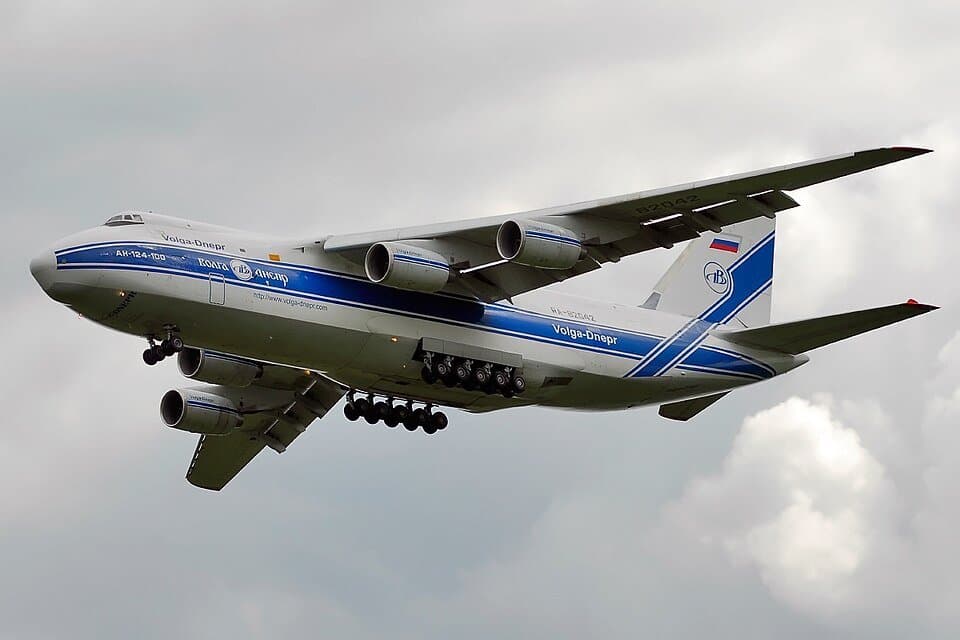
Credit
Alex Beltyukov · CC BY-SA 3.0 · Resized · CC BY-SA 3.0 · Source ↗ · Modified


Preparing your view.
At a glance
Measured figures
An-124-100M · Length
Single source69.1 m (226 ft 8 in)[source]
An-72 · Length
Single sourceConfiguration
| Specification | Antonov An-124 Ruslan | Antonov An-72 |
|---|---|---|
| Crew | Eight (pilot, copilot, navigator, chief flight engineer, electrical flight engineer, radio operator, two loadmasters)[source] | five[source] |
| Type | Heavy transport aircraft[source] | Transport aircraft[source] |
| National origin | Soviet Union[source] | Soviet Union[source] |
| Manufacturer | Antonov[source] |
28.07 m (92 ft 1 in)[source]
Empty; An-124-100M · Empty weight
Single sourceMaximum take-off; An-124-100M · * Maximum landing weight
Single sourceMaximum take-off; An-124-100M · Max takeoff weight
Single source181,000 kg (399,037 lb)[source]
402,000 kg (886,258 lb) * Maximum landing weight: 330,000 kg (727,525 lb)[source]
Empty; An-72 · Empty weight
Single sourceGross; An-72 · Gross weight
Single sourceAn-124-100M · with max payload
Single sourceFerry; An-124-100M · with max fuel and minimum payload
Single source3,700 km (2,300 mi, 2,000 nmi) with max payload[source]
14,000 km (8,700 mi, 7,600 nmi) with max fuel and minimum payload[source]
An-72 · Range
Single source4,325 km (2,688 mi, 2,336 nmi)[source]
An-124-100M · 4 × Progress D-18T (D-18 Series 4 on -150 models) high-bypass turbofan engines thrust each
Single source4 × Progress D-18T (D-18 Series 4 on -150 models) high-bypass turbofan engines, 226.8 kN (51,000 lbf) thrust each[source]
An-72 · 2 × Lotarev D-36 series 1A Turbofan thrust each
Single source2 × Lotarev D-36 series 1A Turbofan, 63.9 kN (14,330 lbf) thrust each[source]
Bars compare reported quantities only. A larger figure does not make a system better; configurations and test conditions differ.
Antonov[source] |
| Designer | Antonov[source] | — |
|---|
| Built by | Antonov Serial Production Plant Aviastar-SP[source] | — |
|---|
| Status | In service[source] | In service[source] |
|---|
| Primary users | Russian Aerospace Forces Volga-Dnepr Airlines Antonov Airlines Maximus Air[source] | Russian Aerospace Forces Russian Navy Angolan Air Force Soviet Air Force (historical)[source] |
|---|
| Number built | 57[source] | 133[source] |
|---|
| Manufactured | 1982–2004[source] | 1977–2002[source] |
|---|
| Introduction date | 1986[source] | — |
|---|
| First flight | 24 December 1982[source] | 31 August 1977 ( 1977-08-31 )[source] |
|---|
| Developed into | Antonov An-225 Mriya[source] | Antonov An-71 Antonov An-74[source] |
|---|
| Capacity | 88 passengers in upper aft fuselage, or the hold can take an additional 350 pax on a palletised seating system / 120,000 kg (264,555 lb)[source] | up to 52 passengers or 10 tonnes of cargo[source] |
|---|
| Aspect ratio | 8.6[source] | — |
|---|
| Airfoil | TsAGI Supercritical[source] | — |
|---|
| Fuel capacity | 210,172 kg (463,343 lb) / 262,715.15 L (69,402.00 US gal; 57,789.25 imp gal)[source] | — |
|---|
| Approach speed | 230–260 km/h (140–160 mph; 120–140 kn)[source] | — |
|---|
| Wing loading | 640.1 kg/m 2 (131.1 lb/sq ft)[source] | — |
|---|
| Thrust/weight | 0.23[source] | — |
|---|
| Take-off run (maximum take-off weight) | 3,000 m (9,800 ft)[source] | — |
|---|
| Landing roll (maximum landing weight) | 900 m (3,000 ft)[source] | — |
|---|
| Source measurement | Assembly of the first aircraft begun in 1979; the An-124 (which was sometimes referred to as the An-40 in the West ) performed its maiden flight on 24 December 1982.[source]Antonov An-124 Ruslan · Lead; only the objects and conditions stated in this passage In 1971, design work on the project commenced at the Antonov Design Bureau ; the lead designer of the An-124 (and the enlarged An-225 derivative) was Viktor Tolmachev . During development, it was known as Izdeliye 400 ( Product #400 ) in house, and An-40 in the West . The design produced broadly resembled the Lockheed C-5 Galaxy , an American strategic airlifter, but also incorporated numerous improvements, the greater use of carbon-fibre composites in its construction (comprising around 5% of the aircraft's total weight) and the more extensive use of titanium being amongst these benefits. Aluminium alloys make up the primary material used in its construction, limited use of steel and titanium alloys were also made. The An-124 has a fully-pressurized upper 88-passenger deck, but unlike the C-5, the main cargo deck is only partially-pressurized. The An-124 doesn't have any inflight refuelling capability.[source]Antonov An-124 Ruslan · Development / Background; only the objects and conditions stated in this passage Sales of the An-124 to various commercial operators proceeded throughout the 1990s and into the mid 2000s; many of these were former military aircraft that were refurbished by Antonov prior to delivery, or unfinished fuselages that had been preserved, rather than producing new-build aircraft. During the early 2000s, the cargo operator Volga-Dnepr opted to upgrade its An-124 freighter fleet, these works included engine modifications to conform with chapter four noise regulations, various structural improvements that increased service life, and numerous avionics and systems changes to facilitate four person operations, reducing the crew needed from six or seven.[source]Antonov An-124 Ruslan · Development / Post-Soviet developments; only the objects and conditions stated in this passage During April 2008, it was announced that Russia and Ukraine had agreed to resume the production of the An-124 in the third quarter of 2008. One month later, a new variant — the An-124-150 — was announced; it featured several improvements, including a maximum lift capacity of 150 tonnes . However, in May 2009, Antonov's partner, the Russian United Aircraft Corporation announced it did not plan to produce any An-124s in the period 2009–2012. During late 2009, Russian President Dmitry Medvedev ordered production of the aircraft resumed; at this point, Russia was expected to procure 20 new-build An-124s. In August 2014, Jane's reported that, Russian Deputy Minister of Industry and Trade Yuri Slusar announced that production of the An-124 had been stopped as a consequence of the ongoing political tensions between Russia and Ukraine .[source]Antonov An-124 Ruslan · Development / Post-Soviet developments; only the objects and conditions stated in this passage At MAKS Air Show in 2017, the Central Aerohydrodynamic Institute (TsAGI) announced its An-124-102 Slon (Elephant) design to replace the similar An-124-100. The design was detailed in January 2019 before wind tunnel testing scheduled for August–September. It is intended to be produced at the Aviastar-SP factory in Ulyanovsk. It should transport 150 t (330,000 lb) over 3,800 nmi (7,000 km) (up from 1,675 nmi, 3,102 km), or 180 t (400,000 lb) over 2,650 nmi (4,910 km) at 460 kn (850 km/h). The Russian MoD wants a range of 4,100 nmi (7,600 km) with five Sprut-SDM-1 light tanks and their 100 crew, or 300 armed soldiers.[source]Antonov An-124 Ruslan · Development / Russian replacement design; only the objects and conditions stated in this passage The planned An-124-102 is larger at 82.3 m (270 ft) long from 69 m (227 ft), with an 87–88 m (286–290 ft) span versus 73.3 m (240.5 ft) and 24.0 m (78.7 ft) high compared with 21.0 m (68.9 ft). A new higher aspect ratio , composite wing and a 214–222 t (472,000–489,000 lb) airframe would allow a 490–500 t (1,080,000–1,100,000 lb) gross weight . It should be powered by Russian PD-35s developed for the CR929 widebody, producing 35 tf (77,000 lbf) up from 23 tf (51,000 lbf). Two fuselages are planned, one for Volga-Dnepr with a width of 5.3 m (17.4 ft) from the An-124's 4.4 m (14.4 ft), and one for the Russian MoD of 6.4 m (21 ft) wide to carry vehicles in two lines.[source]Antonov An-124 Ruslan · Development / Russian replacement design; only the objects and conditions stated in this passage On 5 November 2019, the TsAGI released pictures of a 1.63 m (5 ft 4 in) long and 1.75 m (5 ft 9 in) wide model, ahead of windtunnel testing. On 26 March 2020, TsAGI released new pictures of a wind tunnel model, announcing that the researchers of the Institute had completed the first cycle of aerodynamic testing; the results confirmed the characteristics laid down during preliminary studies.[source]Antonov An-124 Ruslan · Development / Russian replacement design; only the objects and conditions stated in this passage A single An-124 is capable of carrying up to 150 tonnes (150 long tons; 170 short tons) of cargo internally in a standard military configuration; it can also carry 88 passengers in an upper deck behind the wing centre section.[source]Antonov An-124 Ruslan · Design; only the objects and conditions stated in this passage The cargo compartment of the An-124 is 36×6.4×4.4 m (118×21×14 ft), ca. 20% larger than the main cargo compartment of the C-5 Galaxy, which is 36.91×5.79×4.09 m (121.1×19.0×13.4 ft).[source]Antonov An-124 Ruslan · Design; only the objects and conditions stated in this passage The An-124 is powered by four Lotarev D-18 turbofan engines, each capable of generating up to 238–250 kN of thrust.[source]Antonov An-124 Ruslan · Design; only the objects and conditions stated in this passage Other features intended to ease loading including an onboard overhead crane in the cargo deck, capable of lifting up to 30 tonnes, while items up to 120 tonnes can be winched on board.[source]Antonov An-124 Ruslan · Design; only the objects and conditions stated in this passage In May 1987, an An-124 set a world record, covering the distance of 20,151 km (10,881 nmi) without refuelling. The flight took 25 hours and 30 minutes; the takeoff weight was 455,000 kg.[source]Antonov An-124 Ruslan · Operational history / Significant activities; only the objects and conditions stated in this passage In July 1985, an An-124 carried 171,219 kg (377,473 lb) of cargo to an altitude of 2,000 m (6,600 ft) and 170,000 kg to an altitude of 10,750 m (35,270 ft).[source]Antonov An-124 Ruslan · Operational history / Significant activities; only the objects and conditions stated in this passage In July 2010, an An-124 was used to transport four 35-foot and three 21-foot skimmer boats from France to the US to assist with the clean-up of the Deepwater Horizon oil spill .[source]Antonov An-124 Ruslan · Operational history / Significant activities; only the objects and conditions stated in this passage An An-124 was used in May 2018 to transport an 87,000 lb die tool from Eaton Rapids, Michigan, US to Nottingham, England to restart Ford F-150 production after a fire in the Eaton Rapids Magnesium Casting Facility.[source]Antonov An-124 Ruslan · Operational history / Significant activities; only the objects and conditions stated in this passage On 3 March 2023, an An-124 delivered 101 tons of humanitarian aid for earthquake victims in Turkey and Syria.[source]Antonov An-124 Ruslan · Operational history / Significant activities; only the objects and conditions stated in this passage An-124-100M-150[source]Antonov An-124 Ruslan · Variants; only the objects and conditions stated in this passage Version with a payload increased to 150 tonnes (maximum take-off weight 420 tonnes), with uprated Lotarev D-18T series 4 engines; one An-124-100 converted[source]Antonov An-124 Ruslan · Variants; only the objects and conditions stated in this passage An-124-115M[source]Antonov An-124 Ruslan · Variants; only the objects and conditions stated in this passage Variant with one seat in the rear and the rest of the cargo area (approx. 1,800 square feet) dedicated to freight[source]Antonov An-124 Ruslan · Variants; only the objects and conditions stated in this passage Proposed version with General Electric CF6-80C2 engines, each rated at 59,200 lbf (263 kN)[source]Antonov An-124 Ruslan · Variants; only the objects and conditions stated in this passage Joint proposal with Air Foyle to meet UK's Short Term Strategic Airlifter (STSA) requirement, with Rolls-Royce RB211-524H-T engines, each rated 60,600 lbf (264 kN) and Honeywell avionics—STSA competition abandoned in August 1999, reinstated, and won by the Boeing C-17A .[source]Antonov An-124 Ruslan · Variants; only the objects and conditions stated in this passage On 15 November 1993, RA-82071, operated by Aviastar Airlines , crashed into a mountain at 11,000 feet (3,400 m) while in a holding pattern at Kerman , Iran. There were 17 fatalities.[source]Antonov An-124 Ruslan · Notable accidents; only the objects and conditions stated in this passage On 6 December 1997, RA-82005 , operated by the Russian Air Force , crashed in a residential area after take-off in Irkutsk , Russia. All 23 people on board and 45 people on the ground were killed.[source]Antonov An-124 Ruslan · Notable accidents; only the objects and conditions stated in this passage Capacity: 88 passengers in upper aft fuselage, or the hold can take an additional 350 pax on a palletised seating system / 120,000 kg (264,555 lb)[source]Antonov An-124 Ruslan · Specifications (An-124-100M); only the objects and conditions stated in this passage Length: 69.1 m (226 ft 8 in)[source]Antonov An-124 Ruslan · Specifications (An-124-100M); only the objects and conditions stated in this passage Wingspan: 73.3 m (240 ft 6 in)[source]Antonov An-124 Ruslan · Specifications (An-124-100M); only the objects and conditions stated in this passage Height: 21.08 m (69 ft 2 in)[source]Antonov An-124 Ruslan · Specifications (An-124-100M); only the objects and conditions stated in this passage Wing area: 628 m 2 (6,760 sq ft)[source]Antonov An-124 Ruslan · Specifications (An-124-100M); only the objects and conditions stated in this passage Empty weight: 181,000 kg (399,037 lb)[source]Antonov An-124 Ruslan · Specifications (An-124-100M); only the objects and conditions stated in this passage Max takeoff weight: 402,000 kg (886,258 lb) * Maximum landing weight: 330,000 kg (727,525 lb)[source]Antonov An-124 Ruslan · Specifications (An-124-100M); only the objects and conditions stated in this passage Fuel capacity: 210,172 kg (463,343 lb) / 262,715.15 L (69,402.00 US gal; 57,789.25 imp gal)[source]Antonov An-124 Ruslan · Specifications (An-124-100M); only the objects and conditions stated in this passage Powerplant: 4 × Progress D-18T (D-18 Series 4 on -150 models) high-bypass turbofan engines, 226.8 kN (51,000 lbf) thrust each[source]Antonov An-124 Ruslan · Specifications (An-124-100M); only the objects and conditions stated in this passage Cruise speed: 865 km/h (537 mph, 467 kn) max[source]Antonov An-124 Ruslan · Specifications (An-124-100M); only the objects and conditions stated in this passage 800–850 km/h (500–530 mph; 430–460 kn) at FL 328-394 (32,800–39,400 ft (9,997–12,009 m) at regional pressure setting)[source]Antonov An-124 Ruslan · Specifications (An-124-100M); only the objects and conditions stated in this passage Approach speed: 230–260 km/h (140–160 mph; 120–140 kn)[source]Antonov An-124 Ruslan · Specifications (An-124-100M); only the objects and conditions stated in this passage Range: 3,700 km (2,300 mi, 2,000 nmi) with max payload[source]Antonov An-124 Ruslan · Specifications (An-124-100M); only the objects and conditions stated in this passage 8,400 km (5,200 mi; 4,500 nmi) with 80,000 kg (176,370 lb) payload 11,500 km (7,100 mi; 6,200 nmi) with 40,000 kg (88,185 lb) payload[source]Antonov An-124 Ruslan · Specifications (An-124-100M); only the objects and conditions stated in this passage Ferry range: 14,000 km (8,700 mi, 7,600 nmi) with max fuel and minimum payload[source]Antonov An-124 Ruslan · Specifications (An-124-100M); only the objects and conditions stated in this passage Service ceiling: 12,000 m (39,000 ft) max certified altitude[source]Antonov An-124 Ruslan · Specifications (An-124-100M); only the objects and conditions stated in this passage Take-off run (maximum take-off weight): 3,000 m (9,800 ft)[source]Antonov An-124 Ruslan · Specifications (An-124-100M); only the objects and conditions stated in this passage Landing roll (maximum landing weight): 900 m (3,000 ft)[source]Antonov An-124 Ruslan · Specifications (An-124-100M); only the objects and conditions stated in this passage | — |
|---|
| Reported operators | — |
|
|---|