FORCETALLY
Loading the evidence…
Preparing your view.


Preparing your view.
Radar & sensorsIn service
passive Night vision device
AN/PVS-4 is a passive originating in United States. It was built by Optic Electronic Corporation of Dallas. Reported operators include United States.
 United States
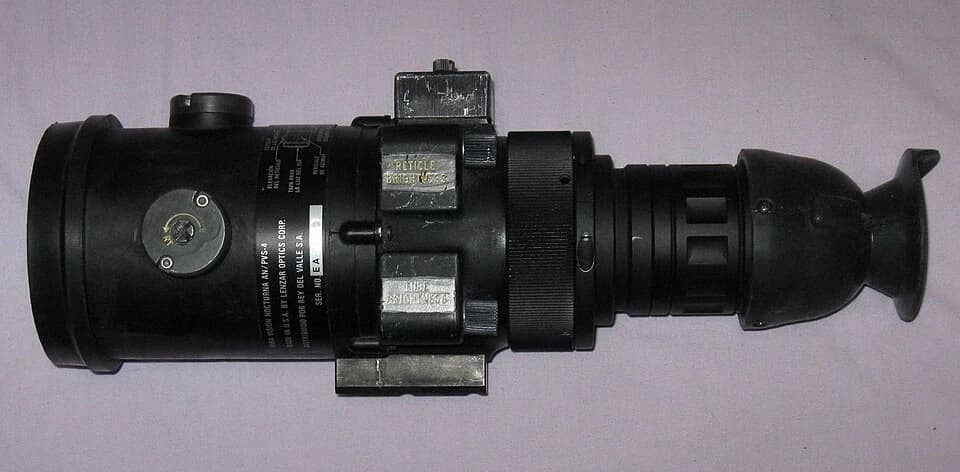
AN/PVS-4 Starlight Scope in the source-pictured complete optical-unit configuration.
David_kitson ( talk ) ( Uploads ) · Public domain · Resized / optimised · Public domain · Source ↗ · ModifiedPassive
United States
Night Vision Device
1978–present
United States
Persian Gulf War
Optic Electronic Corporation of Dallas
1975
Optic Electronic Corporation of Dallas
1977–2002
> 150,000
AN/TVS-5, NVS-700, NVS-800
4.0 lb (1800 g )
320mm (l) x 120mm (h) x 100mm (w)
32 lp/mm
Passive
MX9644
14.5 degrees
600m (Starlight)
400m (Starlight)
3.6x
2
ITT FX9860, ITT F4845 (civilian Gen3+1) ITT F4844 Gen3+1 ITT F4849 Gen3 FO+twist ITT F9860 Gen3 FO+twist Northrop Grumman MX-9644 MX9644/UV Gen2 MX9644/UV Gen3+1 Northrop-Grumman Gen3 MX-11619 Northrop-Grumman Gen3 MX-11620 Newcon Optik NC107663I Alpha Optics AC-22525R Noga Light Type 6014 DEP-Photonis XX-2050 DEP-Photonis XX-2052Q HiOptic 1XZ25/25W HiOptic XX-1470 Ei-SOVA XX-2500 Harder Digital HD1400 Harder Digital HD1450
Australia : Formerly used by ground defence units of the Royal Australian Air Force
Georgia : Used by Georgian Armed Forces and police Special Task Units.
Spain : Grupo Especial de Operaciones (Special Operations Group, GEO)
Turkey : Formerly used by the Turkish Land Forces
United States : Formerly used by the U.S. Marine Corps
Canada : The AN/PVS-4 was used by the Canadian Armed forces under the designation AN/PVS-503 complete with its own unique markings on the housing. As well as the AN/TVS-5 for use on crew served weapons.
passive Night vision device
The AN/PVS-4 uses a 25mm screw-type variable-gain Image Intensifier tube. Operational voltage is 3.0 Volts. Early production models feature two circular battery compartments located on the main housing. These battery compartments are designed to accommodate one 3.0V BA-5567/U, or two 1.5V BA-3058/U simultaneously. Later designations such as the AN/PVS-4A use two common AA batteries (BA-3058/U) via a purpose-built adapter (PN A3009873) that attaches to one of the circular battery compartments. Use of the adapter negates the need for BA-5567/U and BA-3058/U. AN/PVS-4s still in use today are typically upgraded with the AA battery adapter even if they have not been upgraded to a third generation tube. Some AN/PVS-4A models made after 1984 feature an integral AA battery housing that does not require the use of an external AA battery adapter.
The ITT F4849 and ITT F4960 (MX-11619 and MX-11620) were also developed which use a 25mm Gen3 tube. As these tubes were proximity focussed, it was necessary to add a Fiber-Optic inverter to the tube to both extend the optical length of the device and the Gen3 photocathode was also mounted in some cases on a Fiber Optic plate rather than the usual Gen3 glass plate to match the focal point of the AN/PVS-4 optics. These tubes provided significant performance increase in gain but very little in the way of resolution.
Two other tube developments that occurred but were not widely manufactured included optical relays to invert the image both in front and behind a Gen3 25mm tube. This allowed for significant increases in tube resolution and performance over the FO based third generation tubes and involved a lens assembly being housed in a container that matched the MX-9644 tube exactly.
The AN/TVS-5 is an observation scope, although it does come with reticles and can be used as a weapon sight as well. With a larger catadioptric lens and higher zoom level, it is rated with a detection range of over 1 Kilometer with a third-generation image intensifier tube.
A direct descendant of the AN/PVS-4 using an advanced Gen III+I F4844 Image tube, it is capable of identifying targets at ranges of up to seven kilometers. It is intended as the sighting mechanism for the Stinger missile. It features as 2.26x zoom and a 23.5 degree field of view.
The M16 reticle features a range-estimator and a three-point cross-hair that provides an aiming point for close range, 200m and 400m. The same reticle is also used for the M203 and the M79.
The M60 reticle is similar to the M16 reticle but contains points rather than crosshairs for 200m, 400m and 600m. This reticle is used for the M14 and M249 also.
The M72A1 reticle contains a rangefinder with marks for 100, 200, and 300 metres. This sight is used on the M72 LAW .
The M67 reticle is similar to the M72A1 reticle, but contains range marks for 200, 400, 600, and 800 metres.
There are also surveillance model derivatives specifically designed to use civilian versions of the tube, such as the Star-Tron, which uses the ITT F4845 25mm tube.
Because of the limited availability of 25mm image intensifier tubes and housings to civilians, and what AN/PVS-4s did become available tended to have well used tubes and as a result, civilians tended to avoid buying them.
Range of detection 600m (Starlight)
Range of recognition 400m (Starlight)
An example of a noted shortcoming ultimately considered insignificant was an enemies ability to detect the reflection of the AN/PVS-4 objective lens using an active infrared night vision device. The IR device needed to detect the AN/PVS-4 required a straight-on unobstructed view, and AN/PVS-4 detection only occurred using an active device (as opposed to passive). The IR light emitted from the enemy's active device would be clearly observable to a anyone employing an AN/PVS-4, making the enemies position easily known.
An example of a noted shortcoming ultimately considered insignificant was an enemies ability to detect the reflection of the AN/PVS-4 objective lens using an active infrared night vision device. The IR device needed to detect the AN/PVS-4 required a straight-on unobstructed view, and AN/PVS-4 detection only occurred using an active device (as opposed to passive). The IR light emitted from the enemy's active device would be clearly observable to a anyone employing an AN/PVS-4, making the enemies position easily known.
Reference text from Wikipedia contributors, used under CC BY-SA 4.0.
AN/PVS-4 equipment records. Variants, orders and quantities are shown as reported in each inventory source; coverage is incomplete.
Keep exploring
Passive
United StatesPassive/Active
United StatesPassive electronically scanned array
transportable passive electronically scanned array air search 3D radar
United Statesadaptive target acquisition module
 Germany
naval medium to long-range air and surface surveillance multibeam passive electronically scanned array 3D radar
 Netherlands
 Australia
 Canada
 Georgia
 Pakistan
 Spain
 Türkiye