FORCETALLY
Loading the evidence…
Preparing your view.


Preparing your view.
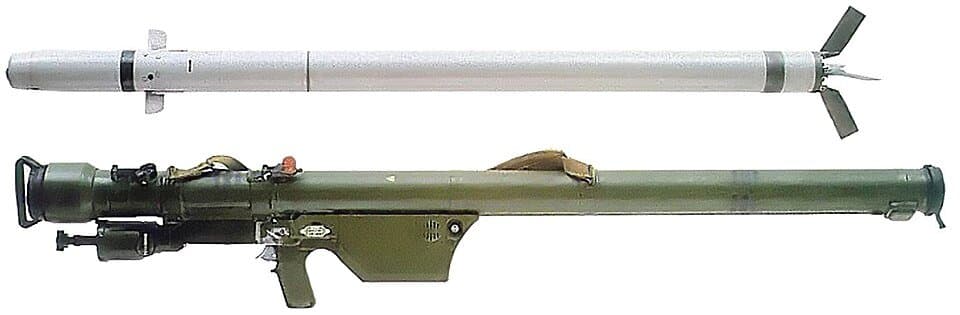
Portable air defenceIn service
Man portable surface-to-air missile launcher
9K32 Strela-2 is a man portable surface-to-air missile launcher originating in Soviet Union. Reported operators include Al-Nasser Salah al-Deen Brigades, Al-Qaeda in the Arabian Peninsula, al-Qaeda in the Islamic Maghreb, Al-Shabaab, Algeria, Angola, Azerbaijan, Benin, Boko Haram, Botswana, Bulgaria, Burkina Faso, Burundi, Cambodia, Cape Verde, Chad, Cuba, Czech Republic, Democratic Forces for the Liberation of Rwanda, Democratic Republic of the Congo, Ecuador, Egypt, El Salvador, Eritrea, Ethiopia, Georgia, Ghana, Guinea, Guinea-Bissau, Guyana, Hamas, Hezbollah, Houthis, India, Indonesia, Iran, Islamic State, Ivory Coast, Kazakhstan, Kurdistan, Kurdistan Workers' Party, Kuwait, Kyrgyzstan, Laos, Lebanon, Libya, Mali, Mauritania, Mauritius, Moldova, Mongolia, Morocco, Mozambique, Namibia, New People's Army, Nicaragua, Nigeria, North Korea, Oman, Palestinian Islamic Jihad, Peru, Popular Front for the Liberation of Palestine - General Command, Qatar, Rapid Support Forces, Romania, Russia, Rwanda, Sahrawi Arab Democratic Republic, Serbia, Seychelles, Sierra Leone, Slovakia, Somalia, Somaliland, South Sudan.
Technical data
Man portable surface-to-air missile launcher
Soviet Union
1970–present
See operators
War of Attrition Yom Kippur War Portuguese Colonial War Vietnam War Cambodian Civil War The Troubles Basque conflict Western Sahara War Communist insurgency in Thailand Rhodesian Bush War Nicaraguan Revolution Uganda–Tanzania War Salvadoran Civil War 1982 Lebanon War Lebanese Civil War Iran–Iraq War Gulf War Falklands War Second Sudanese Civil War South African Border War Soviet–Afghan War War in Afghanistan Syrian occupation of Lebanon Yugoslav Wars Iraq War Libyan Civil War Insurgency in Egypt Sinai insurgency Syrian Civil War War in Donbas Yemeni Civil War Libyan Civil War Russo-Ukrainian war Gaza war Iran war
KBM ( Kolomna )
c. 1964
US$ 75,000 (launcher with 5 missiles, export price to Libya , 1972–1973)
True scale
Sourced dimensions beside a 1.75 m human reference.
See it in your room. Scan with your phone to open this model in 3D, then place it in your space.
Points represent sourced observations, including revisions. Revisions on the same effective date are not separate inventory events. Ranges appear in the table and are not plotted as exact points.
| Observation / report period | Value | Source | Claim state |
|---|---|---|---|
| 28 Sept 2026 | 0.072 m | Wikipedia contributors | superseded |
| 28 Sept 2026 | 0.072 m | Wikipedia contributors | superseded |
| 28 Sept 2026 | 0.072 m | Wikipedia contributors | superseded |
| 28 Sept 2026 | 0.072 m | Wikipedia contributors | superseded |
| 28 Sept 2026 | 0.072 m | Wikipedia contributors | superseded |
| 28 Sept 2026 | 0.072 m | Wikipedia contributors | superseded |
| 28 Sept 2026 | 0.072 m | Wikipedia contributors | approved |
See versions
9.8 kg (21.6 lb) (Strela-2M missile) 15 kg (33.1 lb) (system, ready to fire)
1.44 m (4 ft 9 in)
72 mm (2.8 in)
0.3 m
800 m (2,600 ft) (Strela-2M) (minimal range)
3,700 m (12,100 ft) (Strela-2) 4,200 m (13,800 ft) (Strela-2M)
1.15 kg (2.5 lb) directed-energy blast fragmentation warhead (Strela-2M), 370 g (13 oz) HE content
Non-delay impact and grazing fuzes, 14–17 second delay self-destruct.
50–1500 m (Strela-2) 50–2300 m (Strela-2M)
430 m/s (1,400 ft/s) (Strela-2) 500 m/s (1,600 ft/s)(Strela-2M)
Infra-red passive homing (AM-modulated reticle seeker head with uncooled PbS detector element), proportional navigation logic
Al-Nasser Salah al-Deen Brigades
Al-Qaeda in the Arabian Peninsula
al-Qaeda in the Islamic Maghreb
Al-Shabaab
Algeria
Angola
Azerbaijan
Benin
Boko Haram
Botswana
Bulgaria license-built
Burkina Faso
Burundi
Cambodia
Cape Verde
Chad
Cuba
Czech Republic
Democratic Forces for the Liberation of Rwanda : 2 systems
Democratic Republic of the Congo
Ecuador
Egypt
El Salvador
Eritrea
Ethiopia
Georgia
Ghana
Guinea
Guinea-Bissau
Guyana
Hamas
Hezbollah
Houthis
India
Indonesia
Iran
Islamic State
Ivory Coast
Kazakhstan
Kurdistan
Kurdistan Workers' Party (PKK)
Kuwait
Kyrgyzstan
Laos
Lebanon
Libya
Mali
Mauritania
Mauritius
Moldova
Mongolia
Morocco
Mozambique
Namibia
New People's Army
Nicaragua
Nigeria
North Korea
Oman
Palestinian Islamic Jihad (also known as al-Quds Brigades)
Peru
Popular Front for the Liberation of Palestine - General Command
Qatar
Rapid Support Forces
Romania
Russia
Rwanda
Sahrawi Arab Democratic Republic
Serbia
Seychelles
Sierra Leone
Slovakia
Somalia
Somaliland
South Sudan
Both Strela-1 and Strela-2 were initially intended to be man-portable systems. As the Strela-2 proved to be a considerably smaller and lighter package, however, the role of the Strela-1 was changed, becoming a heavier, vehicle-mounted system with increased range and performance to better support the ZSU-23-4 in the regimental air defense role.
In order to address the shortcomings, two improved versions were ordered in 1968; as an intermediate stop-gap the slightly improved 9K32M "Strela-2M" (NATO reporting name SA-7b) to replace the original, as well as the more ambitious Strela-3 .
As the modifications introduced with the Strela-2M were relatively minor, the process was fast and it was accepted in service in 1970. The Strela-2M replaced the Strela-2 in production lines immediately. Improvements were made particularly to increase the engagement envelope of the new system:
Higher thrust propellant increased slant range from 3.4 to 4.2 km (2.1 to 2.6 mi) and ceiling from 1.5 to 2.3 km (0.93 to 1.43 mi)
Improved guidance and control logic allowed the engagement of helicopters and propeller-driven aircraft (but not jets) approaching at a maximum speed of 150 m/s (490 ft/s; 340 mph)
Maximum speed of receding targets was increased from 220 to 260 m/s (720 to 850 ft/s; 490 to 580 mph)
Contrary to what was initially reported in some Western publications, more recent information indicates that, while lethality on impact had proven to be a problem, the warhead remained the same 1.17 kg (2.6 lb) unit (including 370-gram (13 oz) TNT charge) as in the original. This remained the warhead of all Soviet MANPADS up to and including most 9K38 Igla variants; to address the problem of poor lethality, a more powerful HE filling than TNT, improved fuzing, a terminal maneuver, and finally a separate charge to set off any remaining rocket fuel were gradually introduced in later MANPADS systems, but the original Strela-2/2M warhead design of a 370-gram (13 oz) directed-energy HE charge in a pre-fragmented casing remained.
The Strela-2M was also procured for use on-board Warsaw Pact warships; installed on four-round pedestal mounts aboard Soviet amphibious warfare vessels and various smaller combatants, the weapon remained unchanged, but was assigned the NATO reporting name SA-N-5 "Grail".
The manufacturer lists reaction time measured from the carrying position (missile carried on a soldier's back with protective covers) to missile launch to be 13 seconds, a figure that is achievable but requires considerable training and skill in missile handling. With the launcher on the shoulder, covers removed and sights extended, reaction time from fire command to launch reduces to 6–10 seconds, depending greatly on the target difficulty and the shooter's skill.
After activating the power supply to the missile electronics, the gunner waits for electricity supply and gyros to stabilize, puts the sights on target and tracks it smoothly with the launch tube's iron sights, and pulls the trigger on the grip stock. This activates the seeker electronics and the missile attempts to lock onto the target. If the target is producing a strong enough signal and the angular tracking rate is within acceptable launch parameters, the missile alerts the gunner that the target is locked on by illuminating a light in the sight mechanism, and producing a constant buzzing noise. The operator then has 0.8 seconds to provide lead to the target while the missile's on-board power supply is activated and the throw-out motor ignited.
On launch, the booster burns out before the missile leaves the launch tube at 32 m/s (100 ft/s) and rotating at around 20 revolutions per second. As the missile leaves the tube, the two forward steering fins unfold, as do the four rear stabilizing tail fins. The self-destruct mechanism is then armed, which is set to destroy the missile after between 14 and 17 seconds to prevent it hitting the ground if it should miss the target.
Once the missile is five and a half meters away from the gunner, about 0.3 seconds after leaving the launch tube, it activates the rocket sustainer motor. The sustainer motor takes it to a velocity of 430 metres per second (1,400 ft/s; 960 mph), and sustains it at this speed. Once it reaches peak speed, at a distance of around 120 metres (390 ft) from the gunner, the final safety mechanism is disabled and the missile is fully armed. All told, the booster burns for 0.5 seconds and the driving engine for another 2.0 seconds.
It has a 1.9 degree field of view and can track at 9 degrees per second.
The first combat use of the missile is credited as being in 1969 during the War of Attrition by Egyptian soldiers. The first "kill" was claimed on 19 August 1969. An Israeli 102 Squadron A-4H Skyhawk was hit with a shoulder-fired missile 19 km (12 mi) west of the Suez Canal and pilot SqL Nassim Ezer Ashkenazi captured. Between this first firing and June 1970 the Egyptian army fired 99 missiles resulting in 36 hits. The missile proved to have poor kinematic reach against combat jets, and also poor lethality as many aircraft that were hit managed to return safely to base.
The Americans responded with a large strike package of 12 A-7 Corsairs and 16 A-6 Intruders (supported by a single E-2C Hawkeye , two EA-6B Prowlers and two F-14As) launched from the carriers USS John F. Kennedy (CV-67) and USS Independence (CV-62) sailing in the Mediterranean. The aircraft were to bomb Syrian installations, AAA sites and weapons depots near Falouga and Hammana , some 16 km (10 mi) north of Beirut - Damascus highway, when they were received by a volley of (possibly up to 40) Syrian SAMs, one of which hit a Corsair (AE305 of the VA-15 ), forcing the pilot to eject over the sea before being rescued by a USN search and rescue mission.
In the early dawn of 31 January 1991 during the Battle of Khafji in Operation Desert Storm , an Iraqi soldier shot down an American AC-130H gunship with a Strela 2, killing all 14 crewmembers.
Strela-2 missiles have been used against Turkish Army helicopters by the PKK in northern Iraq . During Operation Hammer ; on 18 May 1997, a Strela-2 missile was used to shoot down an AH-1W Super Cobra attack helicopter. On 4 June 1997, another Strela was used to bring down a Turkish Army AS-532UL Cougar transport helicopter in the Zakho area, killing the 11 soldiers on board. The video of the first attack was used extensively for PKK propaganda and eventually released to the Internet. Greece and Serbia 's intelligence services, as well as Iran, Syria, Armenia, and Cyprus were traced as possible sources of the missiles.
The spate of helicopter shoot-downs during 2006 and 2007 in Iraq has been partly attributed to the prevalence of the Strela amongst Sunni insurgent groups of that time; while al Qaeda is said to have produced an hour-long training video on how to use SA-7s.
The Strela-2 system was also given to North Vietnam , where along with the more advanced Strela-2M it achieved 204 hits out of 589 firings against US and South Vietnamese aircraft between 1972 and 1975 according to Russian sources. (Some sources, such as Fiszer (2004), claim that it was used from 1968 onwards).
Roughly 95–120 kills and several dozen damaged are attributed to Strela-2/2M hits between April 1972 and the Fall of Saigon in April 1975, almost all against helicopters and propeller-driven aircraft. As in the War of Attrition, the missile's speed and range proved insufficient against fast jets and results were poor: only one U.S. A-4 Skyhawk , one U.S. F-4 Phantom and three South Vietnamese F-5 Freedom Fighter are known to have been shot down with Strela-2s during the conflict.
The table shows heavy losses particularly in the beginning of May, with especially lethal results on the 1st and 2nd, where the shootdown of the O-2 FAC led to further losses when a rescue operation was attempted. After these initial losses, changes in tactics and widespread introduction of decoy flares helped to counter the threat, but a steady flow of attrition and necessity of minimizing time spent in the Strela's engagement envelope nonetheless continued to limit the effectiveness of US battlefield air operations until the end of US involvement in South-East Asia. The United States lost at least 10 AH-1 Cobras and several UH-1 Hueys to Strela-2/2M hits in South East Asia.
In 1977, the Republic of Afghanistan received the Strela-2M for use by the Afghan Army . The Strela-2M was used also in Afghanistan during the Soviet–Afghan War by the Mujahiddeen. The missiles were obtained from various sources, some from Egypt and China (locally manufactured Sakr Eye and HN-5 versions of the SAM), and the CIA also assisted the guerrillas in finding missiles from other sources.
Results from combat use were not dissimilar from experiences with the Strela-2/2M from Vietnam: while 42 helicopters were shot down by various Strela-2 variants (including a few Mi-24s until exhaust shrouds made them next to invisible to the short-wavelength Strela-2 seeker) only five fixed-wing aircraft were destroyed with the weapon. Due to its poor kinematic performance and vulnerability to even the most primitive infra-red countermeasures, the guerrillas considered the Strela-2 suitable for use against helicopters and prop-driven transports, but not combat jets.
Chechen forces had access to old Soviet stockpiles of Strela-2M and Igla missiles, as well former Soviet Army personnel trained to operate them. In the First Chechen War , Russian forces lost about 38 aircraft of which 15 were caused by MANPADS with another 10 probably caused by MANPADS, while the rest were caused by other anti-aircraft weapons. During the Second Chechen War the Russians lost 45 helicopters and 8 fixed-wing aircraft—the majority presumably caused by MANPADS.
The SA-7 saw heavy usage by all sides during the Georgian Civil War . The first known loss to an SA-7 happened on 13 June 1993, when a GAF Su-25 was shot down by a Strela over Shubara. On two later occasions, Georgian airliners (a Tu-134A and a Tu-134B) were shot down by SA-7s, killing a total of 110 people.
FRELIMO fighters in Mozambique were also able to field some SA-7s with Chinese support, although the weapon is not known to have caused any losses to the FAP, even if it forced Portuguese pilots to change their tactics. In one case a Douglas DC-3 carrying foreign military attaches and members of the senior Portuguese military command was hit by an SA-7 in one of the engines. The crippled plane managed to land safely and was later repaired.
Using an SA-7, the Sudan People's Liberation Army shot down a Sudan Airways Fokker F-27 Friendship 400M taking off from Malakal on 16 August 1986, killing all 60 on board. On 21 December 1989, an Aviation Sans Frontières Britten-Norman BN-2A-9 Islander (F-OGSM) was shot down by an SA-7 while taking off from Aweil Sudan, killing the four crew on board.
After having taken off from Dakar , Senegal , en route to Arrecife , Canary Islands , flying 5 minutes behind Polar 2 and at a lower altitude of 2,700 m (9,000 ft), Polar 3 was shot down by a SA-7 fired by the Polisario.
In another incident, on 8 December 1988, two Douglas DC-7 CFs flying at 3,400 m (11,000 ft) from Dakar, Senegal to Agadir , Morocco for a locust control mission there, had SA-7s fired at them by the Polisario.
Vickers Viscount, Flight RH825 , 3 September 1978 – downed by a Strela missile near Kariba Dam. After initial impact, the pilot was able to make an emergency landing in a nearby field but the aircraft broke up on impact. Eighteen of the fifty-six passengers in the tail section survived the crash. Ten of these survivors were shot dead at the crash-site by insurgents, who later looted the bodies and wreckage.
Vickers Viscount, Flight RH827 , 12 February 1979 – shot by down Strela missile near Kariba Dam; all 59 people on board were killed.
Strela-2M missiles were available to Argentinian troops in the Falkland Islands during the Falklands War . War Machine Encyclopedia shows no records of any launches, but several missiles were captured.
On 15 June 1987, a Contra-operated Beechcraft Baron 56TC (reg. N666PF, msn. TG-60) was hit by Sandinista anti-aircraft fire over the Nueva Segovia Department. The (formerly civilian) light utility aircraft , which was removed from the US registry two years before, and was reportedly modified to carry rockets for use in an air-to-ground light strike role , was downed after an attack that reportedly included dropping leaflets and, possibly, reconnaissance. The aircraft crashed 6 km (4 mi) inside Honduras , in an area known as Cerro El Tigre and its three occupants, all former military elements of the Somoza dictatorship , were injured and captured after the crash landing and were treated in Honduras. The pilot, Juan Gomez, a former colonel in Somoza's National Guard was also reported to be the head of the Contra air force. A Russian source credits the Baron's downing to a Strela-2 fired from Murra by Sandinista soldier Jose Manuel Rodriguez.
In late December 2012, a video showing FARC rebels attempting to shoot down a Colombian Air Force Arpía helicopter with an SA-7 in the Cauca raised the alarm in the Colombian military, though the missile failed. During that same month, a Strela was captured by the Colombian military. It is believed that they might came from Cuba, Nicaragua or Peru; the only Latin American operators of the type.
At the beginning of the Croatian War of Independence , the Croatian forces did not have an air force, and the anti-aircraft weapons they had at their disposal were more symbolic than dangerous for their opponents (about 25-30 light air defense systems Strela-2M). On September 19, 1991, the Croatian Air Defense shot down a J-22 Orao with the Strela-2M over the Đakovo area. The first Yugoslav aircraft shot down over the Adriatic Sea was the G-2 Galeb , which was hit by a Strela-2M by a police officer during the battle of Šibenik on September 20, 1991. A day later shooting down of two enemy aircraft in the same area in a short time, known by the cry "Both have fallen" occurred. On that day members of the Croatian Army during the Battle of the Dalmatian Channels shot down two J-21 Jastreb using M55 anti-aircraft gun and Strela 2M. On November 8, 1991. in Gorski Kotar, the Croatian air defense shot down MiG-21R with the Strela-2M. On April 24, 1992 during the siege of Dubrovnik an enemy aircraft was shot down with the Strela 2M.
The Army of Republika Srpska , backed by the Armed Forces of Serbia and Montenegro , used Strela-2M and upgraded Strela-2M/A missiles against Bosnian, Croatian, and NATO forces. On 3 September 1992, an Italian Air Force G.222 transport was presumably shot down by a Strela-2M during a United Nations relief mission near Sarajevo. Serbian forces shot down a Croatian Air Force MiG-21 in September 1993 with a Strela-2M. On 17 December 1994, a French Navy Dassault Étendard IVP was hit by a Strela-2M, but managed to return to its carrier.
The Provisional Irish Republican Army (IRA) acquired some missiles from Libya. One was reported to have been fired at a British Army Air Corps Lynx helicopter in July 1991 in South Armagh ; however, it missed its target. To counter the new threat, the British helicopters flew in pairs below 15 meters (50 feet) or above 150 meters (500 feet).
9K32M Strela-2M : "SA-7b Grail"
Fasta-4M : East German variant consisting of 4 Strela-2Ms mounted to a fully rotating turret. used by the NVA and Volksmarine
CA-94 and CA-94M : Romanian license-built versions of the 9K32 and 9K32M, respectively
Finland : Strela-2M operated under designation 'ItO-78'
Latvia : 5 Strela 2M in 2008
North Macedonia : 54 in 2008
{"datatype": "wikibase-item", "datavalue": {"type": "wikibase-entityid", "value": {"entity-type": "item", "id": "Q3704976", "numeric-id": 3704976}}, "hash": "9b3e0b03bdf2117b6b2e14d73541152c07745502", "property": "P176", "snaktype": "value"} … {"datatype": "wikibase-item", "datavalue": {"type": "wikibase-entityid", "value": {"entity-type": "item", "id": "Q2439883", "numeric-id": 2439883}}, "hash": "bb3e100db89af66c6ba0a093bdf9cc2b221f3d6e", "property": "P176", "snaktype": "value"} … {"datatype": "wikibase-item", "datavalue": {"type": "wikibase-entityid", "value": {"entity-type": "item", "id": "Q12742921", "numeric-id": 12742921}}, "hash": "99a87e02455754da6402fe310b9dcfd947ded37d", "property": "P176", "snaktype": "value"} … {"datatype": "wikibase-item", "datavalue": {"type": "wikibase-entityid", "value": {"entity-type": "item", "id": "Q704574", "numeric-id": 704574}}, "hash": "c9772464e0c8e95c3f420e69c36feb909e968c7f", "property": "P176", "snaktype": "value"}
SA-N-5 USSR Very short range Kora , Khukri & Veer -class corvette
Reference text from Wikipedia contributors, used under CC BY-SA 4.0.
9K32 Strela-2 equipment records. Variants, orders and quantities are shown as reported in each inventory source; coverage is incomplete.
 Algeria
 Angola
 Azerbaijan
 Benin
 Bolivia
 Botswana
 Bulgaria
 Burkina Faso
 Burundi
 Cambodia
 Cape Verde
 Chad
 Croatia
Approximate count for 9K32 Strela-2M. Service scope: Croatian Army; does not replace a national total. 1 distinct count cell(s) from the same source list; shared rowspan cells counted once. Retired, wholly reserve and on-order rows are excluded; the reported count retains any explicitly mixed stock scope in the quoted row. Count column(s): quantity: 500~. Origin: Soviet Union Yugoslavia. The listed variants/roles are the scope, not an immediately deployable count. The components do not establish one inventory census date; the stored date is the retrieved source snapshot.
 Cuba
 Cyprus
Reported count for 9K32 Strela-2. Service scope: Cypriot National Guard; does not replace a national total. 1 distinct quantity component(s) from the same source list; shared rowspan cells counted once. Explicit source inventory scope: active; no other stock status or total inferred. Count column(s): in service: 100. Origin: Soviet Union Russia. The listed variants/roles are the scope, not an immediately deployable count. The components do not establish one inventory census date; the stored date is the retrieved source snapshot.
 Czechia
 Democratic Republic of the Congo
 Ecuador
 Egypt
 El Salvador
 Eritrea
 Ethiopia
 Georgia
 Ghana
Reported count for 9K32 Strela-2. Service scope: Ghana Army; does not replace a national total. 1 distinct count cell(s) from the same source list; shared rowspan cells counted once. Excludes retired/reserve/on-order rows. Count column(s): quantity: 200. Origin: Soviet Union. The listed variants/roles are the scope, not an immediately deployable count. The components do not establish one inventory census date; the stored date is the retrieved source snapshot.
 Guinea
 Guinea-Bissau
 Guyana
 India
 Indonesia
 Iran
 Ivory Coast
 Kazakhstan
 Kuwait
 Kyrgyzstan
 Laos
 Lebanon
 Libya
 Mali
 Mauritania
 Mauritius
 Moldova
 Mongolia
 Morocco
 Mozambique
Reported count for 9K32 Strela-2. Service scope: Land Forces; does not replace a national total. 1 distinct count cell(s) from the same source list; shared rowspan cells counted once. Retired, wholly reserve and on-order rows are excluded; the reported count retains any explicitly mixed stock scope in the quoted row. Count column(s): quantity: 20. Origin: Soviet Union. The listed variants/roles are the scope, not an immediately deployable count. Dates are the count-cell citations' stated source period (2013), not the article revision. Cited source 2013-08-23. Edition or publication years do not claim an exact inventory census day.
 Myanmar
 Namibia
 Nicaragua
 Nigeria
Reported count for 9K32 Strela-2. Service scope: Nigerian Army; does not replace a national total. 1 distinct count cell(s) from the same source list; shared rowspan cells counted once. Excludes retired/reserve/on-order rows. Count column(s): quantity: 100. Origin: Soviet Union. The listed variants/roles are the scope, not an immediately deployable count. The components do not establish one inventory census date; the stored date is the retrieved source snapshot.
 North Korea
 North Macedonia
Lower-bound count for 9K32 Strela-2. Service scope: Army of North Macedonia; does not replace a national total. 1 distinct quantity component(s) from the same source list; shared rowspan cells counted once. Explicit source inventory scope: active; no other stock status or total inferred. Count column(s): in service: 30+. Origin: Soviet Union. The listed variants/roles are the scope, not an immediately deployable count. The components do not establish one inventory census date; the stored date is the retrieved source snapshot.
 Oman
 Peru
 Qatar
 Romania
 Russia
 Rwanda
 Serbia
 Seychelles
 Sierra Leone
 Slovakia
 Somalia
 South Sudan
 Sudan
Lower-bound count for 9K32 Strela-2. Service scope: Sudanese Air Force; does not replace a national total. 1 distinct count cell(s) from the same source list; shared rowspan cells counted once. Retired, wholly reserve and on-order rows are excluded; the reported count retains any explicitly mixed stock scope in the quoted row. Count column(s): in service: +400. Origin: Soviet Union. The listed variants/roles are the scope, not an immediately deployable count. Dates are the count-cell citations' stated source period (2019), not the article revision. Cited source 2019-03-15. Edition or publication years do not claim an exact inventory census day.
 Tajikistan
 Tanzania
 Turkmenistan
 Uganda
 Ukraine
 Vietnam
 Zimbabwe
Al-Nasser Salah al-Deen Brigades, Al-Qaeda in the Arabian Peninsula, al-Qaeda in the Islamic Maghreb, Al-Shabaab, Algeria, Angola, Azerbaijan, Benin, Boko Haram, Botswana, Bulgaria, Burkina Faso, Burundi, Cambodia, Cape Verde, Chad, Cuba, Czech Republic, Democratic Forces for the Liberation of Rwanda, Democratic Republic of the Congo, Ecuador, Egypt, El Salvador, Eritrea, Ethiopia, Georgia, Ghana, Guinea, Guinea-Bissau, Guyana, Hamas, Hezbollah, Houthis, India, Indonesia, Iran, Islamic State, Ivory Coast, Kazakhstan, Kurdistan, Kurdistan Workers' Party, Kuwait, Kyrgyzstan, Laos, Lebanon, Libya, Mali, Mauritania, Mauritius, Moldova, Mongolia, Morocco, Mozambique, Namibia, New People's Army, Nicaragua, Nigeria, North Korea, Oman, Palestinian Islamic Jihad, Peru, Popular Front for the Liberation of Palestine - General Command, Qatar, Rapid Support Forces, Romania, Russia, Rwanda, Sahrawi Arab Democratic Republic, Serbia, Seychelles, Sierra Leone, Slovakia, Somalia, Somaliland, South Sudan
Equipment reference ↗Keep exploring
Man-portable surface-to-air missile
 United States
Man-portable surface-to-air missile
 China
Man-portable surface-to-air missile
 Japan
Manportable surface-to-air missile ( MANPADS )
 South Korea
Man-portable/Vehicle-mounted surface-to-air missile
 United Kingdom
Man-portable air-defense system SHORAD Very short-range air-to-air missile
Lower-bound count for 9K32 Strela-2. Service scope: Sudanese Air Force; does not replace a national total. 1 distinct quantity component(s) from the same source list; shared rowspan cells counted once. Explicit source inventory scope: active; no other stock status or total inferred. Count column(s): in service: +400. Origin: Soviet Union. The listed variants/roles are the scope, not an immediately deployable count. Dates are the count-cell citations' stated source period (2019), not the article revision. Cited source 2019-03-15. Edition or publication years do not claim an exact inventory census day.